Really? Thursday, May 1 2014 

This is why I like dirt floors in the basement.

The north basement is under water.  And I do mean that.  The water has gone down, and still one encounters several inches sloshing about….Before you get to the door into it.  No I don’t know how deep it got in that section!  The door is locked from the Inside…that door and the lock for the door is only accessible through the water.  I’m not wading.  The columns are soggy.  They have been soggy before.  They will be soggy again.  The water will drain.  The world will not end.  (hyperbole aside, I doubt it is more than six inches at the most, simply because the central basement Is Not flooded and so the rise wasn’t that much…still not wading.)

The plants are happy!

Experiments with daffodils Wednesday, Apr 30 2014 

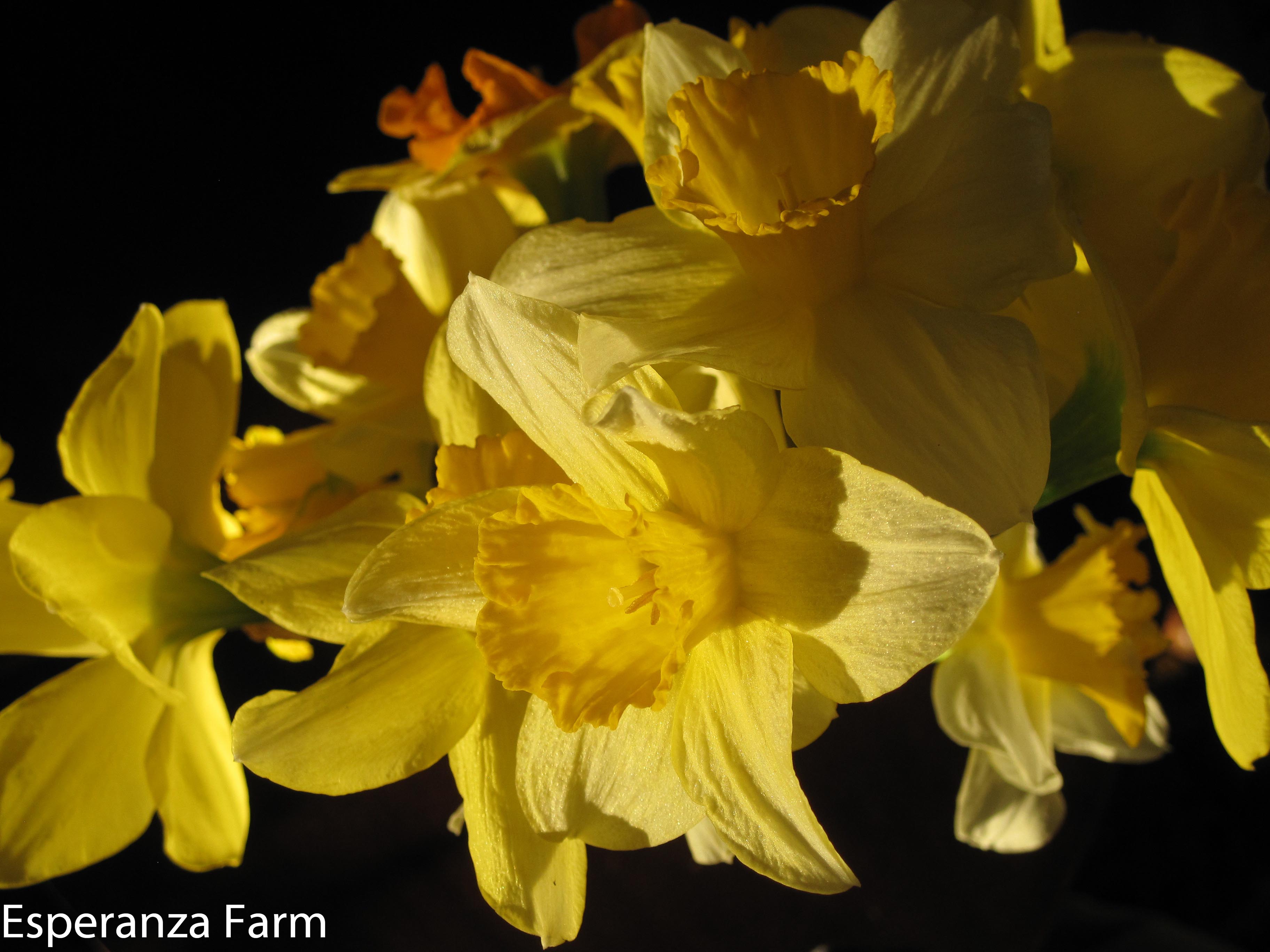
As with crocus, I am fascinated by daffodils. I cannot have enough of them. One of my current frustrations is trying to figure out the best way to divide the clumps.  Now, I know, I know, in the fall.  You try finding them without digging things that don’t want to be dug.  Or better yet, try digging in the clay soil after it has baked all summer.

So last year, I tried moving some of them ‘in the green’.  I haven’t killed any that way (a plus) but they didn’t all bloom this year (a negative).  One cluster that I did try this with, however, has bloomed quite well.  This is a relief, because it was a set I lifted and divided because I did not want to lose it. It was an overcrowded, single clump.  To the best of my knowledge, only two other single or double bulbs were on the property. This made me nervous (eggs all in basket syndrome) because it was and is a particularly nice antique example.  An early long trumpet, with thin twisted petals; it is a bicolor with stable color (not changing as it matures) ivory petals and a deep gold trumpet.  Too many modern daffodils, in my opinion, have very heavy, triangular petals and almost a coarse look to them.  Not this one.

096

Over the top Tuesday, Apr 29 2014 

From the church’s Easter lilies.  In previous years, we’ve been able to get the classic white lilies to come back in following years.  This one, which came from the narthex (the standard whites are always for the altar display), appears to be a ‘Stargazer’ on steroids.  Theoretically it should be fine; but it was so overfed that it may not have much left.  Still, it does look rather appropriate in the library!

087

Who owns the land? Sunday, Apr 27 2014 

(Meandering partial points of philosophy)

I got to thinking on this topic, never really far from my mind, following a comment I read related to the recent little scrum about cattle.  The comment that got my back up was a statement that easterners can’t possibly know anything about owning land since they haven’t lived on it for generations unlike the ranchers in question.  There were so many things wrong with that statement that I couldn’t come up with anything that wasn’t rude in response.  One more polite strand was the theory of ownership as a legalized expression of the territoriality of mankind.

Now most people living in urban areas, and the urban metropolis of the east coast dominates the concept of the east coast*, don’t (or more accurately can’t) know the land in the naturalistic sense that we usually think of when we talk about knowing and owning the land.  But the instinctive desire for ownership is nevertheless present, evident in such seemingly disconnected locations as the rent control apartments of Harlem.  Who ‘owns’ those apartments?  That isn’t land, at least not in the way a rancher or farmer or forester thinks of it.  But it is the territory of that person even though it is the legal property of someone else.  Try kicking that person out of their little walk-up, I daresay their reaction will be just as unprintable as booting someone off their ranch.  Whether it is or is not justified, legal or illegal, doesn’t matter, that little (or big) area is Theirs.

For the most part, the majority of people in the US like to ignore that urge, because for many of us it is quiescent.  We move from one house to another without really thinking about it…except, of course, for that little voice that is always planning our dream home.  We don’t have territory that we call Ours, but is this because we don’t think that way or is it because we have never been challenged with forced eviction while living in our ‘temporary’ territory? Or is it because a mobile, modern, finance driven lifestyle has fundamentally changed us after three generations?

The questions aren’t easy.  If they were the Middle East would be solved, as would Ukraine.  How many years, how many generations? Why do some people set down roots easily but also move easily?  Or some never set down roots anywhere? Or some who have only one place that is home and no other?

The questions are made more complicated by the role of our government and law in the question. In our legal system, if we own the land, it implies we bought it from someone and that someone else can buy it back.  That, however, flies in the face of our instincts: this is mine, there is no price.  But if the other person isn’t operating on that instinct in regards to that specific piece of land such a reaction is baffling.  There are plenty of people who truly don’t ‘get’ that instinctive reaction or don’t recognize it for what it is.  Importantly, it also flies against the often overlooked bit of philosophy which is unusual to American political thought: man’s right to his property, and by extension his property, is not a right created by the government; rather it is an inalienable right.  Property taxes, income taxes, estate taxes, and a host of regulations have chipped away at this idea; but we still have some concept of it.

We make it even more complicated of course: trying to balance the theory of inalienable Private, individual ownership of some land with inalienable Public, communal ownership of other pieces.  That balancing act, in Connecticut, is essentially theoretical.  The Federal government owns only .4% of Connecticut land, tied with Rhode Island for dead last.  Not even 1 percent.  (compared to 84.5% of Nevada).  That, of course, gets into a whole other strand outside the scope of this post.

In any case, things get quite uncomfortable.  To return to the Middle East, I sometimes think that Israel and the Arab World are closer in their fundamental philosophy than either are to the dominant trend in Western thought.  They both understand that part of human nature is: ‘This is Mine’.  Meanwhile our arguments are turning on whether human nature should have that part of not. And generally proving that said part is alive and kicking. Awkward, that.

What do I know? This land, for this time, is my responsibility.

Is responsibility ownership?

*If easterners purportedly believe that all westerners are the idiot townspeople of ‘Blazing Saddles’, I’m sometimes of the mind that all westerners think all easterners just stepped vacantly off the set of ‘Friends’.  Neither is correct.

Mid-Atlantic Harbor Scene Saturday, Apr 26 2014 

August, 1909

From the archives, just for the fun of it.

1909003032

Not Snow Friday, Apr 25 2014 

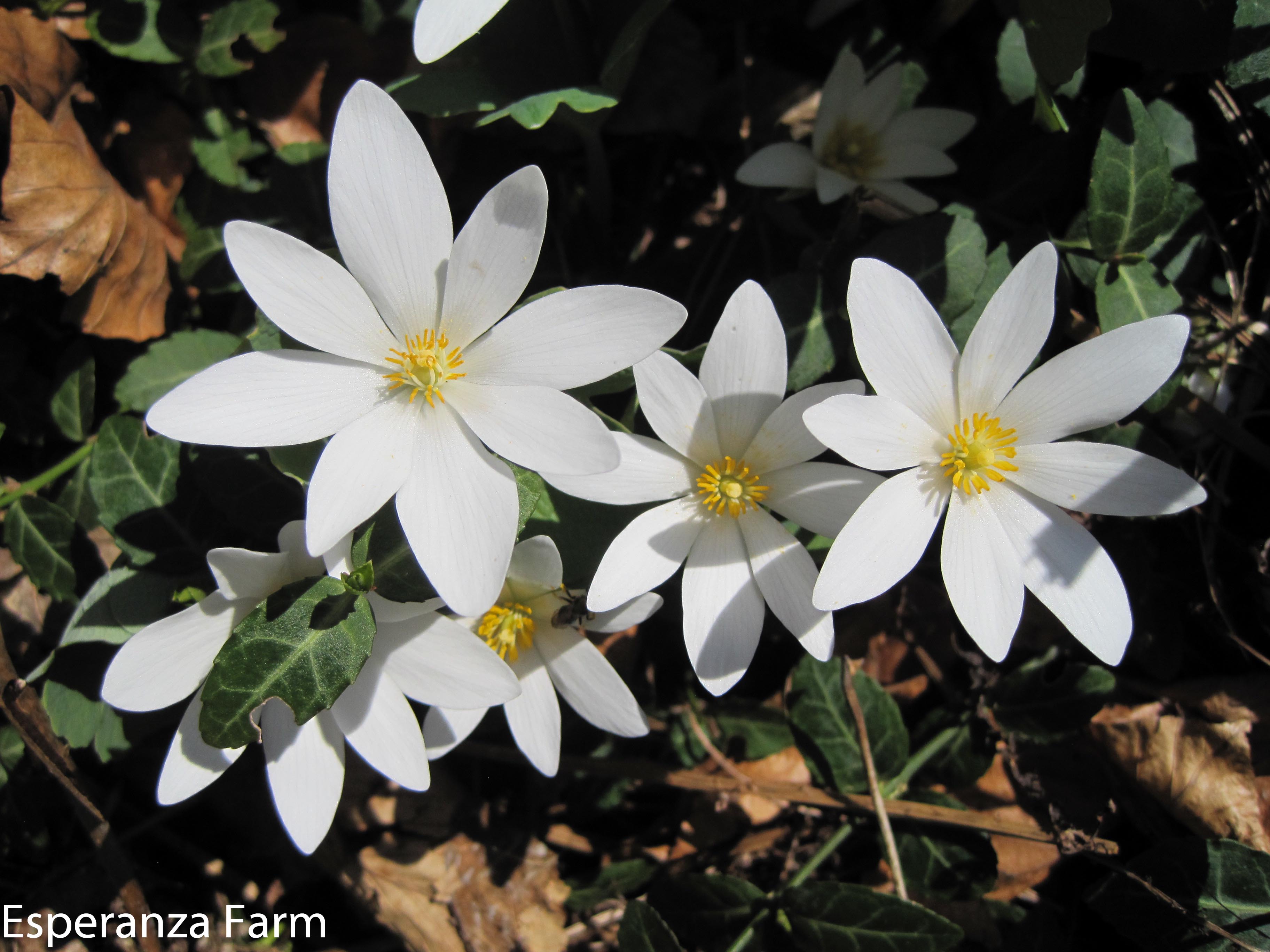
One of my favorite spring flowers is bloodroot (sanguinara canadensis).  We have a rather happy patch in a clump of ferns/wintercreeper at the base of the old pear tree stump.  When I looked a few days ago, only a few buds were up, today I came home from work and the patch was a sparkling white.  There are few other flowers that grow here that have that level of bright shine and absolutely pure white color (or non color!).

IMG_0344

Spring? Friday, Apr 25 2014 

What spring?  It’ll get around to it at some point I suppose.  In the meantime, the peas are coming up, the daffodils are blooming (though not with great abandon this year, too dry last year and the year before I suspect), the trout lilies are sloooowwwly multiplying. They are an odd little volunteer patch near the gingko, for several years just a few leaves, now the patch is about a yard across, with probably a hundred plus little leaves (each leaf representing one growing point). We have no idea how they got there, but they like it.  Last year, one bloomed; this year four bloomed.  They take their time growing. But the flower, a lovely clear yellow, shaped liked a delicate tiger lily but less than an inch across is worth the wait.  The bloodroot is up, but not quite blooming yet.  The scilla and chiondoxa are just about finished.

The red maple contemplated blooming this year, a few red tassels up there.  The forsythia got frozen.  Forsythia is a waste of one’s time.  The birds love its dense tangle, but I think we average one year in four for decent blooms here.  Absurd.


Photo of the Day Wednesday, Apr 23 2014 

Iris in the flagpole garden last year.  I hope I don’t bother it with my reorganization this year.  I shouldn’t, the iris (blue) and the Oriental poppies (true red) are in the center, I’m fiddling with both long edges of the arc.

IMG_0769


On Age Tuesday, Apr 22 2014 

I was perusing some photos on the internet the other day of Los Angeles at the turn of the last century.  Of course, for all intents and purposes, LA didn’t exist.  It is always a little disconcerting to consider cities of that sort.  To realize that this house existed as Esperanza before several of the major cities in the U.S. were anything more than waystops on the map.

Having lived in the UK for a few years, and for one year in a building built in the 1600’s, the discrepancy is even more apparent.  When the streets existed before this continent was known to Europeans?  It permanently warps what is or is not considered history. At the same time, the comparison can hide just how much have things have changed.  Esperanza existed 130 years ago, but it was a very different Esperanza in some respects.  In others not.  Recognizing the correct balance between the changed/unchanged and should change/should not change…That is the challenge.

Alleluia Sunday, Apr 20 2014 

IMG_0278


« Previous PageNext Page »