
At twilight after a thunderstorm. The tree in the foreground is a volunteer scarlet oak.
Comments Off on Connecticut Summer Sky
Landscapes and Modern Photos photography, scarlet oak 15:05
At twilight after a thunderstorm. The tree in the foreground is a volunteer scarlet oak.
Comments Off on Connecticut Summer Sky
Esperanza and Historical Events architecture 12:52
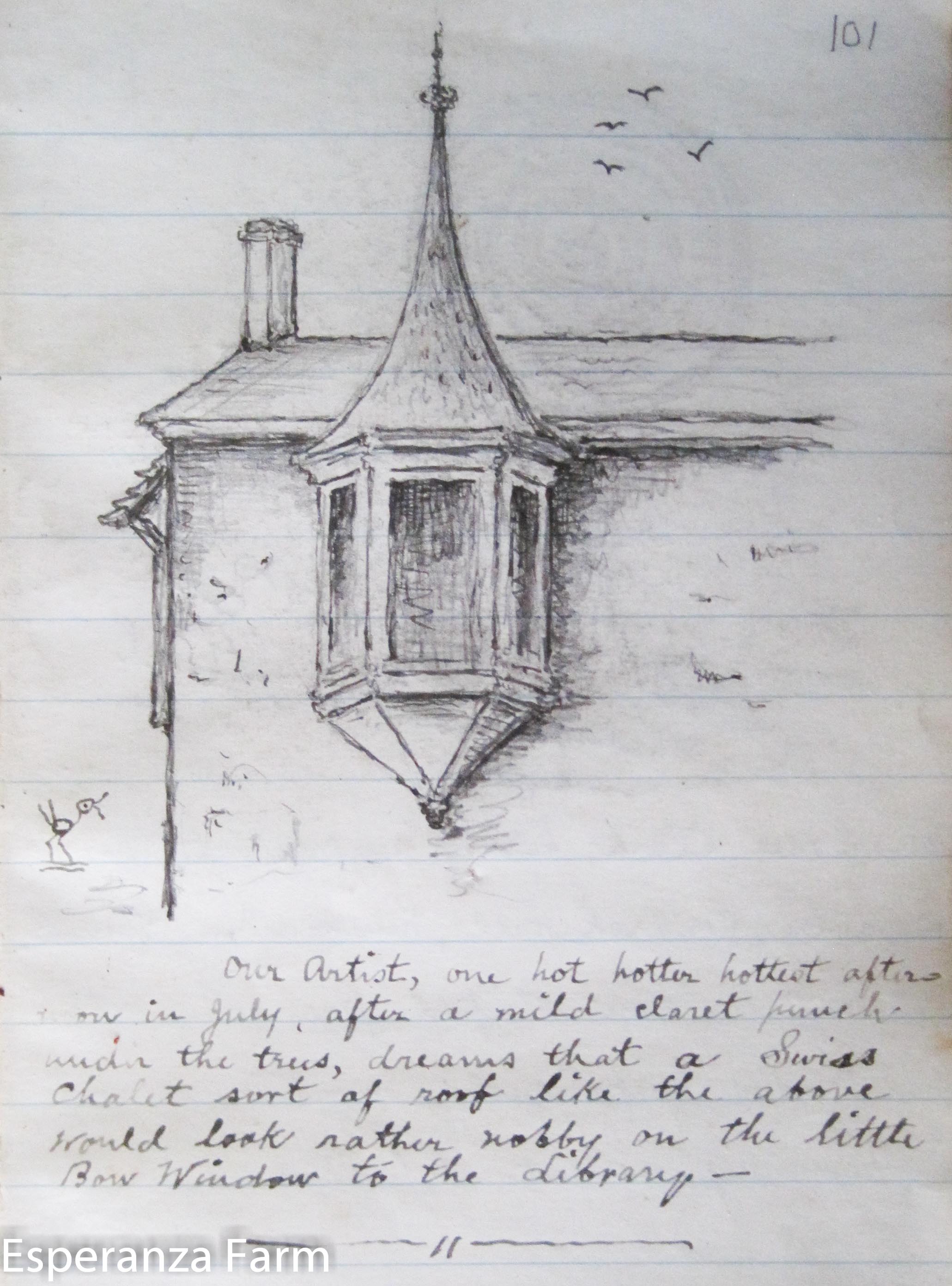
“Our artist, on hot, hotter, hottest afternoon in July, after a mild claret punch under the trees, dreams that a Swiss chalet sort of roof like the above would look rather nobby on the little Bow Window to the library”
From the 1879 guestbook. The bay window and the library (it would cease to be the library in 1893, when the present library was added) are on the second floor at the south end. The bay window is a simple one, in keeping with the classical lines of the rest of the house. It looks exactly like the window in the sketch, minus the Swiss chalet top which was Not added! The question is, ‘nobby’ is that a good or bad adjective?
gardening and Modern Photos gardening, lilies, photography 10:44

Some lilies, ‘Muscadet’ and ‘Casa Blanca’ by the east porch
Comments Off on Random Photo
gardening and Modern Photos actaea racemosa, gardening, photography 11:47

Also known as bugbane and black cohosh, with the latin name of actaea racemosa (formerly cimicifuga racemosa); snakeroot is a eastern N.A. native growing from Ontario to Georgia. It is increasingly rare in some areas, actually considered to be threatened if not locally endangered in Ct. This is probably because it is a slow growing plant, taking several years to flower, and prefering shaded, damp woods. The closely related a. simplex is the species from which the cultivated types have been bred, including the purple varieties.
Esperanza has a lot of snakeroot, to the point where it is almost a nuisance in some spots. A fully mature plant really should be considered as an herbaceous shrub. It is the backbane of the late July garden, the flower spikes (which can reach 8 feet) twist and turn in a wonderfully dynamic fashion. Despite the name bugbane, the pollinators love it. The one in the picture is growing up through the low branches of a Japanese maple.
Comments Off on Black Snakeroot
Uncategorized 13:56

(Not my photo) He was a perfect gentleman the other day with a whole group of little kids who had come specially to give Robbie!!! a carrot. There were five of them, all slightly intimidate by his size; but they enjoyed themselves I think. Mercifully, he has decided that daylilies just don’t taste good.
gardening and Modern Photos gardening, lilies, photography 15:07

In my opinion, it would not be late July in New England without a big stand of Oriental Lilies by the main door. Preferably located where their fragrance, which is strongest at night, can drift inside. It is a spicy scent, not ‘floral’ really at all. They are a little early this year, they really ought to be in August; but I certainly enjoy them. It is also worthwhile to note that while the lily beetles will eat them, they prefer the Asiatic lilies; so the latter can function as a trap reducing the amount of effort needed to protect the Oriental lilies. Though one still needs to keep a very close eye on them. Support is also useful, in this spot some ferns help out, elsewhere, lanky rugosa roses give some support.
gardening gardening, squash bugs, vegetable gardening 09:59
Which I am barely staying ahead of… The winter squash patch, which is the patch that is being most heavily attacked, has a couple of hills with the vines sprawling in between and finally beginning to extend out of the borders. It isn’t large, perhaps 4’x5′ in size. All of the plants touch, and earlier in the season I was finding squash beetles evenly distributed on all of the plants. However, I took three extra tomatoes and planted them in the middle. Now, I don’t think those tomatoes are going to produce very much, though they seem to be quite healthy. However, on the squash vines that are in direct contact with the tomatoes…I am not finding squash bugs nor eggs. I find them on the other side of the plant, but not on sections intertwined with the tomatoes.
This, it seems to me, is potentially very interesting. Maybe it is a fluke, or maybe it is a partial solution?
gardening and Landscapes and Modern Photos daylilies, gardening 14:14

The daylilies along the fence, nearly all big orange doubles. It is a bit hard to believe that all of those came out of one very crowded 20′ by 5′ foot strip, now part of the vegetable garden, two years ago. The strip they are now is about 130 feet long and 4 feet wide.
(in other news, still too hot. But the guys got close to a 1000 bales of hay off the field, or over 100 bales on acre. which is rather impressive)
Comments Off on Orange Tide
Esperanza and Uncategorized historic houses 10:27
All I have to say on the weather. So instead of gardening, house cleaning!
I finally got the Old Hall cleaned yesterday, and everything in it, aside from the rug which will have to go to the cleaners. The floor in the hallway was covered with linoleum at some point, at least over seventy years ago. It might have been closer to a century plus, if it was redone when the parlor was done at the turn of the century. It has stood up to traffic quite well, there are only a few points of failure: the bottom of the stairs where people turn on it, and the point in the middle where one of the c.1800 floorboards bounces up and down to the tune of an inch and a half.
It has an elegant small mosaic pattern of what might best be described as diamonds and crosses with flourishes. Cream, brown, dark red, a dark blue, and a light blue. It has darkened over time.
Antique linoleum is actually quite cleanable, if one is willing to be careful with the amount of water used. Copious amounts of water do nothing good to it because the jute backing will swell at a different rate than the linoleum if it gets too wet. This causes it to curl, which you really don’t want, though it will uncurl. Obviously, this is not something would have happened originally; but since old linoleum is almost guaranteed to have a million fine cracks, the jute will be exposed to moisture.
The most important thing is to make sure that you have linoleum cleaner. TRUE linoleum cleaner. Most floor cleaners for ‘linoleum’ flooring will dissolve true linoleum. Some of them in a matter of minutes. As will things like bleach. This is bad. Consequently, like so many things for this house, we get our linoleum cleaner from a specialty store. If I can’t get it someday, well straight ivory soap works…
Uncategorized bats 10:24
I like things that fly, I really do. I also like bats. But I Do Not like to observe bats inside the house. Peacefully reading, when a fast moving object caught my eye. The appropriate response, before further inspection, is to get the big Keeping Room doors shut so it is confined to the library and the keeping room (think living room)*. Then get all the inside lights off, including computer screens, turn on an exterior light, open the door, and wait. You must keep a close watch on the door, however, to ensure you see it fly out as they almost always accelerate. Blink and you risk spending the night holding the door open, wondering. We have done this before…
This particular bat was having great fun navigating at about 18 inches off the floor. Very active, with an incredible turning radius, and utterly silent. Quite a good sized one, with a fairly light belly, so I thought it was a chimney swift at first. They also get in some times; but are easier to get out since a)getting bit isn’t a concern and b) they’ll usually end up clinging to a screen or wall.
Heaven only knows where it got in though. They live in the roof. Or, sadly, it is more accurate to say lived. The colony crashed, probably due to disease. Now seeing two bats a night is unusual. It used to be easily 20-30 plus.
*The terminology of ‘Keeping Room’ is iffy. Some people are adamant that a ‘keeping room’ should be next to the kitchen. This one could not be farther from the kitchen if it tried. On the other hand, some people are adamant that it refers to the room with the main or biggest hearth. In which case…this one definitely qualifies.
Comments Off on High Speed Low Altitude
 Acair Fearann