Finally! Monday, Apr 29 2013 

This is an odd spring, very slow, cold and dry. The redbud tree, which usually dominates the east lawn from mid-April has yet to come into flower. On the other hand, the peas are finally up.
We are always the last on the hilltop for things to break bud. I rely on the star magnolias as a gauge, ours is two weeks behind the valley and almost a week behind the other two on the hilltop. The same holds for our saucer magnolia. It doesn’t really make sense, except to demonstrate how complicated the micro environments are. If we look at the saucer magnolias, ours is located on the north lawn in the garden. So it has western exposure, wind/sun block to the east, and is in part shade (almost full sun at the moment, due to the number of deciduous trees). It is also in heavy, wet clay soil in an essentially ‘unimproved’ setting (shrubs, perennials, uncultivated and undrained). The other two magnolias, belonging to a neighbour at the same elevation, also have the same western exposure. To the east they have a wind/sun block, but it is a house rather than trees. The magnolias are also in a heavily fertilized, manicured, turf lawn in full sun. The soil in that area has been improved, cultivated, and thoroughly drained.
Now then, what is the deciding factor? Is it the full sun? Is it that a modern turf lawn heats up much faster so the soil warms faster so the plant blooms that much earlier? If that is the case, then some interesting variables arise concerning heat islands and the commentary about plants blooming earlier than they used to….no question that they are a little earlier, but the accompanying questions are which plants, where, and what has changed in that location?

Tulips and daffodils Saturday, Apr 27 2013 

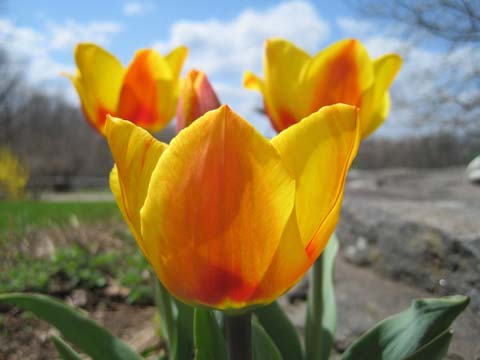
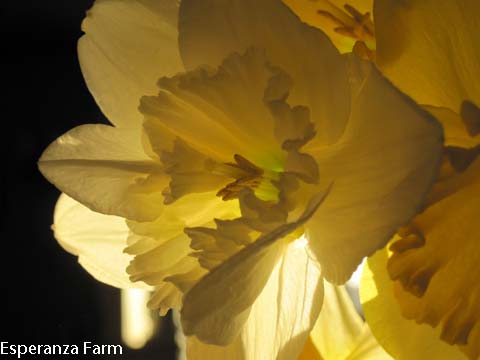
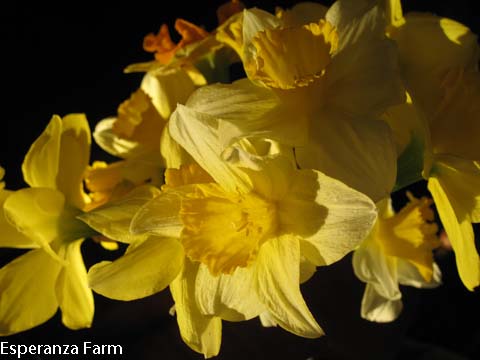
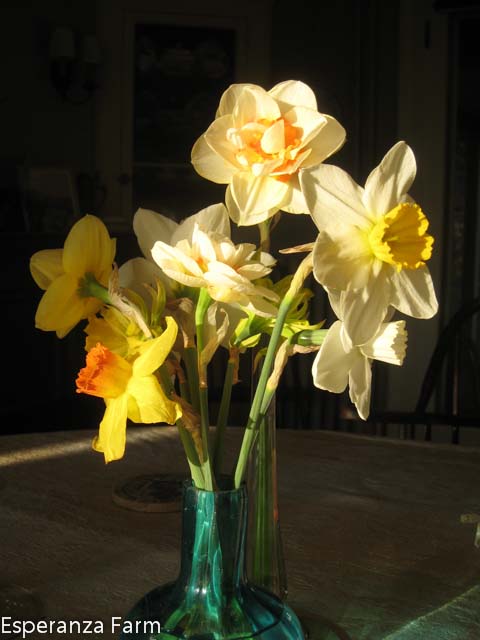
It is glorious weather here, those of us who are gardeners are eying the water level,* on the other hand, a perfect day for a local celebration on a small town green, which I just got back from…always there is a trade-off. Below are two pictures which are good examples of today here. The daffodils are our mystery daffodils. Many years ago they were down by the pond (and there are still thousands down there) but being overcrowded and shaded they didn’t bloom. Well, I should clarify, only a few ‘poeticus’ bloomed, Nothing else. Now I have a fondness for the poeticus type, and so my Mom and I dug a bushel basket or two (including some that were blooming at the time) and she planted them on the bank. What appears the next year? Hundreds of classic yellow trumpets and nary a white poeticus in sight. ?
The tulips are very classic with true black markings inside, but of course I can’t recall their name…
*If gardeners had an icon it would be Goldilocks.

IMG_0333

IMG_0342

Daffodils inspired by Chihuly Monday, Apr 22 2013 

IMG_0287

IMG_0281

IMG_0278

Digging oneself a hole Friday, Apr 19 2013 

In the last few days I have undertaken to shift a variety of shrubs hither and yon, it being that sort of weather. This gives me plenty of opportunity to practice my hole digging abilities.
I always laugh at the earnest illustrations that accompany many plants…though I have discovered that probably the majority of people out there do Not know how to dig a hole (never mind plant something), so the illustration is needed. Still, the hole is so elegant: a nice symmetrical hole, a nice pile of dirt, a person leaning contemplatively upon a spade… Right. Now, I have had the occasion to dig a few easy holes. It was a revelation when I was helping to plant some trees down in a river valley, in an area of deep soil and no mature trees; this it was clear was what they meant, a few easy scoops and voila!
Now here…well, first off it is sticky, heavy clay till. It can be wet enough to merrily adhere to the shovel even when it is shaken vigourously. There are the rocks, ad infinitum. Then, well then there are the tree roots. Having hacked through the mat of fiber roots at the surface, you hit (usually just where you need to place the root ball of the new plant) great writhing roots. Anything up to two inches can be severed by a shovel* but often, as was the case today, these are roots the size of an arm. I try to dig around those, so much for the symmetry of my holes. Hole digging is a vigourous exercise, aided by a sharp knife at times, sturdy boots, and determination.
In my morbid turns of mind, I have always wondered how on earth grave-diggers did it. You can’t do six feet deep around here. At least I can’t.

*I’ve always felt that ‘blunt instrument’ is a misnomer when applied to a shovel.

Crocus photos Tuesday, Apr 16 2013 

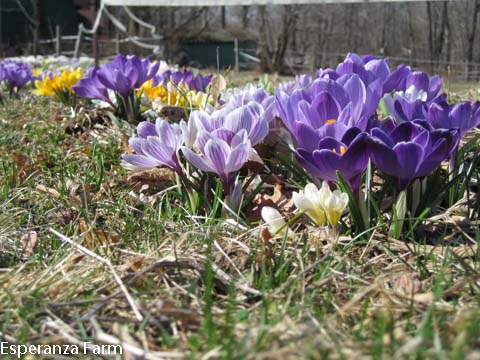
IMG_0206

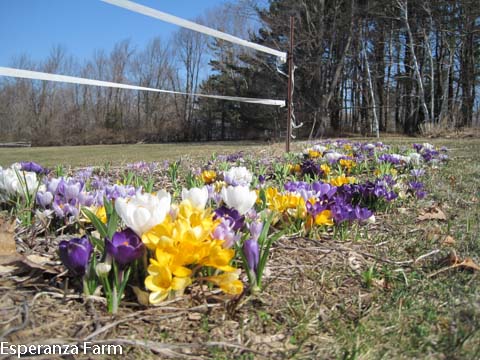
IMG_0199

IMG_0195

What is blooming? Monday, Apr 15 2013 

It finally being spring. The elevation changes around here are very evident; down in the valley (lower by about 500 feet) the red maples and star magnolias are just starting to bud out, as are the forsythia and quince. Up here, while definitely almost there, they are not quite there yet.
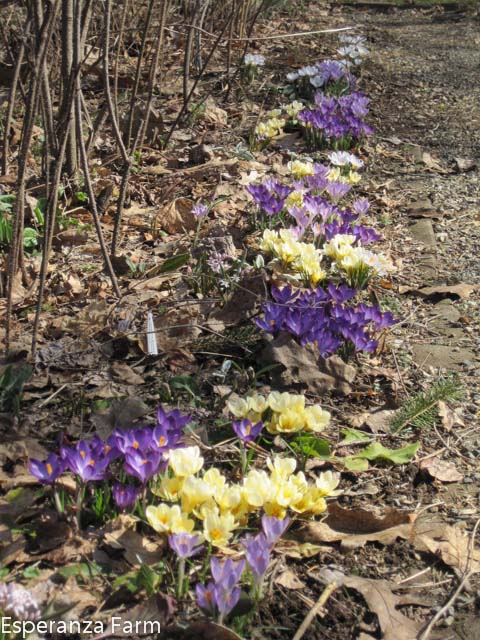
The crocus continue, primarily the big vernus and flavus types; your classic big bold crocus colors. But the smaller chrysanthus (cream yellow/blue pastels), which have been going for nearly a month, are still quite showy. A few of the ‘Ruby Giant’ tommasinianus are still blooming, but the straight species is done. Interestingly, the small biflorus (very little, white with dark purple striping) which I had thought would be early is only just started up.
The daffodils are contemplating life. Van Sion, the old doubled yellow/green, is blooming quite happily.
The scilla, primarily the classic Siberian blue, is blooming. We also have some of the white/pink/blue bifolia type; those have a pyramidal bunch of upward facing flowers in pastel shades, rather than the Siberian’s few bells of cerulean blue.
The snowflakes, Leucojum vernum, which is Not the more commonly sold Leucojum aestivum, is still blooming. L. vernum blooms beginning in early March; L. aestivum is in May.
The Galanthus are essentially done.
The few remaining Chiondoxa gigantea are blooming. They aren’t especially happy where they are, too many leaves.
The Hellebores are finally starting up. (so much for being Lenten Roses!!!)
The Pulmonaria (Sissinghurst White and Mrs Moon) are blooming.
Others? A bit of chickweed
Yes, yes, I know, you would like pictures…

Green Fire Friday, Apr 12 2013 

It is always astonishing to watch the fields turn green in the spring. One day they are brown, the bleached flat brown of late winter grass that has neither shine nor movement; and then a few days later they are vivid green. You can see it happen: first along the north hedgerow where it is warmest, and then in fingers along areas of wet ground, and then in regular bands where the hay was cut the shortest*, and then the patterns vanish into the grass. Last will be the area shaded by the south hedgerow. On a day like today, when the ground is warm but it is cold and raining, you can actually see the difference during the course of the day.

The lawns are going to look exceedingly good this year. For the first time in living memory, they all got raked in the spring. So no thatch, no matted leaves. We hadn’t raked them in the fall, just let the leaves get mulched in by the mower.

*The cutter bar must have needed a bit of adjustment, not much, just a centimeter or two, but there are noticeable stripes.

This is how you trim a tree Thursday, Apr 11 2013 

IMG_0229

We sometimes have to get some work done by professional arborists. This crew spent a good bit of yesterday taking dead wood out of the two oaks on the north lawn. There are three guys in the photo, can you find them? Tree climbing is an art, so is being able to drop a large amount of wood with the only damage being one, one!, daffodil.

Photo of the Day Wednesday, Apr 10 2013 

IMG_4571

They aren’t actually blooming yet, from last year!

If I hear one more Monday, Apr 8 2013 

happy chirp from a weatherman about ‘sunny and in the 70’s and isn’t it wonderful!’ I will not be responsible for my actions. My winter squash bed (deep, soft, soil) has cracks in it, in early April. We have a slightly unique problem here, we are much more sensitive to drought issues than the rest of the area. The top of the hill naturally ends up with less water than anywhere else (that old issue of water running Down hill), so strike one. The house-lot is five acres of massive trees, not simply mature but running to as big as possible and as many as possible. Consider how much water must be contained in one dormant 100 foot tall tree and then multiply that by 10, then add about 30 40-80 foot trees…that is a lot of water. Then have all those trees break dormancy. You are looking at thousands of gallons of water which are required.
It is better than last year, slightly less dry, I suppose. And yes, I enjoy complaining about the weather. Railing against something one cannot possibly control is quite satisfying. You can’t feel guilty about the weather.*
In other news, I still haven’t gotten the colour balance in the crocus fence line right, entirely too much white and yellow happening. Clearly the only solution is more bulbs right? What a shame. Meanwhile, picture me swearing at daffodils; narcissus obvallaris (the Tenby daffodil) to be precise. It apparently hates this country, it bloomed well the first year…but by its second and third years…piffle. I’ll stay with my classic King Alfreds and van Sions.**

*I’m sure someone can!

** Which almost certainly are actual King Alfreds and not 20th century imposters, but that is another story.

« Previous PageNext Page »