Mystery dedications Tuesday, Mar 25 2014 

One of the more amusing points about having a massive library is stumbling across truly odd things, such as this:

Here is the dedication:

“To Alice: When the golden sun is setting and your life is free from care, When over a thousand things you are thinking, Will you some times think of me. There are few friends in this wide world that love is fond and true, But friend when you count them over place me among the few.”

A lovely dedication, yes? (aside from a ‘that’ which grammatically ought to be a ‘whose’)  Presumably on a book of poetry or maybe on a novel?  Er, no.

Rather it is found on the fly of: ‘The Legislative Manual for the State of New York. 1859’  A drier tome cannot be found, it is essentially an address book listing such gripping items as all the current postmasters for the state, population tables for towns, updates on law cases, and so forth.

Who was Alice? Furthermore, who wrote the dedication, and why? Were they copying it from something else in haste because they liked it? The cover of the book is stamped: H.R. Selden from A. Perry.  If A. Perry is Alice, why is the dedication on a book she gave?  Who is H.R. Selden?

The emotion is known, the reasons will be forever unknown.

My Friend Tuesday, Mar 18 2014 

(Digging through a clipping book by William Webster Ellsworth, a bit of poetry.  It is unclear if it is his, or if it is a translation that he did.  However, since everything else in the book is work that he did, it is likely that it is his.  It appeared in Scribner’s Monthly, later known as the Century Illustrated Magazine in 1875-76.  He did write some poetry when he was young, but then turned to working primarily as an editor, feeling that he didn’t have what it took to be a creative writer.  His standards were rather high…)

My Friend

(After the German)

The friend who holds a mirror to my face,

And hiding none, is not afraid to trace

My faults, my smallest blemishes, within;

Who friendly warns, reproves me if I sin,

Although it seem not so, he is my friend.


But he who, ever flattering, gives me praise,

Who ne’er rebukes, nor censures, nor delays

To come with eagerness and grasp my hand,

And pardon me, ere the pardon I demand,

He is my enemy, although he seem my friend.

Inner Workings Sunday, Mar 16 2014 

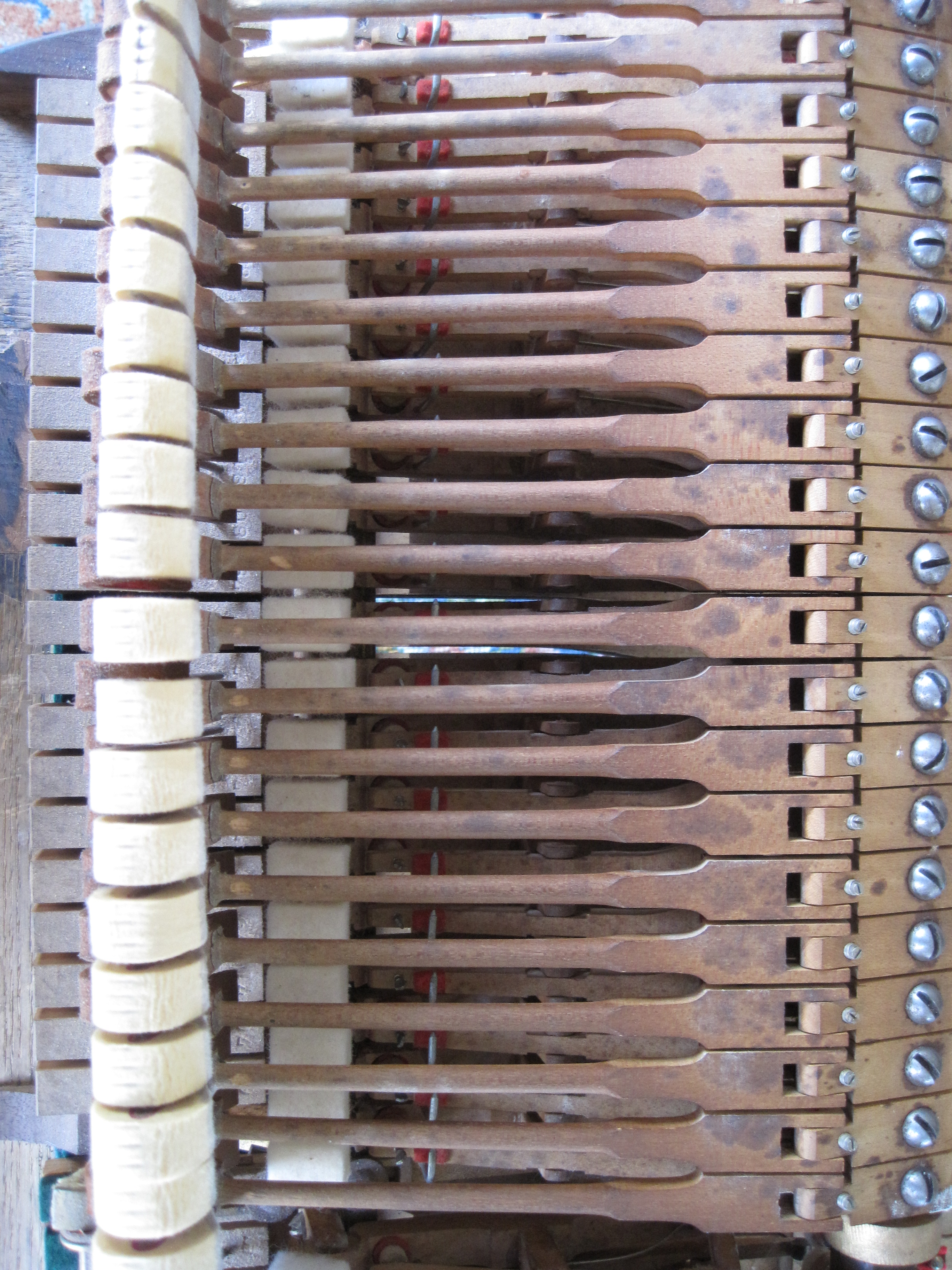
The primary piano in the house is an 1898 Model A Steinway.  It has, since 1898, always been in the corner of the big Keeping Room.  It possesses a classic Steinway tone and quality that, in my biased opinion, is hard to match.  (but loyalty to pianos is rather like the traditional Chevy/Ford/Dodge rivalry)  Admittedly, it does have a few quirks in its temperament making it very unforgiving for people who don’t have strong hands and control.

It had developed a rather disconcerting, barely audible, high frequency ring on certain notes due to some misbehaving dampers.  This meant that the action got pulled out today, which gives one a very different look at a typical grand piano:

025


027

024

At the time that this piano, no.  94008, was built and when it was first played here in this house, the Steinway Company was making pianos for: the Queen of England (Victoria), the Prince of Saxony, the German Emperor, the Queen of Spain, the King of Sweden and Norway, the Emperor of Austria (also King of Hungary), the King of Italy, and the Emperor of Russia.  A different world…


Broken Storm Thursday, Mar 6 2014 

IMG_4407

Mardi Gras 1891 Tuesday, Mar 4 2014 

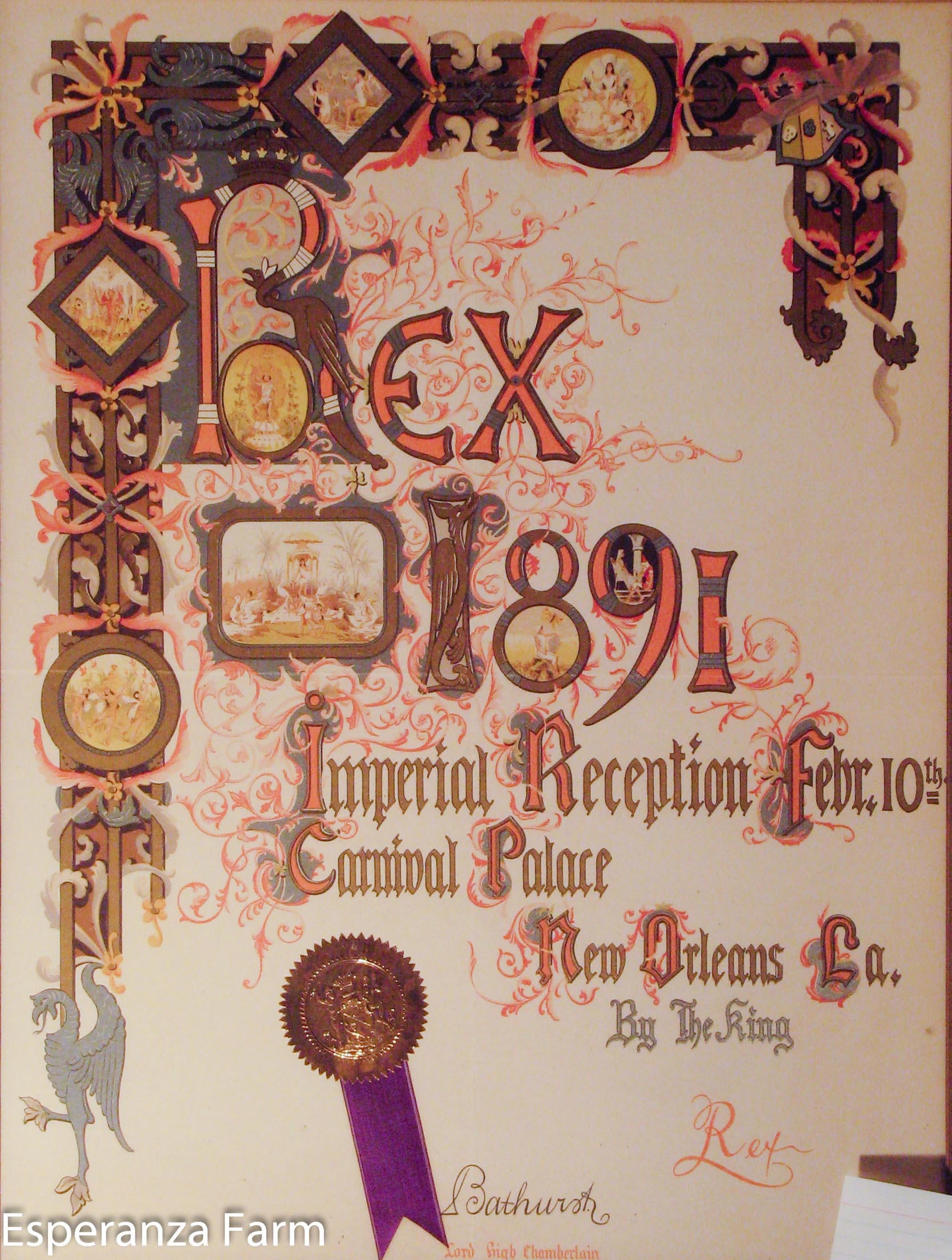
Probably both Morris Smith and his daughter, Carlotta, were in New Orleans.  Morris had business interests in the city and continued to visit there until he retired.  Both Carlotta and Fannie spent a great deal of time in New Orleans; Helen and her family never did as far as I can tell.

IMG_4611

My version of climbing the walls Wednesday, Feb 19 2014 

(it is raining, or snaining, or ice at the moment) is to start cleaning the walls.This is not as odd as it sounds.  The house’s walls are almost entirely plaster (a few wood paneled and wallpapered rooms aside).  Most of this plaster is either original horse-hair plaster or restored plaster, all genuine plaster on lathe, no sheet-rock or plasterboard in this place! In many of the rooms either the plaster is, itself, colored or the paint job is custom.  Consequently, you cannot put another layer of paint on the walls.*  Partially because it would be a horrendous job and partially because the visual texture of the plaster is important.

The importance of texture should not be underestimated.  Most of the walls are a very rough plaster, almost nubbly.  The ceilings are smooth plaster, this creates a nice contrast.  It also creates a wall that doesn’t have any reflective qualities, and a wall where a crack caused by settling doesn’t shout. I would estimate that a room with painted plaster can probably take another two coats before you lose the texture for a total of four coats.  That isn’t much, since it needs to last indefinitely, (the previous job lasted about a century) and you really can’t strip paint from plaster with any ease.  But rough plaster catches dirt.  A decade since the restoration/repainting and the dust starts to show.  Especially on the two areas with particularly rough plaster, high traffic, and light blue and rose colored walls….  It sort of creeps up the wall above radiators and near doors.

So washing walls.  But how? You don’t want to actually get it wet.  It turns out that a certain sponge (Magic Erasers) work quite well with minimal water.  I can’t take credit for this discovery, but it works.  Thankfully, there is essentially no grease/oil in the dust so it comes off quite easily.  The only drawback is rough plaster makes sandpaper seem smooth.  I go through a sponge to the square yard.  There are a lot of yards of wall….


*In the Keeping room and Yellow room the walls are a rough plaster that used a small amount of mica mixed into the sand. A paintbrush in those rooms would be grounds for violence.  All the other plaster walls were originally painted/colored in 1893/94 and repainted in 2000 onwards.  Several rooms are oddities: in Green Room, the walls were given a smooth finish/float coat of green tinted plaster.  In other rooms grey, rough plaster was painted, in others it was painted and then wallpapered, and so forth.

Connecticut Hills Sunday, Feb 16 2014 

IMG_2745

Pushing the camera rather too far. The light in the trees is actually ice on the highest branches. Taken from the attic landing porch.

Cabin Fever Monday, Feb 10 2014 

is a mostly useless phenomenon, something along the lines of the wet cat in a room full of rocking chairs: pissed off, paranoid, and pacing.*

On the other hand, one sometimes manages to do something useful with it.  As it might be rearranging the artwork on a staircase wall.  Artwork that had not been changed since the 1920’s when it was put together as a nod to the Ellsworth/Webster family history and the Century Company publishing business.  Only a few shifts here and there, not a complete turnover.  But a refreshing change of imagery.  I got tired of two dour old men watching me.  I am sure that Mr. Caine and Mr. Gilder were good friends of William Webster Ellsworth, but enough was enough.  The Sphinx and the Cell are now balanced by an English church and a New York canal scene.

Changing the artwork actually isn’t the easiest decision to make, for the simple reason that the wall in question uses hangers driven into the plaster as opposed to the picture rail.  Hanging things off a picture rail is fiddly business, getting the wires the right length and all, but nothing compared to the question of ‘do you really, really want to drill a hole here?’  Colored plaster, or plaster with a custom paint job, does not take kindly to patching if you get it wrong.

*Combined with stewing about an article that I need to be writing.

Organizational skills Thursday, Feb 6 2014 

I am mildly confident that we have found all the boxes of china in the house*….of course, I had assumed that we had previously done so…an errant box packed some thirty-two years ago just showed back up again.  A lovely surprise, but not what we had expected to find buried in that room.  I think I have found appropriate spaces for just about everything that was in it.  I think there are also very few places in the house which contain boxes that have not been gone through in recent years, i.e. the last decade; that lot (which I was not a part of, so it doesn’t totally count for the control freak!) might have been almost the last.  Not quite the last though!

My favorite remains the massive, locked suitcase that was too heavy to move and to which we finally took bolt cutters…only to discover it was entirely full of German textbooks.

I have a warped sense of humor, I have sometimes wondered just how long it would take, and how many people it would take, to do a really thorough job of a search warrant on this place.  Never mind upon which door does that knock (or No Knock these days) happens.

*Let’s leave the barn out of this discussion, shall we?  Let’s also leave the boxes that have been opened and hurriedly shut out too, yes?

Happy (Belated) 142 Birthday! Wednesday, Jan 29 2014 

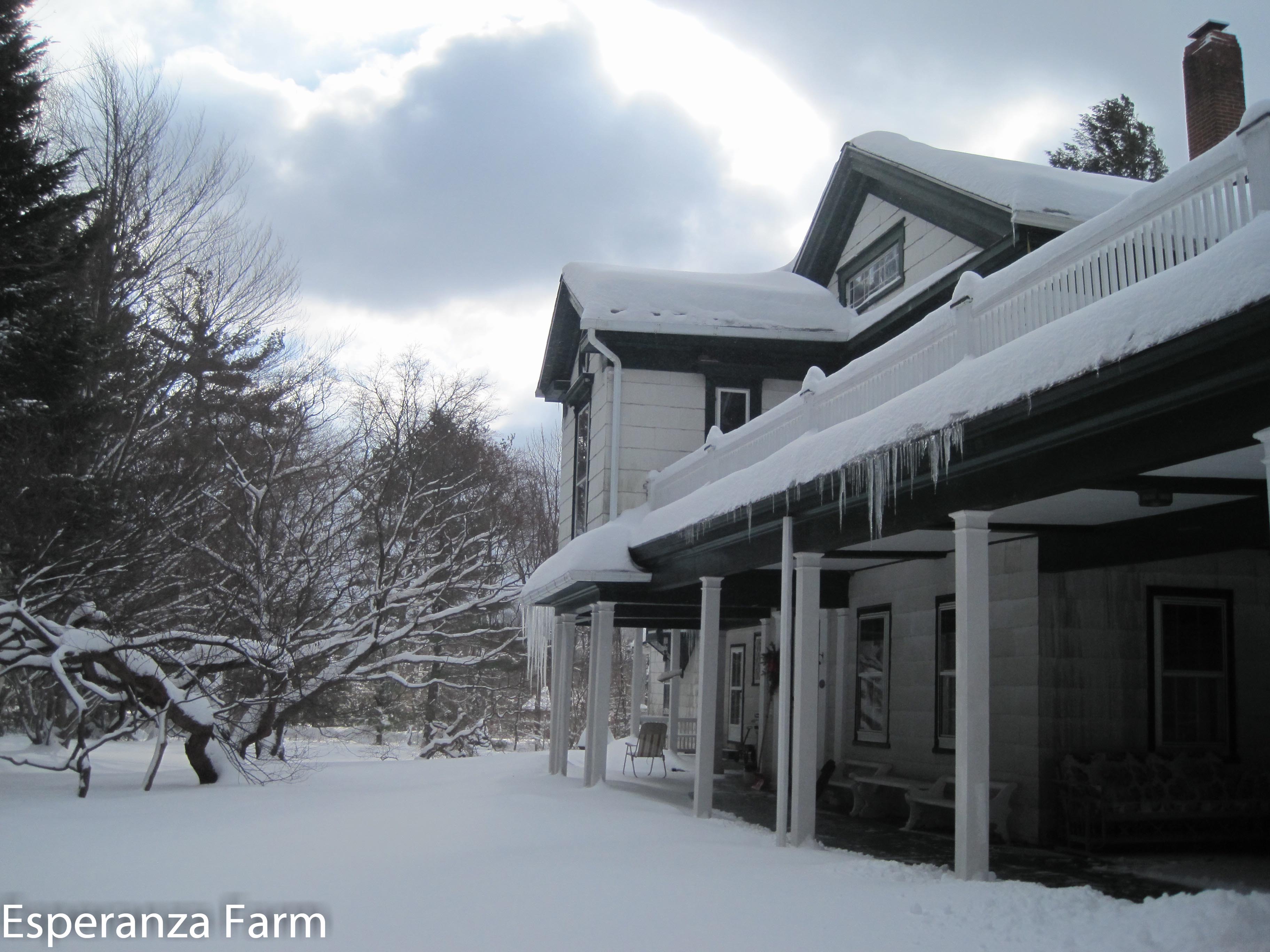
Julie purchased the Kellogg house in 1871, just to the south of Esperanza.  That house burned that fall, probably due to the spontaneous combustion of oil-soaked paint rags.  A house was later built on the site to serve as a farm cottage; it was sold off in the 1960’s.  Rather than go to the trouble of rebuilding, Julie and Morris decided to purchase the neighboring Lyman property.  There were probably two reasons for this: first, it meant they could move in that summer; secondly, the house prices for hilltop farms were sufficiently depressed that it was actually cheaper. (the majority of southern New England farmers had given it up as a bad job, the immediate area had close to a dozen abandoned farms at that time)

So, in January 1872, with the sales of her books going well, Julie purchased what would become Esperanza.

“hundreds of nights on the white road have I passed it by, in my lonely walk, and stopped and listened to it, standing there in its lights, like a kind of low singing in the trees; and when I have come home later, on the white road, and the lights were all put out, I still feel it speaking there, faint against heaven, with all its sleep, its young and old sleep, its memories and hopes of birth and death, lifting itself in the night, a prayer of generations.”

Gerald Stanley Lee, writing of Esperanza in his book ‘The Lost Art of Reading’ published 1902.

« Previous PageNext Page »