Hope Rises Eternal Wednesday, Feb 27 2013 

It is about 33 and pouring rain out there (so much for replenishing the water table, the ground is frozen); but looking through pictures always lifts the spirits.

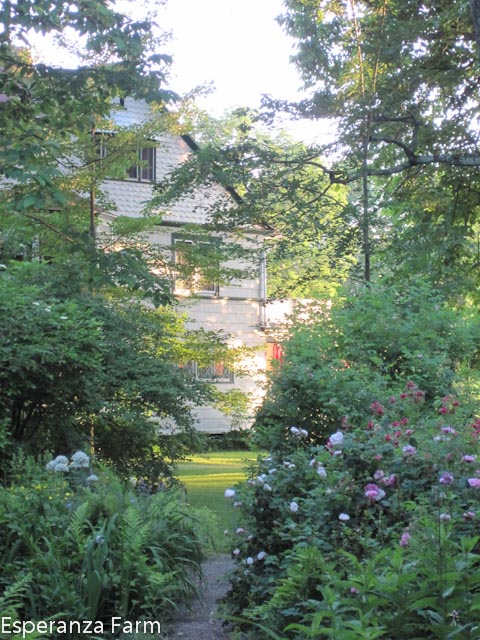
I like this one, taken in June, even if it is a bit fuzzy.  I was especially pleased to find that the combination of Moss Roses and Alliums is used in other gardens, Hidcote in England to be exact.  Such illustrious company for us little folk!  The yellow flowers just visible in the left foreground are evening/Ozark primroses. 

IMG_7975

Amaryllis ‘Apple Blossom’ Monday, Feb 25 2013 

IMG_2653

Frustrated plans Sunday, Feb 10 2013 

It is somewhat stupid to have begun pruning an apple tree just before the storm.  I am now stuck eyeing the unfinished project from the window.  I am sure that if I was made of tougher stuff, I’d be out there pruning.  Somehow, however, 28 inches of snow, plus Drifting, just aren’t conducive to any ease of work.*  And no, I don’t have snowshoes from which I can prune!  So I shall content myself with contemplating which branches I want to work on and how.  The tree will wait and the snow will melt, would that life was always so!

*as this town had one of the ‘official’ stations for measurement, I can be fairly confident in that amount.  It would impossible to measure that on the property: if it isn’t under a tree, it is in the wind.  Actually, there was one wind-free spot, or less windy, the north-west, bottom corner of the hayfield: the snow was still stuck to the branches in that corner even after high winds all Saturday; an interesting bit of information to see clearly demonstrated.  I will say that thigh high drifts are an awesome workout, and they make both the fishpond (which needed shoveling for the waterfall to continue to work if this next storm is ice) and the barn marvellously far away.

Why New England? Friday, Feb 8 2013 

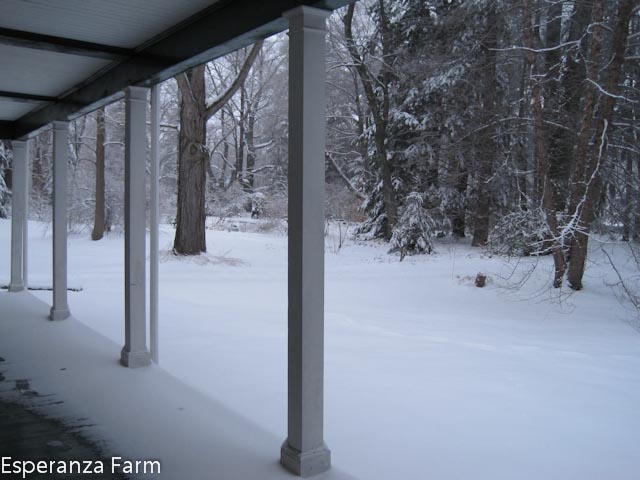
Because this: (January)

IMG_7222

Or this: (February)

IMG_7343

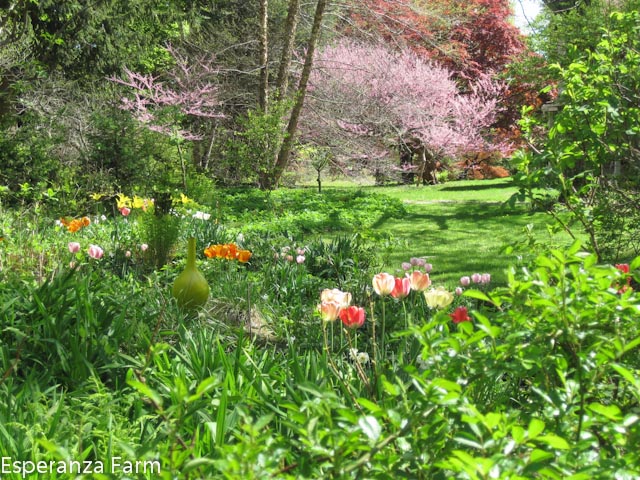
Will eventually turn into this: (April/May)

IMG_5068

(if you’re lost, note the three-stemmed river birch in all the photos: right side in the first two, center on the last)


Contemplations on Gardening Wednesday, Feb 6 2013 

Considering the seed packets that arrived in the mail today, mostly vegetable seeds, I was struck by the miracle, the everyday miracle, that is gardening.  It is a triumph of nature: taking this tiny seed and creating a plant that may produce many pounds of produce in a few short months.  It is also a triumph of the modern world.  How rich we are, that we can order seeds from half a continent away, every spring, and the choices are endless.  I can grow any vegetable that I want, from any continent, from any culture.  Some may take more work than others; some may be harder to find, but I can.  If I want an heirloom tomato similar to the original pre-Columbian, or an Italian, or a Ukrianian, or perhaps a modern genetically engineered hybrid?  All possible.  And next year, something different.

Whatever one’s take on gardening; that really is amazing.

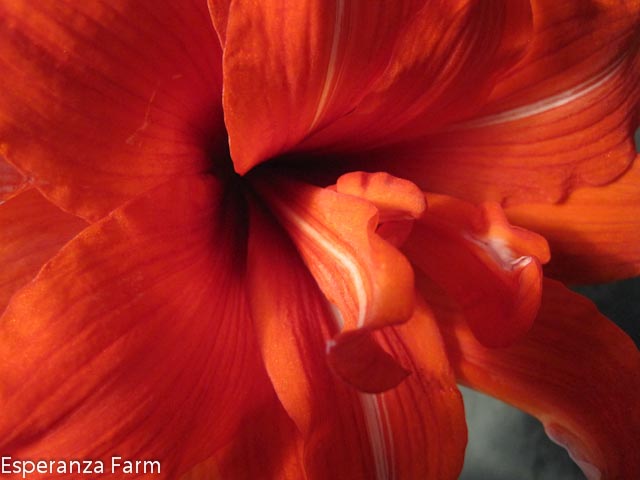
Indoor Gardening Tuesday, Feb 5 2013 

IMG_7340

Unknown Amaryllis, possibly ‘Red Lion’.  Further research: it is ‘Peacock’.

Water Wars Wednesday, Jan 30 2013 

Nice, foggy, rainy weather….lots of water….the ground is frozen rock hard.   Entirely too much of that water is going to go running off into the rivers.  Actually, the rather interesting things, for those of us interested in this sort of thing, is that the ground is not frozen solid in the woods.  It is frozen of course, but it retains some ‘give’.  That is to say, anywhere with deep leaf litter has the capability to absorb the water connected to this warm spell despite the extreme cold that came before.  Lawns, hayfields, bare fields; those all might as well be impermeable bits of pavement right now.  Today there are no puddles in the woods, there are on lawns.*  There is also plenty of run-off from the frozen lawns, if there is any slant at all.  Eventually, of course, the sponge quality of the woods will be filled up and the intermittent streams will start to run; but it will take much more water to create an intermittent stream in the woods than one bordering a field, subdivision, or road.

We know that forests are better at recharging ground-water than developed areas.  The immediate assumption is that is solely due to the developed areas using the immediate water and having more impermeable surfaces such as roofs, patios, parking lots, etc.  But it is also due to the fact that forest areas are genuine sponges.  It would be interesting to do a storm-water comparison of two identical house-lots, with identical houses, and the only differences being that one has retained over half of its original tree-cover/topsoil and the other has it stripped to lawn.  I think the result would be sobering.

Water companies used to buy watersheds in this area to protect the water quality.  Inadvertently, and happily for all concerned, they have also helped to protect the amount of water available by doing that.   Of course, it still isn’t nearly sufficient; but it helps. 

Do water-wars exist in the east as well as the west?  Oh, yes indeed!  google: farmington, mdc, uconn, mansfield, etc. to see one in action.

*unless of course your lawn has decided to establish some nice colonies of what look like sphagnum moss, in which case the puddles disappear.

Garden seeds Tuesday, Jan 29 2013 

‘Tis the time! The vegetable garden has quite quickly become remarkably useful.  It is actually a bit too small,* the winter squash have been relegated to the old slope paddock, no longer used for horses, where they are much happier.  The squash, that is; they are designed to sprawl amongst tall field grasses and the bugs don’t seem to find them. 

The variety of seed out there is rather amazing.  But, I most confess, that when part of the aim is to fill a small freezer, there is a certain tendency to prefer the tried and true classics.  Thankfully, the seed companies have sort of caught on to this.  The old, keeping varieties are popping back up again, in and amongst the exotics. 

Certain things won’t grow here without excessive coddling: sweet potatoes and eggplants chief among them.   Also, mysteriously, cucumbers…despite the fact that our neighbor routinely has plenty.  On the other hand, the good New England classics are quite happy: peas, beans, carrots, beets, kale, squash, chard, parsnips, spring lettuce.   Peppers and tomatoes if started right… There is a reason for local cuisine.

*I can see it from Google though (Google sees everything), we have a slight wiggle in the western bed.

Brr Friday, Jan 25 2013 

Still a bit chilly.  The good thing, a very good thing, is that this is just the sort of cold spell that helps to check nasty bugs like wooly adelgid on hemlocks.  It will still be here, of course, but every year one can keep ahead of it…! 

I am rather glad that there is just a touch of snow on the ground at least; it helps to protect the plants from complete desiccation.  The rhododendrons don’t look terribly happy, but they’ll manage.

In other gardening news, various persnickety seeds ought to be contemplated fairly soon.  You really have to wonder how some of these plants ever grow on their own…freeze it, boil it, soak it, wack it, forget it, what did the poor seed ever do?

Forest? Monday, Jan 21 2013 

IMG_9862

This is a somewhat deceptive photo of perhaps one the most important features of the place.  From its purchase in 1872 Julie began planting trees in front of the house, between it and the then sleepy road.  She added to the already extant group of two Sugar maples and two Norways, with a grouping of Norway spruces, and a line of maples along the road.  By the 1880’s a commentator noted that it was going to become a ‘lovely grove’ in front of the property.  Such natural landscaping, while all the rage in the cities where the first great landscape parks were being created, was unusual in an area dominated by open fields, charcoal wood lots, and the picturesque but rigid lines of sugar maples along hedgerows.  Over the century this grove has gradually been bulked up with more trees.  And more distance.   And, of course, size: many of the trees are between 70 and 90 feet in height. The maple in the foreground was orginally planted on the road edge.  Mercifully, when the state highway was created in the 1930’s, it was moved away from the house.  It is actually visible in this photo, at the center back.  The road, like the house, runs north-south; this photo was taken looking directly northeast.

Today, this area, 500 feet long and between 40 to 100 feet wide, acts and looks like a piece of undisturbed forest.  Over time, some of the native wildflowers have recolonized it: starflower, trillium, canadian lily-of-the-valley, wood aster, princess-pine, etc.  Many of these have had help in first getting established, but are now genuine colonies.  However, it is aggressively managed: both in the removable of undesirable plants and the planting of new trees and shrubs to continue to block the road, to add to the wooded nature, and to ensure that in another century it might still look like a forest.

« Previous PageNext Page »