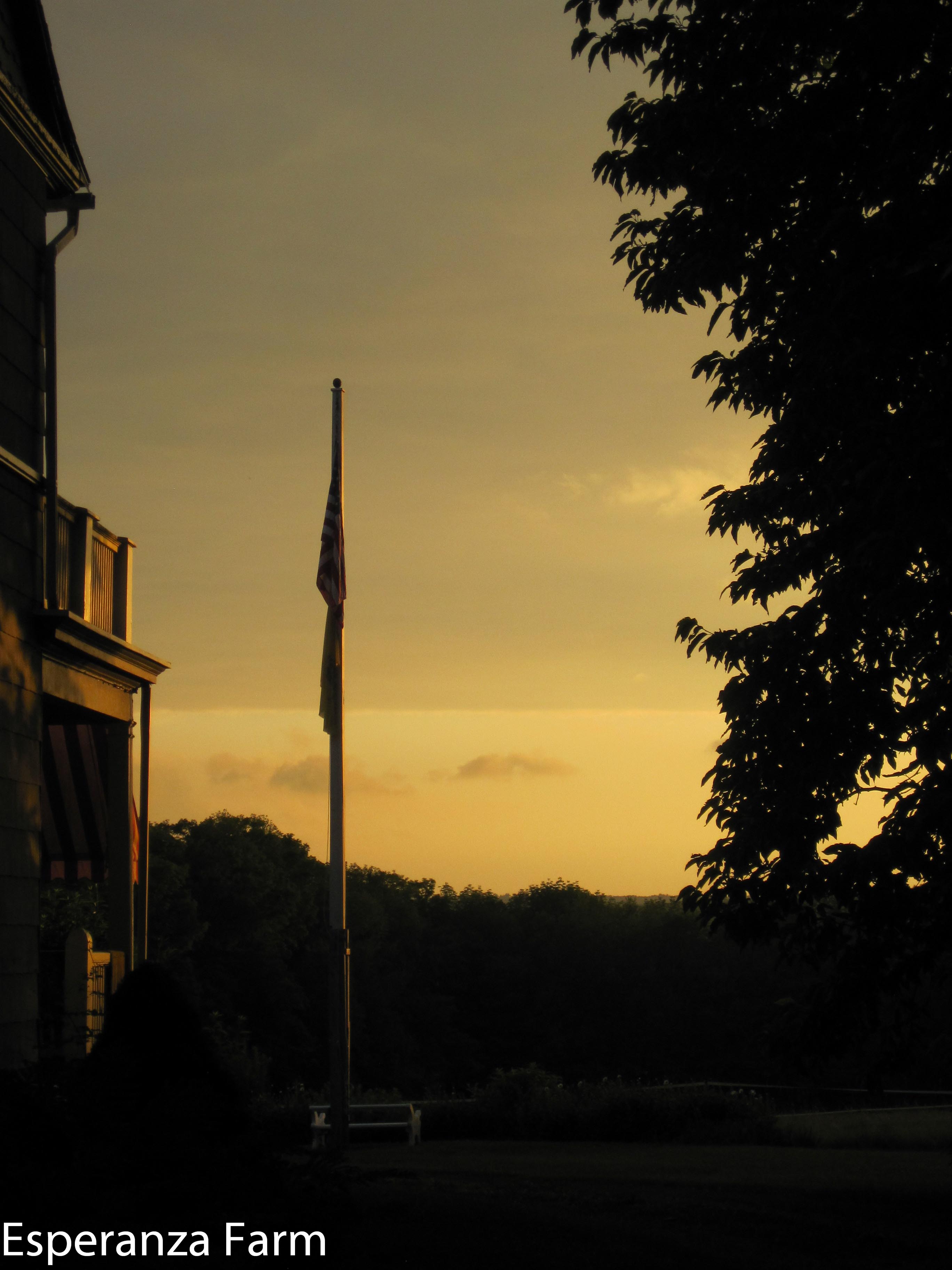
The flagpole, which was put up in 1999, has gone through a variety of forms, the first was the top of a Norway spruce, this one is basically a box. We can pivot it down to untangle the lines or do repairs. Originally, the drive had a turn around below the flagpole. That is long gone, but the area is the only well-draining, truly full-sun, garden. Well, mostly sun, with the trees and house to the east, it is in the shade until mid-morning. It is currently an arc of white Shasta daisies, earlier it was red Oriental Poppies with blue and gold iris; in the fall it will be mostly dusky pink and blue from NY/New England asters and Joe-Pye weed, with a touch of goldenrod.
The bench gives you a bit of scale. The large tree looming there is a bit of the big Cucumber Magnolia.
Sunset at the Flagpole Saturday, Jul 13 2013
gardening and Landscapes and Modern Photos gardening, landscapes, photography 13:27
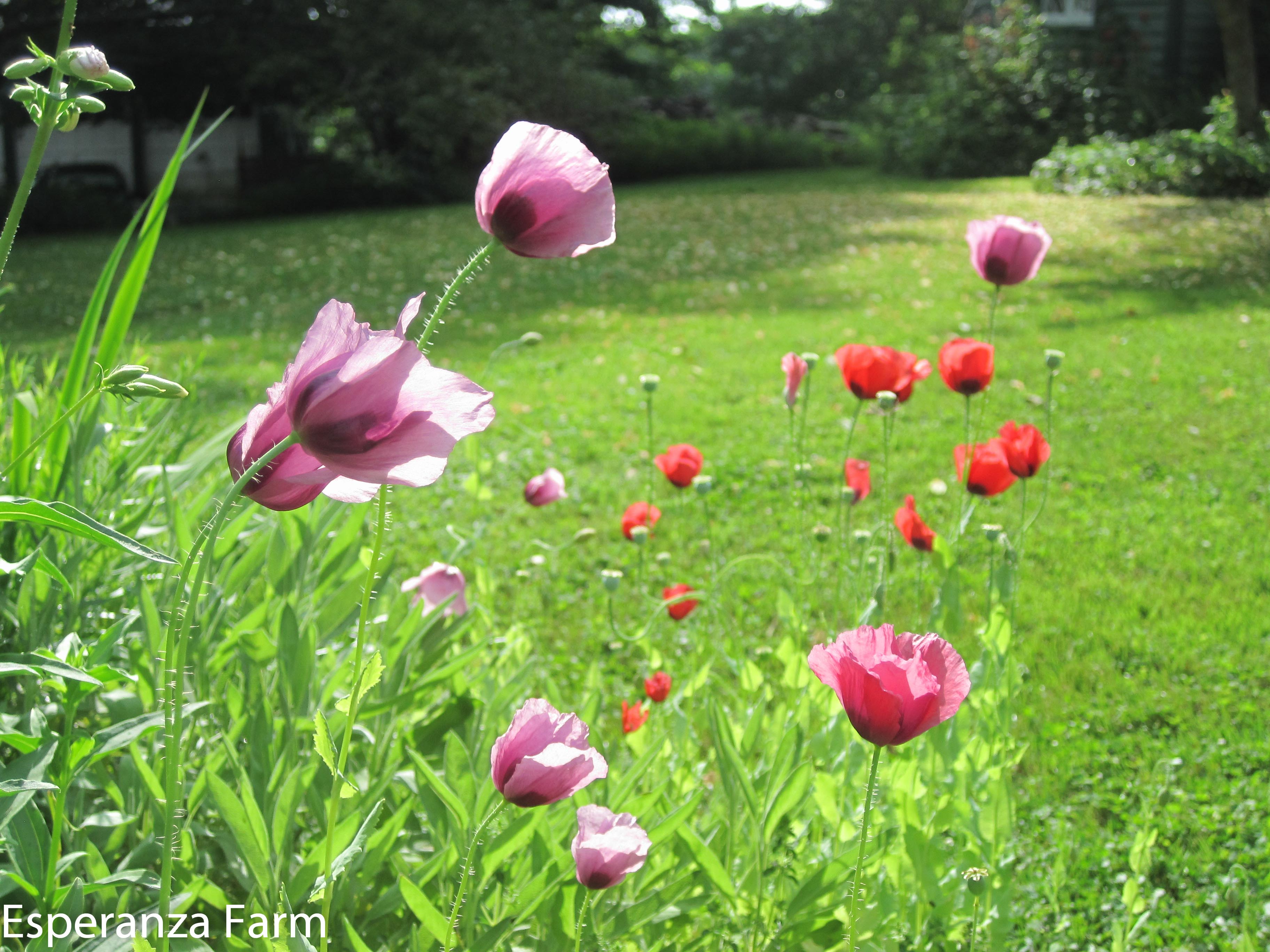
Poppies in the wind Thursday, Jul 11 2013
gardening and Modern Photos gardening, photography 14:19
Fire hose Wednesday, Jul 10 2013
with bath temperature water!
Aside from thunderstorms…
The green beans have finally gotten their act together, about two weeks later than last year, but better late than never. (I know they are late not because I wrote it down, but because I came across a carefully labelled freezer bag from last year for green beans that had a June date, the first ones this year have a July date)
Chard, lettuce, beets, beans, squash/pepper coming along; the peas are just about played out. A few jars of currant jelly, which I cannot take credit for. On the other hand, if I wanted to I could make gallons of tarragon and mint vinegar.
The daylilies are quite impressive, so far this year the thunderstorms have not struck that fence line; I’d prefer not to have lightning-fried daylilies again.
Comments Off on Fire hose
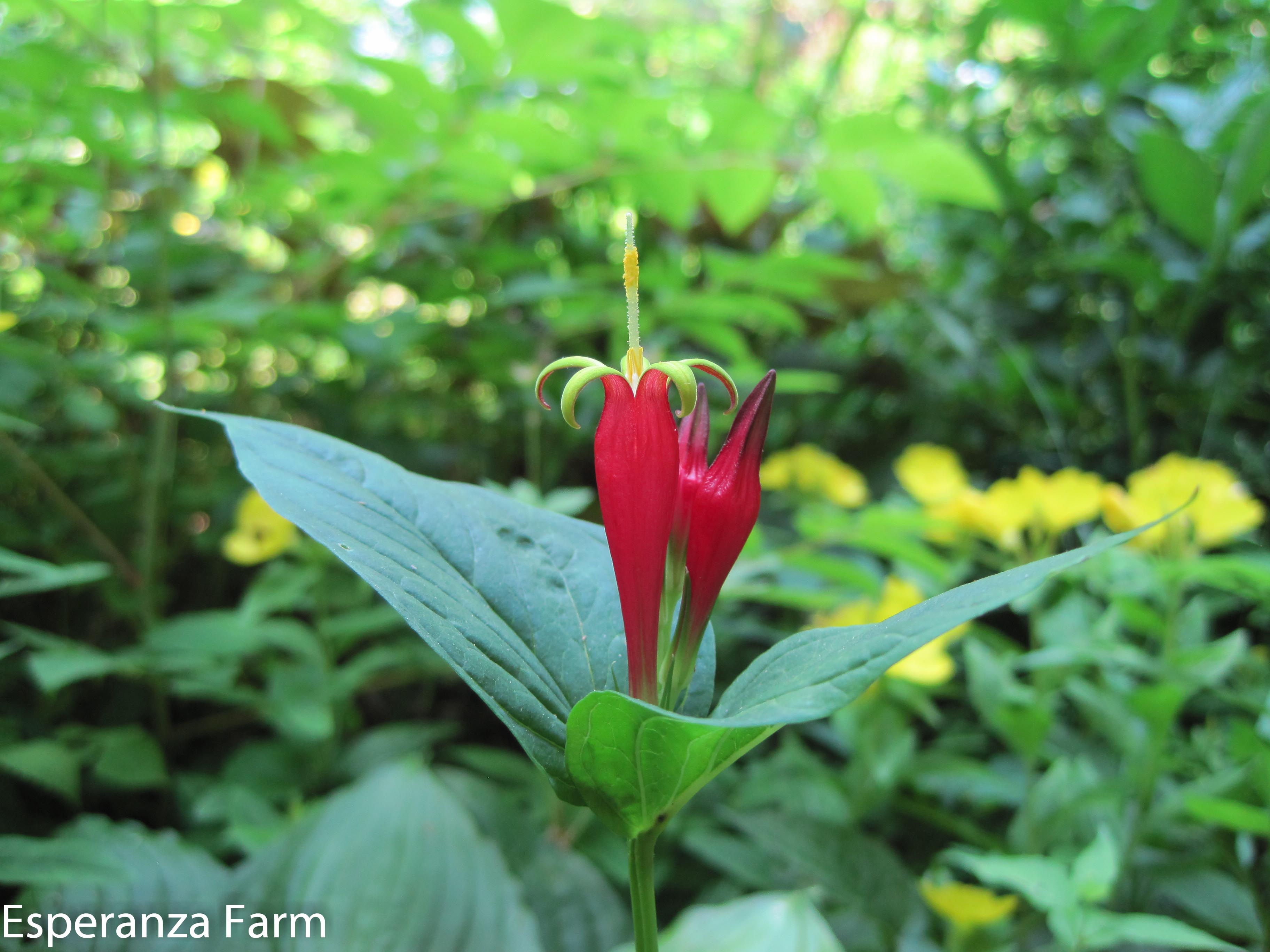
Spigelia marilandica: Indian Pink Saturday, Jul 6 2013
gardening and Modern Photos gardening, photography, spigelia marilandica 15:07
This is almost certainly as far north as one can push this plant (erratic zone 5, technically zone 6 but capable of zone 4 winters). However, my small clump is slowly increasing by about a stem or two a year. It comes up Extremely late, so marking its location is critical. The yellow background is Ozark primrose, a very happy and useful plant.
On Fire Friday, Jul 5 2013
and gardens. I got to thinking about this while dealing with squash bugs, which had I not gone to check the winter squash yesterday, almost won this round. Thankfully, my nose has decided that the smell is tolerable (except I cannot get it off my hands). They may still win the round.
In any case, they probably overwintered in some garden debris on the slope that I didn’t adequately clean up. Cleaning up the garden is one of the most critical parts of keeping the bug population under control. Squash bugs, along with several others, do not die when sprayed with most of the insecticides that you can use and not kill off everything else. Clean gardens give one an edge on the ever growing number of bugs which cannot be controlled unless you use expensive amounts of chemicals. (or spend hours each day hand-picking)
Now the best way to clean a garden and its soil is fire. Channelling my inner medievalist here, I can come up with any number of illuminations for manuscripts that show the peasants burning off their fields. The Native Americans practiced fire agriculture on a massive scale, a continental scale. So did the colonists. So do farmers in most other countries.
Now, I’ll admit that playing with fire, is well…playing with fire. There are many areas of the US where it would be criminally stupid to burn off a field. More than criminally stupid, it might well be homicide. Anyone burning a field west of the Mississippi probably ought to be run out of town.
And yes, doing it on a massive scale in the rainforests is a bad idea. But that has more to do with using it to clear new ground. Going back to my medieval peasants, they were using it to clean intensively used ground in densely populated areas.
It would be nice if that tool in our gardening tool collection wasn’t completely off limits. Or as close to off limits as it comes. Yes, of course, you can get a burn permit for certain days (for a hefty fee) for a brush pile. But what you can’t do is burn a section of ground. We have developed a seriously weird mentality when it comes to fire in our society, an absolute terror of it. This terror may (I’m not qualified to say, but the argument seems sound) contribute to extremely hot and destructive wildfires. It probably also helps to create gardens loaded with disease and bugs in climates such as New England’s.
Not mind, you that our vegetable garden is not set up to allow it to be burned off (neither the peach tree, or the power lines…or that pesky thing called The House would appreciate it) so it is a moot point. Still, in New England, if I was setting up a big garden again, I think I’d like to build that option in, regardless of the legality.
Is it Just me? Wednesday, Jul 3 2013
Or is summer flying past this year? The hostas are blooming, at least the big white ones are, the standard hosta is about to, assuming I get around to spraying it for deer…. The Phlox has set its buds, as has the Joe-Pye weed, the wood aster, and probably (though I haven’t checked, the New England/New York asters). I don’t really associate flower buds on those until mid-July. It is a good thing I have stopped pinching them back a few weeks ago (usually you can pinch them back until the end of June/July 4th)! Not, I assure you, out of any prescience…just luck, laziness, and a lack of desire to garden in the rain. Still it seems that a lot of flowers have really raced through the growing season. No doubt to ensure that when we have a goodly group of guests at the end of August, the gardens look just as horrid as they can possibly manage.
On the other hand the vegetable garden is a bit of a damp squib, at least as far as tomatoes. Still chard tonight, snow peas last night, tomorrow lettuce. It isn’t all bad.
Comments Off on Is it Just me?
Run What You’ve Brung Tuesday, Jul 2 2013
gardening and Landscapes gardening, landscapes 14:43
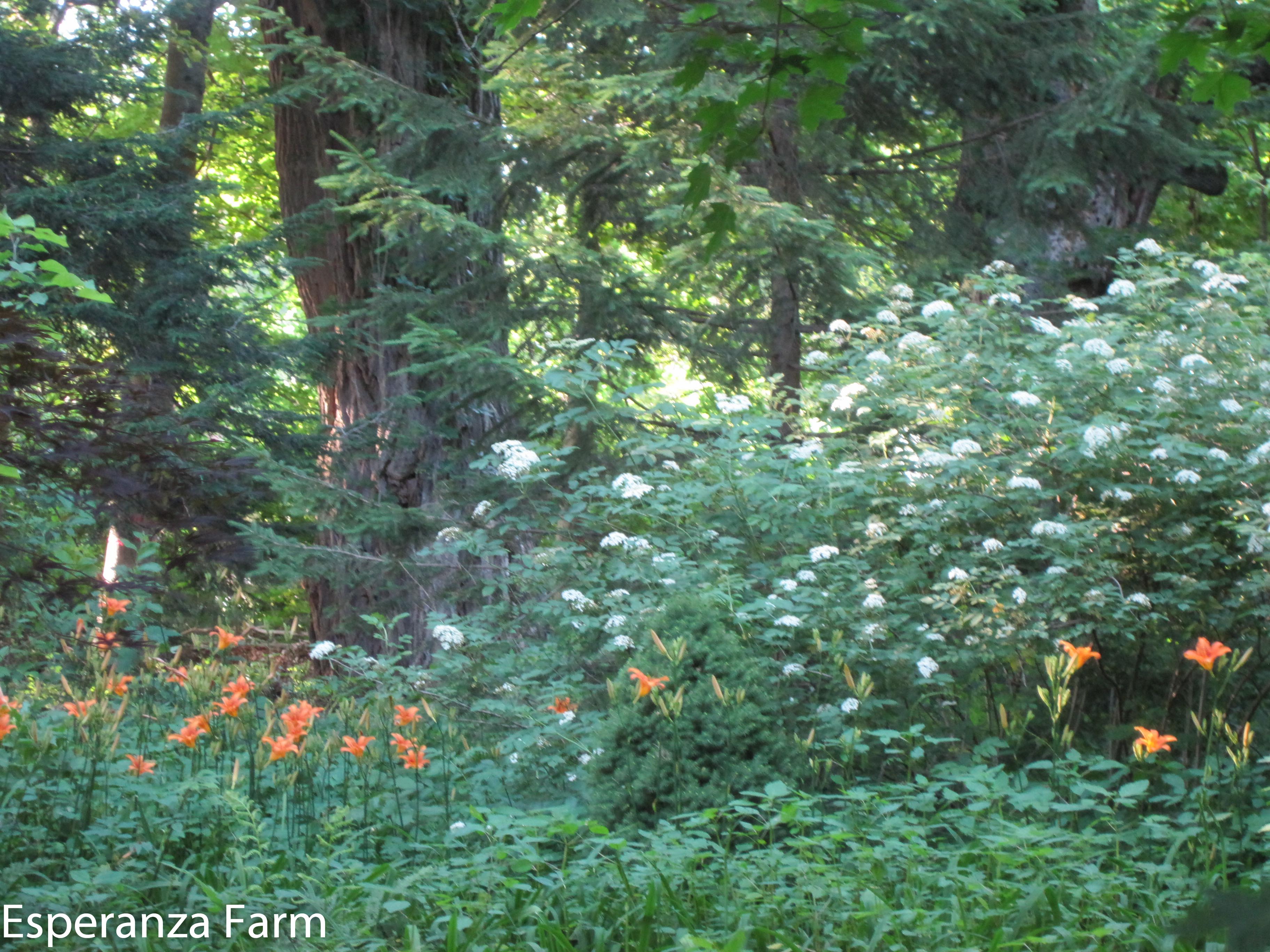
Most gardeners do not have unlimited budgets, Esperanza is no exception. In this case, a decent display is created by an entirely untended, unplanted volunteer combination: the classic orange ditch lily and native elderberries. It won’t win any awards, but you know it doesn’t look bad filling in the distant background. And it didn’t cost anything!
The Problem of Trees Sunday, Jun 30 2013
Trees gardening, trees, weather 13:15
I keep anticipating the sound of chainsaws over at our neighbours. They, like us, have large lawns and large old trees. Unlike us, they have not been at all lucky. We lost a few trees up by the house during the hurricane last year, but all but one were minor points in the landscape. Now down in the woods, near that old willow in the last post, it looks like a giant’s game of pick-up sticks: a set of black locusts going every which way (and all are hung). But those locusts were all exhbiting serious structural issues already. However, we haven’t* lost any of the trees on the lawn.
Our neighbours, however, have lost four sugar maples and big copper beech. None were outwardly problematic in their structure, but they were all about as big as they ought to get. I have some theories, unproven of course.
First: spacing, trees are evolved to work together. Their roots are intertwined, and if their canopies touch it would stand to reason that the wind loads are, if not less, at least distributed. Extremely wide spacing forces them to stand and fall alone. The trees on our lawn are much more closely spaced, creating a high closed canopy.
Secondly: competitive growth. One of the more interesting points a state forester mentioned to me once was the Sugar Maples are designed to grow in a dense forest situation. Put them in a full sun situation and they can grow too big, too full, and too fast overtaxing the strength of their wood and their roots. It stands to reason that certain other tree species might be better adapted to standing alone; anything requiring full sun to get started, or evolved to handle fire, or perhaps flooding?
Lastly: over-fertilization. Our neighbours fertilize their lawn, heavily, the previous owners never did. This also helps create lush growth in the trees. But, it would seem to me, if the tree is already as big as it ought to get, mechanically, than a sudden spurt of heavy new growth, which catches the wind and the water, might just be too much.
Theories anyway. Probably half-baked.
*I know, I know I just jinxed us, we’ll get a storm tonight and down they’ll come.
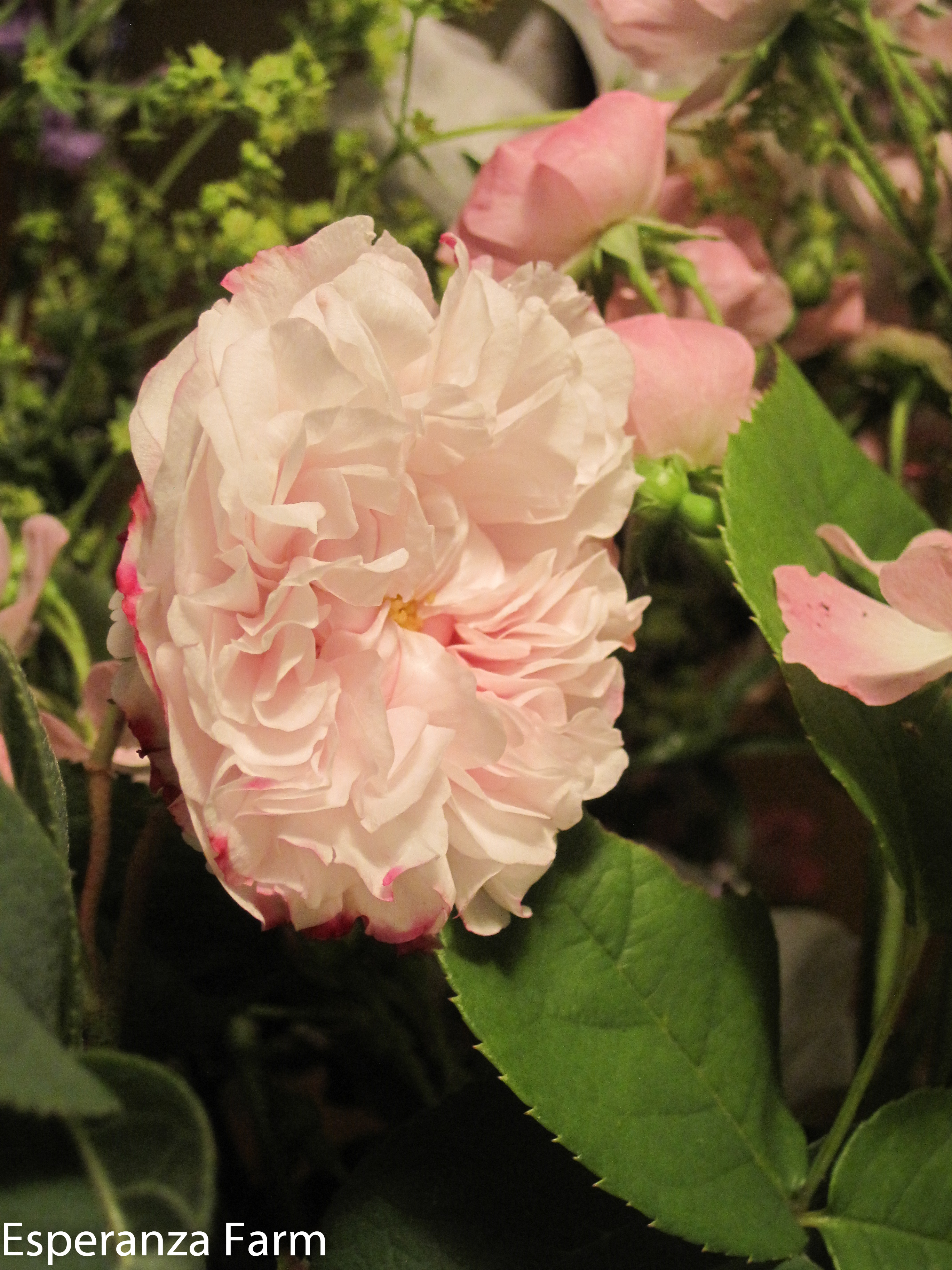
Still on Roses Wednesday, Jun 26 2013
gardening and Modern Photos gardening, photography, roses 09:48
Night Lights Monday, Jun 24 2013
gardening ecology, gardening 09:46
This has already been an odd summer, we had our last frost on the last weekend in May and the temperature yo-yo has continued.
However, it is definitely summer now. I saw, without really looking for them, a whole group of lightning bugs last night. Warm, still nights seem to be a requirement, so this constant wind has probably been a trial. As always, they prefer the west lawn and the meadow. I think they like being able to drift down out of the tulip and magnolia trees into the tall meadow grass. One of my hopes with keeping a section of the northwest lawn uncut is that it will help them. There are also a couple big clumps of goldrenrod in those areas. It certainly has become a favoured spot for the Phoebe, so there must be bugs!
They are lovely to watch, little points of light throughout the dark.