Someday, I will diligently write down precisely what I planted where. This year the biggest mystery are the wonderful orange tulips by the well-stone, pictured a few days ago. The problem is that we didn’t plant orange tulips there, or at least the shipping order for last fall doesn’t have orange tulips on it or at least doesn’t have those orange tulips…. They are quite pretty, much better than the plan. The problem is that not knowing what they are makes it rather hard to deliberately replicate….
I think I am confident that the lovely cream daffodils in amongst the daylilies on the fence row are in fact ‘Pueblo’. I was uncertain for awhile.
Fun and games.
Taking notes Wednesday, May 1 2013
Sanguinaria canadensis Tuesday, Apr 30 2013
gardening and Modern Photos gardening, photography 08:42
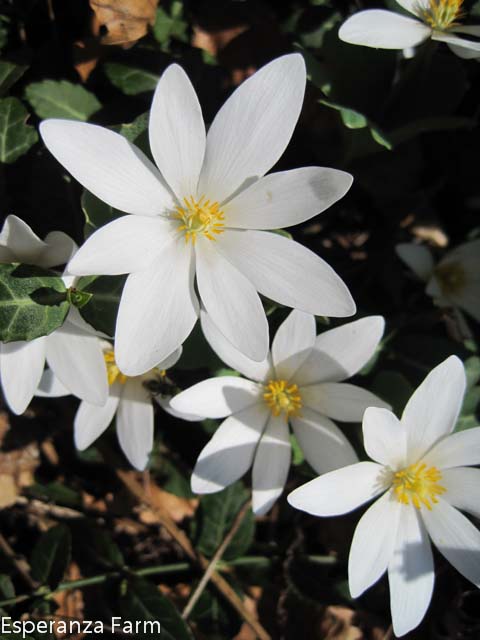
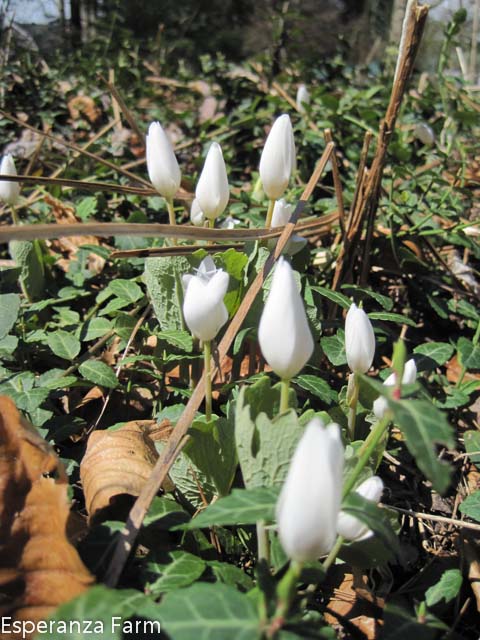
Bloodroot is one of those amazing spring flowers, they aren’t there, aren’t there, and then overnight there they are in all their glory. The flowers of the bloodroot are incredibly fragile, the slightest touch will cause the petals to fall. They are also, however, one of the truest White flowers out there. Like some other flowers, such as iris or trillium, the cells in the petals are very reflective, so a large clump can be almost blindingly bright in the sun. We have one large clump (about two dozen flowers this year) and several smaller clumps elsewhere, on the theory that having them all in spot is hazardous.

Comments Off on Sanguinaria canadensis
Finally! Monday, Apr 29 2013
Landscapes gardening 10:15
This is an odd spring, very slow, cold and dry. The redbud tree, which usually dominates the east lawn from mid-April has yet to come into flower. On the other hand, the peas are finally up.
We are always the last on the hilltop for things to break bud. I rely on the star magnolias as a gauge, ours is two weeks behind the valley and almost a week behind the other two on the hilltop. The same holds for our saucer magnolia. It doesn’t really make sense, except to demonstrate how complicated the micro environments are. If we look at the saucer magnolias, ours is located on the north lawn in the garden. So it has western exposure, wind/sun block to the east, and is in part shade (almost full sun at the moment, due to the number of deciduous trees). It is also in heavy, wet clay soil in an essentially ‘unimproved’ setting (shrubs, perennials, uncultivated and undrained). The other two magnolias, belonging to a neighbour at the same elevation, also have the same western exposure. To the east they have a wind/sun block, but it is a house rather than trees. The magnolias are also in a heavily fertilized, manicured, turf lawn in full sun. The soil in that area has been improved, cultivated, and thoroughly drained.
Now then, what is the deciding factor? Is it the full sun? Is it that a modern turf lawn heats up much faster so the soil warms faster so the plant blooms that much earlier? If that is the case, then some interesting variables arise concerning heat islands and the commentary about plants blooming earlier than they used to….no question that they are a little earlier, but the accompanying questions are which plants, where, and what has changed in that location?
Comments Off on Finally!
Tulips and daffodils Saturday, Apr 27 2013
gardening and Julie's Pond and Modern Photos gardening, photography 15:06
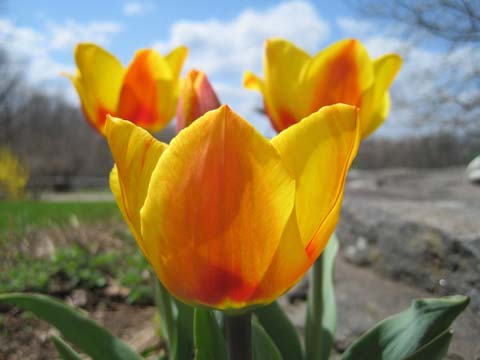
It is glorious weather here, those of us who are gardeners are eying the water level,* on the other hand, a perfect day for a local celebration on a small town green, which I just got back from…always there is a trade-off. Below are two pictures which are good examples of today here. The daffodils are our mystery daffodils. Many years ago they were down by the pond (and there are still thousands down there) but being overcrowded and shaded they didn’t bloom. Well, I should clarify, only a few ‘poeticus’ bloomed, Nothing else. Now I have a fondness for the poeticus type, and so my Mom and I dug a bushel basket or two (including some that were blooming at the time) and she planted them on the bank. What appears the next year? Hundreds of classic yellow trumpets and nary a white poeticus in sight. ?
The tulips are very classic with true black markings inside, but of course I can’t recall their name…
*If gardeners had an icon it would be Goldilocks.

Letters Friday, Apr 26 2013
Historical Events history, letters, women's history 10:02
A short vignette from a letter by Martha Kilbourne to Helen, dated 1873. Martha, or Mattie, was one of Helen’s close friends, she was 16 when she wrote this letter.
“Lizzie is in Great Barrington and will stay there until school commences. It is so very warm she does not dare to go down to Conn. She is boarding in a splendid old farm house. It has two very large rooms on the first floor, her room is over 20 feet square, is furnished in the modern style and very richly. Her parlor is richly furnished it has pale green with rose buds embroidered on it (note: she means the furniture in the room, not the room!). It has two sofas, one sleepy hollow chair, four easy chairs, a large table, inlaid cabinet, piano, and a beautiful case for music. She has a balcony running by both rooms.”
It is clear from the description, since the parlor is unlikely to have been much larger than Lizzie’s other room, that excessive amounts of furniture are typical in upper middle class houses of this time period. The sheer number of chairs! (the original transcription, I should add, suggests there are another 11 chairs…but I have my doubts about the transcription)* A piano would almost be a required item for Lizzie, or any girl in that class, during the summer in order to keep up with her lessons.
Esperanza’s excess of furniture was clearly not a unique situation…
* the eleven is the only number that is typed as a number and not as a word, and there are several other longer numbers in the letter which are typed as words. This discrepancy rings alarm bells.
Comments Off on Letters
Wildlife Wednesday, Apr 24 2013
Uncategorized 13:22
One watches one’s step it seems, I opened the basement door to be greeted by a very pretty garter snake. He was in no particular hurry, and went off along the garden, giving me a very good opportunity to watch him.
I can’t help but consider the sheer level of life around this place (at the time I was observing the snake, I was also able to see nine different bird species, three different butterflies, and numerous insects or arachnids) and wonder at how much my neighbours (whose lawn care is busy vacuuming the lawn) have or don’t have.
It isn’t that, on principle, I object. They have every right in the world to vacuum the lawn. It’s just, I wish that I could show them the inherent wonder of this world in all its burgeoning diversity. No doubt they see it in other ways. I hope, anyway.
(the butterflies were: Cabbage Whites*, a Spring Azure, and a Mourning Cloak)
*the Cabbage White does challenge my love for said burgeoning diversity!
Comments Off on Wildlife
Eventide Tuesday, Apr 23 2013
Landscapes and Modern Photos landscapes, photography 08:36
Daffodils inspired by Chihuly Monday, Apr 22 2013
gardening and Modern Photos gardening, photography 08:23
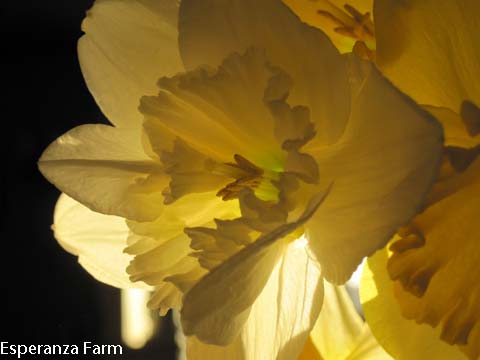

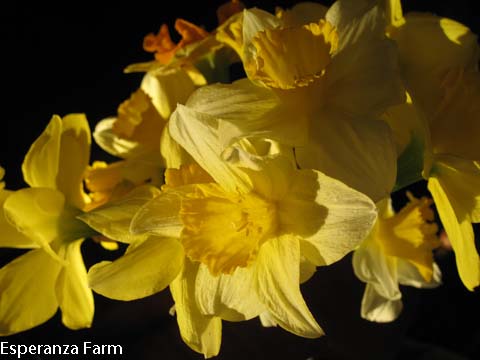
Comments Off on Daffodils inspired by Chihuly
Feeding the Birds Sunday, Apr 21 2013
Uncategorized birding 13:29
I am not at all sure that we meant the pergola, from which one may usefully survey the garden and all three birdfeeders, to be a perch for a big Red Tail Hawk…. On the other hand, the peas will be safe from the crows that way.
I actually am very glad to see a number of raptors hanging about, it seems to me that if the top of the food chain is around, the bottom must be at least decent.
The count right now includes the Red Tails (a breeding pair who have been here several years), Long Horned Owls, Short Eared Owls, and the Cooper’s Hawk. The last memorably nailed a robin at high speed about twenty feet from me the other day. Quite impressive.
Comments Off on Feeding the Birds
Digging oneself a hole Friday, Apr 19 2013
In the last few days I have undertaken to shift a variety of shrubs hither and yon, it being that sort of weather. This gives me plenty of opportunity to practice my hole digging abilities.
I always laugh at the earnest illustrations that accompany many plants…though I have discovered that probably the majority of people out there do Not know how to dig a hole (never mind plant something), so the illustration is needed. Still, the hole is so elegant: a nice symmetrical hole, a nice pile of dirt, a person leaning contemplatively upon a spade… Right. Now, I have had the occasion to dig a few easy holes. It was a revelation when I was helping to plant some trees down in a river valley, in an area of deep soil and no mature trees; this it was clear was what they meant, a few easy scoops and voila!
Now here…well, first off it is sticky, heavy clay till. It can be wet enough to merrily adhere to the shovel even when it is shaken vigourously. There are the rocks, ad infinitum. Then, well then there are the tree roots. Having hacked through the mat of fiber roots at the surface, you hit (usually just where you need to place the root ball of the new plant) great writhing roots. Anything up to two inches can be severed by a shovel* but often, as was the case today, these are roots the size of an arm. I try to dig around those, so much for the symmetry of my holes. Hole digging is a vigourous exercise, aided by a sharp knife at times, sturdy boots, and determination.
In my morbid turns of mind, I have always wondered how on earth grave-diggers did it. You can’t do six feet deep around here. At least I can’t.
*I’ve always felt that ‘blunt instrument’ is a misnomer when applied to a shovel.
Comments Off on Digging oneself a hole
 Acair Fearann