Waterproof Flowers Saturday, May 25 2013 

I am not going to object to the several days of cold rain, though 50, raining, and constant wind, is bracing. The rain now means daffodils next year, among other things (you know, minor things: like enough groundwater!). And it has refreshed the water in the ponds, reducing the duckweed/algae thing. I am glad the tomatoes aren’t out yet, however.
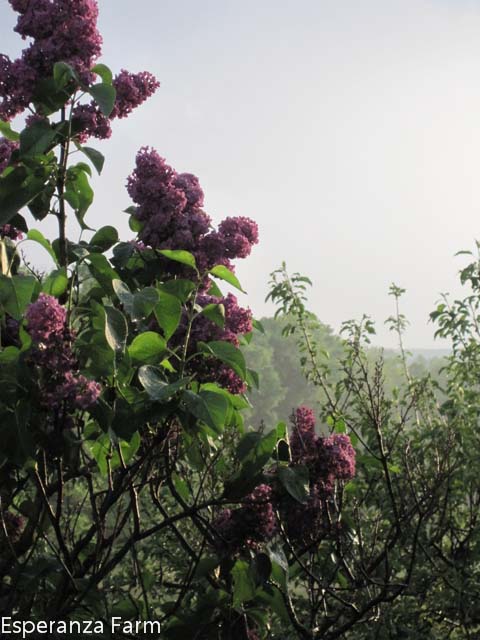
It does give one a good chance to look at what flowers can or cannot stand up to such large amounts of water and wind. Lilacs melt, as only lilacs can, into rather unappealing mush. If the flowers panicles are young and unbruised by the wind, they stand up well. But if they are at all passed their peak…brown mush.
The early clematis ‘Mayleen’ seems to think it is just fine, despite an exposed location where the flowers can get beaten against the trellis in the wind, they are apparently undamaged. None of the others have opened yet.
The evergreen azaleas…mush, pretty mush, but still. They were past their peak anyway, but usually they last a little longer. The exception is one red azalea, its smaller flowers seem to be able to handle the rain.*
The deciduous azaleas are a surprise, despite the huge flowers of the Exbury types, the rain has not damaged them. The native swamp azaleas are quite happy.
The viburnums are variable, snowball types tend to catch the water…mush. The mariesi snowflake types don’t mind.

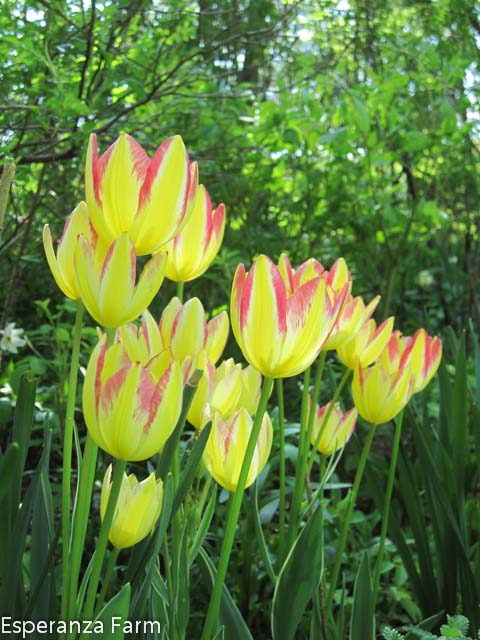
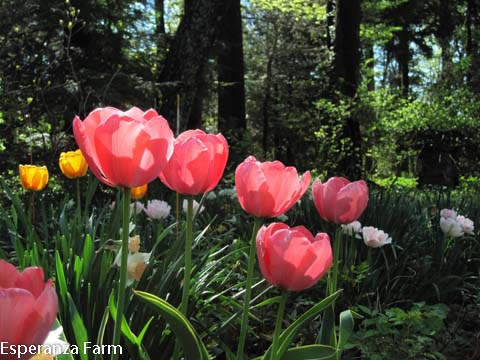
Columbines love it, although I think it may shorten the individual flower’s life. Tulips disintegrate, but they were essentially done. Camassia can get flattened if it lacks support. Sweet woodruff, tiarella, forget-me-nots, rocket, trillium: all very happy.
The real surprise performers are the iris. They are just starting to open, and as long as they are staked or have short stalks, the rain doesn’t seem to bother them at all, nor does the wind.

*This is an azalea of uncertain parentage, tiny evergreen leaves and equally tiny scarlet red flowers. Think cardinal flower red. It is in a terrible location which has gotten much too shady, but the idea of moving a thirty year old azalea scares me.

Mavourneen Friday, May 24 2013 

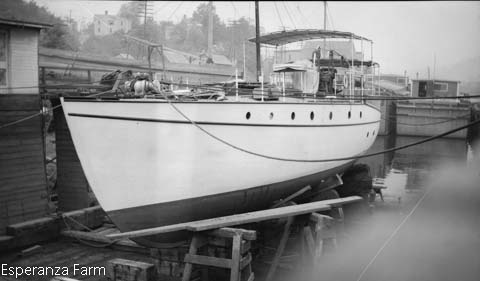
Figure I ought to put a few photographs of Mavourneen up. These are from 1908.

1908001214

1908001207

Wooden hulled, powered with a somewhat cantankerous gasoline engine. She had a fairly spacious cabin and galley kitchen.

Gravity! Thursday, May 23 2013 

The large, but muffled, crash last night has finally been identified: an outwardly healthy, Large, limb from the big sugar maple east of the house. This maple is probably closing in on two hundred years old and is about eighty feet tall. It is fairly happy, as elderly maples go, but it does sometimes drop things. In this case when I say large, I mean pushing eight inches in diameter and about thirty feet in length, falling from somewhere over fifty feet up. Interestingly, it must have caught briefly on the way down,the butt end is swung ninety degrees away from the tree. Outwardly healthy, but inwardly quite rotten: rain plus a full flush of new growth equals gravity winning. I was once told that the most dangerous time to be out in the woods is late spring/early summer after a rainstorm. Windy days can be a bit scary, but it is the calm day when everything is saturated with water that you have to watch out for, limbs drop with no warning and no sound…till they hit. In any event, no damage this time around.

After the Storm Wednesday, May 22 2013 

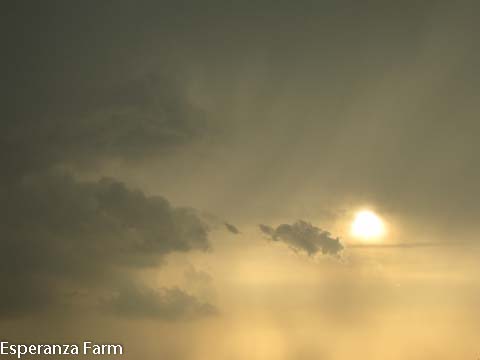
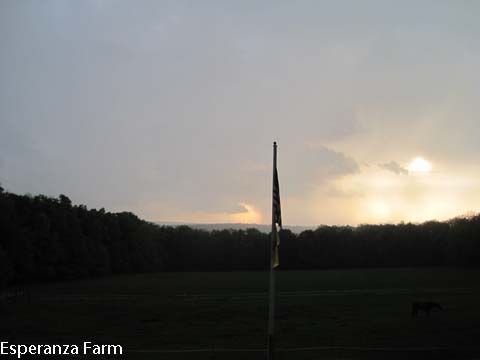
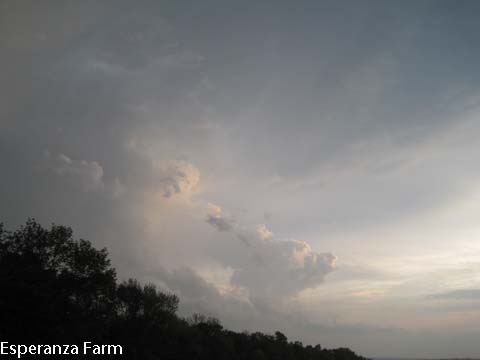
We have jumped from cold New England spring to hot, muggy New England summer essentially overnight. Naturally, the storms have come along; this one hammered the towns to the west and south with hail and numerous ground strikes, we (thankfully) simply got a lot of much needed rain.

IMG_0680

IMG_0682

IMG_0690

IMG_0694

IMG_0699

Summer Activities Tuesday, May 21 2013 

An excerpt from the very beginning of the yacht Mavourneen’s log by Lucy Morris Creevey, daughter of Helen Yale Ellsworth and William Webster Ellsworth. Lucy was married to George Creevey. Helen and WWE, like Julie and Morris, had known New York City well, but weren’t really ‘New York’ people (if that makes sense). George, however, was a New Yorker, despite his life-long love of the Adirondacks and camping. He worked in New York as a doctor, first as a surgeon and then in anesthesiology; his brothers, William and John, were also New Yorkers, involved in law and politics.
So it isn’t surprising that that most New York of activities interested him. Yachts. The Mavourneen was a motor yacht built in 1907, the family had it only till the outbreak of World War I when it has handed over to the coastal defense effort.
Lucy kept a detailed account of several of the trips they took along the east coast waterways and the St Lawrence/Champlain canal systems. George took excellent photographs as well.
“Thursday, Aug. 8 (1907)
Entire morning spent in puttering, until twelve o’clock, then Captain G. raised his flags and the M. was in commission! We had luncheon, said goodbye to all the Cramptons, and at eight minutes of three we broke out the anchor and off we went. The little Cramptons set off giant fire crackers and everybody waved and we were very happy at starting. She moved deliciously thro the water, the day was fine, and it seemed too good to be true that we were actually moving away from Morris Cove. Note: Do Not try to buy anything in the line of provisions at Cousin Eli’s grocery store, he hasn’t anything one wants and what one buys is sour.
We pulled in behind Duck Island Breakwater to lie there for the night. It was so warm that we thought we would get in for a swim. I came up in ballet costume to find the temperature lower by about forty degrees, a squall blowing and Captain G. busy finding another anchorage not quite so near the stern of a great black schooner that seemed to be dragging back upon us. We did get in a chiefly refreshing swim, then a sunset and dinner, soon to bed, and our first day was too joyous!
Saw porpoises. L.M.C.”

*the Cramptons were the family who built the boat down at Morris Cove, Ct.

From a walk Sunday, May 19 2013 

IMG_0676

IMG_0675

IMG_0671

IMG_0664

IMG_0616

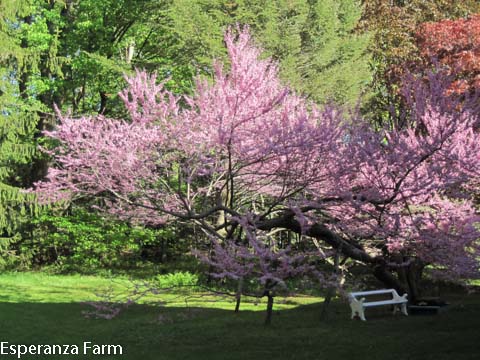
Taken in the last few days, these show the big garden, some tulips in the rose garden, some trillium grandiflorum under the chestnut trees, a bit of path east of the house, and the redbud on the east lawn which is still surviving!

Garlic Mustard Friday, May 17 2013 

Pull away! We went for years without this pest here, and then it exploded. I personally lay the fault partially at the feet of the town: it can be traced to some fill for the road, and then several catastrophic washouts which deposited the road all over the Royal Oak area.* That being said, it would have gotten here anyway. And had I been paying attention, I might have caught it the year before the road washed. Some of you will recall, it was the fast thaw following the winter of all the snow that did it. The hurricanes finished the job.
At any rate, it is here. Victory, however, is possible. I went down to the Calf Pasture and wood road entrance the other day, with the gloomy assumption that I would be spending the day on that section. Amazingly, I found that the last two years have substantially reduced the infestation. The wood road had almost none (five plants); the Calf pasture had perhaps one-sixth the amount that it had last year. Now, I’ll have to get it again later in the summer and next year (a lot of first year seedlings were visible) but that is a far cry from the near 100% cover of the last two years. This gave me the time and the impetus to start in on Royal Oak proper. Maybe in a few years we’ll get it under control. It will never be eradicated, but it might fall under seasonal management as opposed to Oh My God.
As to why…well the Calf Pasture has golden-rod, Wake-Robin, Jack-in-the-Pulpit, Canadian Lily-of-the-Valley, Baneberry, Cranesbill, Hay fern, Cinnamon Fern, Christmas Fern, various bunch grasses, grape, honeysuckle, dogwood, and various others.* All of which are going to do much better if they aren’t being choked by Garlic Mustard, which will eventually kill off most other understory plants. (it is actually capable of stressing mature trees thanks to the chemicals in its roots)
In my opinion, one has a certain responsibility to the land, if not to future generations. That said responsibility carries the dubious joy of seven ticks, wading in poison-ivy, and pulling Garlic Mustard till one’s respiratory system rebels; well, that is a very small price.
*the Royal Oak, Calf Pasture, and wood road entrance are about 6 acres of former pasture, evenly divided between flat and steep with rocks. They are now mostly open, second-growth forest. Several intermittent streams cut through the area, the dirt road is perched above it.
*I wasn’t doing plant ID, just passing observations while pulling.

Nice place to have a cup of coffee… Thursday, May 16 2013 

IMG_0662

IMG_0660

View from the south porch, showing the little kitchen and pergola…now if I could just get the clematis to grow along the top bar rather than curling up in a bunch…

Deciphering old letters Wednesday, May 15 2013 

Reading difficult handwriting is an interesting example of how the mind works. We have a wonderful ability to fill in gaps and decipher unreadable pieces, as long as there is some context. It has some similarity with certain word games, combining Scrabble and Fill-in-the-blank. One rapidly becomes aware of whether or not one has mastered a hand, however, when confronted with a proper name. Context and familiarity can help: if the place name or last name is an expected one, chances are better that it will be deciphered. On the other hand, if it is a place name or last name (those are especially bad) which is entirely unfamiliar, one’s actual ability is quickly revealed. Sometimes, a last name is doomed to obscurity. I have a passage here: ‘we moved Mrs. P????’s piano’ from a letter I am working on. Well, Mrs. P. doesn’t show up again in the letter, and the involved letters ‘i,e,l,b,r’ are blurred. An educated guess can be made: ‘Pollbiers’ but, frankly that doesn’t ‘feel’ right. So, a question mark is left, and one moves on. Maybe, at some point it will be made clear, either by increased familiarity or by a better example. Still it is likely that she will remain as ‘Mrs. P.’ Personally, I have a sneaking suspicion that the difficulty in deciphering odd last names is part of the explanation behind the old style of saying, ‘Mrs. B.’ or ‘Mr. M.’ along, of course, with space and labour saving.

Tulips Tuesday, May 14 2013 

IMG_0451

« Previous PageNext Page »