The right tool for the job Saturday, Apr 19 2014 

makes all the difference.

Shifting the Shasta Daisies in the flagpole garden, which meant hauling out a solid 20 square feet of matted plants, I was happy to have my belief confirmed.  A digging knife, of the heavy duty sort with a wickedly sharp serrated edge on one side and a straight blade on the other, is indispensable for that sort of perennial plant division.  A good digging knife has to be made with nearly the thickness of a shovel, with a full tang, a good handle, and capable of holding an edge; the amount of force one wants to be able to use is considerable.

Shasta daisies form a mat of surface roots about the width of a finger.  Like most roots they have a fair bit of ‘give’ in them, so cutting through them from directly above takes quite a bit of force, even with a sharp shovel. Remember that the ground below them also compresses, enhancing that give.  Now, you can get through them with a shovel; but the amount of force is considerable.  Furthermore, the effective use of the shovel (or even a properly sharpened edger) means morrising about in the garden somewhat.  Not what you want to be doing if the Shastas are encroaching on asters, poppies, and irises that do not want to be damaged.  With the knife however, one can stab through the mat and cut back towards one very effectively, sectioning the mat into pieces.  Then insert the shovel and pry out the section.  Voila.  The other plants are undisturbed, the Shastas are out.  Now….I just have to finish reworking the edges and replant the blessed things…..  The easy part is done.

The knife I use came from Lee Valley and is about as close to indestructible as one can get, highly recommended.


Your photo for the day Friday, Apr 18 2014 

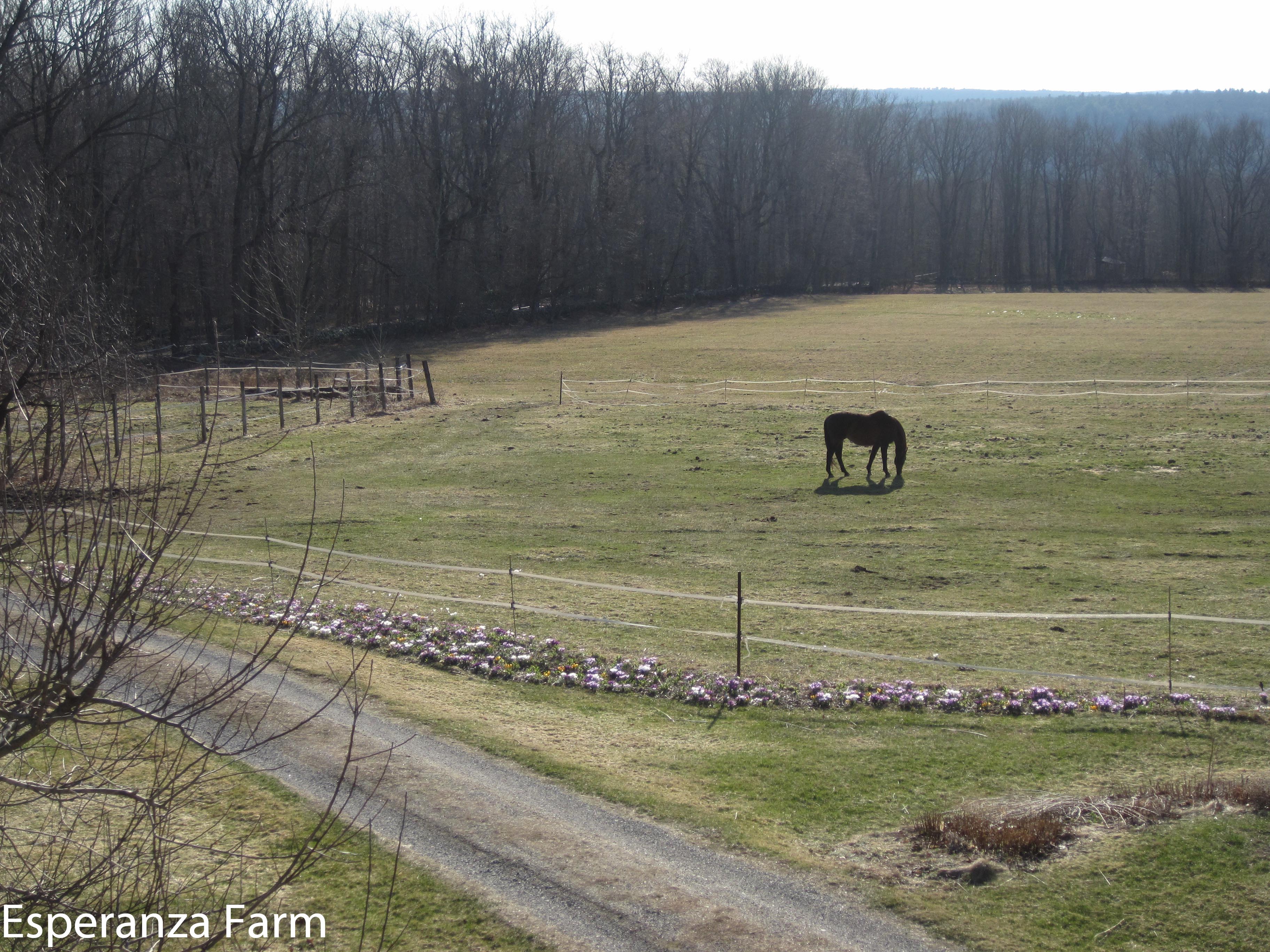
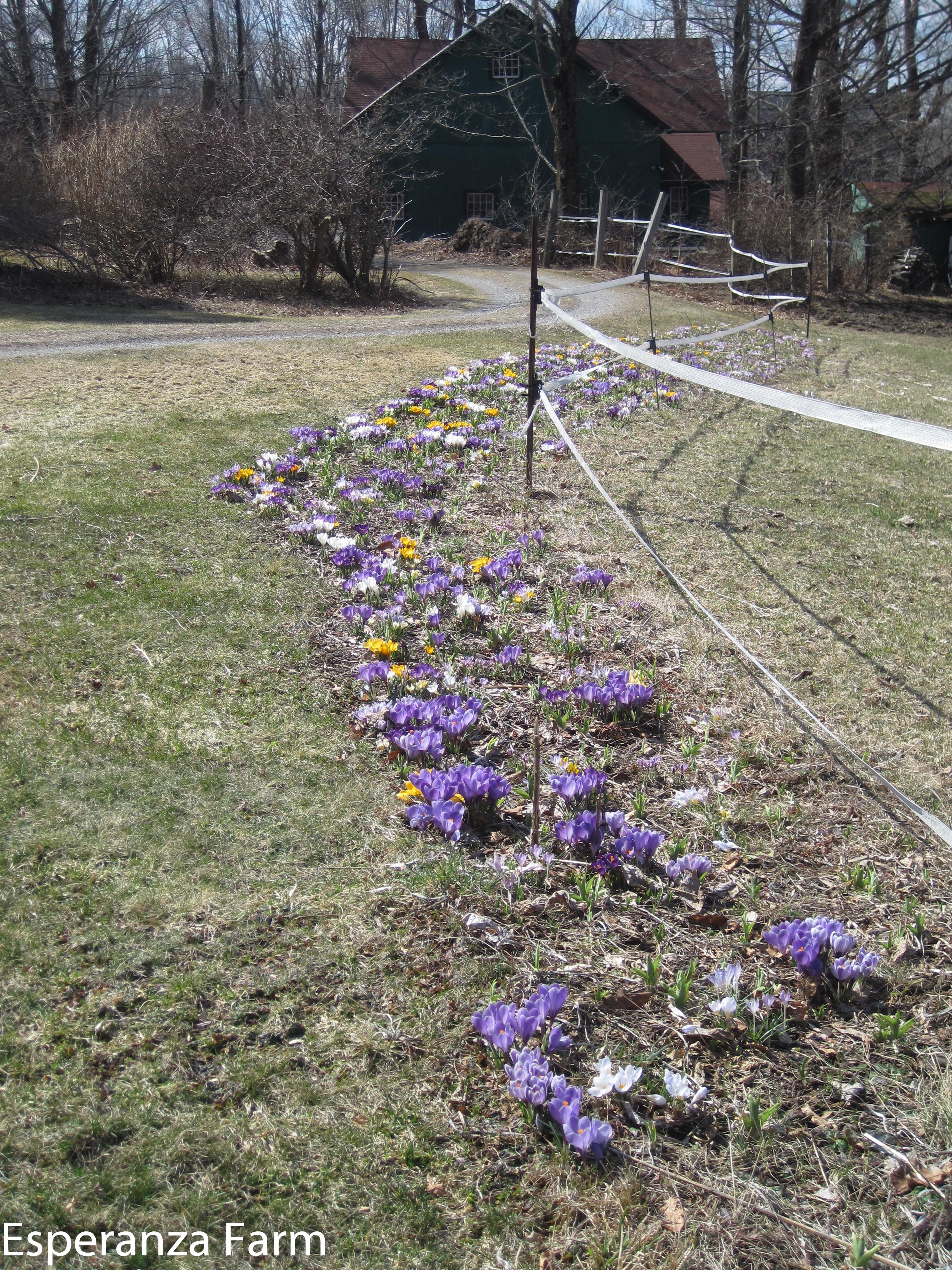
Well two, actually. The old horse and the new crocus fence line.  This was taken seven days ago, the crocus are essentially gone now and the field is bright green.

(p.s., I’m running Opera as a browser, if this page loads oddly or slowly tell me, I don’t know how well it is playing with photos yet)

IMG_2869

IMG_2846

Contemplations Thursday, Apr 17 2014 

It snowed which didn’t do somethings any good at all.  Actually, it was more the very welcome inch and a half of rain that melted the last few crocus and snowdrops and smashed the chionodoxa under the river birch to bits.  I hope that the latter recover a bit and establish themselves, it would be nice to have a pool of bright blue by the drive there.

I suspect by the time it warms up tomorrow, that the meadow will complete its transformation from brown to green.

Elsewhere, the daffodils, scilla (squill), pushkinia*, tulips, hyacinth, and others are all coming along.  Spring bulbs are an international gathering: Siberia, Central Asia, the Black Sea, Spain, Wales, Scotland, England…  Following close behind are the spring ephemerals, the natives of the rich woodlands of the Americas.

Time to plays into it, hyacinths once flourished here in the 1870’s.  No trace of those are left, but they made the local newspaper then.  Maybe someday the hyacinths by the pond will be re-established.  But scilla grew for my grandmother here and the same bulbs still spring up a bright, saturated blue, the Van Sion daffodils were collected by my father at a site that was being bulldozed, the King Alfreds on the bank came out of the woods and surprised us all, the odd mixed daffodils from a school garden planted by my mother.

How can a flower, so fragile, be a link of space, of time, of memory? Is it not a miracle in our everyday lives?


*Similar to the scillas, a delicately striped blue and white, eye catching and unusual. Tough as nails.  For John, it is near Merlin, with love.

Long distance relationship Tuesday, Apr 15 2014 

Julie and Morris had, for most of their marriage, a long distance relationship with the only contact through letters.  It wasn’t always easy.  Here is a passage from a letter in 1857:

“Now here I sit scribbling away against time and to what end, I cannot interest you, I cannot amuse you, I cannot comfort you. I need not advise you, and don’t you think I were as well in bed and asleep?

…You are maybe at church, maybe in Mollie’s room, maybe smoking with Mr. Allen, possibly in your room, perhaps writing to me. At any rate, Dear Morris, if there comes a bright dream of home to you tonight and pleasant looks from home faces, I shall be there, and you will see me.

I put your picture under my pillow the other night in the hope that I might dream of you. But instead I dreamed all night of getting a convict out of a prison dungeon and was horribly afraid of him after all, and so awoke dreadfully fatigued and miserably disappointed. I have had some pleasant dreams of you through this winter. I have seen you, talked with you and have waked with such fresh and real impressions of your presence, that I have gone joyfully all the day long.”

Crocus angustifolius Monday, Apr 14 2014 

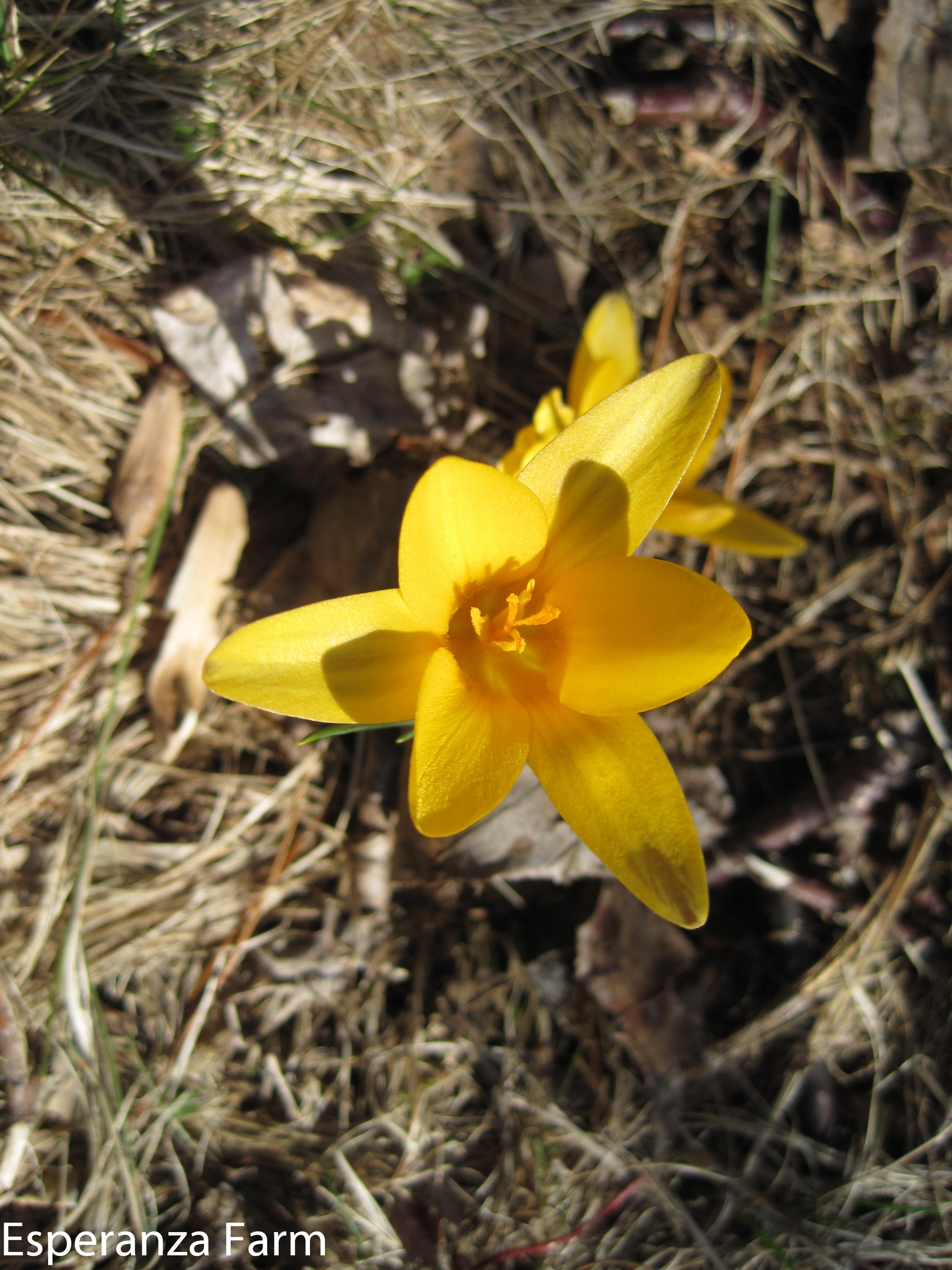
Alright, I’ll admit it. I have officially crossed the line and become a plant nerd.  I have a certain fascination with crocus at the moment.  A definite favorite right now is C. angustifolius (also known as C. susianus), commonly referred to as ‘Cloth of Gold’.  Native to Crimea and the northern Black Sea coast, it favors grasslands that are dry in the summer.  I figured I’d give it a shot in the tall grass of the northwest lawn under the white birches.  It certainly didn’t object to the winter, since either I can’t count or each corm was willing to send up multiple flowers.  It is supposedly fragrant, but I haven’t stuck my nose into a flower to find out.  A bright yellow crocus with a distinct star shape from above, more like some of the species tulips, rather than the classic cup of a Dutch crocus.  It may be more sensitive to sunlight than others (all crocus close at night or on cloudy days) since in my brief observation of a few days it is only completely open on bright mornings (the photos below were taken in a clear, late afternoon and the flowers had already noticeably closed).  It is a brilliant yellow with the outside feathered in what can only be described as royal purple.  Whether it is the name, the color, the shape, or its original location….I am always reminded of classical myths surrounding the Black Sea, primarily of course Jason and the Argonauts, but also other suggestions of a harsh land of great wealth and beauty.

IMG_2906IMG_2909

Spring Sunday, Apr 13 2014 

I think we can safely call winter over…the peepers are finally going hard in Julie’s pond.  They started a few days ago in the pond across the road in East Meadow, but that pond is in nearly full sunlight and is fed by the regular seasonal water table rise.  Today, they have been going consistently all day in Julie’s pond, which is down in the woods and is spring fed.  It is, therefore, significantly colder than any other pond.

There is a wood duck pair down there as well, though I doubt they will nest…too much activity on the road.  The real question is whether I will see any baby salamanders swimming about down there this year.  I did last year, but only by pure chance.

Card Games Saturday, Apr 12 2014 

Circa 1920.  Do note the tea cups, with saucers, and sugar bowls! I am not entirely sure of who the people are; it is possibly Bradford Ellsworth and Juliet Inness.  But that is a guess. Note as well that the house still had the narrow wooden clapboards painted green rather than today’s larger, white asbestos. The change to the perceived size and weight of the house was unfortunate, on the other hand the paint bill is a lot smaller.  If one had unlimited cash….

1920c017002

One for the crow Friday, Apr 11 2014 

or all for the crow….We think that is what went after the newly planted peas anyway.  But, we have more peas we can plant, they didn’t get all of them (probably), and so we will simply have a staggered crop.  It could be worse.  We didn’t Have to have those peas.

Most of the gardening done in the Western world is by choice (farming is different, though arguably still a choice).  I think because it is a choice that the failures can be harder to deal with or at least hard in a different way, and there will be failures.  That may be the hardest part of it.  One does work that is meaningful on a truly fundamental level, work that has embedded within it a great deal of anticipation, of hope, of promise, and has already meant hard labour, time, and likely money.  And then, something entirely outside of your control comes along and destroys it.  But the thing, the really great thing, is that you can plant something else and something will grow.  Maybe not what was originally planned, but something still will grow.

I’ll quit before I wander farther into sloppy metaphors and philosophy.  Still, gardening is good for the soul.  Often because of the beauty it brings, but sometimes in that backhanded fashion called ‘character building’.

Heave ho, it’s off to work Thursday, Apr 10 2014 

We go.  or something.

I finally re-dug the two slope garden beds, I had essentially abandoned them in situ last November after the frost killed the tomatoes and pole beans and the winter squash were collected.  They are now dug and turned down to the clay.  They aren’t weed free of course, but a first pass on bindweed, bedstraw, and witch-grass has been made. There were still a few chunks of frost in there though.  But being on the slope in full sun they dry out very quickly and so were quite workable.   Unlike the main garden, which is flat and therefore still soggy.  New England hilltops: your choice of clay or rock; mud or drought

Now if I can just fix the fences to manage the elderly horse, who has apparently developed a tendency to run blindly back to the barn on the shortest route….which is through that area.  The question is, does one make the fence more solid or does one make the fence very visible but easily breakable.  I’m going to go with the latter.  He isn’t trying to escape or go through the perimeter fence.  And I’d much rather lose vegetables than have a horse tangled in fencing.

But I have to keep the turkeys off of the area, this is best done with netting.  Horse plus netting? Nightmare.  I am thinking it may have to be creatively done.

On sewing machines Tuesday, Apr 8 2014 

From a letter by Morris to Julie, March 1860:

“If you get the sewing machine, get one of Wheeler and Wilson’s, and have Susan (Julie’s maid and general helper) learn how to work it. Dear Julie, though it may be pleasant for you to work on the Sewing Machine, please do not do it very much, as it might make you lame, besides other casualties which I have heard sometimes have come to ladies from the use of the machine. Don’t laugh. I think it will be a good thing and an excellent arrangement for Susan. If she can perfect herself in the use of the machine, she will never come to want and will always have the means of obtaining an excellent living. I trust however, she will never see the necessity of going about for sewing or ever leave the house at 31 Chestnut Street (their home) except when we go to a larger and more pleasant house.”

« Previous PageNext Page »