Forest? Monday, Jan 21 2013 

IMG_9862

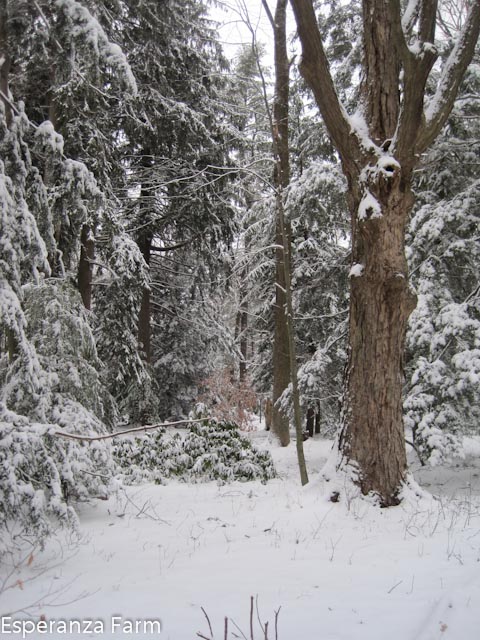
This is a somewhat deceptive photo of perhaps one the most important features of the place.  From its purchase in 1872 Julie began planting trees in front of the house, between it and the then sleepy road.  She added to the already extant group of two Sugar maples and two Norways, with a grouping of Norway spruces, and a line of maples along the road.  By the 1880’s a commentator noted that it was going to become a ‘lovely grove’ in front of the property.  Such natural landscaping, while all the rage in the cities where the first great landscape parks were being created, was unusual in an area dominated by open fields, charcoal wood lots, and the picturesque but rigid lines of sugar maples along hedgerows.  Over the century this grove has gradually been bulked up with more trees.  And more distance.   And, of course, size: many of the trees are between 70 and 90 feet in height. The maple in the foreground was orginally planted on the road edge.  Mercifully, when the state highway was created in the 1930’s, it was moved away from the house.  It is actually visible in this photo, at the center back.  The road, like the house, runs north-south; this photo was taken looking directly northeast.

Today, this area, 500 feet long and between 40 to 100 feet wide, acts and looks like a piece of undisturbed forest.  Over time, some of the native wildflowers have recolonized it: starflower, trillium, canadian lily-of-the-valley, wood aster, princess-pine, etc.  Many of these have had help in first getting established, but are now genuine colonies.  However, it is aggressively managed: both in the removable of undesirable plants and the planting of new trees and shrubs to continue to block the road, to add to the wooded nature, and to ensure that in another century it might still look like a forest.

Rolling the carpet back Saturday, Jan 19 2013 

Planning out some planting on the tennis court section today in the wind.  This is actually a rather important shift; it naturally starts us working on the north line on the meadow, below the house lot proper and west of the tennis court.  It is not that a great deal of work does not still need to happen on the house lot, itself.  But that the completely out-of-control areas are now farther out.

It is a little hard to recall that at one point, not that long ago, walking to the north line on and east of the tennis court was impossible.  That I now know what is growing and where, even if it is still full of poison ivy and briars, is nevertheless something of an accomplishment.  It would revert almost immediately, if we stopped work; and there are still some large trees that (depending on the opinion) perhaps ought not to be there.  But it isn’t ‘overgrown’ in the same way.

Slow but steady!

Photo of the day Friday, Jan 18 2013 

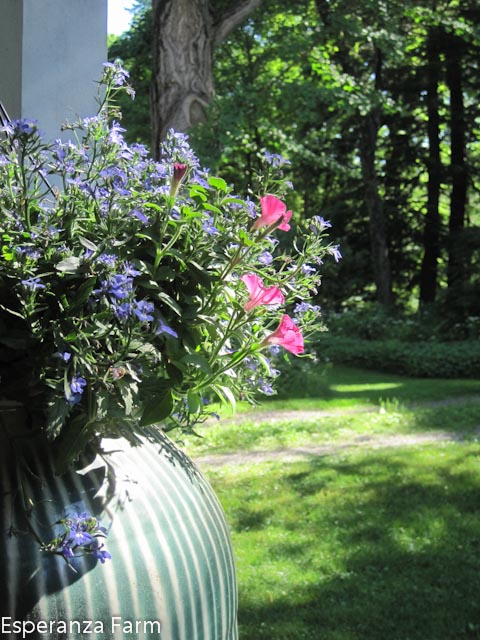
Because, while sunny it is cold out there; so a memory of June.

IMG_7803

Late night snow Thursday, Jan 17 2013 

Yesterday’s little snowstorm was very elegant.  It was nasty wet weather, so its beauty is really only appreciable from the standpoint of being able to retreat to ‘warm and dry’.  But, about four inches of wet snow, sticking to all the trees makes for a lovely picture, especially this morning with the sun peeking out.  The ice on top ensured that it really Stuck.

It was also lovely driving home last night, the hemlocks and pines were great white curtains, arching over the road.  The crescent moon, low in the sky, had broken out of the clouds.  And while the landscape was a pale, white-blue; it was a sharp, shining gold arc in an ink black sky.

We interrupt our regular programming Tuesday, Jan 15 2013 

to note that the majority of citizens involved in a small town’s: commissions, church choirs, historical societies, library boards, and other subversive organizations will be considered felons and fugitives from justice if they live in the state of New York in a year and a day and if they have not, by that date, surrendered their property without proper recompense in accordance with an ex post facto law that contravenes the spirit if not the wording of the Constitution.

That is all. We now return to our regular programming.  Following the fine example of the New York state legislature comments concerning this post will neither be discussed nor answered.

Sightlines Tuesday, Jan 15 2013 

Continuing to work on clearing burning bush from the western edge of the tennis court.  Over time, this had filled in the bank (which ranges from almost three feet at the south corner to only a few inches at the north corner) it had also filled in the area between the bank and the fence line.  The end result was a non descript, fuzzy line.  The view was there, but it lacked a good framework.  Now, if one stands at the garden house, looking west, you still look across the tennis court/pine grove at the distant hills.  But suddenly one notices that the view is framed by a v.  The point is a big maple, just east of the tennis court (its long axis is N-S), the ends are two big, multi-trunked pines and two red maples.  Those trees have always been there, but you see them now as sharp silhouettes.  Much better.

Editing, as one gardener said, taking out that which is not needed.

Thwack! Monday, Jan 14 2013 

It being a pleasant day (if unseasonably warm, we Do Not need another spring drought, but I bet we get one) and the ‘real’ world being its charming self; I spent several hours outside doing actual work.

The west edge of the tennis court* has been sadly neglected and was going to burning bush.  I would like the edge to eventually be strategically located clumps of blueberry,chokeberry, steeplebush, shadblow and others interspersed with native bunch grasses and flowers.*  Step one is the removal of the burning bush.  I have begun this process, very satisfying.  Although I want to retain a few burning bushes on the property, I am rather of the mood that it Does Not need to be there; sitting here thinking on it, I just might get rid of all of it tomorrow.  Except for the SW corner clump on the tennis court proper (not the stuff on the west bank), that has an actual reason for existence.

Cutting things down is almost as fun as planting them…

*I dare you to play tennis on it.  A raised court made of sand/clay it is incredibly well draining (unlike the clay till soil of the rest of the property); starting in the 1930’s it was let to grass; it is now a pine grove with a few Norway maples, oaks, ashes and hemlocks.  (and Lots of poison ivy) Nature triumphs!

*whatever wants to grow, Pagoda Dogwood (cornus alterneafolia) is a happy volunteer, I hope to get some sweet fern going, black cherry and aspen really want to populate the area as well but as trees are not quite what I want.

Busy world out there Sunday, Jan 13 2013 

I was poking about in the woods yesterday, looking at a property line, and noting who else had been out there.  Snow is very, very useful for that sort of long-term observation.  As it has been warm, the prints were a bit hard to decipher but: deer, coyote, domestic dog, fox, domestic cat, bear, squirrel, turkey, possible grouse, mystery critter, and mice.  Everybody uses the same routes, which can make it a bit hard to figure out, especially the dog/fox/cat group if they are at all melted are overlaid.  I suspect there is a dog as well as a coyote, simply because there was a single, big canine coming into the area on a very different route than all the other tracks.  I can’t tell them apart except when there is, as this time, a notable size difference.  And, of course, some of those tracks might be bobcat tracks; I did see one this year in that area, so it is possible.

As for our mystery critter: not the right shape for a dog, (nor the right behaviour unless dogs can climb trees), bigger than a domestic cat, wide splayed toes but not shaped like the possum/coon/skunk types, and Claws.  Take a bird’s toes and attach them to a cat paw, and you’d have it. 

My favorite track this winter was in light, powdery snow; it was where some bird of prey, probably an owl, had struck at a mouse in the snow.  It had missed, but there was a perfect imprint of the tail, and wing tips, with another set of wing tip marks as it took back off again.

Rug Repair Saturday, Jan 12 2013 

Slowly and patiently.  Repairing an oriental rug so badly damaged, and of relatively little value, is perhaps a ridiculous thing to be doing.  Every few weeks I get around to doing a fair piece of it; for awhile I was bogged down in fiddling with an interior section, but right now I am recreating (essentially free-hand) an entire end with three sections of patterning.  It is a thought provoking experience.  I don’t think that we do enough work with our hands these days; it is so easy to simply go buy a new rug and done.  The material object is devoid of any meaning, the process is devoid of meaning  I’m not saying that we shouldn’t sometimes just buy a new one, and certainly being able to simply run out to the store is an awesome choice.  But I am not sure that time spent hand-making something is necessarily lost time.  This rug, I know the physical value of it as opposed to simply the monetary price tag.  As I work on it I have plenty of time to think, but you can’t be angry or tense.  It isn’t nearly as bad as working with animals, but if you’re tense than the thread tension is wrong and that won’t do.   Most people could do with that sort of hand work…

Being a perfectionist and working by hand does slow one down a bit.  If three inches have to come back out because you didn’t get it quite right, then three inches have to come back out.  There’s no compromise on getting it right, either it is or it isn’t.  Right doesn’t have to equate to perfect, because ‘perfect’ in this case would be ‘new’.  Right this instance not only includes the stitching, the colors, the tension, and all that, but also the age, previous repairs acknowledged and either removed or worked with, usually both.

Proper Ladies Thursday, Jan 10 2013 

For certain readers from certain areas that may or may not start with ‘C’ this may or may not offend.

IMG_9469

Julie was nothing if not independent; making her own way as an author, she was nonetheless highly aware of the correct societal norms, especially as they concerned her daughters. She insisted that they learn the proper skills and manners to succeed in society; her letters are full of remarks and corrections, even when her daughters were adults, and give us a great deal of insight. One of the more disconcerting aspects of examining the upper middle-class, well-educated, women of the late nineteenth century is just how accomplished, independent, and frankly formidable so many of them were…several generations before women’s lib (but I won’t go there). They may not have occupied the upper echelons of business and they may not have been able to vote, but they were neither dim nor silent.*

Some attributes of a proper lady, judging by what Julie encouraged in her daughters: they were comfortable travelling alone throughout the US and with appropriate escorts in Europe, they were well-read, multilingual (Latin, French, and German at least), they could manage the household, ride a horse, drive a horse, make clothing, do fine embroidery, read music, hold up their end of a conversation, garden, could draw passibly and had elegant handwriting, and could shoot.

It is that last thing, of course, that in the current climate will no doubt appall some of my readers. Yet, Helen carried a handgun much of the time and needed it once to fend off a robbery on the road to Hartford, Lucy in the next generation generally had a handgun in her purse, and if I recall correctly Helen Adelaide once backed her husband up with rifle in hand in the tense hours of negotiating a potential agricultural strike.

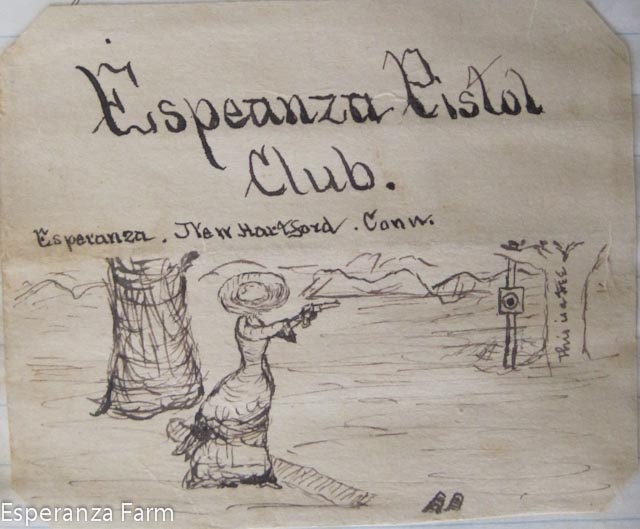
Aside from being used on a farm as varmint control and for hunting (the former generally only the men, the latter sometimes by women as well), guns were regarded as potentially useful tools that a proper young lady should know how to use if needed. They were tools that ensured their independence and relative safety and were absolutely nothing unusual that merited concern. They were also fun tools, as the sketch from the guest book from the summer of 1877 shows. The woman in question was Helen Yale Smith Ellsworth.

We know that the guns owned were designed to be carried in a purse or pocket. Given that, given the independent nature of the people in question, and given that there was no particular desire to collect guns; the only reasonable inference that I can draw is that the women of that generation felt that having the ability to carry gave them a level of defense that their mothers and grandmothers lacked. It wasn’t paranoia or politics, I very much doubt either Helen or Lucy were given to such; it was simply part of being a capable woman. Despite its enduring popularity in the novels of that day and today, ‘damsel in distress’ was not approved practice.

I’m happy to report that the ability to use tools continues today.

*Obviously, there were some dim bulbs, there always are.
*By well read think Memorizing the English Canon from Shakespeare on.

« Previous PageNext Page »