of the West Meadow on the second cutting. Actually taken a week ago, the trees have really started to turn now.

Comments Off on Obligatory photo
Landscapes and Modern Photos connecticut, photography 21:52
of the West Meadow on the second cutting. Actually taken a week ago, the trees have really started to turn now.
Comments Off on Obligatory photo
Landscapes weather 11:42
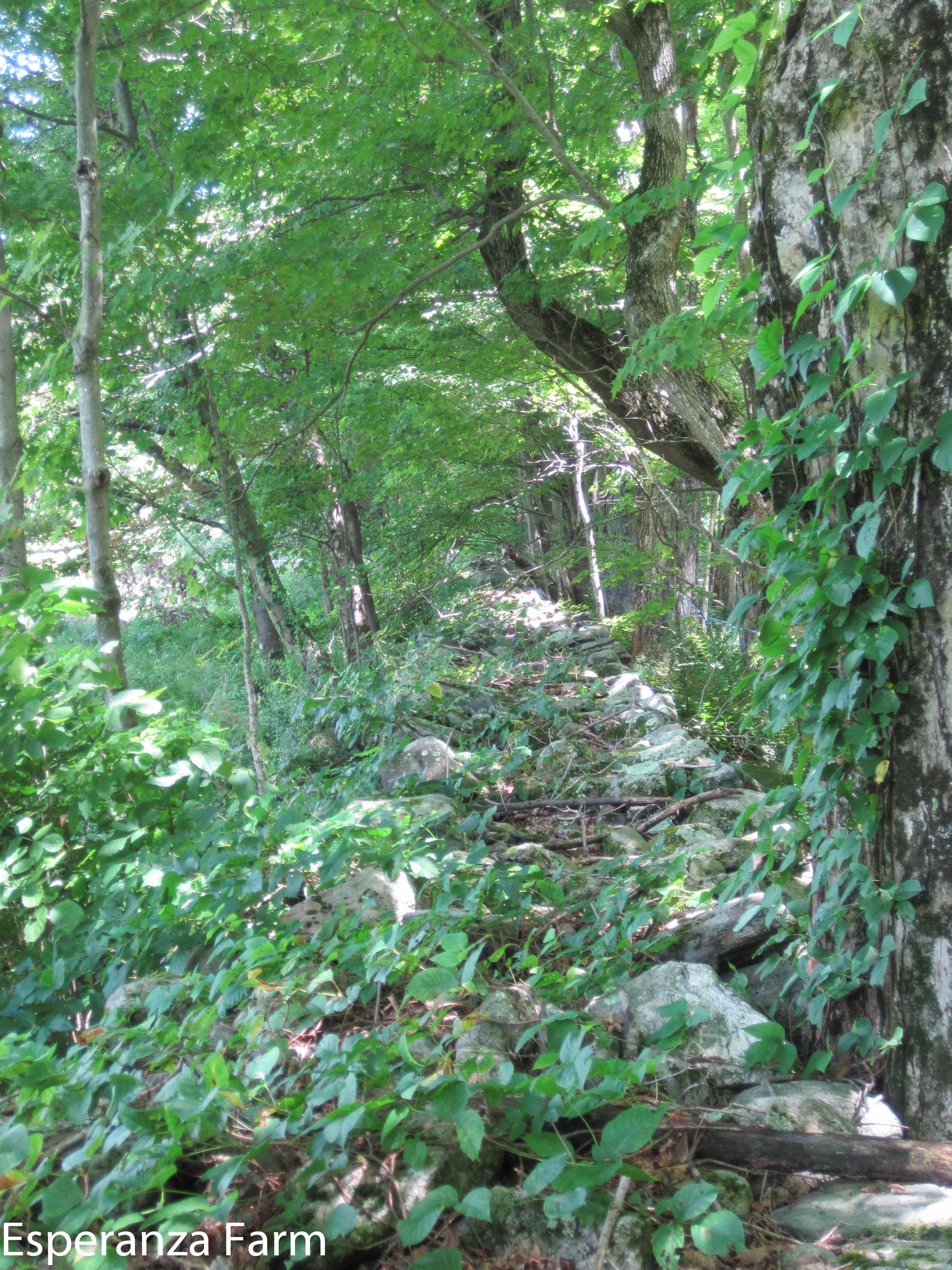
I was looking at the hay-field hedgerows the other day, eyeing the work that needs to be done, now that the hay is finished for the year.
As I got to the bottom hedgerow I noticed something a bit odd…large amounts of skinned wood and bark scattered here and there, with splinters hung up in the trees and scattered out in the field. Look a bit harder. Sure enough, the tallest ash (about 16 inches in diameter and fifty plus feet in height) in the hedgerow was most assuredly damaged. A direct lightning strike had blown off the entire quarter-side of it, for all the world like someone had split a single long rail starting about forty feet up and running to the ground. The largest ‘splinters’ were about 12 feet long and up to seventy feet away. One that stabbed itself into the field* actually bent from the impact, no easy thing to do to a chunk of ash several inches thick. They are also bone dry. I can see where inspiration for a split rail came from! For that matter where the myths of Paul Bunyan came from.
*a late season hay-field around here has a little more given than concrete, but not much.
Landscapes gardening 20:24
Now is the time to mow, or cut, or trim. At least for things like re-sprouted barberry and burning bush. It is too late in the year for them to regenerate successfully, but too early for them to have gone dormant. Unlike many of the native plants, which have realized it is fall; and, if cut now, would simply wait for spring quite happily. The barberry will re-sprout next year; but by cutting it right now, it has essentially lost an entire year.
So, despite the poison ivy still being exceedingly green, I spent a good bit of the afternoon clearing around the sugar maple sap line* along the lane and along a neighbour’s boundary line. I have some orphan arborvitae, originally destined for the highway, that may go along that neighbor’s line. It is not a problem, yet, but it might be in a decade or so; better to plant it now and have the privacy screening in place. As for the highway, well! It can’t get much worse!
*This is called being a good steward…my trees, my land, his lines. Would he be unhappy if I didn’t cut the barberry? No. Does it make his life easier? Yes. Is it, in the long run, also good for the land? Yes. Prior to that line being there we were essentially ignoring it. Now, I have selected some young maples for the next generation, the invasive shrubs are under control, and we are beginning to see some regrowth of wider variety of shrubs/grasses/flowers. There is no financial gain for us, except for a few gallons of free maple syrup. (and I doubt he makes much extra cash) But the land benefits.
gardening and Landscapes 14:06
The right tool for the right job and all that…
Probably one of the most useful tools, in fact an indispensable tool, for how we are maintaining much of the house lot: i.e. moderately open mature woods with certain types of underbrush/ground cover, is our trimmer.
Our landscape is actually not in equilibrium, it is always trying to fill in with brush and saplings. Because we do not have a particularly severe deer problem here (thank you, George!) and I don’t think the fire department would approve of an annual burn (the other way to have an open understory) it has to be cut. But because we don’t want an entirely open understory, but rather one filled with certain plants only, it is a matter of selective editing. I cut the area once a year, at the most, and have to go around volunteers we want to encourage, cut the innumerable Norway maple seedlings, excess goldenrod, briar, wood aster (in the right place I want them, but not every where), etc. I need a tool, in other words, that can go through something an inch plus in diameter without slowingg, but has the accuracy to come within centimeters of a baby holly, dogwood, or viburnum. It is over five acres, so doing it by hand…not happening! I do it in the fall because the spring plants/ferns can tolerated being walked all over at this point. If I squish some aster or goldernrod it isn’t a problem. If I do it too late though, all the leaves are off the babies and I can’t tell a Norway maple from a Sugar maple from an oak.
The answer is a Stihl FS130 professional trimmer, with the brush knife essentially permanently attached. The brush knife is the rather nasty thing that resembles an oversize three pointed star. (The whippy little string head is a useless gadget as far as I am concerned).
(yes, I am pretty good at the memory game, I know where almost all the babies are!)
Comments Off on Considering Tools
Landscapes 22:15
I like the dark. I like it especially when I know the territory, as it might be these woods. There is, of course, always an awareness of the firmly reined-in fear, panic in the old sense of the old god Pan, that something is out there. Perhaps that control is part of why I like it. There is a stillness, a waiting quality to the night. It helps, of course, to be confident that there is nothing natural to fear. The horse will alert to a bear before I need to react to it. And frankly, there are no people who know these woods as well as I. And those that can move in them more confidently, in the dark, than myself? Well a) life isn’t a movie; and b) I wouldn’t have a chance wherever or whenever.
In any case, watching the woods, or a house, in the dark* brings new dimension to a landscape. Certain trees have a whole new aspect, perhaps a density that sets them apart in a way that was not apparent in the daylight or a branch which catches the eye. The long grass is a dappled shade, whereas the mown lawn is a neat surface of hard lined light and dark. The goldenrod is a heavy scent in the air, the crickets are almost too loud, the rustling of a sleeping bird on the branches, the horse eating in the field. There are no mosquitoes late in the night.
*semi-dark, in this a lot of light provided by the house. Moon light works equally well. Pitch dark is rare, unfortunately.
gardening and Landscapes and Modern Photos gardening, photography, trees 22:25

Comments Off on Light and Shadow
Esperanza and Landscapes and Modern Photos landscapes, photography 10:02
Esperanza and gardening and Landscapes and Modern Photos gardening, vegetable gardening 10:31

That is the peach tree with the lettuce box in center of the photo. Our chimney swift colony lives in the chimney which is in the center, a good location for them!
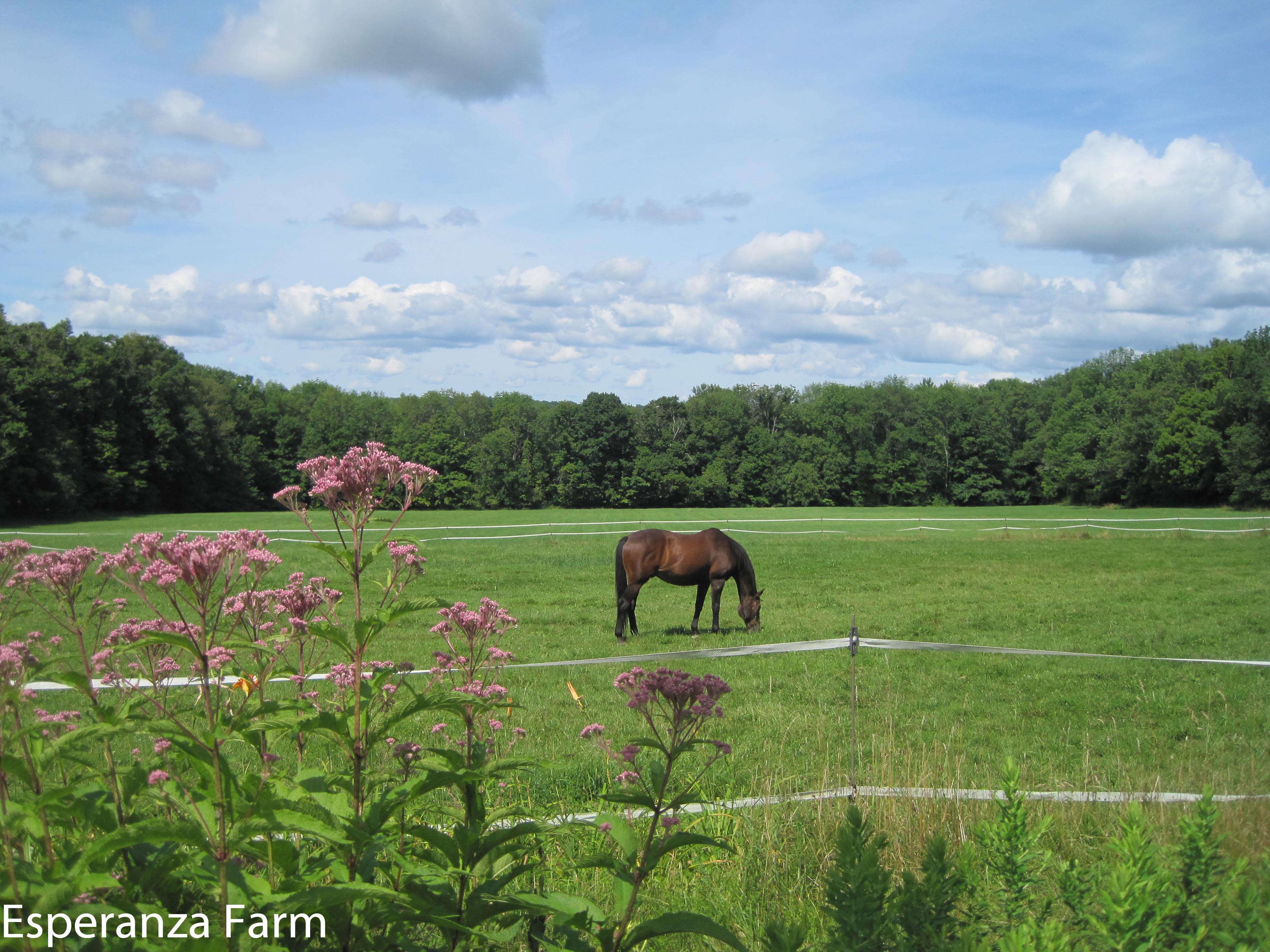
Landscapes and Modern Photos connecticut, horses, photography 10:24
Landscapes and Modern Photos photography, scarlet oak 15:05

At twilight after a thunderstorm. The tree in the foreground is a volunteer scarlet oak.
Comments Off on Connecticut Summer Sky
 Acair Fearann