Because this: (January)

Or this: (February)
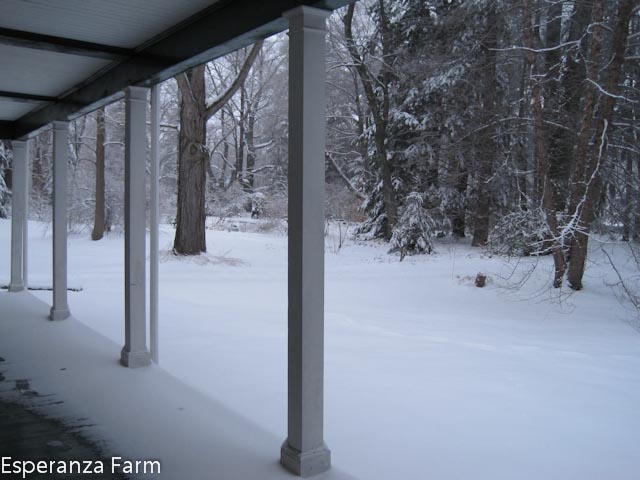
Will eventually turn into this: (April/May)
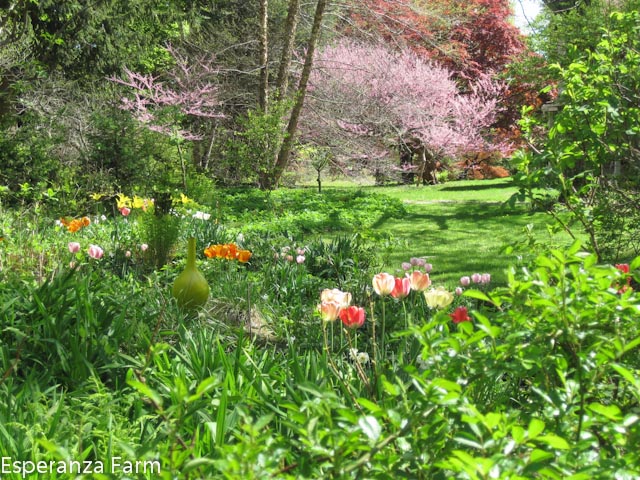
(if you’re lost, note the three-stemmed river birch in all the photos: right side in the first two, center on the last)
gardening and Modern Photos gardening, photography 15:05
Because this: (January)
Or this: (February)
Will eventually turn into this: (April/May)
(if you’re lost, note the three-stemmed river birch in all the photos: right side in the first two, center on the last)
Considering the seed packets that arrived in the mail today, mostly vegetable seeds, I was struck by the miracle, the everyday miracle, that is gardening. It is a triumph of nature: taking this tiny seed and creating a plant that may produce many pounds of produce in a few short months. It is also a triumph of the modern world. How rich we are, that we can order seeds from half a continent away, every spring, and the choices are endless. I can grow any vegetable that I want, from any continent, from any culture. Some may take more work than others; some may be harder to find, but I can. If I want an heirloom tomato similar to the original pre-Columbian, or an Italian, or a Ukrianian, or perhaps a modern genetically engineered hybrid? All possible. And next year, something different.
Whatever one’s take on gardening; that really is amazing.
gardening and Modern Photos gardening, photography 14:08

Unknown Amaryllis, possibly ‘Red Lion’. Further research: it is ‘Peacock’.
Comments Off on Indoor Gardening
gardening 15:44
Poking their noses up. It actually is remarkable how tough some plants are. Spring bulbs, which only have a few optimal months to grow, flower, set seed, and store energy, have to balance too late with too cold. Some daffodils, crocus, and snowdrops have thought about starting up, especially in areas with strong south exposure. They are currently very chilly indeed. And very solidly frozen. Still, even in the middle of winter there are signs of spring.
Comments Off on Confused plants
‘Tis the time! The vegetable garden has quite quickly become remarkably useful. It is actually a bit too small,* the winter squash have been relegated to the old slope paddock, no longer used for horses, where they are much happier. The squash, that is; they are designed to sprawl amongst tall field grasses and the bugs don’t seem to find them.
The variety of seed out there is rather amazing. But, I most confess, that when part of the aim is to fill a small freezer, there is a certain tendency to prefer the tried and true classics. Thankfully, the seed companies have sort of caught on to this. The old, keeping varieties are popping back up again, in and amongst the exotics.
Certain things won’t grow here without excessive coddling: sweet potatoes and eggplants chief among them. Also, mysteriously, cucumbers…despite the fact that our neighbor routinely has plenty. On the other hand, the good New England classics are quite happy: peas, beans, carrots, beets, kale, squash, chard, parsnips, spring lettuce. Peppers and tomatoes if started right… There is a reason for local cuisine.
*I can see it from Google though (Google sees everything), we have a slight wiggle in the western bed.
Comments Off on Garden seeds
Still a bit chilly. The good thing, a very good thing, is that this is just the sort of cold spell that helps to check nasty bugs like wooly adelgid on hemlocks. It will still be here, of course, but every year one can keep ahead of it…!
I am rather glad that there is just a touch of snow on the ground at least; it helps to protect the plants from complete desiccation. The rhododendrons don’t look terribly happy, but they’ll manage.
In other gardening news, various persnickety seeds ought to be contemplated fairly soon. You really have to wonder how some of these plants ever grow on their own…freeze it, boil it, soak it, wack it, forget it, what did the poor seed ever do?
Comments Off on Brr
Continuing to work on clearing burning bush from the western edge of the tennis court. Over time, this had filled in the bank (which ranges from almost three feet at the south corner to only a few inches at the north corner) it had also filled in the area between the bank and the fence line. The end result was a non descript, fuzzy line. The view was there, but it lacked a good framework. Now, if one stands at the garden house, looking west, you still look across the tennis court/pine grove at the distant hills. But suddenly one notices that the view is framed by a v. The point is a big maple, just east of the tennis court (its long axis is N-S), the ends are two big, multi-trunked pines and two red maples. Those trees have always been there, but you see them now as sharp silhouettes. Much better.
Editing, as one gardener said, taking out that which is not needed.
Comments Off on Sightlines
gardening and Modern Photos gardening, photography 11:23
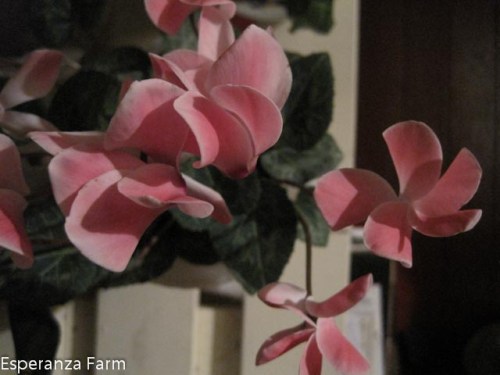
Indoor gardening, a bog-standard cyclamen from above:
Comments Off on Whirly gig
One can get trapped in the details; but the ‘fix it now’ policy when gardening or doing maintenance is always a good one. Not to be confused with the ‘rush around madly without setting up’ approach, however. There is always time to get the right tools.
This thought wandered through my brain yesterday when I was busy removing the last of the hemlock trunk, rolling it over to the road fence for a bit more sound dampening.* I noted that one of the young corner spruces looked wrong: the last two feet of its leader was bare with an odd little top knot. On closer inspection, a beech branch had grown long enough during the summer to interfere. It had yet to damage next year’s buds too badly, but was on its way. The damage was several months in the making, but wasn’t visible until the leaves were off. The obvious solution was to walk back to the house, get the pole saw, go back out and trim the beech properly so as to avoid the issue for another two or three years. A matter of five minutes solved what might otherwise lead to the injury and resulting deformity of the tree. Ten minutes of pruning reduced other interference with a shadblow and the surrounding trees. Its easier to prune when they are small…
*Does it actually work, I don’t know; does it pyschologically appear to? yes.
Comments Off on It’s the little things
Fog and mud…not exactly what one has in mind for December; although highly appropriate for lowland Scotland….which this isn’t.
Still, I can’t mind. What will no doubt be only one of my planting projects for next year showed up finally; a collection of slightly unhappy (thanks to the delivery service) bare root trees. They are settled in for the winter in the vegetable garden, and this sort of warm, wet weather is just what they needed. Several experiments in the lot. I may be pushing the zone and microclimate with a Sweetbay Magnolia, but it would be nice to have and an ideal replacement for an overgrown Burning Bush.* Two Carolina Silverbells, which contrary to name should grow this far north in cultivation, also replacing some Burning Bush. Two Downy Serviceberries, location TBA but likely replacing…you guessed it: Burning Bush; I believe that they are the type that we had at the other house: a lovely tree that made a delicate lace cloud of hanging clusters of ivory blossoms followed by purple-red berries beloved of the birds. A crabapple, precise location TBA, also hopefully of a type that the birds appreciated.
*I am of two minds on Burning Bush…it can be structurally elegant when properly trimmed, the fall colour (whether pale salmon or crimson is spectacular), my grandmother loved it, the animals do use it….But, the stuff is wickedly invasive and entirely too common in the landscape here. It is also a labour intensive shrub needing yearly major pruning to look its best, and even then presents a rather coarse and boring outline. It Only looks good or dramatic at least (not the same thing!) for a week or two in the fall, the rest of the time it is just a big shrub. There are a few that will be kept, here and there, but they are gradually getting replaced.
Comments Off on Mud Season
 Acair Fearann