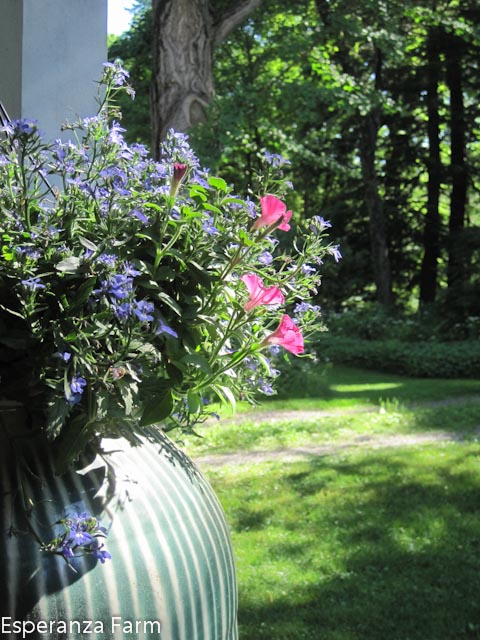
Because, while sunny it is cold out there; so a memory of June.
Comments Off on Photo of the day
Uncategorized gardening, photography 12:25
Because, while sunny it is cold out there; so a memory of June.
Comments Off on Photo of the day
Continuing to work on clearing burning bush from the western edge of the tennis court. Over time, this had filled in the bank (which ranges from almost three feet at the south corner to only a few inches at the north corner) it had also filled in the area between the bank and the fence line. The end result was a non descript, fuzzy line. The view was there, but it lacked a good framework. Now, if one stands at the garden house, looking west, you still look across the tennis court/pine grove at the distant hills. But suddenly one notices that the view is framed by a v. The point is a big maple, just east of the tennis court (its long axis is N-S), the ends are two big, multi-trunked pines and two red maples. Those trees have always been there, but you see them now as sharp silhouettes. Much better.
Editing, as one gardener said, taking out that which is not needed.
Comments Off on Sightlines
It being a pleasant day (if unseasonably warm, we Do Not need another spring drought, but I bet we get one) and the ‘real’ world being its charming self; I spent several hours outside doing actual work.
The west edge of the tennis court* has been sadly neglected and was going to burning bush. I would like the edge to eventually be strategically located clumps of blueberry,chokeberry, steeplebush, shadblow and others interspersed with native bunch grasses and flowers.* Step one is the removal of the burning bush. I have begun this process, very satisfying. Although I want to retain a few burning bushes on the property, I am rather of the mood that it Does Not need to be there; sitting here thinking on it, I just might get rid of all of it tomorrow. Except for the SW corner clump on the tennis court proper (not the stuff on the west bank), that has an actual reason for existence.
Cutting things down is almost as fun as planting them…
*I dare you to play tennis on it. A raised court made of sand/clay it is incredibly well draining (unlike the clay till soil of the rest of the property); starting in the 1930’s it was let to grass; it is now a pine grove with a few Norway maples, oaks, ashes and hemlocks. (and Lots of poison ivy) Nature triumphs!
*whatever wants to grow, Pagoda Dogwood (cornus alterneafolia) is a happy volunteer, I hope to get some sweet fern going, black cherry and aspen really want to populate the area as well but as trees are not quite what I want.
Comments Off on Thwack!
gardening and Modern Photos gardening, photography 11:23
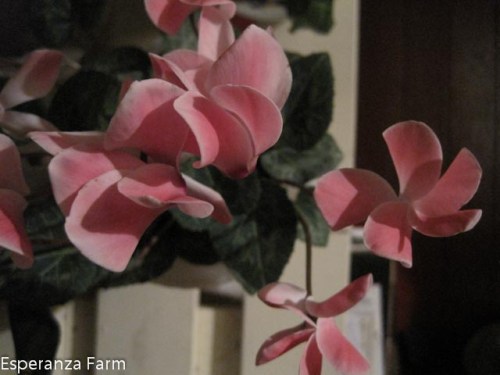
Indoor gardening, a bog-standard cyclamen from above:
Comments Off on Whirly gig
One can get trapped in the details; but the ‘fix it now’ policy when gardening or doing maintenance is always a good one. Not to be confused with the ‘rush around madly without setting up’ approach, however. There is always time to get the right tools.
This thought wandered through my brain yesterday when I was busy removing the last of the hemlock trunk, rolling it over to the road fence for a bit more sound dampening.* I noted that one of the young corner spruces looked wrong: the last two feet of its leader was bare with an odd little top knot. On closer inspection, a beech branch had grown long enough during the summer to interfere. It had yet to damage next year’s buds too badly, but was on its way. The damage was several months in the making, but wasn’t visible until the leaves were off. The obvious solution was to walk back to the house, get the pole saw, go back out and trim the beech properly so as to avoid the issue for another two or three years. A matter of five minutes solved what might otherwise lead to the injury and resulting deformity of the tree. Ten minutes of pruning reduced other interference with a shadblow and the surrounding trees. Its easier to prune when they are small…
*Does it actually work, I don’t know; does it pyschologically appear to? yes.
Comments Off on It’s the little things
Fog and mud…not exactly what one has in mind for December; although highly appropriate for lowland Scotland….which this isn’t.
Still, I can’t mind. What will no doubt be only one of my planting projects for next year showed up finally; a collection of slightly unhappy (thanks to the delivery service) bare root trees. They are settled in for the winter in the vegetable garden, and this sort of warm, wet weather is just what they needed. Several experiments in the lot. I may be pushing the zone and microclimate with a Sweetbay Magnolia, but it would be nice to have and an ideal replacement for an overgrown Burning Bush.* Two Carolina Silverbells, which contrary to name should grow this far north in cultivation, also replacing some Burning Bush. Two Downy Serviceberries, location TBA but likely replacing…you guessed it: Burning Bush; I believe that they are the type that we had at the other house: a lovely tree that made a delicate lace cloud of hanging clusters of ivory blossoms followed by purple-red berries beloved of the birds. A crabapple, precise location TBA, also hopefully of a type that the birds appreciated.
*I am of two minds on Burning Bush…it can be structurally elegant when properly trimmed, the fall colour (whether pale salmon or crimson is spectacular), my grandmother loved it, the animals do use it….But, the stuff is wickedly invasive and entirely too common in the landscape here. It is also a labour intensive shrub needing yearly major pruning to look its best, and even then presents a rather coarse and boring outline. It Only looks good or dramatic at least (not the same thing!) for a week or two in the fall, the rest of the time it is just a big shrub. There are a few that will be kept, here and there, but they are gradually getting replaced.
Comments Off on Mud Season
Esperanza and gardening gardening, history 11:07
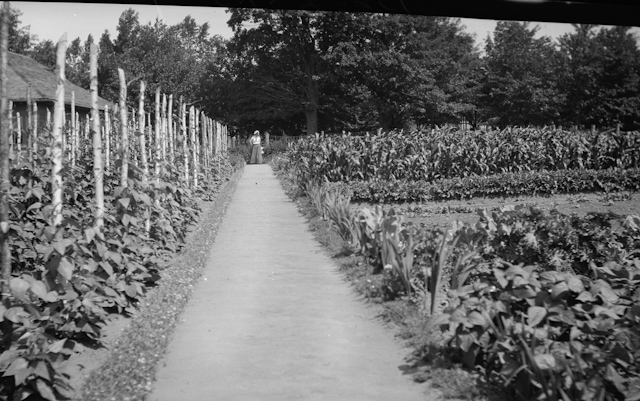
Esperanza is still sometimes for some purposes called Esperanza Farm. The relationship between the house and the farm is a complicated one, leading deep into women’s history, the rise of scientific agriculture, and economics. I won’t get into it here. Suffice it that the cottage, long sold and now a winery, produced sufficient vegetables, dairy products, meat, and cut flowers to support Esperanza, its dependencies, and sometimes enough to sell. Obviously, it did not have to support the family through the winter; although it did add to households of the various caretakers, we know late season vegetables were part of the wages so to speak. The dairy products were sold during the winter.
Here is a picture of the edge of the cottage garden taken in 1909: corn, pole/bush beans, lettuce, and gladioli are all visible.
Comments Off on Cottage gardens
gardening and Modern Photos and Uncategorized gardening, photography 09:13
One could take the winter off….well no. Anyway, houseplants in this house face some rather serious obstacles. Most of the house is actually quite dark, a majority of the rooms can easily sink to 55 at night in the winter*, and the major issue that pretty much all the furniture Must Not get water on it. Obstacles. Nonetheless, to the running bemusement, if not horror of the other inhabitants, the houseplants are conquering territory. They started in the kitchen, a warm, sunny nook, with one elderly and happy Christmas cactus in an upstairs room since sometime back in the 1960’s. They now have a commanding advantage in: the kitchen, the dining room, the basement (three spots), and three rooms upstairs. And horrors, just invaded the library.
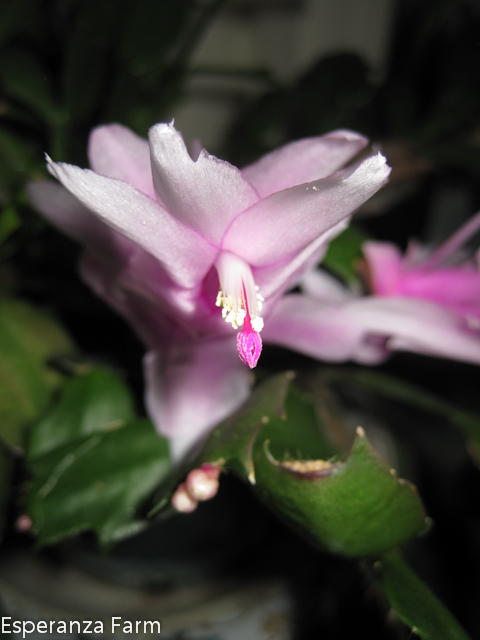
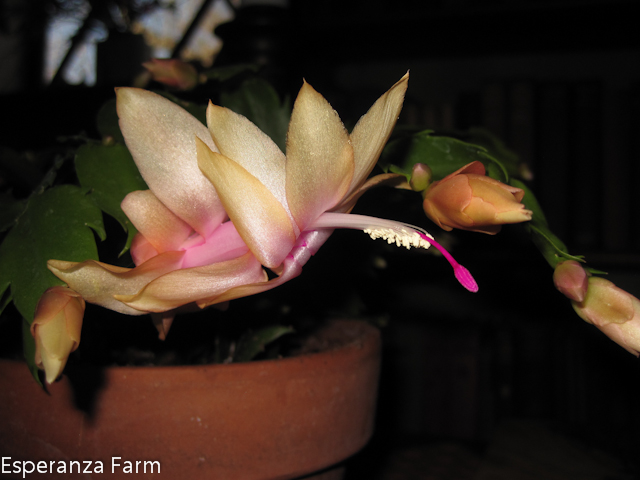
Here are two invaders of the library. I like Christmas cactus, I can’t kill them, they like temperatures in the low 60’s down into the 50’s, the bloom every single year without fuss, they don’t need pruning, and so forth. Of course, the don’t want to bloom at Christmas, but hey.
A yellow one:
And a pink one
*The record is 38, but that was set with a loose storm window in that room; the usual winter low is 47. Heavens knows what it was before the storm windows.
Comments Off on Indoor gardening
Uncategorized birding, gardening 22:43
Spring migration is always seen as a big thing, spotting the first robin or bluebird is a harbinger of hope. However, fall’s migration tends to be equally noticeable. The juncos appear by the dozen, as does a wintering flock of chickadees.* And sometime between October and December, the robin flock descends on the property. We must have a pretty popular stop-over place for them; because they will hang out in the area for some time; usually twenty or thirty in a group. A few stalwarts will hang late into winter if it doesn’t snow. It took me awhile to figure it out, the mystery of the vanishing ilex berries, a much favoured snack for robins. The roadside bush is always the last to go, despite it having an abundant crop; I suspect because it is right next to the road, whereas the others are tucked into the woods a bit.
Today, I nearly collected a group of robins as I turned into the drive. They all flew up into the trees, as if a sudden swirl of red and brown leaves had chosen to return to the sky.
*Unlike the titmice, the chickadees do not hang about in the summer nor does the cardinal, though he/she nests here.
Comments Off on The Robins of Fall
Esperanza is nothing if not complex, both inside and outside. The house’s architecture is baffling, the contents both diverse and vast, and the grounds quite full of plants and animals.
I was pondering this today, while contemplating the fact that I really ought to update the sadly out-of-date tree list I have. It currently stands at about 150 distinct tree and shrub species, not broken into specific cultivars, on 18 acres. It doesn’t include the pond or woods, mind you. This is a decidedly large number… Of course, what I really need to do is start taking notes everytime something gets planted. It is typical of my gardening, that on acquiring another azalea…I planted it, removed the tags, and now haven’t a clue as it what it is. Aside from a small-leaved, evergreen azalea, of course.
Next time maybe?
 Acair Fearann