
Clematis ‘Henryi’ and ‘Nelly Moser’; unknown old single red peony, mixed columbine, unknown old yellow and blue iris. Purple Heuchera, variegated Asian grass, woodbine (Virginia Creeper). The Little (summer) kitchen south of the house.
gardening and Landscapes and Modern Photos clematis, gardening, iris, photography 08:52
Clematis ‘Henryi’ and ‘Nelly Moser’; unknown old single red peony, mixed columbine, unknown old yellow and blue iris. Purple Heuchera, variegated Asian grass, woodbine (Virginia Creeper). The Little (summer) kitchen south of the house.
Historical Events history 09:30
July, 1876

Note the modification to the bird signature on this one, with the hat and the little bird.
Nellie is Helen Yale Smith Ellsworth, Julie’s daughter and William Webster Ellsworth’s wife.
Comments Off on From the Guestbook
Esperanza and Historical Events history 11:42
Julie purchased the Kellogg house in 1871, just to the south of Esperanza. That house burned that fall, probably due to the spontaneous combustion of oil-soaked paint rags. A house was later built on the site to serve as a farm cottage; it was sold off in the 1960’s. Rather than go to the trouble of rebuilding, Julie and Morris decided to purchase the neighboring Lyman property. There were probably two reasons for this: first, it meant they could move in that summer; secondly, the house prices for hilltop farms were sufficiently depressed that it was actually cheaper. (the majority of southern New England farmers had given it up as a bad job, the immediate area had close to a dozen abandoned farms at that time)
So, in January 1872, with the sales of her books going well, Julie purchased what would become Esperanza.
“hundreds of nights on the white road have I passed it by, in my lonely walk, and stopped and listened to it, standing there in its lights, like a kind of low singing in the trees; and when I have come home later, on the white road, and the lights were all put out, I still feel it speaking there, faint against heaven, with all its sleep, its young and old sleep, its memories and hopes of birth and death, lifting itself in the night, a prayer of generations.”
Gerald Stanley Lee, writing of Esperanza in his book ‘The Lost Art of Reading’ published 1902.
Comments Off on Happy (Belated) 142 Birthday!
Modern Photos and Trees photography, trees 08:55
Though, it would probably be a bit spooky if it loomed unexpectedly out of a dark night. It actually is the root bole of a black locust. It fell over two decades ago; the wood is still very solid, sufficiently so that I would not recommend falling against any of those points. I have a fondness for black locust trees. They are massive, slightly gothic, often picturesque trees.* Some people dislike them, arguing that they aren’t native to New England. They are, however, native to Pennsylvania and points south; so the whole ‘not native’ complaint is somewhat tenuous given the similar climate and short distance between the Appalachians and the Berkshires. More to the point, it is a valuable timber, firewood, and nectar (for honey) tree.
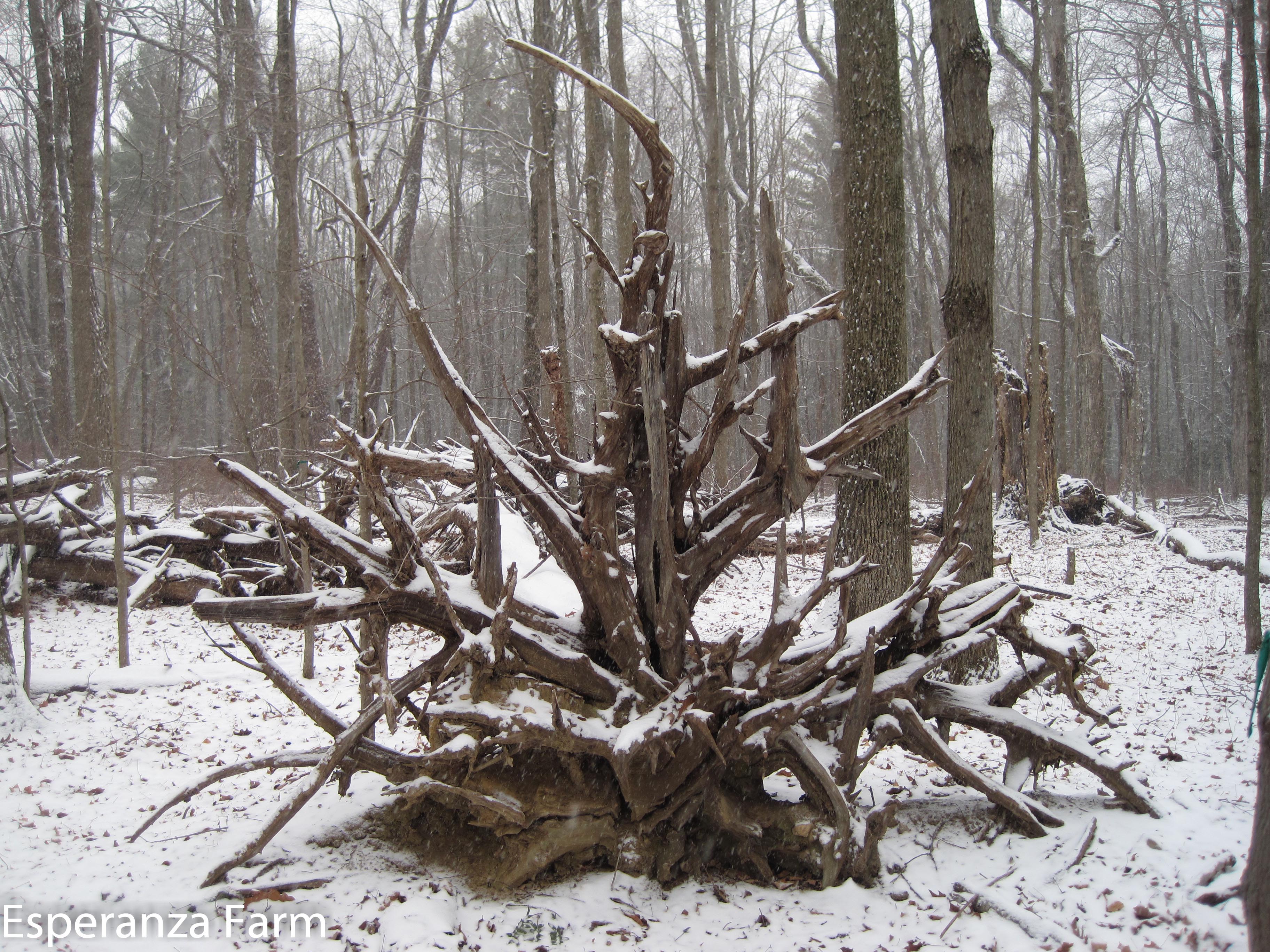
*we have the third largest black locust in the state.
Comments Off on Not a nightmare
Esperanza books, letters 14:24
1856, from a letter by Julie to Morris:
“Dear Morris,
If you can find a copy of ‘My Peninsular Medal’ illustrated and illuminated, bound in double gilt extra, had you not better add it to our collection. It is a rare and choice work you know, and no really fine library is complete without it. Joking aside, we must either pause in our book buying or enlarge our borders for decidedly the place is getting too straight for us. The Edition of Dickens, however, we must have. If indeed it shall be all that it promises, fair sized volumes, good large print, and complete in all the stories. I insist on large print because I mean the delightful tales of this real man shall be my companions when I wear double spectacles from extreme old age, when I walk with a staff and then heavily. Where we will bestow the precious books is a matter to be decided after we really get them. We will resolve ourselves into a committee of two and fix their destination.”
There are several complete sets of Dickens hanging about, so they did get an edition. Whether it was The Edition? Who knows.
gardening and Historic Photos and Landscapes and Modern Photos gardening 11:17
I couldn’t quite get the same photo angle, what I ought to do is go out and exactly retake some of the early photos. But it is interesting to look at these two photos. The first is from 1961, the second from 2011:

Moving from L to R: you can see two low branches of the Gingko in the upper left, since pruned out. Behind that is the white pine which came down in two pieces during the 1990’s; the garden area (mid left) appears to be largely an overgrown thicket, just off left-center midground is a young blue spruce, that never flourished in what was much too wet and shady an area. Directly behind it is a double trunk black cherry, removed in the mid 1990’s. The small garden path between the cherry and the hemlock is visible, this remains today. A particularly interesting tree is the small sapling in front of the hemlock. This is the leaning oak, it is an important piece of the landscape today, but is still an awkward looking tree because it does lean. However, it really is gangly in this photo. To the right of the hemlock is a pine that came down in the 1990’s (we lost several in that decade, self-thinning). The pillar has no euonymous bush on it. The fringe tree on the far right still remains.
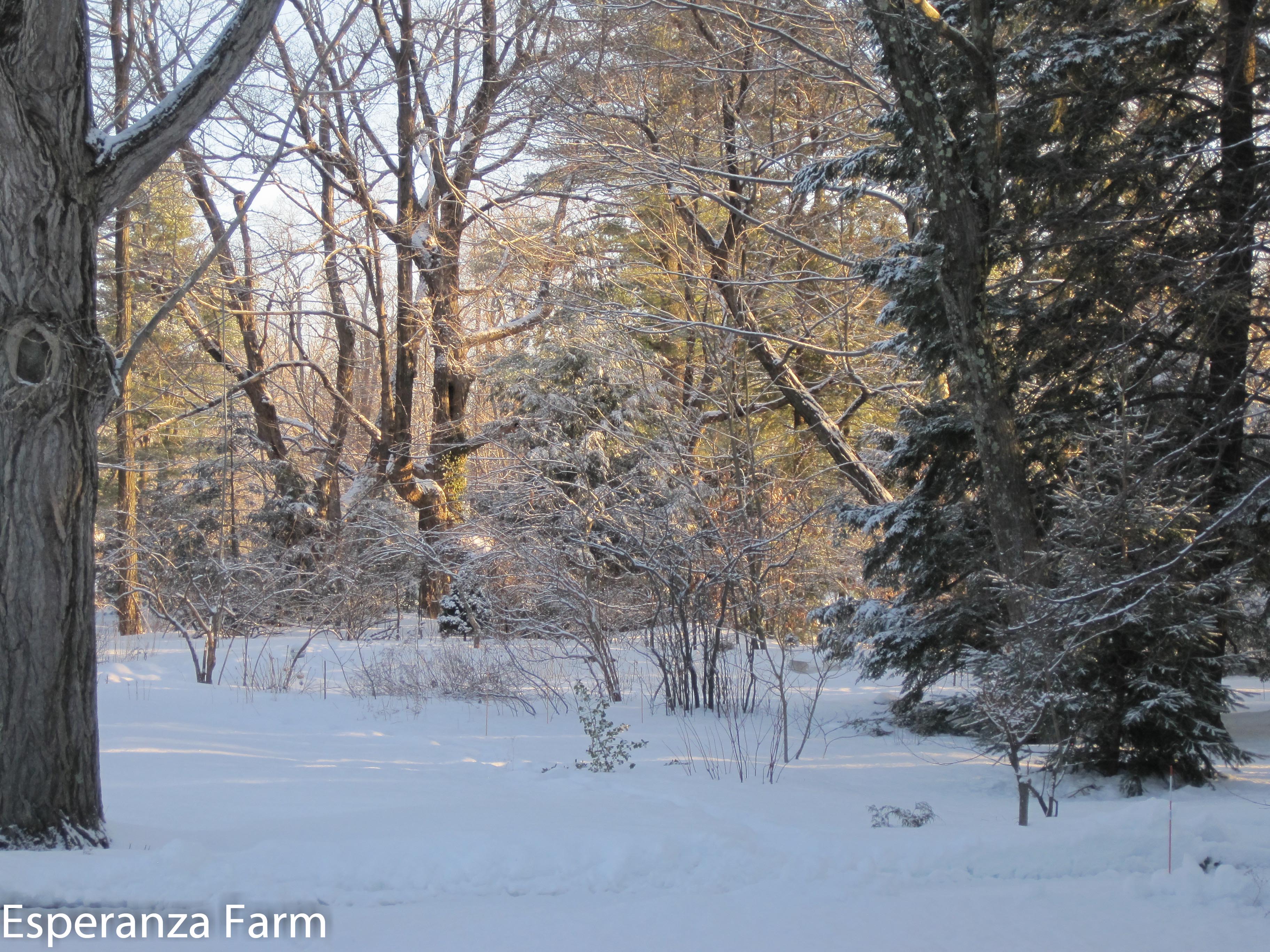
Not quite the same photo: You can see where those low gingko branches were finally taken off, much later than they should have been (when it became apparent a fire truck would not be able to get in the drive). The garden and the area beyond the garden has regained a lot of structure. Those maples are actually in the previous photo, but because of the overgrowth (mostly Norway Maple saplings) you couldn’t see them. The hemlock on the right has not gotten much wider, though it has gotten taller; the thicket of dark shrubs to the hemlock’s left is where the black cherry was. The oak is the real change: all you can see is its trunk. In front of that is a young Norway spruce planted about 8 years ago.
Comments Off on 50 years apart
Uncategorized poetry 15:33
Since I am not, apparently, able to get the work done that I must get done before a deadline…
Winter
I watched the sun set on its time
The mockery it made
Of my careful hours
It shattered the clock I kept
My neat divisions
Equitable of night and day
It vanished from its sky
Comments Off on Procrastination
gardening and Modern Photos gardening, photography 09:35

Shasta daisies beyond, the cucumber magnolia is the frame.
Comments Off on A bench at dusk
One of the invariable questions asked by first-time visitors to Esperanza is, ‘have you read all these books?’ Now, the answer is patently obvious: there are between twelve and fourteen thousand volumes. No. I read a lot, but not necessarily the books in the house. Some books I have read to the point of memorization, others… There is, however, a slightly more embarrassing point that can arise. Some of the books have Never been read, not in their decades, their century plus of life. The give away is that books from the 1800’s and early 1900’s often have uncut, or incompletely cut pages: the quarto fold was never properly cut after printing, leaving the tops or sides of two pages together. If the book has been read completely, that obviously has been dealt with; it is a pain, however, requiring a steady hand and a sharp blade. So if the book has never been read, but only flipped through….well!
But why? The uncut books are almost entirely those associated with William Webster Ellsworth’s publishing and work as a literary critic/reviewer. (Though I did just hit one that was clearly a gift to Carlotta Norton Smith in the 1860’s, not a successful gift it would seem). WWE seems to have gotten a number of books, either for review or for other business, mostly in poetry/drama/memoirs that he never got all the way through. I have to wonder if he reviewed any of them without reading all the way….
Still, awkward!
gardening and Trees gardening 13:40
I enjoy it. Well, most of the time. I enjoy the challenge of making the decision, that slow guessing game of what a cut here and now will do ten years from now. Some trees a pretty forgiving, apples for example, either because they grow fast or because they have plenty of dormant buds. Others are a challenge. Maples, for example, slow growing and unwilling to change direction. The saying measure twice, cut once? More like, look four times, check again, then cut. You can’t glue it back on. And while trees grow, an unwanted hole is still an unwanted hole.
The goal, in my view, is to end with a pruned tree that doesn’t look pruned. I think we did pretty well on the red maple next to the drive. It had to have a major branch taken off, being much too low and heading across the drive. And, of course, some other judicious pruning for balance. Just about every other year we have been limbing it up. Eventually it will have to branch off at about 25 feet to clear the house and drive as a fully mature tree. It is always better to cut the branches when they are smaller. In this case, the limb ought to have come off last year, honestly. You can see the scar, a four inch wide mark on the trunk, but that will heal within a year or two. What you don’t see is a hole or an unbalanced tree. Just a young red maple growing upwards with a nice open set of limbs. And the drive isn’t closed in either….much to the relief of the trucks I am sure!
 Acair Fearann