Identified! Sunday, May 25 2014 

Years ago, we snagged a bit of a creeping, smooth ivy with elegant little purple orchid-like flowers from a wall at Castle Campbell, Scotland. (We brought it back here, Yes I know one is Not supposed to do that, Bad, bad, very bad)  Sadly, it died since we didn’t plant it in a wall but in a nice bit of soil.

Then we found it again, growing with exceeding abandon at Innisfree Gardens in New York. So we misbehaved again and tucked a little bit into the steps by the west kitchen door, nice old crumbling stone steps.  It made it, quite happily, through the winter and is now growing and blooming, and looks like it will have to be trimmed off the various sedums in the area.  Not a particular problem, I already trim the thyme and such.

Any guesses?

It is this guy: http://en.wikipedia.org/wiki/Cymbalaria_muralis  also known as Kenilworth Ivy or Ivy Leaved Toadflax

Will it probably be excessively happy? Probably. But much less of an issue than Gill-over-the-ground, which makes up most of the lawn here; since the toadflax has already shown that it doesn’t care to compete in the lawn (this year’s growing shoots are actively turning away from the grass and heading back over the stones), unlike Gill-over-the-ground.

Sports Saturday, May 24 2014 

In an area with enough space for volunteers to occur, sports are almost inevitable.  The majority of seedlings, whether trees or perennials, are utterly expected.  For example, the majority of Japanese Maple seedlings here take after the big maple: maroon leaves with a relatively coarse outline.  The occasional green seedling occurs, perhaps one in a thousand.  The cut leaf seedling is rarer, perhaps one in ten thousand, and doesn’t seem to have much in the way of vitality.  Which explains the price of cut leaf Japanese Maples rather neatly.

Perennials are even less likely to have sports.  We do have one at the moment though and I ought to figure out how to mark it.  I am not a fan of variegated foliage (outside hostas and pulmonarias, and the odd yucca or iris), I find it deeply suspicious.  Especially in trees.  Though I will admit the variegated Pagoda dogwood looks like it might be a nice addition.  Still, I have my suspicions.

Consequently, two years ago when it first showed up, I eyed the variegated heart leaved wood aster with great trepidation.  It didn’t appear last year (or I didn’t see it).  This year it is up to about five stems.  It is rather pretty, the streaking is a pleasant marled pattern of ivory on green with no deformity of the leaves.

I ought to mark its location.  The thing is we probably have a solid acre plus of wood aster (if you lumped it all together) so five stems….well the odds are rather poor.  And the location is prone to vigorous weeding/poison ivy spraying by yours truly.  But all those plants out there in the trade…for the most part, it is accident, chance, that created them. It is sort of neat to see it happen in one’s own garden.

Hurrying Spring Friday, May 23 2014 

It is an odd year, so cold for so long.  Now Spring is clearly hurrying towards Summer, in some respects. The peas and lettuce are sulking, but the currants have already set berries; the Sugar Maples are fully out, but the locusts still stand gaunt against the sky. The ground is still cool, but already great thunderstorms have swept across the hills.

Spring though is always hurrying, rushing forward.  Not only there is a great deal to get accomplished, and a very short optimum window to do it all in; but the plants are growing and growing fast.  In some cases, inches to the day.  The perennials just refill their space (which one has sometimes forgotten the dimensions of), but the trees….  The young American Beech has put on nearly a foot of growth, to all sides and up, this year.  Even mature trees are suddenly bigger.  And of course, they are bigger, all those leaves and all those cells swollen with water.

The color changes as well.  The kitchen had a brief pink cast for awhile as the redbud bloomed, now it is green to the west with the apple tree, and a red/purple/green tint from the east where the Japanese Maple is suddenly flush with new growth.  The back roads are green tunnels and the meadows are tall with grass.

What is Esperanza? Wednesday, May 21 2014 

People ask that, sometimes silently.

Picture this then, a clear May evening, the fragrance of lilacs and viburnums, watching the sun sink over the western hills and the emerald field, the pure white violets and apple blossoms, the glowing pink, purples and golds of myriad redbuds, azaleas, tulips, and a host of others. and faintly on the sweet breeze the notes of Chopin’s nocturnes.

Or perhaps it is early morning, beneath the towering spruces, oaks, and maples where the white trillium shimmers, the pure white of living marble and the vinca forms a dark green carpet studded by ferns.

Next month will be something different and the one after that.

But always, the house, quiet and cool, with its books and unknown corners.

That is Esperanza.

Lilacs Tuesday, May 20 2014 

Not the best year for them, but still blooming well. They are one of those plants, like daffodils but more so, which are solidly entrenched in our culture but are in fact not found throughout the continent.  They dislike humidity and need cold winters.  The best lilacs I ever encountered were in Canada, growing wild across the abandoned fields of Ontario and holding court in Montreal’s Botanical Garden.

We have only a few here: two classic lavenders flanking the south end along with a white one, and a gorgeous, ancient dark purple one off of the west porch.  Its main stem is close to five inches in diameter, hopefully by hacking a bit of a hole in the overgrown hydrangea we can get some new growth going.  I also did a bit of work today on one of the lavender ones, cutting out two declining main stems (it would have been three but the chickadees objected vociferously), hopefully it will regrow well.

Walt Whitman described them, and the hermit thrush, best of course in one of his better known but rarely read poems its worth the time to go through it, if a bit depressing: http://www.poetryfoundation.org/poem/174748

Virginia Bluebells Sunday, May 18 2014 

IMG_3011


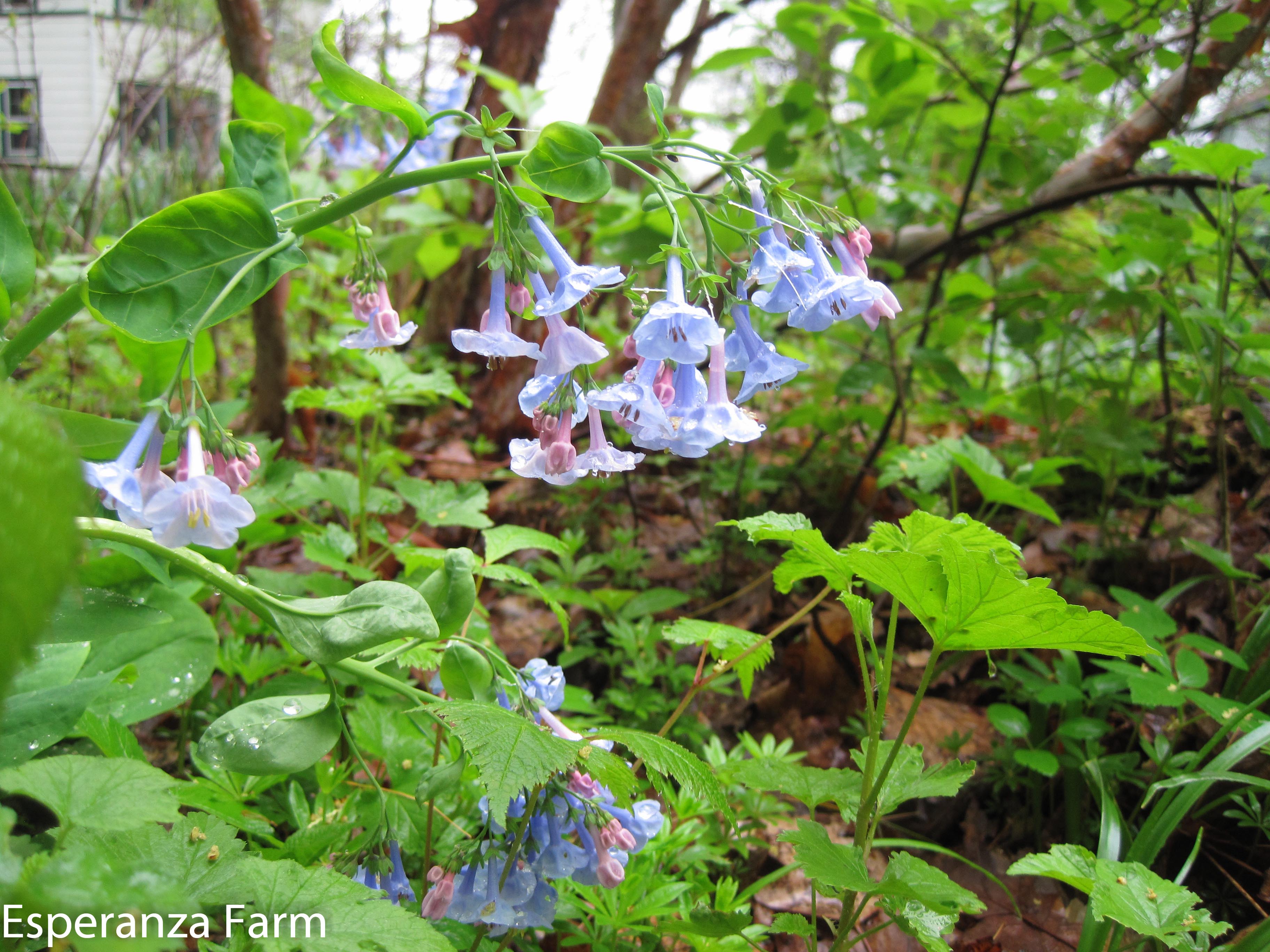
A wildly underused native flower, mertensia virginica, otherwise known as Virginia Bluebells.

This plant likes shady, moist woodlands.  It flowers in the early spring and goes dormant in the summer.  Its big green leaves look a bit like fuzzy lettuce (though when they come up the buds are almost purple/black).  Its flowers…well you can see.  They start as pink buds, but when fully open are a lovely blue.  They are similar in this sense to some of the pulmonarias or lungworts, but without the purple tones to the colors. It is about 12-18 inches tall with an arching, soft habit.

We have one plant, hopefully we can get it to spread and/or divide it.

Highly recommended…if you can find it.

Un, deux, trois Saturday, May 17 2014 

Three little redbuds all in a row, well not so little….  And not in a row either, though the two volunteers are; the parent is just off the left of the screen. It sprawls a good forty feet these days and is up to three support posts, two of which you can see there.  The second redbud is directly in the center of the photograph; the third redbud is the one just next to the white bench on the far right.  The maroon beyond is a volunteer Japanese Maple, whose parent is the trunk looming on the left.  We do volunteers around here!

IMG_3008

Purple Iris Friday, May 16 2014 

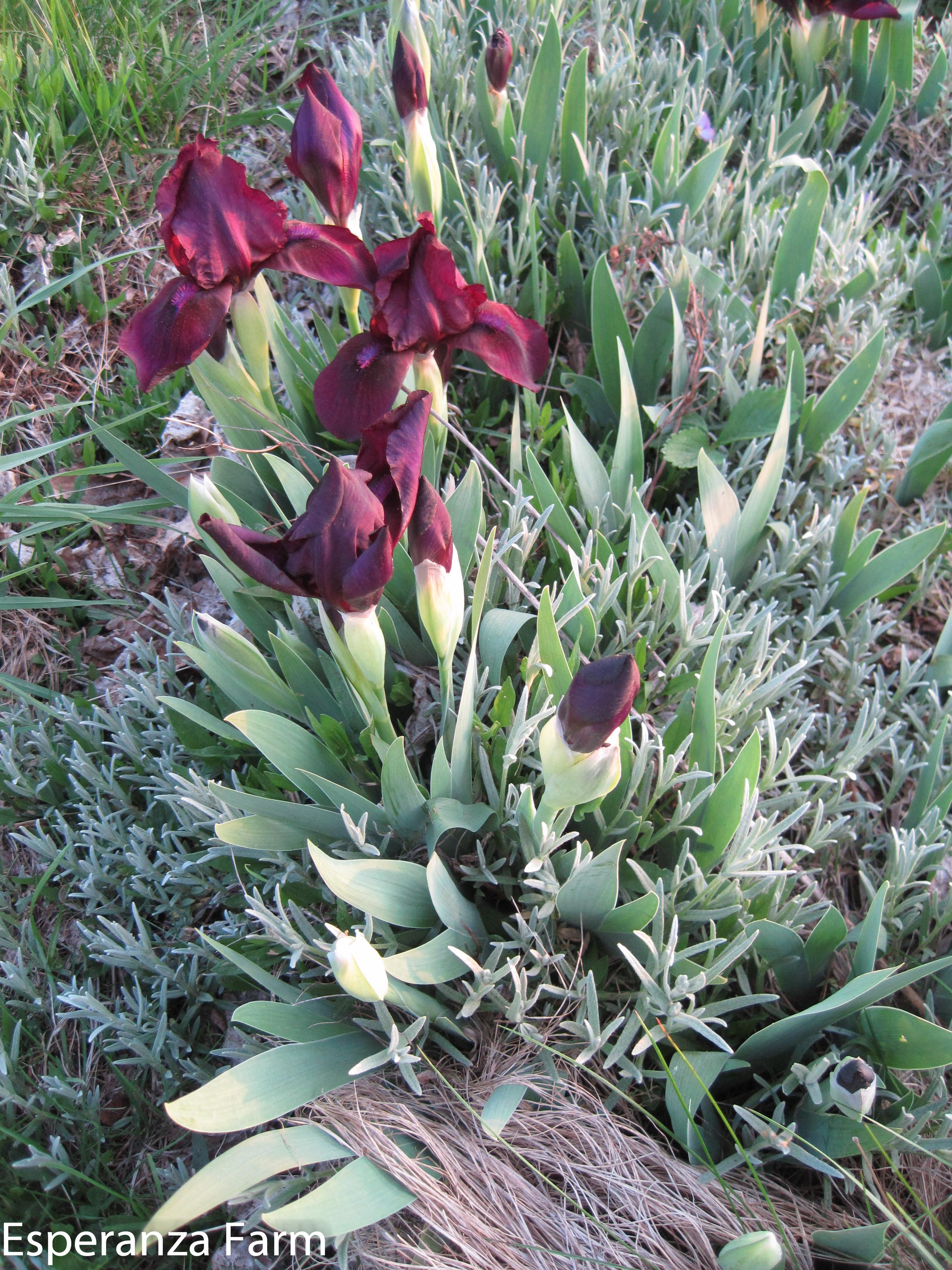
A difficult color to work with as it can look too dark and funereal, additionally, the plants are short, no more than 8 inches, so they can look a little odd in the wrong spot; but the structural effects of the leaves are fun! The purple, silver, green with sharp edges has a definite impact in the right spot…now if we could Just Find that spot!

IMG_3006

Love Letters Thursday, May 15 2014 

Because I was looking for a random letter between Julie and Morris* and this one caught my eye.

April, 1857 from Julie to Morris:

“I have been today, in consequence of lighting by chance upon one of those interminable yellow letters, comparing the present with the past, and cannot help wondering if we are really the two beings who wrote thus to each other. Now Dearest, I see you as I saw you then though a haze of uncertainties, when I never thought to look upon your face again. I have today lived over the days when I wrote those letters at the table in my little room, and so on to the time of your coming, when (how I can’t now conceive) the object of your visit never occurred to me, the Sunday Evening on the sofa, and so on to the Tuesday evening, and so on to the night in Syracuse, and so on to the winter in New Orleans, the first parting, the utter sinking of heart I felt aboard ship and so till little Fanny’s breath touched my cheek, and so on through all our sad partings and joyful meetings, the happy days, the evening amusements, the concerts, the operas, the book-talks, the love and joy and peace, which has filled all our days and nights, and I can’t help believing that we have had full our share of life’s pleasures since we spent that first day together in the parlor of the Graham house so long ago.

….I wish to say this now because I should not like to say it only on paper, but you will never, never know how dearly I love you.

I did not intend to write such a letter but what is writ is writ. I can’t say now as I used to do, ‘you have no power over me’; now you have all the power, I have none, I am all yours.”


*We have lots of letters between other people, it is just these are conveniently transcribed and printed up….

**Twitter lacks somewhat, does it not?!

Hard Winter Wednesday, May 14 2014 

We don’t lose plants to winter all that often.  Well, I ought to say that we don’t lose shrubs and trees to winter that often, perennials are another matter.

This year, one juniper (go figure) is on life support, the hydrangeas only just made it, still not sure about the smoke bush on the tennis court, the roses…well…., they are All alive but beyond that.  The oddest one is a clematis.  Most of them are actually very happy, really happy in fact, including the one that shouldn’t be hardy here.  However, the volunteer fall clematis which grew like mad last year was killed down to six inches above the ground.  The other fall clematis, not six feet away, is just fine.  As is the one in another garden.  The only thing I can figure is that it essentially outgrew itself last year.  Plants are very odd.

« Previous PageNext Page »