On days such as this, when the trees are bare, dark bones and sunset comes down hard and fast, the red blade of night.
Photographs such as this are a remarkable reminder of the passing seasons

Comments Off on Summer Glories Past
Landscapes and Modern Photos 21:27
On days such as this, when the trees are bare, dark bones and sunset comes down hard and fast, the red blade of night.
Photographs such as this are a remarkable reminder of the passing seasons
Comments Off on Summer Glories Past
Esperanza christmas cactus, photographs 21:54
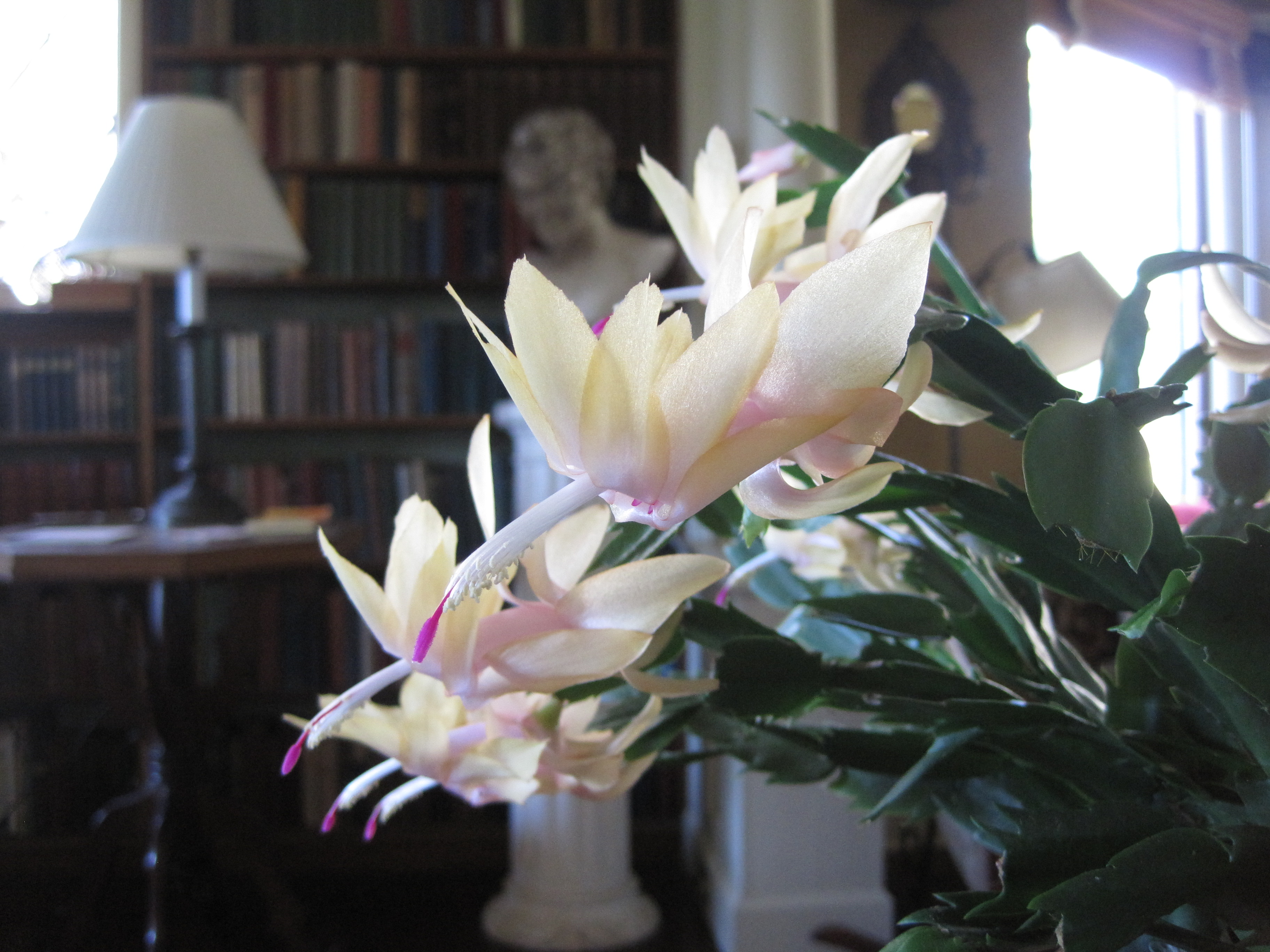
At least they are consistent. I was flipping through photographs from last year, attempting to come up with something relevant*, and noted that I photographed them during the first two weeks of November last year, so they must have been at the height of their bloom then. This year, the same: all three younger ones are blooming like mad right. Two orange/gold and a multi (pink/white), which is actually two plants in one pot. Go figure. At least they’ll look good for some visitors this week.
It must be something about the timing of the blossom set, now is it by temperature or light I wonder? And do I really want to force a plant? I don’t like doing that to them, somehow.

*I could write all day about church budgets, revisions to Episcopal Church structure, parliamentary rules of meeting, trains in the Farmington River valley, reservoirs, trees, or…I can pinch hit and publicly read complicated chunks of OT too!
Comments Off on Christmas Cactus
I was driving down through a decidedly suburban bit of Connecticut today (gah). And noting the lawns. With all their leaf piles: oak, pine, lawn clippings, some maple. Some finely chopped, some just raked. All neatly stacked in nice long rows. By the Side Of The Road for the Garbage Truck.
I am most assuredly not a follow of Gaia*, but I sometimes wish Mother Nature would whack people over the head. Hard. Preferably with a tree branch.
*I was on my way as parish clerk to attend the Diocesan annual convention for the Episcopal Church!
Uncategorized 22:10
Something else entirely. (Hat Tip to Maggie’s Farm)
The History of the English Language
In the beginning there was an island off the coast of Europe. It had no name, for the natives had no language, only a collection of grunts and gestures that roughly translated to “Hey!”, “Gimme!”, and “Pardon me, but would you happen to have any wood?”
Then the Romans invaded it and called it Britain, because the natives were “blue, nasty, br(u->i)tish and short.” This was the start of the importance of u (and its mispronunciation) to the language. After building some roads, killing off some of the nasty little blue people and walling up the rest, the Romans left, taking the language instruction manual with them.
The British were bored so they invited the barbarians to come over (under Hengist) and “Horsa” ’round a bit. The Angles, Saxons, and Jutes brought slightly more refined vocal noises.
All of the vocal sounds of this primitive language were onomatopoetic, being derived from the sounds of battle. Consonants were derived from the sounds of weapons striking a foe. (“Sss” and “th” for example are the sounds of a draw cut, “k” is the sound of a solidly landed axe blow, “b”, “d”, are the sounds of a head dropping onto rock and sod respectively, and “gl” is the sound of a body splashing into a bog. Vowels (which were either gargles in the back of the throat or sharp exhalations) were derived from the sounds the foe himself made when struck.
The barbarians had so much fun that decided to stay for post-revel. The British, finding that they had lost future use of the site, moved into the hills to the west and called themselves Welsh.
The Irish, having heard about language from Patrick, came over to investigate. When they saw the shiny vowels, they pried them loose and took them home. They then raided Wales and stole both their cattle and their vowels, so the poor Welch had to make do with sheep and consonants. (“Old Ap Ivor hadde a farm, L Y L Y W! And on that farm he hadde somme gees. With a dd dd here and a dd dd there…”)
To prevent future raids, the Welsh started calling themselves “Cymry” and gave even longer names to their villages. They figured if no one could pronounce the name of their people or the names of their towns, then no one would visit them. (The success of the tactic is demonstrated still today. How many travel agents have YOU heard suggest a visit to scenic Llyddumlmunnyddthllywddu?)
Meantime, the Irish brought all the shiny new vowels home to Erin. But of course they didn’t know that there was once an instruction manual for them, so they scattered the vowels throughout the language purely as ornaments. Most of the new vowels were not pronounced, and those that were they pronounced differently depending on which kind of consonant they were either preceding or following.
The Danes came over and saw the pretty vowels bedecking all the Irish words. “Ooooh!” they said. They raided Ireland and brought the vowels back home with them. But the Vikings couldn’t keep track of all the Irish rules so they simply pronounced all the vowels “oouuoo.”
In the meantime, the French had invaded Britain, which was populated by descendants of the Germanic Angles, Saxons, and Jutes. After a generation or two, the people were speaking German with a French accent and calling it English. Then the Danes invaded again, crying “Oouuoo! Oouuoo!,” burning abbeys, and trading with the townspeople.
The Britons that the Romans hadn’t killed intermarried with visiting Irish and became Scots. Against the advice of their travel agents, they decided to visit Wales. (The Scots couldn’t read the signposts that said, “This way to LLyddyllwwyddymmllwylldd,” but they could smell sheep a league away.) The Scots took the sheep home with them and made some of them into haggis. What they made with the others we won’t say, but Scots are known to this day for having hairy legs.
The former Welsh, being totally bereft, moved down out of the hills and into London. Because they were the only people in the Islands who played flutes instead of bagpipes, they were called Tooters. This made them very popular. In short order, Henry Tooter got elected King and begin popularizing ornate, unflattering clothing.
Soon, everybody was wearing ornate, unflattering clothing, playing the flute, speaking German with a French accent, pronouncing all their vowels “oouuoo” (which was fairly easy given the French accent), and making lots of money in the wool trade. Because they were rich, people smiled more (remember, at this time, “Beowulf” and “Canterbury Tales” were the only tabloids, and gave generally favorable reviews even to Danes). And since it is next to impossible to keep your vowels in the back of your throat (even if you do speak German with a French accent) while smiling and saying “oouuoo” (try it, you’ll see what I mean), the Great Vowel Shift came about and transformed the English language.
The very richest had their vowels shifted right out in front of their teeth. They settled in Manchester and later in Boston.
There were a few poor souls who, cut off from the economic prosperity of the wool trade, continued to swallow their vowels. They wandered the countryside in misery and despair until they came to the docks of London, where their dialect devolved into the incomprehensible language known as Cockney. Later, it was taken overseas and further brutalized by merging it with Dutch and Italian to create Brooklynese.
That’s what happened, you can check for yourself. But I advise you to just take our word for it.
Copyright (c) 1994 Corrie Bergeron and Ben Tucker all rights reserved
I managed a short jaunt in our own woods today. First time in awhile.
I was pleased to see that the ‘Big Three’ oaks (red, white, and black) all looked pretty good for their age. There are other oaks of course, but these three are old, open grown oaks along the wood track, beautiful trees full of character. Very few acorns under them though. I’d like to know who ate them. Either someone did, or they are the only ones in the state that didn’t Have acorns this year. The north lawn is like walking on marbles right now thanks to the two black oaks on it. It will be a bore to rake it next spring, I am sure.
What makes the lack of acorns more puzzling is the relative scarcity of deer sign in the area. I know we don’t have that many turkeys, a decent flock but not massive. Though, I did observe them cleaning up under another of our white oaks. Or maybe it is the bear…though I didn’t see any sign of him, either. Which is just fine.
Bit of a pity, since I was sort of hoping to get a few acorns and give a shot at sprouting them for planting. But, I don’t need another project anyway! Besides, where would I plant them at the moment?
Comments Off on Acorns
The birds are having a ball: three types of sparrows, titmice, nuthatch, chickadee, juncos, woodpeckers, et al. working away on the dropped apples. Only the mourning doves don’t seem to care for them.
Two stroke engines that start on the first pull: Awesome. Two stroke engines that don’t: language practice.
Chainsaws are wonderful. Sharp chainsaws are even better.
I like the smell of sawdust/gasoline/bar oil.
It was a very nice and productive day. And that really annoying little re-sprouting tulip tree is finally cut down! It wasn’t even what would be sapling size really (three stems, each about four inches, about ten-twelve feet in length). I’ve been using it as guard for the Sugar Maple that is intended for the spot next to the drive. It had gotten a bit ugly, thanks to periodic cutting over the last five years. It will resprout next year of course, to do its job once more. But not at a size which will interfere with the maple.
Comments Off on Thoughts on a day
Modern Photos weather 22:30
One of the oddities of the nearby river system* is that it can produce a heavy fog bank: warm water mixing with cold air, but limited to a single valley because it is also mixing with a another river branch which will generally have colder water.*
Consequently it isn’t uncommon to start out at a 1000 feet with clear blue sky, then see this ahead and below the next hill:

Which will become this:

And end up as this at 400 feet:

Before clearing out completely in about three miles.
*It isn’t a valley: two main rivers, several minor rivers, four (technically five) reservoirs, and two distinct river types squeezed into a few miles.
*It really depends on how much water is needed and where.
Comments Off on Valley Fog
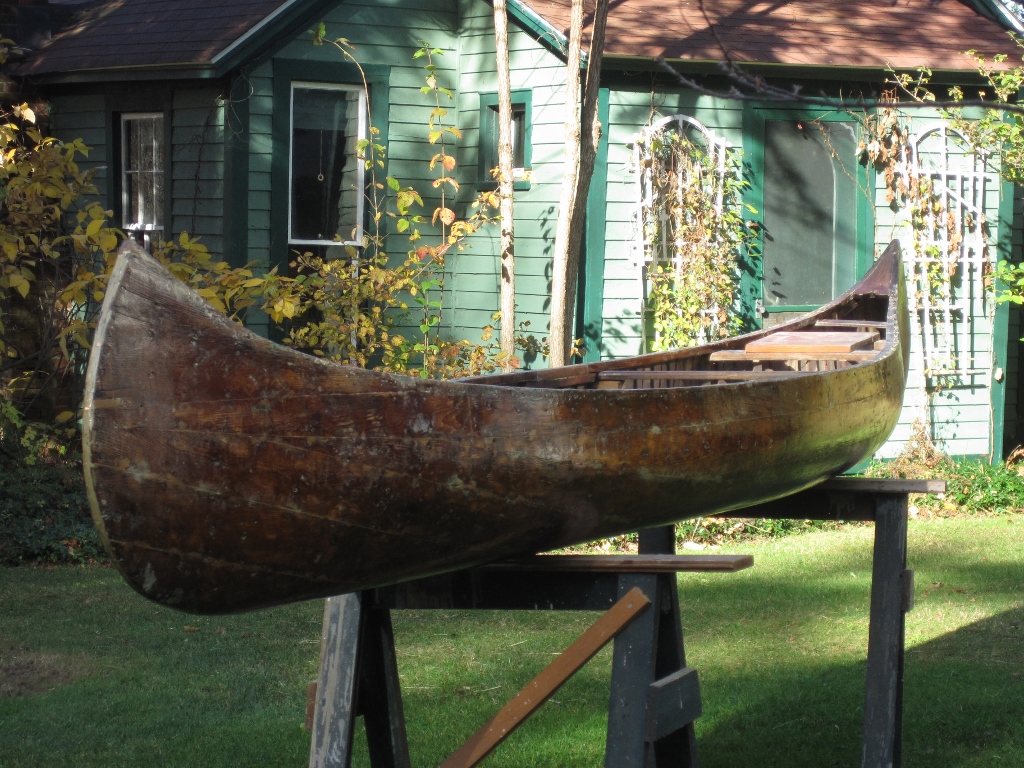
one canoe, Chestnut company style c. 1905. It is most assuredly not flat bottomed and has a noticeable belly to it, very visible in the second photograph. The rebuilt stem ends came out rather nicely (not my work!) It is also getting new cane seats to replace the mismatched pair it currently has. Though, I have my suspicions that it is probably more stable when not using the seats. Now, the question is….how to transport it? At 16 feet…I think the truck may be getting a ladder carrier yet!

Comments Off on Ready for fabric
Landscapes 21:20
I dislike Daylight Savings Time, for the usual reasons of course. Not least that driving home after work in the dark is stupid. I also dislike the fundamental desperate failure of the term. The sun sets on its day and no man will ever change nor save the time that has sped.
But, coming home in the dark isn’t all bad. You see, I like the dark. And I love the bare trees in twilight reaching heavenwards above the still silence of the water. Beneath the great oak the pond is a bottomless mirror of the sky. That oak, that pool. they are there in the daylight; but somehow the twilight of fall brings them closer. In the spring and the summer, the promise of now: the leaf, the flower, the growth for the year, these obscure the bones of the trees, the earth, the water. Those bones change, even within our memory*, but they nonetheless stand apart from man’s understanding of time. There are trees here which were full grown when my grandparents were born, and my grandparents are dead in the fullness of their years.
In November, the age of the trees, the earth, the water is unveiled.
*consider the oak that closed the road in the post of a few days ago.
Comments Off on Daylight Savings
Uncategorized trees 21:18
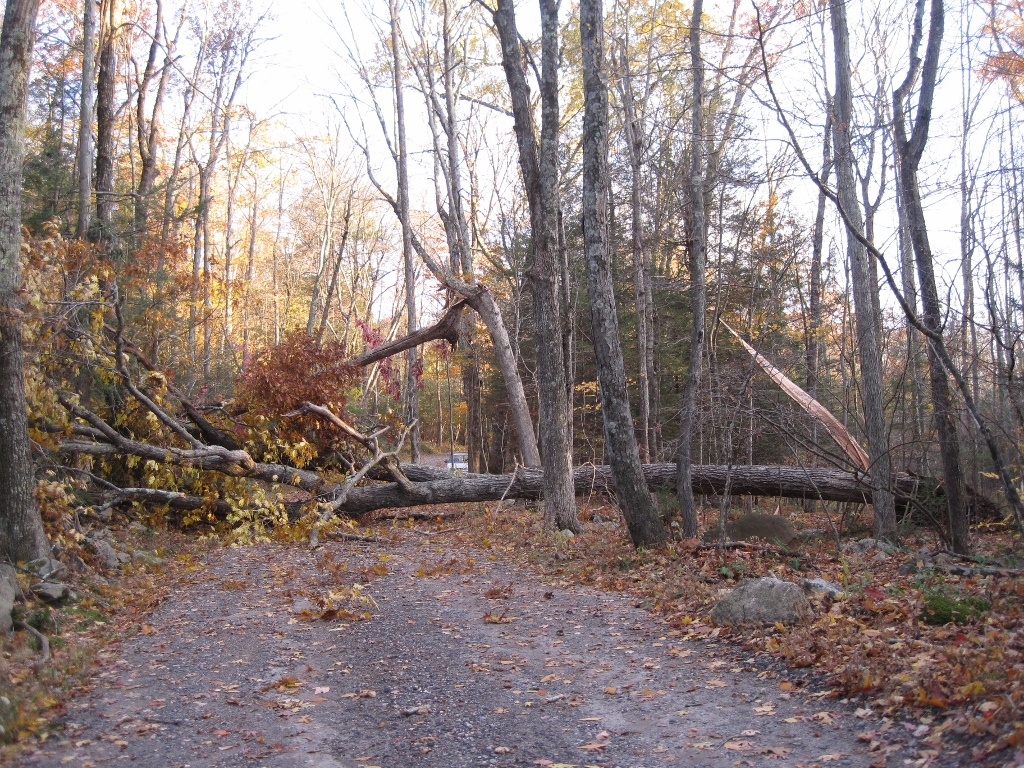
We had some gusty wind today, enough to knock things over at times. Apparently one of these victims was this big red oak. A perfectly healthy tree, but perhaps just too much crown to hold. Far be it from me to figure out why this tree would go over and not any number of others. This one was well balanced with no discernible rot (even after the fact and looking at the base). It squished the white oak next to it as well, which is a pity since I always liked that white oak: it had character. I’ll be interested to see what the town does or does not cut and how, since that is a very nice section of oak there. Past history suggests someone will run off with it. Though, it is large enough that they may not.
The road is sixteen feet wide, for scale.
Comments Off on Road Closed
 Acair Fearann