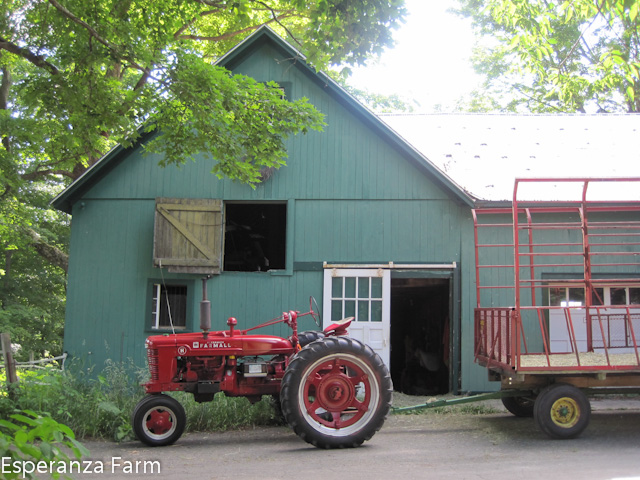
Comments Off on Red and green
Modern Photos farming, photography 12:53
Comments Off on Red and green
Landscapes ecology 16:01
Unless you have been living under a rock, if you are at all interested in environmental news from eastern North America, you know that bats are in serious trouble thanks to a distinctly nasty fungus. White nose syndrome has killed between 5.7 and 6.7 million bats since 2007; when that is combined with the tendency of people to eradicate colonies at the drop of the hat, habitat loss, and light pollution…well the news isn’t good for bats. Despite the fact that the little guys are a free and effective form of bug control. (I also think they are cute)
Happily, Esperanza is doing its part in environmental community service*. We knew from ground evidence/plus seeing them that there were bats in the porch and that there were bats in the south end roof, and that there must be bats in the barn (the mystery is that we never see the bats in it, but the pattern of droppings** is impossible for mice without wings). We didn’t know that there are at least forty in the northwest corner of the roof. Last night, we happened to be at the right place, and they popped out as bats do from roofs: one at a time with a great squeaking and scrabbling. Rather nice to see. But I do wonder what the total count for the house and outbuildings is?
*Because it is the right thing to do…pity that doesn’t translate to the finances.
**the squeamish would perhaps liken it more to a carpet…
Comments Off on Bats in the belfry
Esperanza and Historical Events history 13:39
From the recollections of my grandmother, Eileen Creevey Hall, who was the great-grand-daughter of Julie P. Smith, whose letters I often take excerpts from. Eileen grew up spending summers at Esperanza, along with Carlotta and Kennedy, her two siblings. The following events are from the 1910-1925 era.
“There was only one part of the house which was strictly off limits to us. That was the area south of the dining-room door which led into the domain of The Cook. No children to run about and get in her way! And no wonder! She was responsible for three full meals a day, plus the tea. As there often ten or more people in the dining room, and four maids, and a coachman to be fed, you can easily imagine that she was completely occupied all day.* The big iron range was never cool and it must have been a difficult job to do all that work. And we had to be prompt!”
The kitchen is on its third or fourth iteration since 1893. The big iron cook stove is long gone, unless it is the thing lurking in the basement?, the kitchen put in by Eileen’s mother, Lucy, post WWII lasted with only some changes to the stove and fridge until c.2004.
*Often more; that count only included the ten people who stayed all summer on a routine basis, it didn’t include other guests who might stay anywhere from one night to several weeks.
Comments Off on On kitchens
Uncategorized weather 19:08
are always a welcome break from a heat wave. They are beautiful, aw-inspiring, and terrifying. They are also a bit like very large, slow-moving car accidents…once they are under way, you can do nothing to stop them, and they just might change your life. Unlike a car accident, you can’t do anything, more in the position of roadkill than a driver.
This one took out some branches, had a lovely light show, and some impressive wind and rain. No hail, for which as a gardener I am very appreciative. On the other hand nearly two inches of water in fifteen minutes does interesting things in the basement. I was told that one wall had a nice little fountain, and it certainly made a lake. But, the basement is designed for it, and it will all drain back out. Just, don’t plug the table-saw in for a while, eh?
Comments Off on Thunderstorms
Julie's Pond and Modern Photos photography, summer 16:19
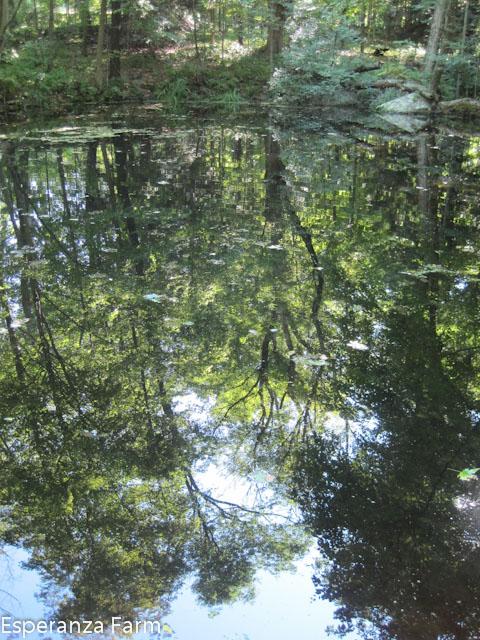
Julie’s Pond. It used to be deep enough, a century or so ago, to swim in. I think there are entirely too many frogs, snakes, and turtles to contemplate such action now (plus about a foot or two of muck). But it is hot enough that even I would almost contemplate a cool swim, and it doesn’t get colder than a spring fed pond!
Comments Off on Pity it isn’t deeper
In lieu of content.
Thanks to the weird spring we had, the flowers are all blooming fast. The ‘Fourth of July’ rose, a bright red floribunda rambler of unknown parentage, is nearly finished and will be done before the Fourth of July. The Goatsbeard, a July staple here, is nearly done. The Shastas and Snakeroots, which should be July-August will be starting soon.
So:
Straight orange daylilies (the ditch lily), cultivars and doubles will be starting in a few days.
June lilies are finishing
All of the roses: rugosas are almost done, the centifolias have peaked, the David Austin varieties are starting
Astilbes are going
Lady’s Mantle
Campanulas, all types
Ozark/Evening primrose
Nepeta Nepeta Mint
Delphinium
Ox-Eye daisy
Pinks
Blue-eyed grass
Milkweed
Cranesbill Geranium
Brown-eyed Susans
Blue Flax
Salvia
Scabiosa
Foxglove
Morning Glories
Nasturiums
Bread-seed poppies
Bachelor’s Buttons
Red Hawkweed
Yarrow
Adenophora
Clematis
Elderberries
Hydrangeas
Numerous others I have forgotten…
Comments Off on What is blooming?
Uncategorized 14:20
The hay is cut, but still the roadsides gleam where uncut field grass shimmers green, gold, silver, and bronze. The elderberries are crowned in ivory; the humble roadside ditch has the first few fire-orange sparks of the daylilies; and the trees have turned dark green against the blue sky where the swallows play. Summer hurries this year and is nearly at its height now, when the sun is about to begin its turn that will take us towards the fall.
Comments Off on June days
Historic Photos and Modern Photos farming, gardening, history, photography 19:16

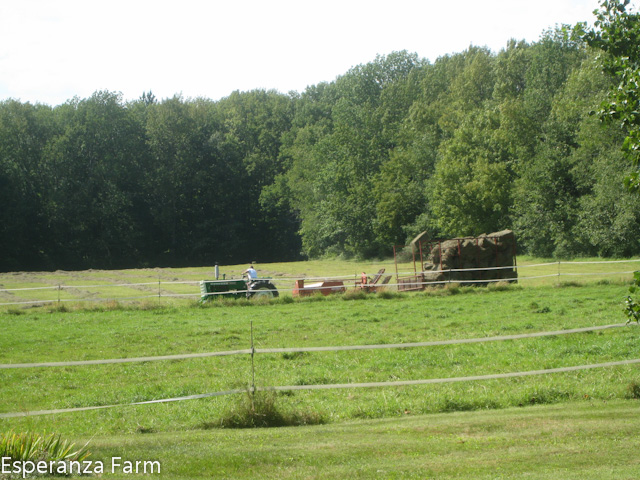
you can see the chucker in action in the modern photo, that eliminates two or three people, right there.
Good thing, since extra bodies don’t seem to be around this year, but what a good year! My guess, conservatively, close to ten tons of hay, and bone dry at that, so very light.*
We are pretty much a cheering squad, a friend does the actual work…
Comments Off on 1911 versus 2011
Modern Photos farming, gardening, photography 15:29
for hay. Connecticut is not an agricultural powerhouse, though like every single state it does have an agricultural sector; it is best known for nursery plants, Christmas trees, and intensive, specialty farms. It is not known for sprawling fields. And honestly, why should it be? Though the Connecticut valley holds some of the finest soils in the world*, the state is small, densely populated, hilly, and rocky. You cannot have a thousand acre field here.
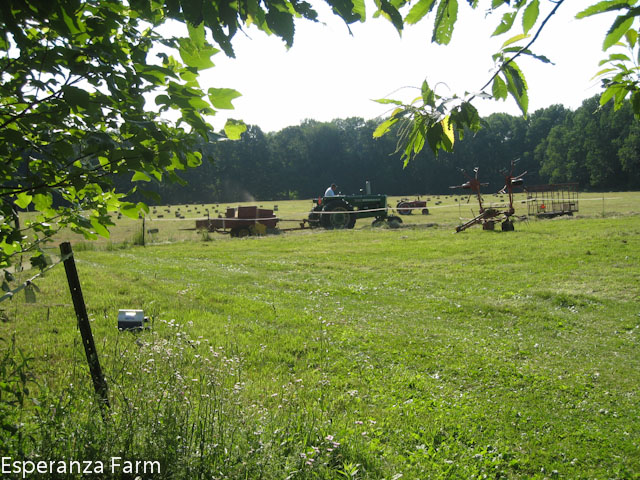
Nonetheless, I grew up bucking hay at least once a year and usually more. At one point we went through 700 bales (55lb square) a year. * This year, I asked for 60. Our field currently produces 1400 bales a year, generally high quality, off of about ten acres. The man who does it, does not make money off of it. He likes doing it, he can use the hay for his cattle, and he has the equipment. In this case, all vintage tractors (several gorgeous Elliots and Farmalls) that need several days steady running a year; they have another life as show tractors.
Hay is an increasingly scarce product here. Hayfields invariably make high quality subdivisions, while hay (though the price has gotten painfully high) is not a high value crop. It is however, labour and equipment intensive in the most spiky and unpredictable fashion. You need at least: one tractor (preferably two), a cutter/conditioner, a tedder, a rake, and a baler. Hay wagons are also recommended. And A Lot of gasoline. Then you need the people to drive the equipment and buck the hay, and you need them at some undefined point in June and again in late August, and you need them to work in the full sun and fast. Why fast? Once hay is down, if it is rained on in the field it goes from 6 dollars a bale to 1.50. Hay weather is also thunderstorm weather.
I will, no matter where I live, for the rest of my life start to get edgy the first weekend in June. Will the hay be good? Are there enough people? Will it rain? Still, I love the thundering roar of the tractors, the smell of hay, of gasoline, the ka-chunk sound of the balers; I loved the challenge of stacking hay as fast as it came off the elevator, the trick of grabbing the hay as it came off the spiked chain without snapping the twine or slipping near a lethal piece of equipment, the trick of stacking six high alone, eight or more with a helper. Who is faster, the stacker or the loader?
Do I mind not having the stress? No. Do I miss it? yeah.
Two years ago, the Elliot in the foreground with the baler, the tedder is the piece unhitched to the right, a Farmall in the distance.
*Connecticut once produced shade-grown tobacco of a quality rivalling the famed Cuban strand.
*I also stacked innumerable hay and straw bales at the farm where I worked.
*Wordpress’ spellcheck hates ‘Farmall’…that says something, doesn’t it?
Projects historic preservation, history 14:25
Historic Preservation has two functions: to aid in preservation, which hopefully includes some form of sympathetic reuse, and to witness the removal of the past. I am not especially keen on preservation that focuses solely on the enshrinement of building fixed in a moment in time. There are a few, rare cases where this is desirable; however, most buildings are better kept in use. If they cannot be used, the society in question probably cannot afford to maintain them. Sometimes, mothballing a building is possible, thereby avoiding demolition or massive changes, with the idea that eventually a more sympathetic use can be found. Mothballing, in fact, probably ought to be a more available option.* But most buildings need to be used, while at the some time recording what has changed (if only so the next guy knows what did and didn’t work)
However, any modification usually means erasing something. But it is also a point of opportunity. This picture shows a minor point of combined destruction and discovery:

Taken during the remodelling of the kitchen eight! years ago, this shows the old south wall of the pre-1870’s farmhouse, before all the additions. The old lathe is visible, over it is the new diamond wire mesh for the new plaster. What is also visible is a shadow on the wall, actually a stain. The diagonal line running from the center of the stove to the top of the photo is the old stairs, also present are the stair treads. These stairs were removed in the 1870’s when the south end was expanded. While it was known from the floorboards of the room above that stairs might have existed, there was no proof until this renovation project. Putting in the new plaster simultaneously revealed and, probably, destroyed this stain. The photo, therefore, becomes an invaluable source of information.
Historic preservation in action.
*It is not due to the combination of security, regulatory, tax, and financial hurdles. Tax and regulatory are huge, especially in locations where property tax exists.
Comments Off on Historic Preservation and Documentation
 Acair Fearann