For comparison
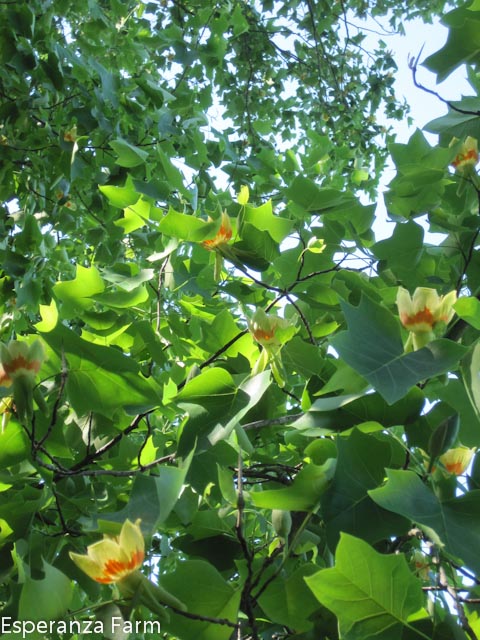
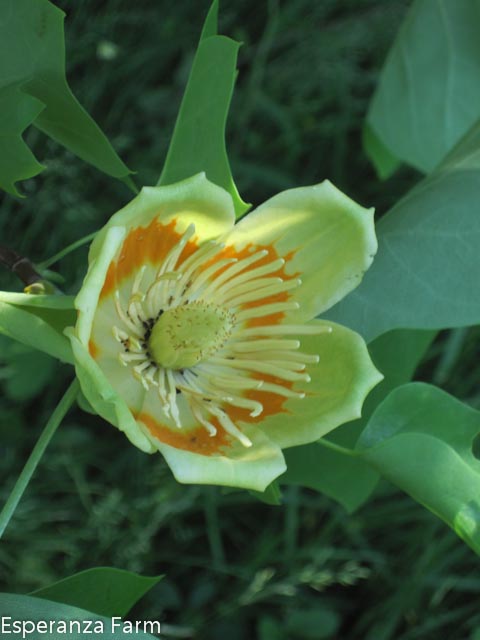
Comments Off on Tulip tree in summer
Modern Photos 23:31
For comparison
Comments Off on Tulip tree in summer
Modern Photos and Uncategorized 17:41
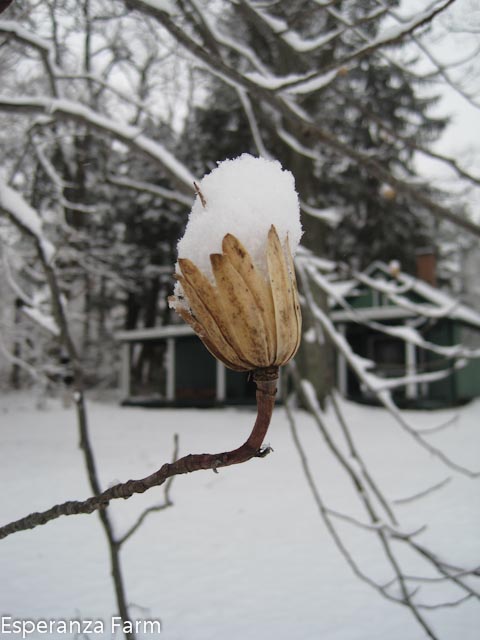
Comments Off on Tulip tree in winter
Landscapes 11:04
The winter view from Esperanza is, as always, dominated by the low ranges of hills that roll off to the west, neither high nor dramatic but very much there. Currently, the primary colour for the distant hills is a deep purple brown. On a day such as this, with light clouds, this blue colour is offset by sun spots. In the distance this colour is a brown-silver, on the closest hill the snow beneath the trees makes it almost white. When the sun comes out fully, much of the blue colour will vanish, but not all and shadows will outline the hills.
This is very different from what it would have looked like a century or more past. It is the trees that impart those colours, those shadows, and the sense of depth. When the trees were not there, and all the hills were fields; white would have been the dominate colour. Even with the oddly shaped fields, a more geometric and sharper landscape would have appeared. Quite interesting, no doubt, but quite different! It also had a much bigger view, Esperanza’s hedgerows were shorter; today hills to the north and south are completely hidden, as is the first small hill to the west, all were very visible a century ago.*
In a century….houses I suspect. A discussion to do some major cutting and then replanting with pine along the bottom property line of the house lot in order to avoid being able to wave at more neighbours sometimes arises. It would be a rather dramatic change…not that those discussing it would be alive to see the end result of course! Which perhaps makes it a weightier decision.
*It’s awkward, I am realizing that the shorthand of ‘century’ doesn’t work for some things, but writing ‘a century plus’ doesn’t have the same ring.
*The eastern view (which if you are a squirrel you can see from the top of biggest Norway spruce) vanished by 1880: Julie added to the maples and Norway spruces already in place, and photographs show that the house’s eastern front was already largely hidden by trees by that time. Today, trees and houses to the east ensure that it is entirely hidden.
Comments Off on Blue hills
Historical Events history, writing 14:13
Though Julie Palmer Smith was the first author to live at Esperanza, her son-in-law, William Webster Ellsworth, was a well respected author, his career at the Century Company, from its beginning’s as an offshoot of Scribner and ending as Secretary (think CEO), meant that he had a formidable network of connections.
A review of his book ‘A Golden Age of Authors’ published in 1919 by Houghton Mifflin* hints at this network; the review was by Albert Bigelow Paine*: “When the MS. arrived and I saw the size of it, I said, ‘It looks formidable but I’ll read it. I’ll do it for Ellsworth, I’ll do anything for Ellsworth.’ Then after dinner I got my clothes off, got into bed, propped up, and began. I hadn’t read three pages before I realized a remarkable thing, viz: that it was not I doing it for Ellsworth, but Ellsworth doing it for me, by the Great Inventor of Letters, yes! I was simply eating it up. I was enthralled, enslaved. I couldn’t stop. I read till late, late (I am an early bird) and at five thirty the next morning I was at it again. It was not a big MS. any more, it was too little.’
A much more interesting, and honest, book review than many!
*He had parted ways with Century Company a few years earlier, following a rather nasty personality clash with the new editors brought in after Richard Gilder’s death.
Historic Photos photography 12:33
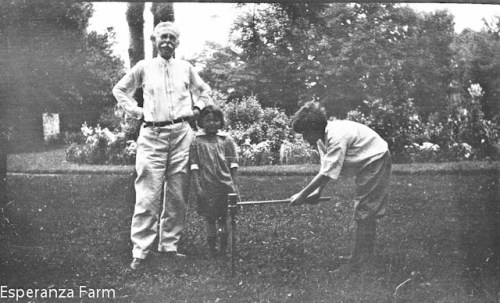
Circa 1915-1920. Kennedy Creevey setting a croquet stake; Eileen Creevey and William Webster Ellsworth (Eileen’s grandfather) watching. On the North Lawn, I think it is about where the ‘little’ Cucumber Magnolia now stands. The flower garden in back is still, or again, a garden. The gravel path, however, is long vanished. Playing croquet on that lawn takes a bit of skill these days, tree roots and nearly a century have turned it into anything but a flat surface.
(I haven’t a clue as to what the white rectangle in the back left is)
The family that this house belongs to or vice versa…has a respectable number of over-achievers in its ancestry. Yale figures rather prominently a few generations back.* To the outside world, those are the important people and they are important, even interesting if you enjoy the history of Connecticut and New York in the 1600’s-1900 centuries. The house comes after the really ‘big’ names, though the over-achievers continue.
Yet, they aren’t actually the people who are important to the house or not the only people. Because, of course, the house, the family reflects everyone. It still exists because some of the family have put themselves into it, entirely, sometimes with grave reservations. In the history of the house Lucy Creevey, who does not show up in the newspapers, is far more significant than her husband, George, who was something of a pioneer in the field of anaesthesia and does get in the news. Lucy did a great deal of work on the house, as well as writing a history of it, shaping future perceptions to a great degree.
And then, of course, in every generation there is the critical influences of the ‘out-laws’. A living house does not exist as a mausoleum for some historic ancestor generations past. It’s culture and outlook change with each generation as new connections are made through these ‘out-laws’: the Catskills, Canada, Kentucky and the Ohio River, Germany, Cincinnati, and the New England coast** The house’s weight shapes and warps these connections of course, an accumulated pile that is larger than the individual, but it cannot ignore or erase them.
When dealing with the history of a place, it may be the house-wife or the farmer who truly shapes it, and not the name blazing in lights. What lesson is there in that? Perhaps nothing, perhaps everything.
*Websters, Ellsworths, Wolcotts, think lawyers, governors, dictionaries, so forth.
**Of course family members also marry out, creating another set of connections. For the alert family members who puzzle over Canada: the marriage of Elizabeth Ellsworth to Frederick Shand Goucher, circa 1910. The Canadian influence pops up in the oddest places.
Comments Off on On ancestors
Landscapes and Modern Photos photography, trees, weather 14:24
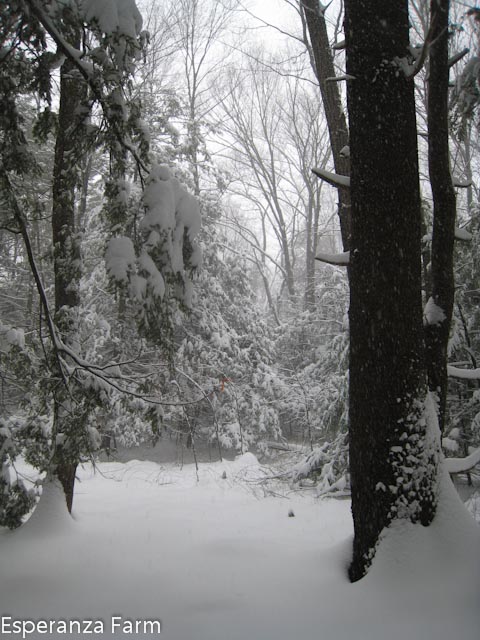
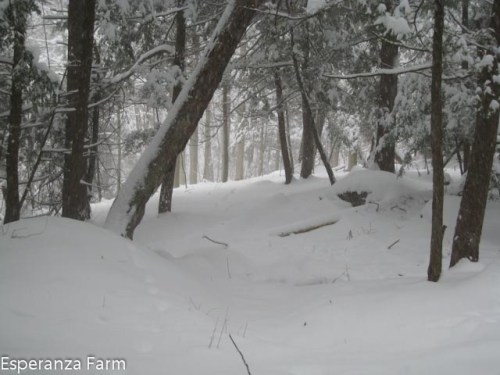
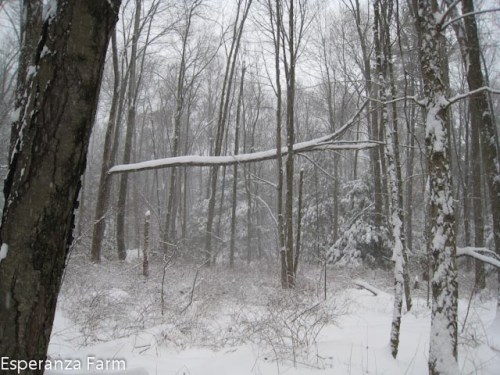
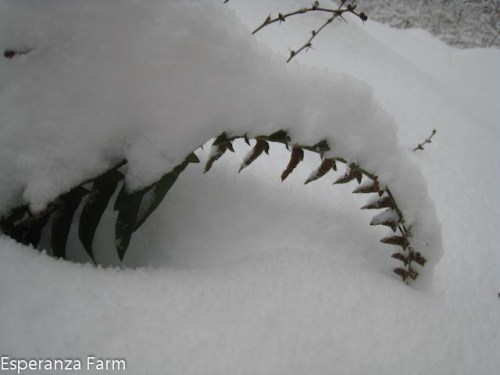
Comments Off on Connecticut woods in winter
Uncategorized weather 14:07
when the house is shaking and the windowpanes rattle. On the plus side…after a distracted morning wondering where the drip is in the library, never a sound one wants to be hearing, I have finally discovered that it is not a drip at all. The big plexiglass panel over the diamond pane windows has developed a tendency to go ‘pop’ at the bottom corner when the winds sets it vibrating just right.
The wind is making nice big drifts out of the snow though. Whirling dervishes of ice rise up out of the meadow and come racing east, the drive that was plowed just a few hours ago is already rapidly closing, while the north lawn has been transformed from a flat plain into a landscape of drifts and eddies around the trees. As the wind hits the west face of the house, it rises and drops the snow; eventually the west lawn will have a great drift that can easily be twenty feet long, for most of its length it will be only a foot or two, but as it drops over the story high bank it will fill the space, eight feet deep. Blocked by the house, the east lawn will have no drifts at all.
Comments Off on You know it’s windy
Projects 13:40
or projects. About this time of year, we tend to start eyeing the house as much as the garden. Reorganization seems to be this year’s theme. Partly because we are, again, completely and utterly out of shelf space for books and partly because the sunniest room in the house is currently being ill-used for art storage.* However, in order to move something somewhere else…first one has to move something else… So in order to reorganize room A, room B has to be cleared, to clear room B one has to reorder (cue ominous music) the Barn.
This leads to a number of projects in and of itself, for example: anybody got nifty ideas on how to attach dust catching curtains to bookshelves which are 10 feet tall, 20 feet long and are in a barn? They have to keep dust out, but let the books breathe to avoid moisture buildup, and have to be easily operable…I’m thinking my Ag. supply company has something….roller shades for dairy barns perhaps?
And for the bibliophiles having heart attacks…those bookshelves will be used for the older technical or professional volumes, horribly written mysteries, and that ilk. Excess encyclopedias, dictionaries, so forth. Anything written pre-1900 or bound in leather is automatically excluded. It still won’t solve the bookshelf problem of course….because the shelves in question are already mostly full…. (and no the answer is not to stop buying or collecting books!)*
*better there than the barn, but the room needs to be usable again.
*in case you’re wondering the last estimate was about 10,000 to 14,000 volumes. Which might be a bit high, since that was a rough guess based on a rough guess of shelf feet. or not, on writing this I just looked at the library, that comes to a bit over 2,000 volumes right there… and the library is misnamed, for other areas have more books…and all rooms have some books…
Uncategorized weather 15:05
Snow, of the heavy damp sort, finishing off as rain. Far nastier stuff to deal with than snow at much colder temperatures. Liquid water at or below the freezing point tends to be heavy and dampening of clothes and spirits. The snowblower can’t deal with it. On the other hand the tractor, believe it or not, started right up and proved effective. Of course, we can’t use the blade on the gravel front drive…so I do hope that no one tries to come in the front entrance. …believing that they can do so, despite it being unplowed, because of the tractor tracks…. Would rather not have to fish a delivery truck out of the meadow.
Comments Off on Brrrr
 Acair Fearann