Weather Tuesday, Dec 8 2015 

complaints….it is nice for some things.  But honestly, forties and sunny day after day does not put one in the mood for Christmas in New England.  Though there was ice all day, thin ice, but still ice on a bit of sheltered water today; so I guess it is trying to be winter.*  I just have this feeling we will pay for it….  more than we already are.

My apologies for the light posting recently, both jobs (and some of the volunteer things) have ratcheted the tension up a bit high.  One job, of course, remains incredibly enjoyable and, God willing, when word comes down from high about the budget will continue as such.  The other is retail in the holiday season in a very, very bad year for retail, less said the better.

However in actual news from here, the canoe has its layer of Dacron successfully applied! It looks sort of like it has been shrink wrapped in parachute cloth.  And essentially that is what has happened.  Awesome!

*Thus neatly demonstrating what had been observed back in the summer: that judging by the healthy hemlocks in that cove it was the coldest spot on the pond.  Considering it is at the northernmost point in the state and shaded from the south and west by a practically vertical hillside of about 300 feet in height, not really a surprise.

So much life Sunday, Dec 6 2015 

out there in woods…the chickadee flitting about above the rhododendrons just after dawn: upside down and right side up all through the trees. The juncos exploding out of the tall grass, tiny flying flecks of slate and bright, bright ivory tail flashes. The squirrels all lined up on the lawn. The evidence of the squirrels in the piles of half eaten acorns here and there.  So many acorns apparently that one can just choose the choicest bit and leave the rest. Even the evidence of man: the nearly complete removal, in a day, of a massive dead oak tree that came down on the road. Somebody got some prime firewood, it had been standing dead for about two or three years and finally tipped over. The only thing left was the butt end and one branch that went a bit too far down the slope, a bit farther than is kosher to go in the ‘if it is wood by the road side it is fair game’ firewood collection strategy.

So much to look at it in a simple walk.

Candles Thursday, Dec 3 2015 

It was nice, the other night, to come home to a house with candles in the windows.  Especially the one on the path up from the barn! Is the tradition from the colonial American period, from the time of Irish persecution, from Judaism, from the Christian liturgy, from the age and world old promise that the traveler will, perhaps even this wild night, return? Does it matter? The candle is lit and the light shines forth.

“There is not enough darkness in all the world to put out the light of even one small candle”- Robert Alden


Forestry Friday, Nov 27 2015 

pondering thereof.  Having been on edge all yesterday (holidays and I do not get on or maybe it was being stuck in the office all day prior or…)

Anyway, I went and killed lots of barberry.  And then wandered about in the woods for most of the afternoon.  I love Connecticut and its land.  But, goodness….I’ve been on quite a bit of it one way or the other, and I really have to say that our chunk is one of the worst in terms of ecology.  Solid barberry, severely high graded fifty years ago, hemlock (dying), ash (dying), and tightly spaced red maple and black birch. The only regeneration is beech. I still love it.  But!

I know what my boss would say: ‘liquidate it’. He might be right.  From the Spring lot (a different issue) down, there are about a dozen good quality oaks and hickories that would be keepers, one nice, but small, pine stand, a few yellow or white birch for aesthetics and…..  Now the narrow strip between the lower road and the first break in the hill is good, a nice mix of beech, tulip, yellow birch, and hickory.*  But it wasn’t poorly managed either. So one would leave that.  It would keep the neighbors happy.

The worst thing about it? It is so bad that it might cost money to do it. The barberry is the real problem along with the deer.  Still, if one could tweak it so that in fifty years it would be a more diverse chunk of forest….

Sure one could wait out the death of the hemlock and ash, but that would be a no go zone till the snags came down, and the result would be uncertain at best and delayed a generation, meanwhile the barberry and, worse the burning bush, just might make a go of a mono-culture…with Lyme Disease.*

It is an interesting comparison to another family piece, not that far away, which reverted from pasture to forest at an earlier date.  That piece is a healthy and very diverse piece of forest; sufficiently high quality that the foresters who have seen it are of the opinion that leaving it alone is a good idea, with which I agree.   Interestingly, the hemlock in that area is doing better, less than half a mile away.*

The question is what is the driving cause for the disparity? Is it the later date and therefore the barberry? The soil? The previous work? That it was regrowing during a time period when the deer population was increasing? Interesting problem.

*That isn’t great, but in comparison!

*The correlation between Barberry, white footed mice, white tail deer, ticks, and Lyme Disease is remarkable in a perverse way.

*The topic of hemlock and what is going on with it in Connecticut is another whole book!

Happy Thanksgiving Thursday, Nov 26 2015 

A mild and quiet day, though I think I might go see if I can deal with some barberry along a stone wall….

For two of my readers, what a pity that this wasn’t the arrangement we sang on Tuesday. (A joint Thanksgiving service with several churches and a particularly painful arrangement of this hymn, at least for those of us who are Anglican by nature)

https://www.youtube.com/watch?v=WBIazkBB9K4

Utter self interest Wednesday, Nov 25 2015 

(I know, I try to keep politics, economics, and religion out of here lest I repeatedly annoy certain cohorts of my readership whom I love dearly and Really don’t want to annoy)

There is much I could write about tonight: land, love, work, stewardship, religion, sunsets over hills, the forest….but I do have to get through this weekend at the other work place, which teaches me still.

So, if you are shopping this weekend? Keep this in mind.

http://spectator.org/articles/64771/something-else-give-thanks

Question Monday, Nov 23 2015 

These November roads

When the moon rides high and cold

Beckon and call to the restless

The shadowed bars of the forest

Are gates on the way

Who has the key?

Not I.

Not fair! Friday, Nov 20 2015 

Had I gotten to the office a bit earlier, I might have hitched a ride up to see the big bull moose that was hanging out up the road a bit.  Interestingly, it was a different bull from the one that was seen about a week ago (no tags).  And, of course, clearly not the cow and calf that has been around either.

Apparently it was an unusually big one for this area.  In any event, whether I saw it or not, still neat!

:) Tuesday, Nov 10 2015 

Something else entirely. (Hat Tip to Maggie’s Farm)


 The History of the English Language

In the beginning there was an island off the coast of Europe. It had no name, for the natives had no language, only a collection of grunts and gestures that roughly translated to “Hey!”, “Gimme!”, and “Pardon me, but would you happen to have any wood?”

Then the Romans invaded it and called it Britain, because the natives were “blue, nasty, br(u->i)tish and short.” This was the start of the importance of u (and its mispronunciation) to the language. After building some roads, killing off some of the nasty little blue people and walling up the rest, the Romans left, taking the language instruction manual with them.

The British were bored so they invited the barbarians to come over (under Hengist) and “Horsa” ’round a bit. The Angles, Saxons, and Jutes brought slightly more refined vocal noises.

All of the vocal sounds of this primitive language were onomatopoetic, being derived from the sounds of battle. Consonants were derived from the sounds of weapons striking a foe. (“Sss” and “th” for example are the sounds of a draw cut, “k” is the sound of a solidly landed axe blow, “b”, “d”, are the sounds of a head dropping onto rock and sod respectively, and “gl” is the sound of a body splashing into a bog. Vowels (which were either gargles in the back of the throat or sharp exhalations) were derived from the sounds the foe himself made when struck.

The barbarians had so much fun that decided to stay for post-revel. The British, finding that they had lost future use of the site, moved into the hills to the west and called themselves Welsh.

The Irish, having heard about language from Patrick, came over to investigate. When they saw the shiny vowels, they pried them loose and took them home. They then raided Wales and stole both their cattle and their vowels, so the poor Welch had to make do with sheep and consonants. (“Old Ap Ivor hadde a farm, L Y L Y W! And on that farm he hadde somme gees. With a dd dd here and a dd dd there…”)

To prevent future raids, the Welsh started calling themselves “Cymry” and gave even longer names to their villages. They figured if no one could pronounce the name of their people or the names of their towns, then no one would visit them. (The success of the tactic is demonstrated still today. How many travel agents have YOU heard suggest a visit to scenic Llyddumlmunnyddthllywddu?)

Meantime, the Irish brought all the shiny new vowels home to Erin. But of course they didn’t know that there was once an instruction manual for them, so they scattered the vowels throughout the language purely as ornaments. Most of the new vowels were not pronounced, and those that were they pronounced differently depending on which kind of consonant they were either preceding or following.

The Danes came over and saw the pretty vowels bedecking all the Irish words. “Ooooh!” they said. They raided Ireland and brought the vowels back home with them. But the Vikings couldn’t keep track of all the Irish rules so they simply pronounced all the vowels “oouuoo.”

In the meantime, the French had invaded Britain, which was populated by descendants of the Germanic Angles, Saxons, and Jutes. After a generation or two, the people were speaking German with a French accent and calling it English. Then the Danes invaded again, crying “Oouuoo! Oouuoo!,” burning abbeys, and trading with the townspeople.

The Britons that the Romans hadn’t killed intermarried with visiting Irish and became Scots. Against the advice of their travel agents, they decided to visit Wales. (The Scots couldn’t read the signposts that said, “This way to LLyddyllwwyddymmllwylldd,” but they could smell sheep a league away.) The Scots took the sheep home with them and made some of them into haggis. What they made with the others we won’t say, but Scots are known to this day for having hairy legs.

The former Welsh, being totally bereft, moved down out of the hills and into London. Because they were the only people in the Islands who played flutes instead of bagpipes, they were called Tooters. This made them very popular. In short order, Henry Tooter got elected King and begin popularizing ornate, unflattering clothing.

Soon, everybody was wearing ornate, unflattering clothing, playing the flute, speaking German with a French accent, pronouncing all their vowels “oouuoo” (which was fairly easy given the French accent), and making lots of money in the wool trade. Because they were rich, people smiled more (remember, at this time, “Beowulf” and “Canterbury Tales” were the only tabloids, and gave generally favorable reviews even to Danes). And since it is next to impossible to keep your vowels in the back of your throat (even if you do speak German with a French accent) while smiling and saying “oouuoo” (try it, you’ll see what I mean), the Great Vowel Shift came about and transformed the English language.

The very richest had their vowels shifted right out in front of their teeth. They settled in Manchester and later in Boston.

There were a few poor souls who, cut off from the economic prosperity of the wool trade, continued to swallow their vowels. They wandered the countryside in misery and despair until they came to the docks of London, where their dialect devolved into the incomprehensible language known as Cockney. Later, it was taken overseas and further brutalized by merging it with Dutch and Italian to create Brooklynese.

That’s what happened, you can check for yourself. But I advise you to just take our word for it.

Copyright (c) 1994 Corrie Bergeron and Ben Tucker all rights reserved

Road Closed Thursday, Oct 29 2015 

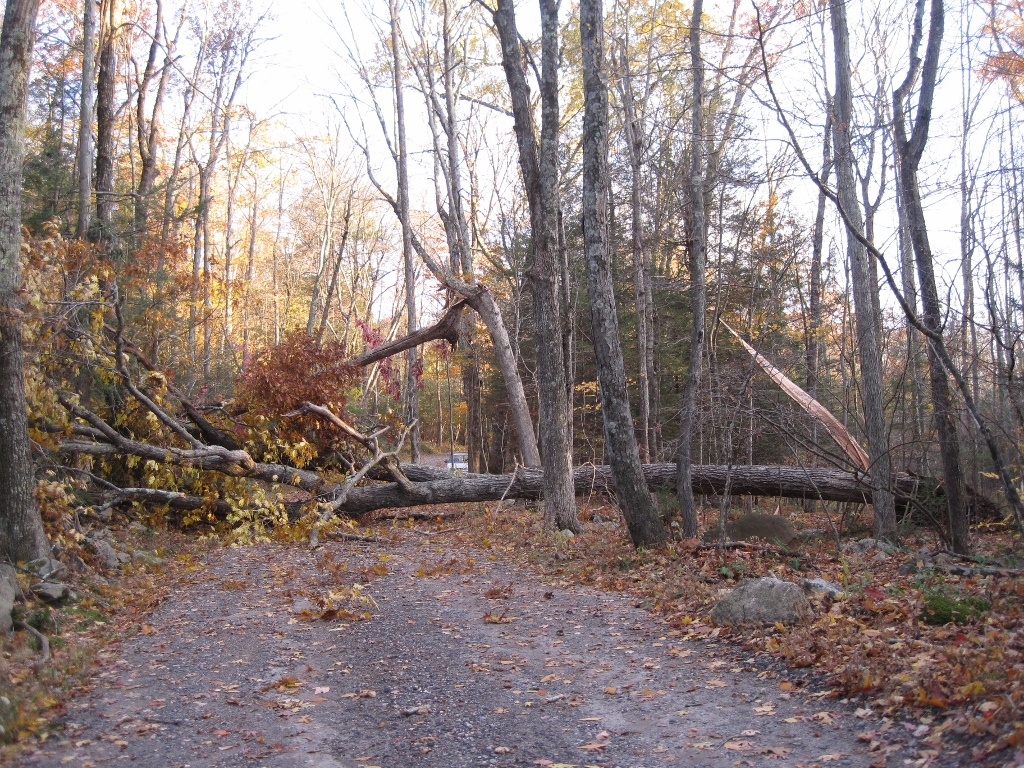
We had some gusty wind today, enough to knock things over at times. Apparently one of these victims was this big red oak. A perfectly healthy tree, but perhaps just too much crown to hold. Far be it from me to figure out why this tree would go over and not any number of others. This one was well balanced with no discernible rot (even after the fact and looking at the base). It squished the white oak next to it as well, which is a pity since I always liked that white oak: it had character. I’ll be interested to see what the town does or does not cut and how, since that is a very nice section of oak there.  Past history suggests someone will run off with it. Though, it is large enough that they may not.

The road is sixteen feet wide, for scale.

033 (1024x768)

« Previous PageNext Page »