Watching the Game Saturday, May 4 2013 

1920c013

early 1920’s. The tennis court doesn’t look like that anymore (which is fine, none of us play tennis). For the plumber, note the spigot there in the lower right, now which mystery pipe do you suppose That is?
The only positively identified individuals are the three closest: George Creevey in the rocker with the most impressive pipe, William Webster Ellsworth with the white moustache, and Eileen Creevey closest to the camera on the bank (shorts and glasses), the boy looking at the camera might be Kennedy Creevey, but he could easily be the boy looking away too.
I should add, that according to the series, the people playing tennis also dressed in the same fashion, actually one has a tie and a hat on…

Letters Friday, Apr 26 2013 

A short vignette from a letter by Martha Kilbourne to Helen, dated 1873. Martha, or Mattie, was one of Helen’s close friends, she was 16 when she wrote this letter.
“Lizzie is in Great Barrington and will stay there until school commences. It is so very warm she does not dare to go down to Conn. She is boarding in a splendid old farm house. It has two very large rooms on the first floor, her room is over 20 feet square, is furnished in the modern style and very richly. Her parlor is richly furnished it has pale green with rose buds embroidered on it (note: she means the furniture in the room, not the room!). It has two sofas, one sleepy hollow chair, four easy chairs, a large table, inlaid cabinet, piano, and a beautiful case for music. She has a balcony running by both rooms.”
It is clear from the description, since the parlor is unlikely to have been much larger than Lizzie’s other room, that excessive amounts of furniture are typical in upper middle class houses of this time period. The sheer number of chairs! (the original transcription, I should add, suggests there are another 11 chairs…but I have my doubts about the transcription)* A piano would almost be a required item for Lizzie, or any girl in that class, during the summer in order to keep up with her lessons.
Esperanza’s excess of furniture was clearly not a unique situation…

* the eleven is the only number that is typed as a number and not as a word, and there are several other longer numbers in the letter which are typed as words. This discrepancy rings alarm bells.

Historical Perspectives Sunday, Apr 14 2013 

I am poking at the project of working through the Ellsworth letters (mostly Emily Webster Ellsworth, Oliver Ellsworth, and Caroline Cleveland Smith with dates between 1820-1860)* I say poking, because the transcription is going to be daunting and it is an open question as to how many people are actually interested. Still, on my first letter I think there is some promise.

This is from July 1847 from Roswell C. Smith to his daughter Caroline (later the wife of Oliver, who was the grandson of the chief justice Oliver and son of William Wolcott Ellsworth). It is a curious letter in many respects, but it is also an interesting glimpse into a very new technology: railroads. Caroline was travelling from New Haven to Hartford by the railroad, rather than the stage. We would look at this letter and wonder why her father is making such a fuss (she was grown and living independently) until we remember that the railroad is the first Mechanical form of travel. A horse or a stage coach, though potentially quite dangerous, will attempt to react and avoid someone stepping out in front of them; they may not succed, but a reaction will occur. A rail car (or an automobile or a plane or an industrial engine or a power tool or…) cannot and will not. We, theoretically, understand that there are many mechanical devices which will continue on their path regardless of a person being in the way.* However, in 1847 many people unless they worked in some of the factories would have little or no experience with this. Looked at that way, the paragraph makes a bit more sense, in my opinion.

“It will be rather difficult for you to pick out your baggage, get it carried up to the City Hotel etc. but you will know more after the trial. Recollect not to stand outside or in front of the cars at any time, one man, Mr. Stockport, who married Miss Benjamin of Norwich, Foster’s wife’s mother’s daughter, lost his life instantly by so doing. Keep in the cars till they stop. In Hartford the baggage is taken off a few rods behind where the cars stop, before it comes to the depot, it goes over a little bridge near ?, then backs some ways into the Hartford depot. Always remem. to stay inside of the cars till they stop. I may give Burgess some directions, as I shall probably be there the day before you arrive as I shall learn by your letter.”

*That is what the box says…whether the list is accurate…no one knows.
*I say theoretically, Youtube gives us hours of proof that we seem to be incapable of figuring out physics.

84 Canal Street, New Orleans Saturday, Apr 13 2013 

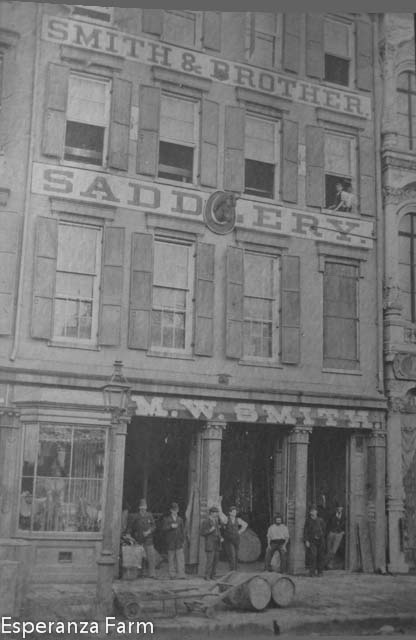
I have periodically mentioned the New Orleans connection. Morris Smith’s other headquarters were located in New Orleans from the late 1840’s through the 1890’s. Subsidiary stores were in Tennessee and Kentucky. Hartford seems to have been the only New England store.*
Morris never owned a house in New Orleans, when the girls joined him down there they took rooms; but otherwise he stayed either with his partners or at the office itself.
This is the only known picture of Morris’ store, the date is unknown:
IMG_8963

It Does Not look like that anymore!

*I have yet to do any research on the company, which is a pity as the little I know is fascinating. For all I know there is loads of information somewhere, but not here.

High Spirits Tuesday, Apr 9 2013 

The romance, if ever there was, of long voyages is rather gone these days… The excitement of people leaving for months or years, with no possible contact but the odd letter (which may or may not correspond with letters sent by the other party), cannot exist in today’s world.
Here is a short excerpt of a letter written by Edward B. Hooker to Helen Yale Smith just after she left for Europe in 1873. A bit of background, she had just turned 18, he was a senior in highschool. They were close friends, but nothing more; although a passing comment in one of Edward’s letters suggests that he would have been happy to be more… In regards to context consider also that this letter to Helen could not have possibly reached her for several weeks, as it would have been on the next mail boat and would then have had to be forwarded to which-ever hotel she was in. All unknowns.

“My gracious how I did yell and cheer when the Baltic left the dock. You must have heard me. Didn’t you? I saw you and Mattie waving your handkerchiefs to a part of the dock entirely remote from our position. Then I up and yelled and I think you saw us for you waved in our direction. I proposed three cheers and gave most of them myself. I don’t see how I managed to stand up on those beams I was so excited. As a last farewell my little deringer made himself heard. Did you hear it?
We all kept up bravely while we were on (could see) the ship, but when she gradually faded away and grew beautifully less and less there was a general caving in. In fact I own to a slight dampness myself. Then the sad remains of us went back.”

Edward would be in Europe during 1875, but they did not see each other again for over two years, though many letters went back and forth. His letters still exist, though not hers, and we see a shift in them from a bouncing teenager to a young man.

From a letter Friday, Apr 5 2013 

In the 1870’s, when her four daughters were all nearly of age: Fanny and Carlotta variously working or caring for family members, Helen in Europe, and Lucy a teenager; Julie spent part of each winter in New Orleans with Morris rather than living in Hartford. New Orleans was clearly a very important part of their lives, yet it always seems to have a curiously insubstantial feel as captured here by a letter from Julie in 1875:

“One week from today I expect to set sail for New York…Already the orange blossoms and the pomegranate buds, and the thousand roses, and the Japan plums, and all the peculiar enjoyments of New Orleans begin to slide backwards into the part and I look forward to the hard work which awaits me at home.”

Julie clearly never saw New Orleans as a home. I strongly suspect that Lucy’s death in New Orleans a few years later ensured that any desire for a connection was entirely extinguished.
The distance was compounded in the next generation: Fanny, and Carlotta all spent a great deal of time in New Orleans, but Helen never did. Helen’s marriage to WWE ensured that the next generation was a solid part of New York City; and New Orleans faded into the past. It still pops up though, here and there in the house. Mostly in the artwork, sometimes in things relating to Fanny and Carlotta (whose letters I have yet to contemplate)

From the Guestbook Thursday, Mar 28 2013 

IMG_9442

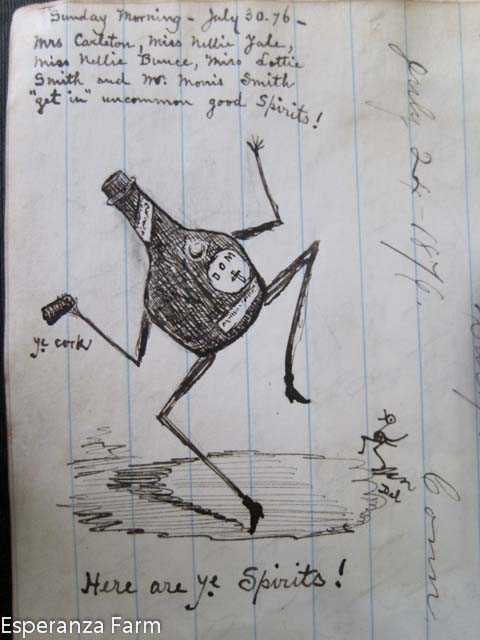
July 1876.  The caption reads: “Mrs. Carleton, Miss Nellie Yale, Miss Nellie Bunce, Miss Lottie Smith, and Mr. Morris Smith ‘get in’ uncommon good spirits!”

Once again the dancing bird is the author’s signature.  Perhaps one of the Carletons. Mrs. Carleton was the wife of Julie’s publisher George W. Carleton, and they often came out for weekends. Nellie Yale is Helen Ellsworth, Nellie Bunce was one of her friends, Lottie is Carlotta Smith (Helen’s older sister), Morris is Julie’s husband and the father of Helen and Carlotta.  Judging by the bottle, I suspect dancing was involved. Music (Carlotta was a pianist) and theater (Helen’s love) were also likely to have been part of the entertainment.

Picturesque Travels Monday, Mar 18 2013 

From , a letter by Edward Beecher Hooker, in Hartford, to Helen Yale Ellsworth, travelling in Europe, 1873:

“Miss Nellie Stanley gave a little party last Wednesday night. I drove over, with Sam, in the carriage carrying Belle Spence, Hattie Coit, and Bob Andrews. We had barely started, when in briskly going over a crosswalk, the carriage bounced and a spring broke. Luckily it was not the main leaf spring, but a minor one, so we went on though the carriage rattled and tipped considerably. It was lovely moonlight. Arrived at Miss Stanley’s about eight. The evening was passed in dancing and conversation, not forgetting the refreshments, oysters, coffee, cake, nuts, candy, and grapes. I danced the Boston, but did not find anyone with whom I could dance quite as easily as Lucy and you.

Left Miss Stanley’s some after eleven. The horse had not been put under a shed and a frost had fallen so the seats were icy and cold. The bridge and causeway on the other side of the river is often dangerous on account of robbers etc. but we were not molested. I was prepared for there was a revolver and slung-shot under the front cushion ready for emergencies. If anything had happened I, with great presence of mind, probably would have shot someone in the carriage and pitched the slung-shot in the river. I really wonder what I would do if I should be attacked. I am afraid I would run or surrender all my valuables and beg for quarter. No one can tell how he would act till he has been tried. I wonder what you will do if you happen to travel in Italy and fall in with brigands. Something heroic and grand without doubt.”

I think it is a sling-shot he is talking about here.  Hartford seems to have had a plague of highway-men in the late 1800’s; at least once a robbery was fought off by the girls.  Hooker’s letters, of which there are about 3o are truly entertaining.  They have a huge amount of information about the social life, culture and education of college age men and women in Hartford at the time.  They also tend to be at once dramatic and understated.  Having finished discussing highway-men, this letter goes back to discussing literature without any histronics.

From the bookshelves Saturday, Mar 9 2013 

I have been remiss, no doubt, in not discussing to any degree the family bookshelf.  That is the bookshelf which holds the various books written by family members.  It does not include, for the most part, books written before Esperanza was purchased, though the top shelf is mostly given over to Roswell Smith, who wrote science textbooks in the mid 1800’s.  But much of the output of the Ellsworths, Websters, etc is not there since that comes before the house.  It isn’t a huge collection: discounting self-published work, but counting doctoral theses it comes to 78 books.  Most generations since, however, have succeeded in getting at least one book published, sometimes more.  It isn’t complete, unfortunately.

Julie’s novels are, of course, included.  As I had created a list for a presentation today, I thought it would be worthwhile to list them here.  This doesn’t include the short stories which were written earlier for various magazines and newspapers.  I don’t know of a complete list of those, tracking down that sort of publication is an absolute nightmare.  The titles give some indication of the themes, which mostly revolved around young people in a bucolic, semi-pastoral small town.

Originally Published by G.W. Carleton & Co.; New York, New York

Widow Goldsmith’s Daughter; 1870

Chris and Otho; 1870

The Widower; 1871

The Married Belle; 1872

Ten Old Maids; 1874

Courting and Farming; 1875

His Young Wife; 1876

Kiss and Be Friends; 1878

Lucy; 1880

Blossom Bud; 1883

Accurate dates or miscellany Monday, Mar 4 2013 

Letters are so useful!

Julie’s pond was definitely dug in the summer of 1874.  The pond today, taken on the winter solstice at sunset.  A few more trees, but a good job on the dam.  It has had to be repaired, but only the once back in 2011.  And considering the size of the embankment, that is no mean feat.  The drop on the far side of the bank in this view is about 12 feet.

IMG_6536


« Previous PageNext Page »