Comments Off on Winter Hemlocks
gardening and Modern Photos gardening, photography, trees 22:59
Comments Off on Winter Hemlocks
gardening and Modern Photos and Trees gardening, trees, weather 12:21
Contrary to the expected, December around here tends more towards ice than snow. This year, the long spell of close/below freezing has meant that our current winter weather is rather mild: it started as snow and is now sort of drizzle.
Other years, however, it comes as ice. That ice can be pretty is in no way a redeeming feature. It tends to prune trees in an unfortunate manner. Most of the native trees can adapt, hemlock and spruce simply droop, white pine unfortunately tends to drop branches, usually snapping off a few feet out from the main trunk.* This doesn’t bother the tree, but people don’t care for it. Birches bend, until they don’t of course. Oaks and Maples stand tall, unless they are unbalanced due to a combination of factors (unbalanced rapid growth, saturated ground, wind, etc.); they usually don’t drop branches in ice storms however.** The truly vulnerable trees are the non-native ornamental ones which often have many narrowly branched limbs, such as Japanese Maples; sadly those tend to tear off at the trunk, making for a difficult pruning job afterwards.
This shows a light ice-load on the trees east of the house, you can see how the Norway Spruces in the background (which normally would be touching) have turned into individual ‘cones’ as the branches are weighed down. The closest trees are pines, and you can just tell that the main branches do not flex at all, only the smaller branches under a few inches in diameter. The Maples in the midground have not changed shape at all.
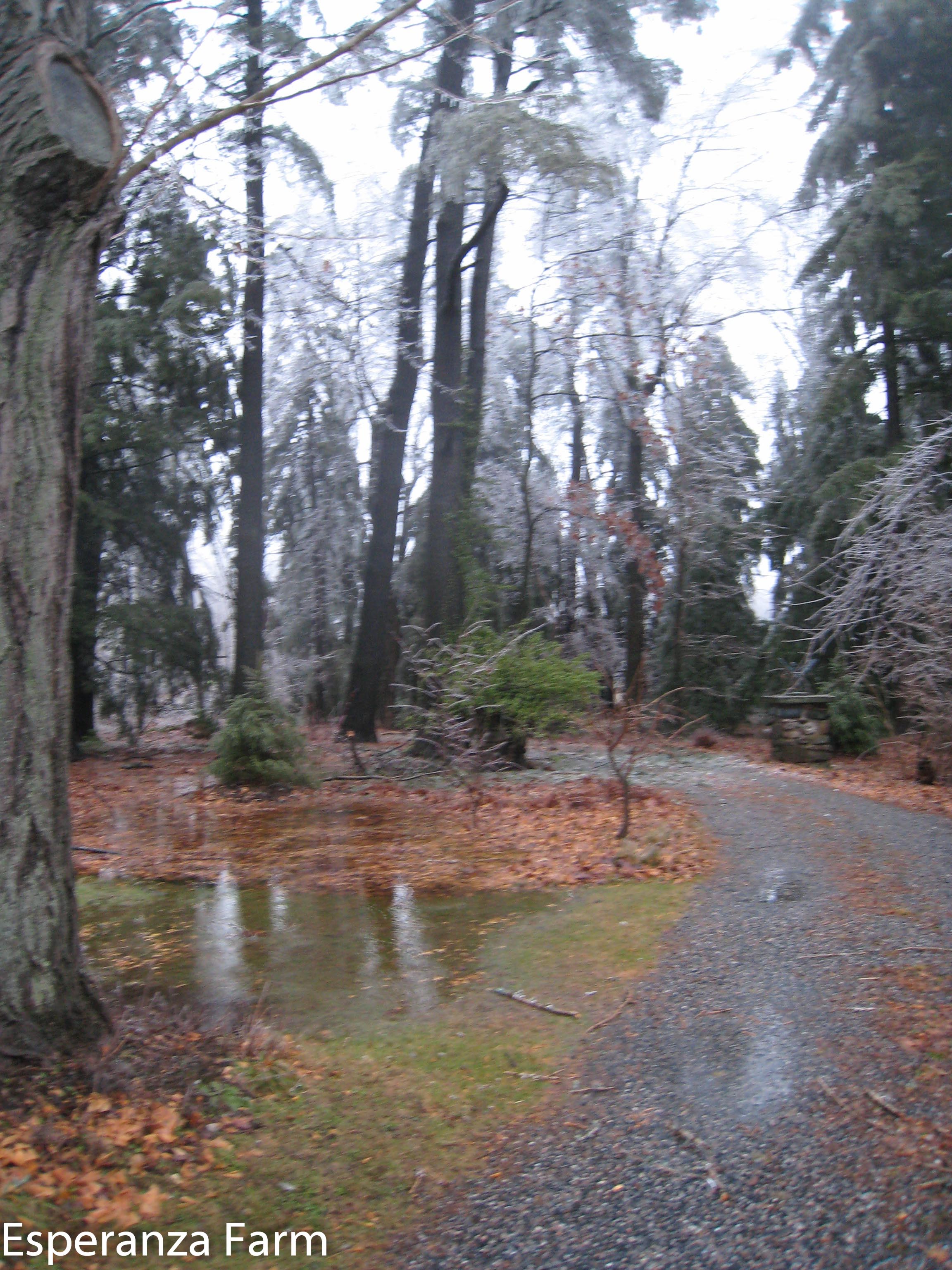
*Mature white pines, that is, the 70 ft plus monsters, such as the ones in the photo. The limbs simply fracture, if you look at them afterwards there is very little tearing in the way you see on maple or ash.
**Look, All Trees can and do drop things in storms (don’t go dancing around in the woods without paying attention to what is above you!)
Balanced trees are important, some trees are more tolerant than others and can carry an uneven load: as is shown by this River Birch, which is quite one-sided, but it capable of bending in the main trunk:

However, there is always a possibility that they can carry the uneven load until they don’t: this double trunk Red Oak was about sixty years old, perfectly healthy. It simply grew a bit too much due to the other side of the road being cleared two years previously, giving it much more light. As you can see, there were no branches on the side facing away from the road. Ice plus saturated ground plus a year of abundant extra growth and…thud. (this was several years ago, the trees have since been aggressively pruned by the DOT)*
.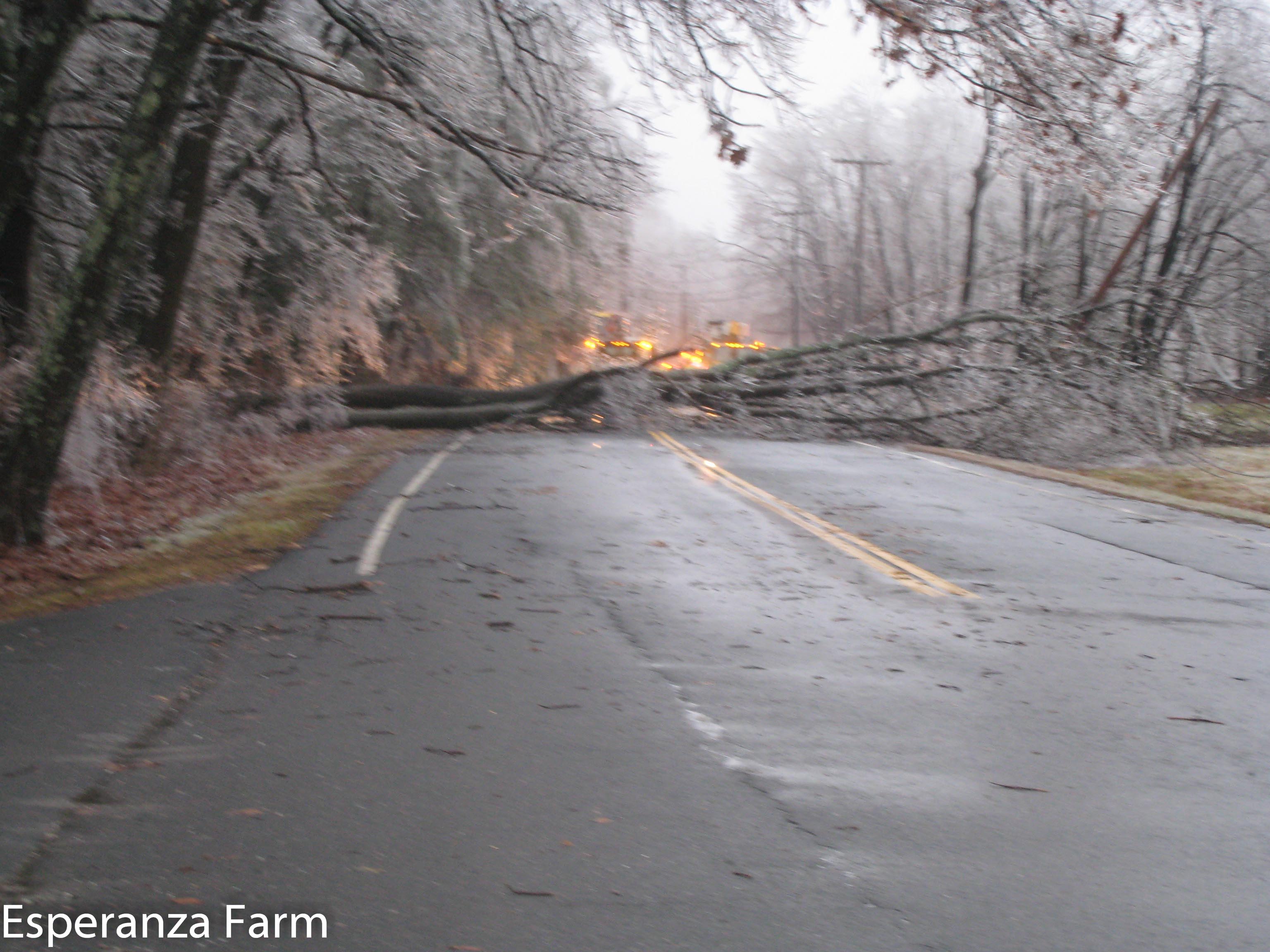
*Murphy’s Law being what it is, there was a car going past at the time. The driver was fine, the car not so much.
Comments Off on December Ice
gardening and Landscapes and Modern Photos gardening, maples, photography 14:38
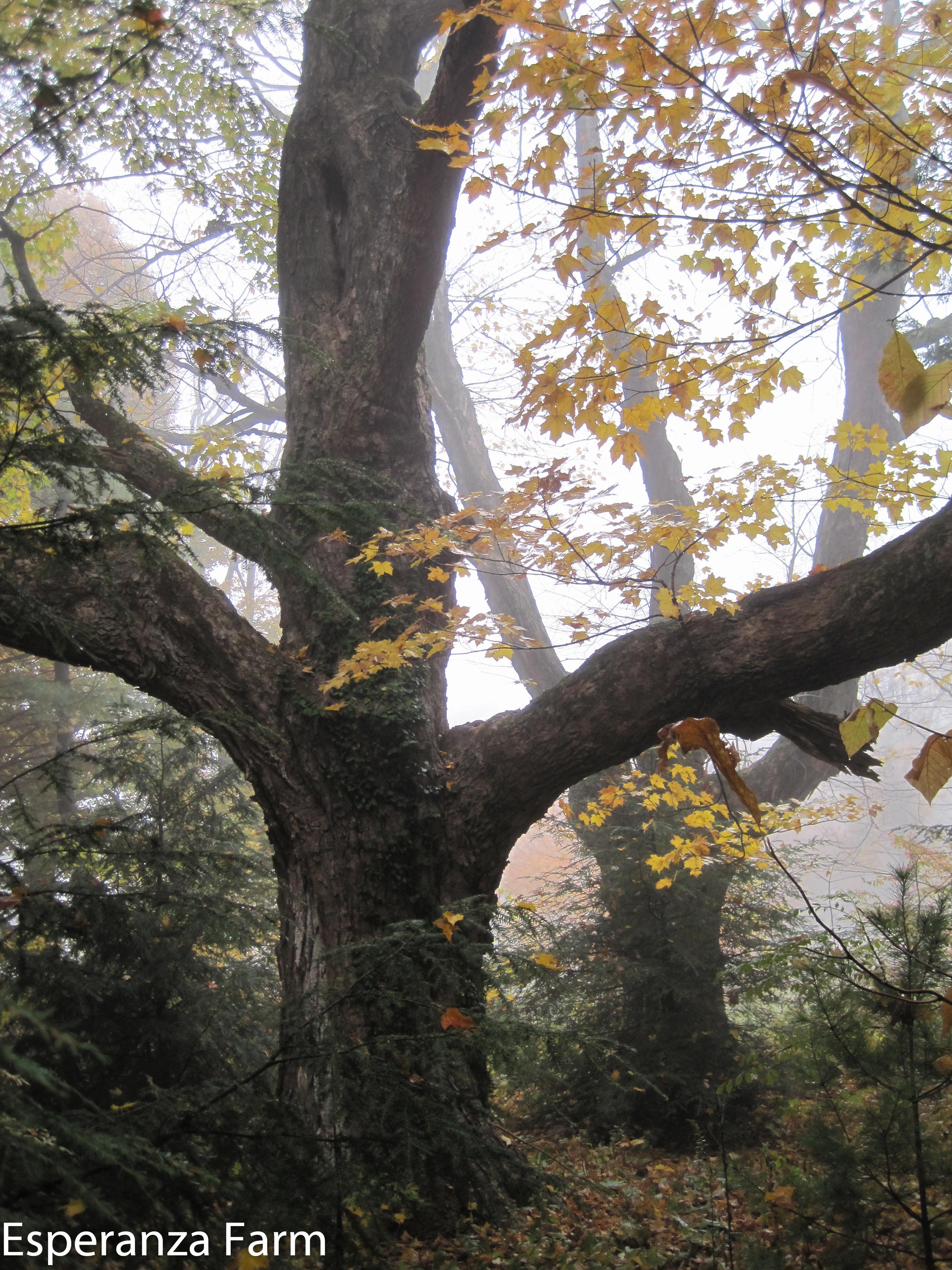
Out beyond the big garden, lining the old road. It is essentially impossible to get a good picture of them, too big and too close! I cannot touch the bottom of those lower limbs, however, even on my toes and arm outstretched. We have planted beneath them with a mix of evergreens, as the new road/highway is only about fifty feet away from this point, off to the right of the photo.
gardening birding, gardening 14:02
The ‘Wolf River’ apple tree that did its once every few years, at random, massive apple crop this year (necessitating marathon sessions of applesauce making) still has a few apples on it. It shouldn’t, for the health of the tree, but I am glad it does.
The apples are frozen solid at the moment, and look a bit like Christmas ornaments as they are scattered picturesquely through the upper branches*. That is nice enough. But what is especially pleasant is the discovery that the odd pockmarks/toothmarks which have been slowly appearing on them belong primarily to the woodpeckers. Sapsuckers, Downy, Hairy, and the lot. I don’t know if the Red Bellied has been past or not, but I wouldn’t be surprised. A nice treat for them and for us.
*It was Supposed to be a semi-dwarf. Ten years on and it is quite clear that we got a standard instead….
Comments Off on Apples and Woodpeckers
gardening gardening, holiday, theology 12:25
We all have specific calendars we pay attention beyond the standard calendar: school, gardening, theological, tax, politics, so forth. I am ‘tuned’ to only two, gardening and theology. (tax and politics can go hang) They are not in conflict in the way school (new year in the fall) and gardening (new year in the spring) are, but rather offset in such a way that they work together. The theological calendar starts its new year in December for me, at the time when the garden is done for the year and I am looking ahead to the coming year. Theologically, the calendar peaks in Spring, with the long summer stretching out ahead in a fairly stable pattern. The same with the garden.
This, of course, is hardly accidental: the early Christians paid close attention to the climate in the Roman Empire, and the seasonal cycle for that bit of the world is roughly the same as it is in northeastern North America, if much milder.*
Consequently, I would have a horrid time adjusting my internal clock to Australia or South America. All of this came to mind talking to my farrier on bitterly cold and windy morning, commiserating on holding horses in the winter and holiday plans. He is originally from LA, and commented that he much preferred New England in the holiday season: ‘everything makes more sense’ (referring to Christmas trees, turkeys, and all that). Obviously, one can have an excellent Christmas in Rio, or Melbourne, or Wellington. But it is rather nice to be able to look forward to the holiday season, it takes the sting away from the fact that it is cold out there! And dark, and cold, and you can’t do anything outside that is constructive and dark and cold and…
Winter is closing in, but next year is already coming.**
*aligning the two calendars was as much about using the natural world as an object lesson/mirror as it was about politics/historical accuracy. One need not get into the tangle of whether it was human manufacture or divine intent plus human manufacture
**I just hope winter holds off a little, as sexton of the nearby cemetery, I have a funeral that is coming up, and this cemetery follows New England tradition if there is snow or the ground is frozen one waits till spring, which is a little hard to explain to people these days. It looks like it will just squeak in.
Comments Off on The turning wheel
Esperanza and gardening and Landscapes and Modern Photos gardening 23:45
One of the more common problems with projects around here is the ‘everything is Bigger’ one. In the house this cropped up recently with the discovery that the ceiling in one room was not 15 feet, but more like 17 plus to the peak….of course in some other rooms it is less than seven, so no guarantees.
It is fairly typical to hit this with trees, usually when we try to prune them.
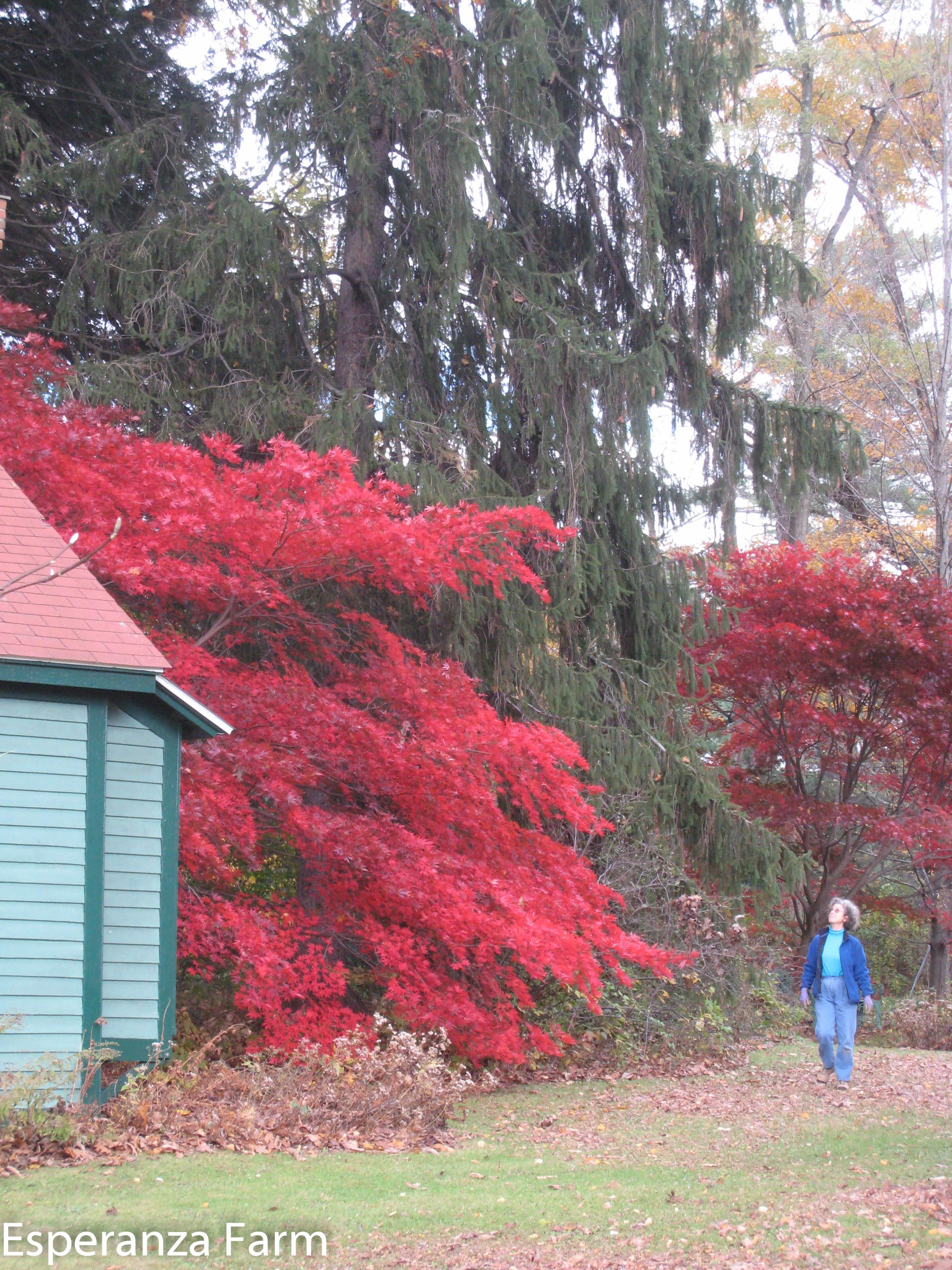
The scale of the place is rarely conveyed in photos, since I hate taking photos of people and most people around here have no desire to have their photo taken.
This rare shot helps illustrate scale. (my apologies to the model! ) 🙂 Consider it in relation to the Japanese Maple photo of a few days, which shows the same trees.
Comments Off on The Problem of Scale
gardening and Historic Photos and Landscapes and Modern Photos gardening, japanese maples, photography 23:02
I mentioned in passing that I don’t object to Japanese Maples, which is good as we have a number of them…Although some of the more strict ‘native plants only’ group would argue for them being invasive; they don’t fit the definition very well here. They grow much too slowly to compete with native maples or oaks, (assuming of course there are native maples to seed the area). They do, however, germinate and grow. We started with two: a finely cut dwarf and a fairly coarse purple/red back in the 1920’s. They have crossed over the years and have produced many babies: some with finer cut leaves than others; some with good fall color (brilliant orange or scarlet), some that are an OK purple/red; some that have green summer foliage (always orange in the fall), some with dark red summer foliage.
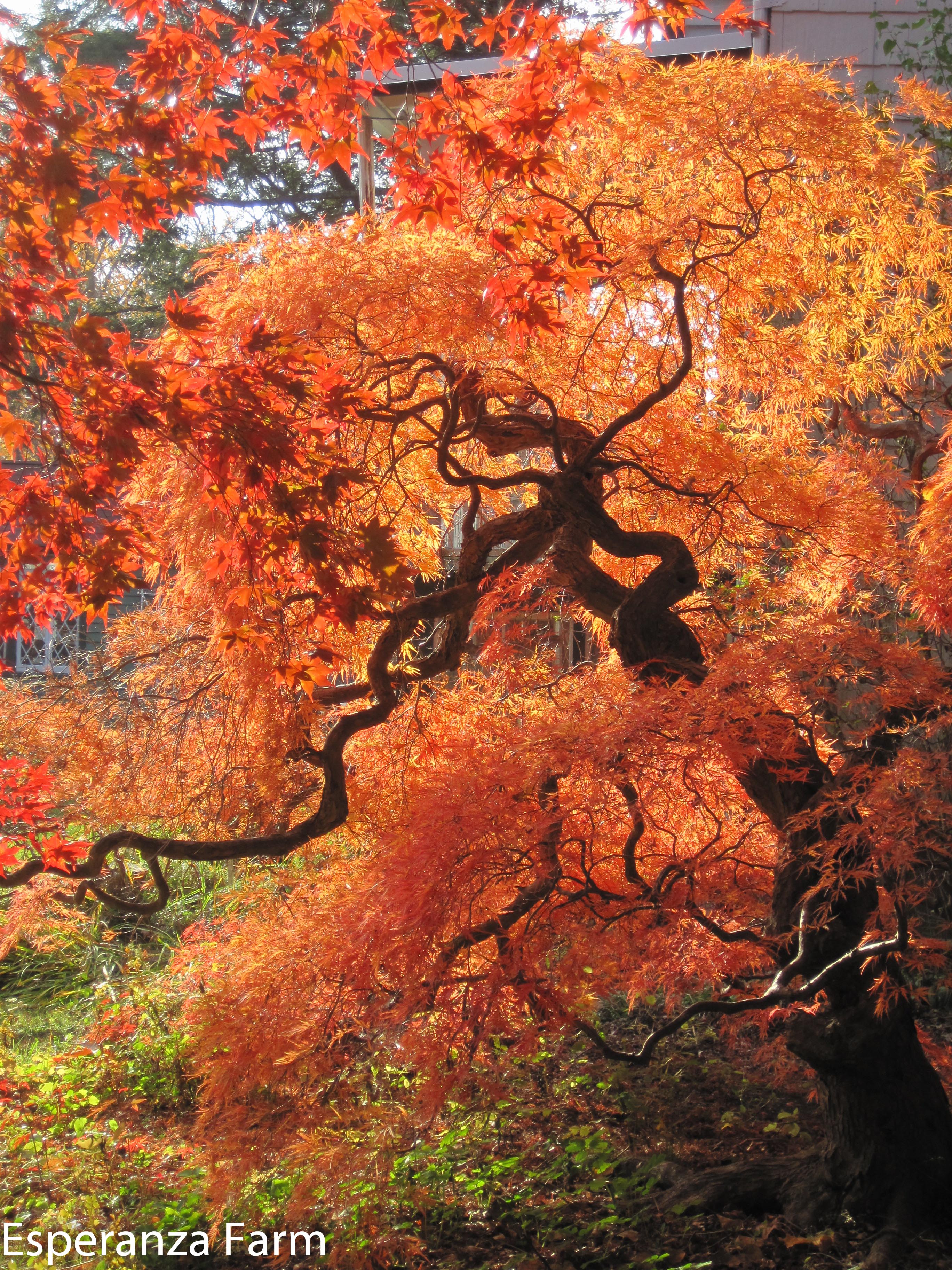 The original dwarf, finely cut one. You can see a branch of the other original in the top left corner. Sadly, this dwarf is not long for the world, this photo was taken three years ago, the top branches have since died.
 One of the babies with a fairly typical medium fine cut, this one is almost green in the summer.
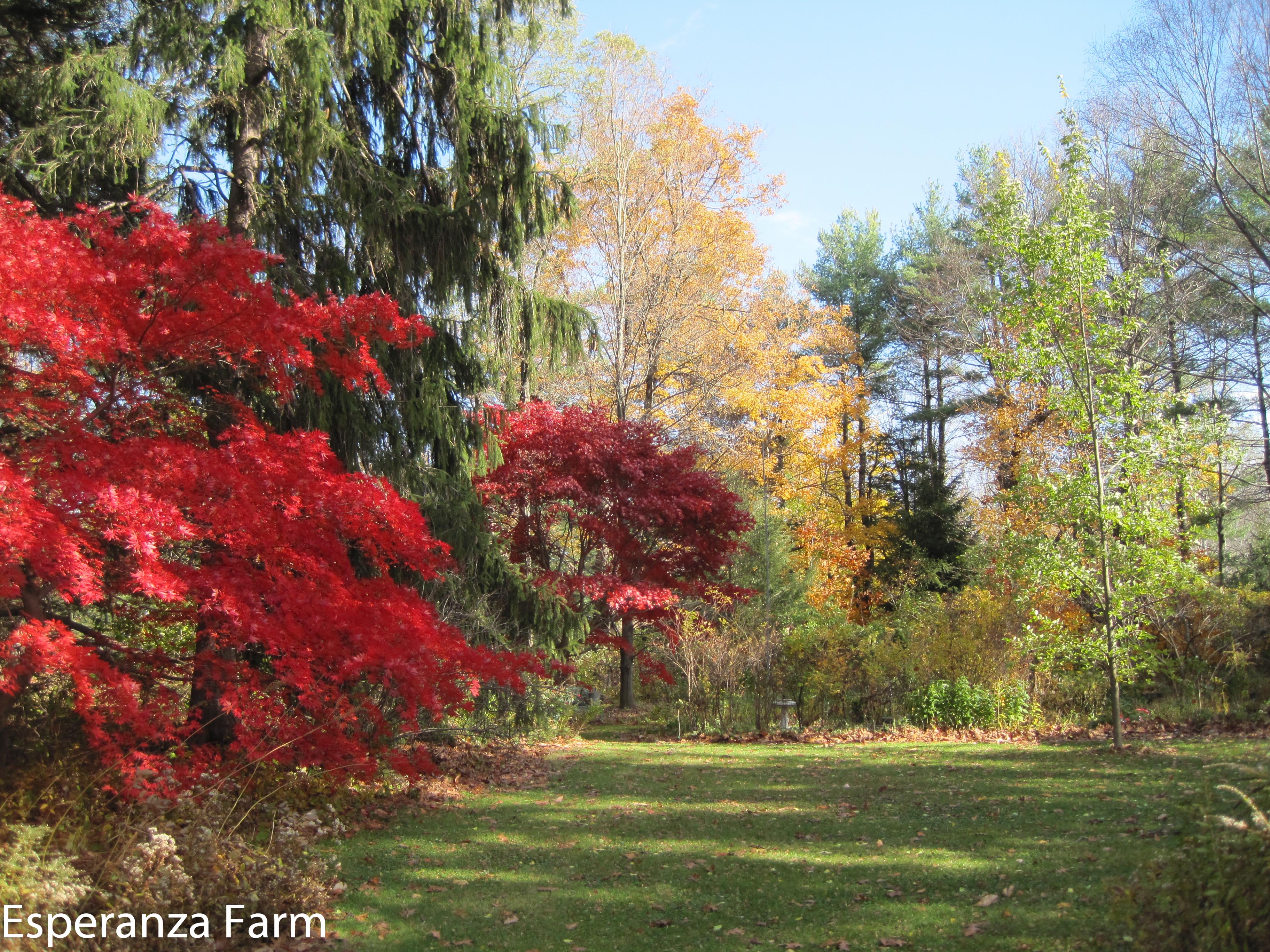 Two of the offspring, the closer one is a genuine scarlet in the fall, the other is noticeably more purple/maroon. That is accurate color in the photo.
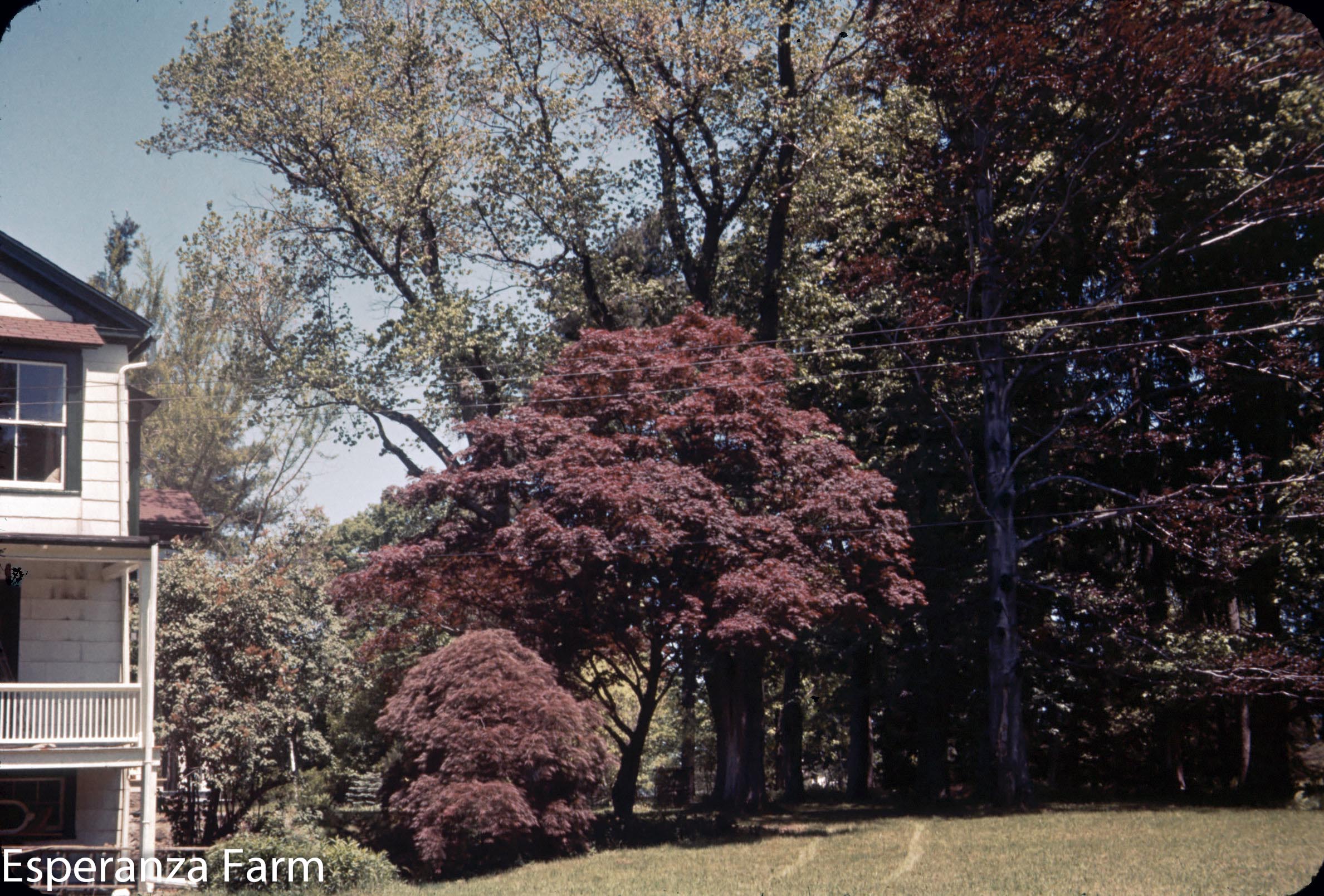 One of the earliest photos that show the original two in 1957.
 The same maples in 2012. This maroon color is the standard for most of the offspring as well.
gardening and Landscapes gardening 22:50
find little engines (in mowers, string-trimmers, chainsaws, etc) to be utterly, totally invaluable and irreplaceable? And utterly infuriating?
The lawnmower didn’t like the cold and didn’t like the load that the leaf-catcher put on it, and kept stalling. It had to be on clean ground with exactly the right amount of choke/throttle to engage yesterday. On the other hand, I can’t imagine raking all those gingko leaves…
And the string trimmer….getting it restarted after refilling the gas tank? Flood, wait, flood, wrench the wrist, flood, start! Then it runs beautifully. And clearing the unwanted seedlings from five acres? While going around all the wanted saplings and seedlings? Well a brush scythe would do it, but it would take forever and not be nearly as neat.
Useful gadgets, but they certainly are prima donnas!
gardening and Trees gardening, gingkos, trees 21:06
We have two Gingkos, one about 120 years old and one about fifty. Thankfully, both are males, so no fruit. They are lovely trees, though the young one is too big for its space. They are quite hardy in this area, but they have some quirks…. In the fall, if the temperature drops to a certain point, they drop ALL their leaves ALL at once (as in less than eight hours). It doesn’t matter if they are still green or have turned gold, they will drop.
As it turns out, it would seem that 25 F is that temperature. At least, yesterday both had essentially all their leaves. Last night hit 25 F; this morning there was a gentle, steady patter of falling leaves. By noon they were bare and the ground was carpeted several inches deep in leaves. This year about eighty percent had turned, so it is a mostly gold carpet; but they are still a bit green and a bit soggy. I will pick them up tomorrow.
The other quirk is that gingko leaves do not decompose easily. Fallen leaves, if they have turned gold and dried out, can last several years in dry shade. They are hydrophobic, even in a watered compost pile, they will form clumps that are literally bone dry despite being surrounded by soggy material. If they are green when they fall, they will decompose…..much like banana peels will…. (i.e. suffocating slime) this is not desirable! We pick them up, separated from the other leaves and create a pile which just sort of sits there. We try to pick up only about half of the oak/maple/magnolia/beech leaves, leaving the rest as mulch; but we try to collect essentially all of the gingko leaves.
gardening and Modern Photos gardening, maples 22:06
I fail, utterly, to understand why people plant Norway Maples by the thousand. Japanese Maples I understand (I’d better, otherwise I am a total hypocrite). But Norways? Now, we have several very large Norways, but I cut every sapling I see. They have poor fall color, rarely have good structure (especially the more modern cultivars), and blah bark. Never mind that havoc they are wreaking as invasive species par excellence!
The quandary is made worse by the existence of three outstanding native maples: Sugar, Red, and Silver. All three have gorgeous fall color, the Red and Silver are very tough trees, (the Silver is a common urban street tree in Montreal), both the Red and Silver are fast growing, they have generally good structure (full grown Sugar Maples are classics), elegant bark, and did I mention the fall color…?
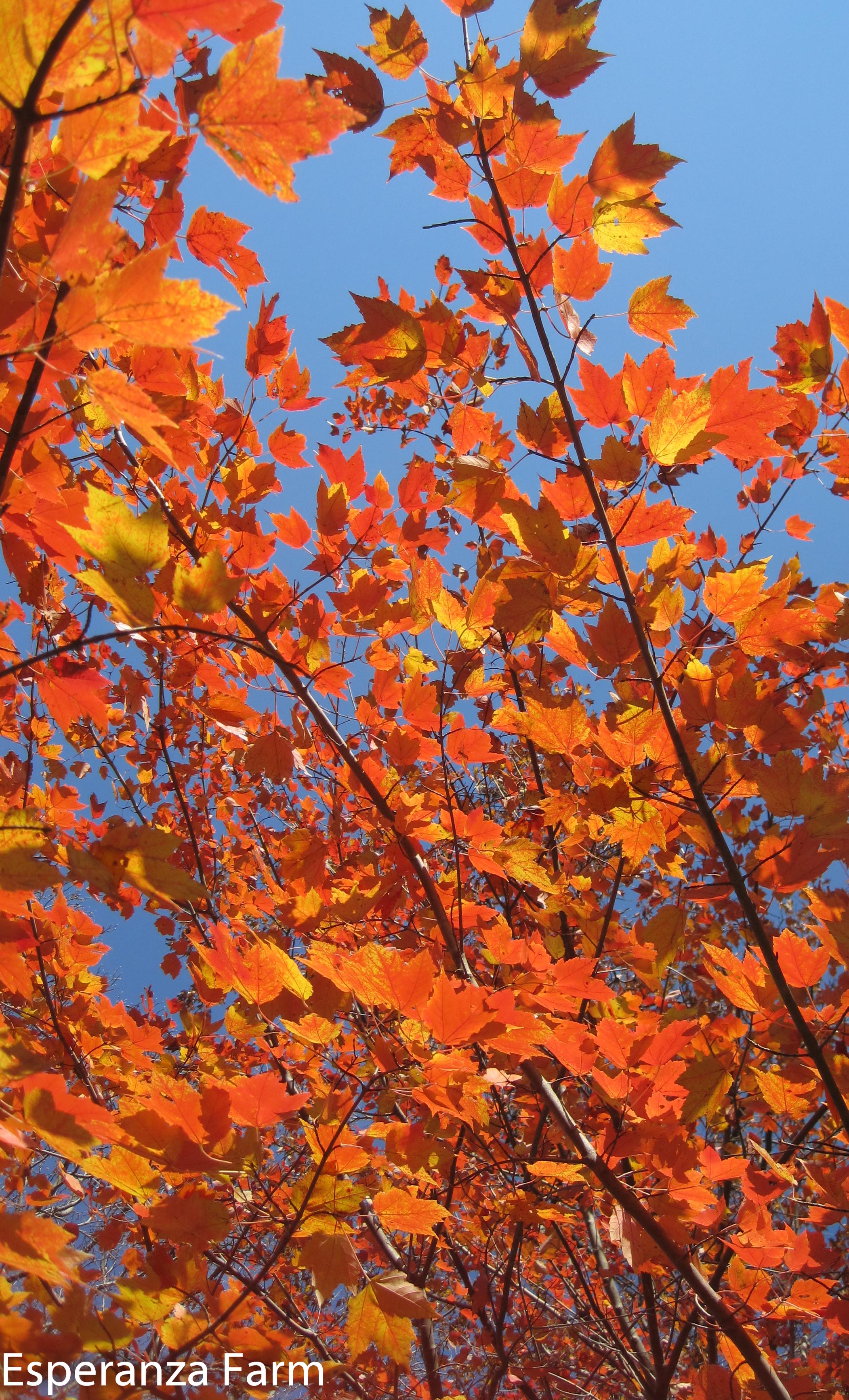
Here is a shot of our young Red Maple, looking up into it, hardly doing it justice. And this, in a Terrible year for fall color. It is an orange one, some around here are a true scarlet. Each tree has a specific color that they turn each year, the base color is not weather dependent, only the brilliance and length of the show.
 Acair Fearann