Sky Holes Friday, Oct 5 2012 

Usually a tree dies gradually, or falls over abruptly taking surrounding branches with it.  Rarely, therefore, is its space in the canopy easily viewed.  In the picture below, however, we have just such an instance.  This was an extremely healthy sugar maple until late last summer.  At that time it got struck by a major lightning bolt.  This blew bark off exposed roots, wilted the ground vegetation surrounding the tree, and left a foot to two foot wide spiral burn all the way down the trunk.  The burn was immediately obvious with patches of charred bark and exposed inner bark layers.  Because it was late in the summer, the tree’s early leaf drop was not immediately indicative of total death (in particular because Hurricane Irene had stripped many other trees).  It was, however, suggestive, as the leaves that dropped had a wilted appearance.

Taken about a week later, this shows the burn mark, some of the wilted ground vegetation, the creamy white object on the lower right in the bank is a root with the bark completely blown off.  The red is inner bark, the dark patches are actually charred sections.  Note the ash in the background has a healed lightning strike scar:

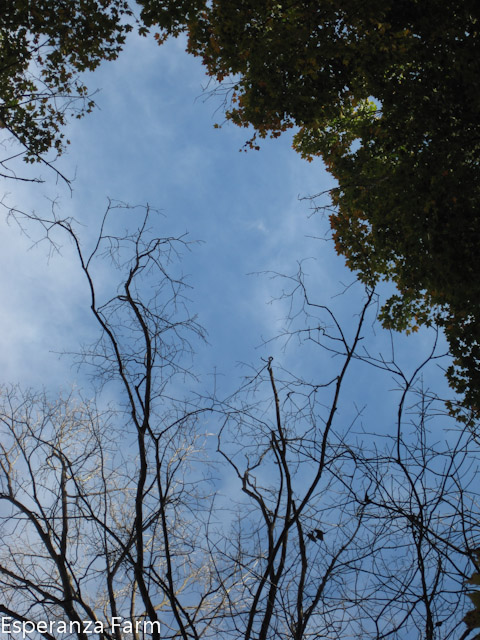
This picture, taken this summer, shows that the tree was immediately killed.  Buds are apparent on the highest branches, formed last summer, but never leafed out.  What is interesting is that many of the twigs are still there, by next year decay will have set in and the tree will have a ‘deader’ aspect, as opposed to the weird ‘winter tree in a summer scene’ appearance.   The dying branches beyond it belong to a large ash, which was already in decline.  It too has been affected by the strike and is far weaker this year.  The dead tips of the maple on the top right corner of the photo may have been caused by the strike, but may be due to the old age of the tree in question.
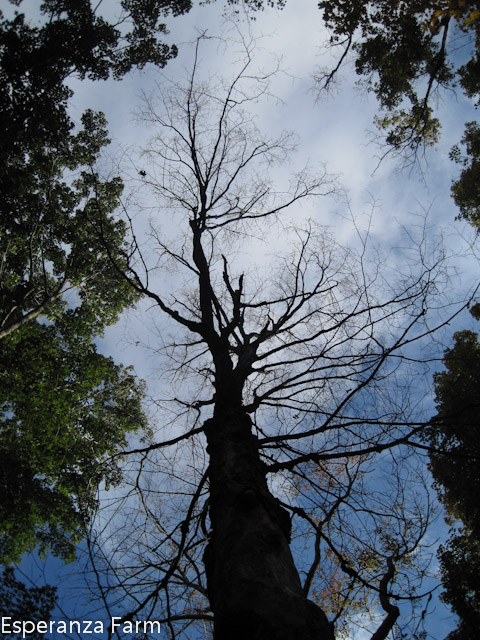
A close up:
 

Don’t Fall In Monday, Oct 1 2012 

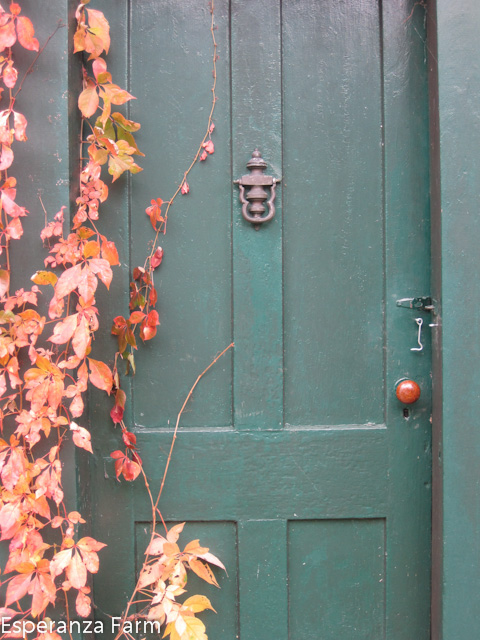
Old Door Thursday, Sep 27 2012 

Photo of the Day Monday, Sep 24 2012 

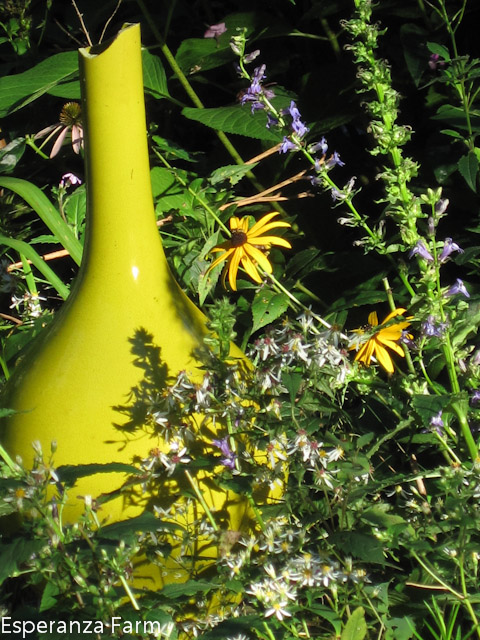
What one does with a badly broken jar; the flowers are blue lobelia, white wood aster, black-eyed susans, and coneflower

Photo of the Day Wednesday, Sep 19 2012 

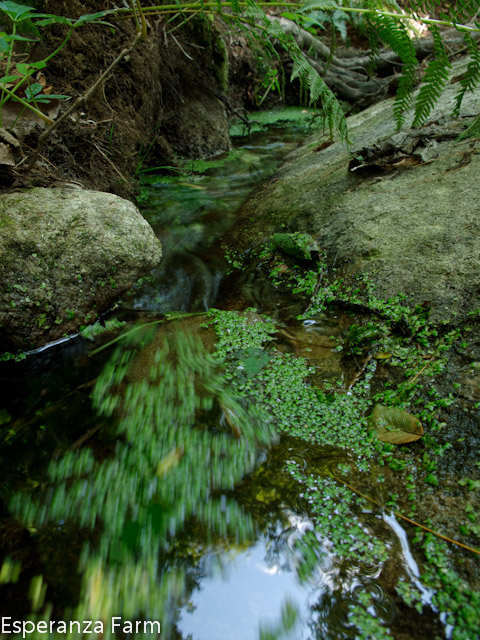
Taken at the outflow of Julie’s Pond last year; this year there is no flow.  The green stuff is duckweed, the bane of people with ponds around here.  It is a floating plant and can’t survive even moderately rough water with any success; but if the conditions are right it can completely blanket a still pond during the summer. If I have to choose between it and algae though, I will take the duckweed any day.

Concerning daguerreotypes Thursday, Sep 13 2012 

In today’s digital world, photographs of people are as ephemeral as the time of their taking.  Images are so common that the majority have little intrinsic meaning or value.  For Julie and Morris, images of the people they loved had a very different value.  They were rare, and given as tokens of affection and remembrance.  Ownership of the image was shared, the person might take it back if the relationship soured.  Because of the physical distance between Julie and Morris, images play an important role right from the beginning. 

In the course of their letters, they discuss miniatures painted on ivory and the daguerreotype, which had entered the stage in 1839.  It was still a very uncertain process, however, and rare.

In 1848, Morris writes: “Speaking of pictures puts me in mind of my daguerreotype. I have had four taken in my life time besides the two you have, and of those four, not one remains perfect. By some chance they have all come back to me and every one has been spoiled and discoloured by the air. I hope that those you have have not suffered a like fate. Yours is as when first taken. I wish that some more experienced artist would visit Rochester and make it his abode, that we might procure more perfect ones.”

I have not examined our collection of daguerreotype, but it is possible that those early ones still exist.  If ever there were miniatures on ivory, they have vanished, however.  I do find the Rochester reference an amusing foreshadowing.

1911 Dump cart Wednesday, Sep 5 2012 

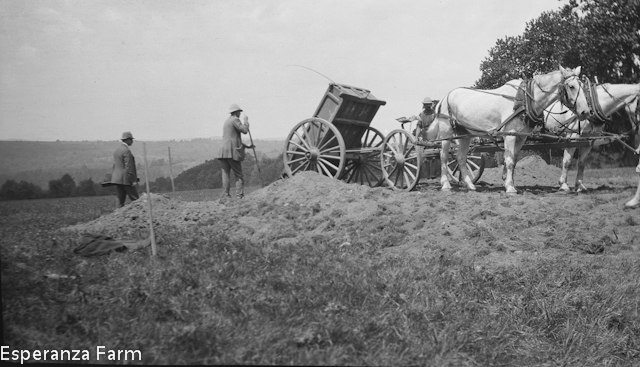
Building the tennis courts (now a nice pine grove, if entirely too well draining soil).  The team is the farm’s work team, probably Percherons or primarily of Percheron stock.  The cart appears to have a rather ingenious design: the actual dump-cart is balanced on the back wheels, which is actually a trailer.  It must have been very maneuverable, if tricky to load.  The wheels are wood, with iron frames and hubs.

Note the rather nice view over Beeney and West hills, the trees in the west hedgerow now obscure almost all of this view.  Note also that the men are wearing coats and hats, despite doing hard work in the full sun, in late August!

Volunteer plants Saturday, Sep 1 2012 

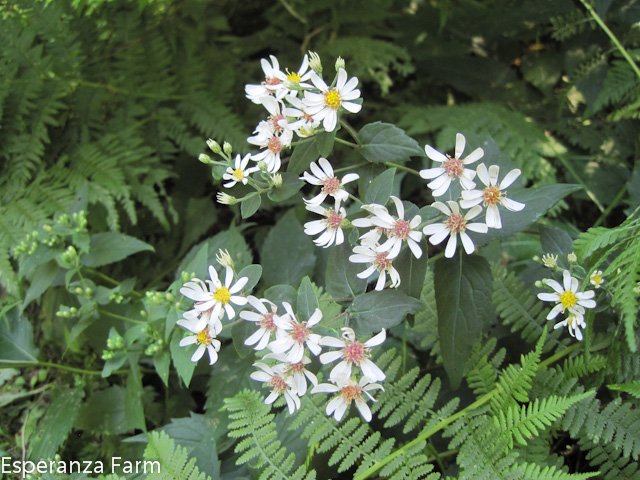
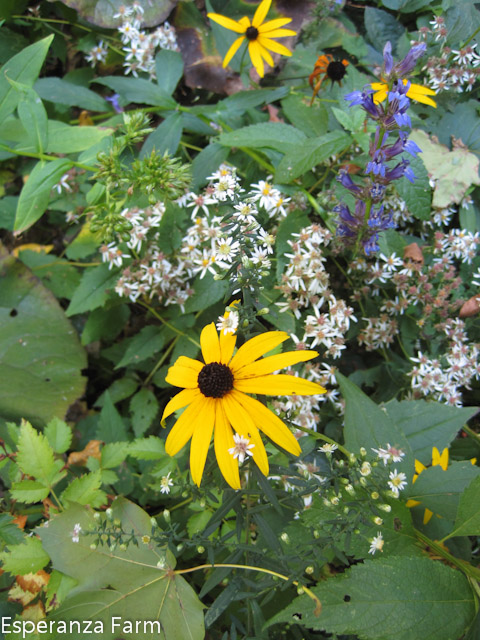
I like volunteer plants.  At this time of year the most prolific volunteer is the heart-leaved wood aster.  Actually verging on an aggressive weed, it blankets whole swathes of the property.  In good years, the old tennis court and the area southeast of the house are covered in a billowing white carpet.  We are removing it from the garden proper though, spreading by running roots it will bury most other plants.

Here it is with several other volunteers: black-eyed susans, blue lobelia, and ferns; the lower picture also shows a small sprig of calico aster in the foreground, identifiable by its narrow, needle shaped leaves.

Sunflower Saturday, Aug 25 2012 

Mowing the Lawn, 1911 Thursday, Aug 23 2012 

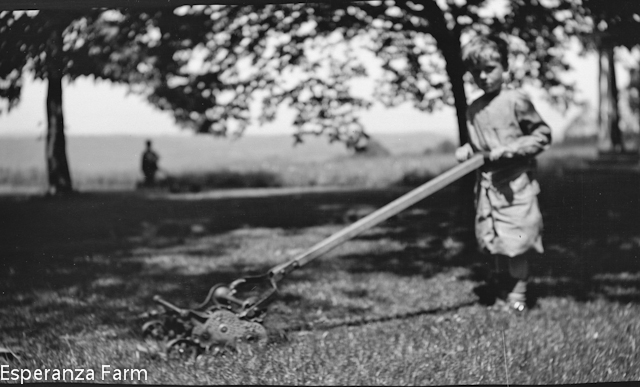
Sadly slightly out of focus; but probably Kennedy Creevey mowing the north lawn or at least trying to. While we still have another reel mower of the same vintage, the one in the photograph is no longer around….looking at it, I can’t say I mind…

« Previous PageNext Page »