Discoveries Tuesday, Aug 14 2012 

I think it is a good thing….I have discovered a box of letters.  (I know, not exactly a new item in this house)  If the inventory list that Eileen created for it is correct, and I have zero reason to doubt it, it adds a nice little bit.  They appear to be letters between Oliver Ellsworth and Caroline Smith primarily (so early 1800’s), with a number of others.   Also another box of letters by William Webster Ellsworth and Helen to various friends.  The Oliver Ellsworth ones are all in a painfully ornate copperplate style, on tiny sheets, and slightly moused.  Naturally.

and someone said once that most of the family letters no longer existed..

Road Trip! Tuesday, Jul 31 2012 

From Nov. 1916 as reported in the New Hartford Tribune:

“Mr. P.J. van Loben Sels, of Oakland and Vorden Ranch, California arrived in New Hartford on Monday, November 12th, after an automobile journey alone (and he is sixty-five years old) across the continent. It will be remembered that Mr. van Loben Sels’ son married Helen Ellsworth, a daughter of Mr. and Mrs. William W. Ellsworth of Esperanza Farm on Town Hill….

Automobilists may be interested in the statistics of the trip…The journey was made in a light Buick six, latest model…From Oakland he went north to Seattle for the sake of the scenery, then east over the generally poor roads of Montana, North Dakota, and Idaho, sometimes being obliged to shovel his way through snow a foot deep on the level, with six or seven feet in drifts. And this in October….

The gasoline cost was 2 cents a mile, about 13.5 miles per gallon*…Within ten years, perhaps four or five, a transcontinental journey in an automobile will be a very common experience.

Mr van Loben Sels will sell his car and sail to Holland on the 21st….”


I may say, I would have liked to know P.J. van Loben Sels.  Anybody out there who wants to tell me anything?

*What great strides we have made, not.

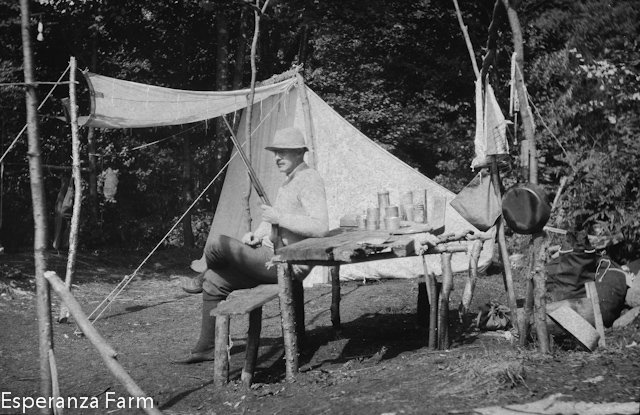
Camping, 1915 Friday, Jul 13 2012 

I think this is George Creevey, Lucy Creevey’s husband.   In real life, he was a well respected NYC surgeon.   Although filed in the West Hill Pond photographs, I suspect this was actually one of the road! trips into the Catskills.  Complete with converted ox cart as a trailer behind a Model A Ford.  Clearly, in that era, being handy with an axe and a bit of rope was a rather useful skill.

On Roofs Wednesday, Jul 11 2012 

One of Esperanza’s signature features is the use of red roof shingles, everything except one side of the barn’s roof (corrugated metal) and the flat porch roofs (rubber) is done in red, asphalt shingles.  Matching the red is a bit of a job, we never do things the easy way.  But it is much more elegant and interesting than acres (not literally, it just feels that way) of black.

However, earlier roofs varied.  Wood shingles, ideally of cedar but not necessarily, were in use well into the twentieth century.  The 1929 inventory of all the buildings records another, somewhat surprising, interlude.  Most of the barns/outbuildings listed have wood shingles.  A few sections of flat roof were made of tin.  But Esperanza, Minnietrost (one of the small cottages), the farmhouse, the help’s cottage, and Appleby all had paper roofs.*  In the photographs it is apparent that this gave the buildings’ profiles a distinctly raw, unfinished look.  Perhaps more our modern sensibilities, since tar paper was a common roofing material at the time.  Unfortunately, I can’t determine either the color or if it was actually paper or felt that was being used.  I do wonder how long they lasted.  It can’t have been long, since I don’t have, I believe, any other photos that show that…but then I haven’t really looked.

*The farmhouse had been Satis Bene, by the time of the inventory it was no longer given a name, though the other named buildings were.  That half of the property, which included the massive dairy barn, several other barns, a creamery, and the help’s cottage was sold in the 1960’s.  It is now a winery.  Appleby was sold by World War II, it is now in disrepair, but is an elegant c.1800 farmhouse.  At the time it had an apple orchard, hence the name.

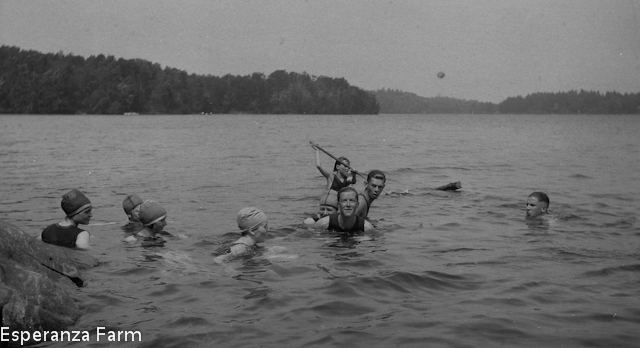
Swimming at West Hill Pond Monday, Jul 9 2012 

Until the big water company reservoirs were built in the 1930’s, New Hartford had only an assortment of small ponds and rivers to swim in.  Greenwoods pond served the town center admirably; it was a large mill pond (really at two miles long it was a lake) created by damming the Farmington River.*  There were other assorted mill ponds throughout town and deep curves of the Nepaug River, swimming holes in fact.  However, there was also West Hill Pond.  Although a dam added height, this was and is a natural pond of substantial depth.  Spring fed it is very cold and very clean, even today.  Pre World War II, there was almost no development on it (there is now!!).

The lake is on the next hill over, and a series of roads has linked Town Hill and West Hill since New Hartford’s founding.*  Until the early twentieth century there was a very direct road, since abandoned.  But even today along several twisting roads it is an easy ride with a horse.  Until the 1950’s/early 1960’s, Esperanza owned two large pieces of the shoreline: ‘Boys and Girls Points’.  These pieces were given to the Boy Scouts’ Camp Sequassen and remain part of the camp today.  Until that time, camping and swimming at West Hill featured prominently in the summer activities.

I can only identify the person paddling past on the log in the background: Eileen Creevey Hall.  The photo is circa 1920-23

*Greenwoods pond vanished entirely in March 1936: a flood took out the dam, which was 32 feet high and 200 feet long); along with the pond went a good chunk of the town.

*Yes, there is an East Hill!


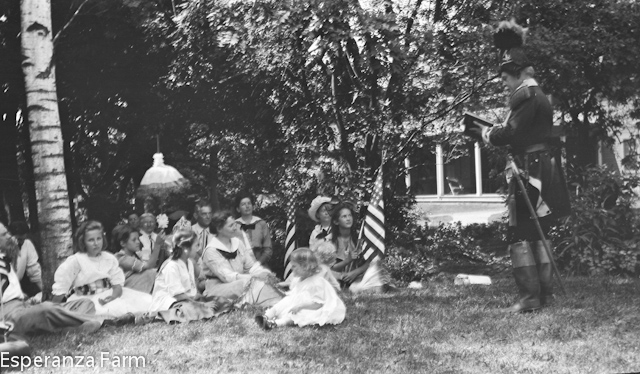
July 4th, 1913 Wednesday, Jul 4 2012 

Celebrating the Fourth in 1913, a reading of the Declaration perhaps?, in an antique uniform, sadly since vanished (except for the sword).  Who all is involved, I couldn’t quite say.  However, the moustache strongly suggests that the reader is William Webster Ellsworth.  He would be the natural choice, as the family’s elder statesman, a gifted orator, and descendant of those worthy Wolcott, Ellsworth, Webster…ad infinitum. 

I do like the parasol.  The house is just visible, today, where they are sitting is a shady garden bed.

Brief Meditations on a Barn Tuesday, Jul 3 2012 

Esperanza’s barn, the barn that is still part of the property that is, is actually two structures: a purpose built horse barn and a standard, English style, barn now used as a garage.  The two are attached to each other, the dates are entirely uncertain.  The carriage/garage section could be anywhere from 1800-1875, without careful examination I wouldn’t care to guess; the horse barn (despite family lore) is almost certainly 1873.  Dating barns is hard, recycled timbers were the order of the day and styles for general purpose barns changed only slightly.

In any event,  having reason to wander in the horse barn, I amused myself by examining the actual structure.  It is a post and beam build, and a big one.  Three east-west beams carry the hayloft: at 48 feet long, and 8inches by 8inches.  The barn floor is carried by another three beams of the same length, but closing in on 12 inchx12inch dimensions.  There are a another set of north-south sills, close to thirty-five feet in length, plus two floors of joists: 38 to a floor, thirty-five feet long, three inches by ten…plus corner/side posts….and the sheathing, and the flooring…in no case can you drive a heavy and very sharp knife in more than two or three millimeters, even with one’s full body weight behind it.

You can’t build them like that today…

From the Guestbook Monday, Jul 2 2012 

Esperanza had, during the late 1800’s to pre WWI, any number of guests; happily, they also maintained a guestbook.  These books are a treasure trove of commentary, signatures, photos, and sketches.  The sketches are usually done in the style of the time: half-caricature, half-line drawing.*

Two entries, from a random page:

“Walter Booth Adams,

Syrian Protestant college, Beyraut, Syria

‘Coffee equal to Syrian coffee, what further praise can I give to the good dinner?’


Adelaide G. Richetts

‘Who came to Esperanza Farm June 10th 1899, carrying a cane and weighing 110 pounds. She left August 3rd, said cane in the bottom of her trunk and her weight was 132.5 lbs. ‘Nuff Said.”

*The only example of the style I can put my hand on is the illustrations by Jean Webster, in her books Daddy LongLegs and Dear Enemy…published in 1915, not much help there.   Jean Webster did visit the place.

On kitchens Sunday, Jun 24 2012 

From the recollections of my grandmother, Eileen Creevey Hall, who was the great-grand-daughter of Julie P. Smith, whose letters I often take excerpts from.   Eileen grew up spending summers at Esperanza, along with Carlotta and Kennedy, her two siblings.  The following events are from the 1910-1925 era.

“There was only one part of the house which was strictly off limits to us. That was the area south of the dining-room door which led into the domain of The Cook. No children to run about and get in her way! And no wonder! She was responsible for three full meals a day, plus the tea. As there often ten or more people in the dining room, and four maids, and a coachman to be fed, you can easily imagine that she was completely occupied all day.*  The big iron range was never cool and it must have been a difficult job to do all that work. And we had to be prompt!”

The kitchen is on its third or fourth iteration since 1893.  The big iron cook stove is long gone, unless it is the thing lurking in the basement?,  the kitchen put in by Eileen’s mother, Lucy, post WWII lasted with only some changes to the stove and fridge until c.2004.

*Often more; that count only included the ten people who stayed all summer on a routine basis, it didn’t include other guests who might stay anywhere from one night to several weeks.

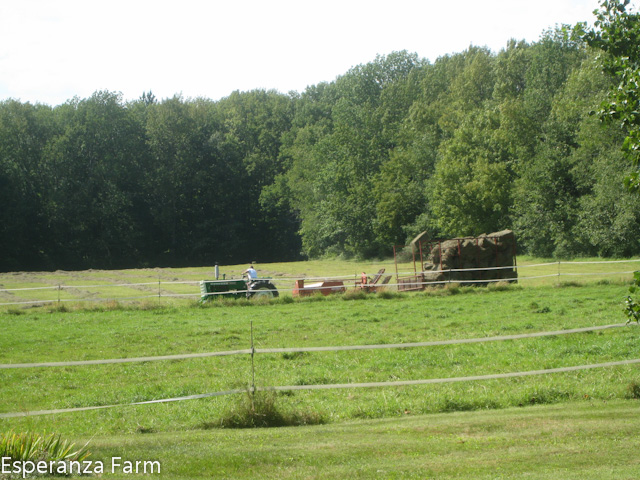
1911 versus 2011 Saturday, Jun 16 2012 

you can see the chucker in action in the modern photo, that eliminates two or three people, right there. 

Good thing, since extra bodies don’t seem to be around this year, but what a good year!  My guess, conservatively, close to ten tons of hay, and bone dry at that, so very light.*

We are pretty much a cheering squad, a friend does the actual work…

« Previous PageNext Page »