Book Reviews Saturday, Jan 5 2013 

Though Julie Palmer Smith was the first author to live at Esperanza, her son-in-law, William Webster Ellsworth, was a well respected author, his career at the Century Company, from its beginning’s as an offshoot of Scribner and ending as Secretary (think CEO), meant that he had a formidable network of connections.

A review of his book ‘A Golden Age of Authors’ published in 1919 by Houghton Mifflin* hints at this network; the review was by Albert Bigelow Paine*: “When the MS. arrived and I saw the size of it, I said, ‘It looks formidable but I’ll read it. I’ll do it for Ellsworth, I’ll do anything for Ellsworth.’  Then after dinner I got my clothes off, got into bed, propped up, and began. I hadn’t read three pages before I realized a remarkable thing, viz: that it was not I doing it for Ellsworth, but Ellsworth doing it for me, by the Great Inventor of Letters, yes! I was simply eating it up. I was enthralled, enslaved. I couldn’t stop. I read till late, late (I am an early bird) and at five thirty the next morning I was at it again. It was not a big MS. any more, it was too little.’

A much more interesting, and honest, book review than many!

*He had parted ways with Century Company a few years earlier, following a rather nasty personality clash with the new editors brought in after Richard Gilder’s death.
*http://en.wikipedia.org/wiki/Albert_Paine

Things in desks Wednesday, Dec 12 2012 

Cleaning out/rearranging things always leads to discoveries here.  Amongst the inventories in the desk was Eileen Creevey Hall’s* diary from her trip to Italy and France in 1927 when she would have been 17.   Unlike those of us with excellent intentions and poor follow-through, she kept the diary the entire trip with a fair bit of detail throughout.

I have yet to do more than thumb through it, but I think it shall bear further investigation.

*In the cast of characters: Eileen Creevey Hall, daughter of Lucy Ellsworth Creevey and George Creevey, great-granddaughter of Julie P. Smith.

letter excerpts Wednesday, Dec 5 2012 

Before magazines were common and well before the internet was even a fictional fantasy, letters were the form of communication.  We’d often like these to discuss the ‘great’ events of the day, those important to history.  The people writing them, however, were as human as we….  Fashion, weather, jobs, conversations, chance meetings, the little important events of lives.

Here Julie writing to her mother in 1845 gives her some information on NYC fashions:

“Dresses stand out as much as ever, stiff skirts are worn and very full indeed. Don’t have your silk made, wait till next year and then come down to New York, and we will go together to Connecticut.* Tight sleeves seem to be the reigning mode with all sorts of caps set into the armhole. Black straw hats are a good deal, trimmed with velvet scarves, mostly crimson. All sorts of fanciful head dresses, made of ribbon, lace, feathers, flowers, and everything else put in all imaginable forms. Hair is worn low and high and between. I have seen all this at the concerts and so on where I have been.”

*Hartford, Ct actually was a fairly important town at the time.  They could probably get clothes cut there in fashions close to that of NYC, but more reasonably priced.

Some chronology Monday, Dec 3 2012 

Always useful…early chronology of Esperanza, before it was Esperanza.

c.1795-1800: the first property deed to mention a house on the site of Esperanza.  The first deed is 1800, but the interior evidence in the house suggests it was built in preceding decade….or the lumber was cut then….

1802-1832: the house (then just the center section built in a typical New England vernacular style) is owned by the Reverend Amasa Jerome, pastor of the Town Hill Church.

1832-1849: owned by Rev. Jerome’s widow, it may have been rented out as a farm during this time.

1849-1859: owned by Rufus Rood, during this time there is mention of a fire causing severe damage and then immediate rebuilding.  It was probably at this time that the core of the southern extension was added.  Remains in use as a farm.

1859-1872: owned by Frederick Lyman.  Continues to be used as a farm.  However, farming in New Hartford (at least on the hills) had collapsed completely by this time: the Town Hill Church and over a dozen houses on the hill were vacant or abandoned by 1870.

1872: bought by Julie Palmer Smith, who had purchased the adjacent property the year before.  The other property had, in her opinion, a better house…but it burnt to the ground in late 1871.  It was cheaper and easier to buy the Lyman property as it meant that they could, as planned, spend the summer of 1872 in New Hartford.

Cottage gardens Tuesday, Nov 27 2012 

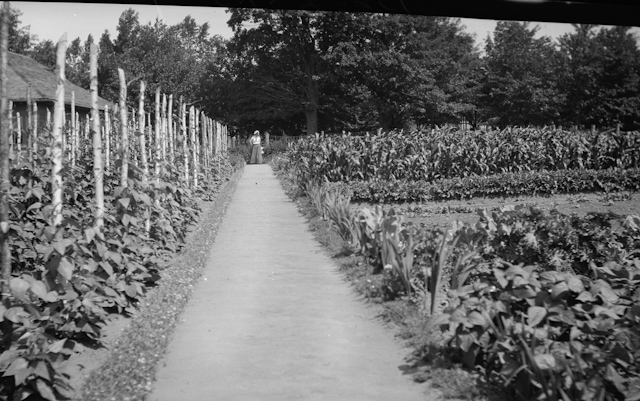
Esperanza is still sometimes for some purposes called Esperanza Farm.  The relationship between the house and the farm is a complicated one, leading deep into women’s history, the rise of scientific agriculture, and economics.  I won’t get into it here.  Suffice it that the cottage, long sold and now a winery, produced sufficient vegetables, dairy products, meat, and cut flowers to support Esperanza, its dependencies, and sometimes enough to sell.  Obviously, it did not have to support the family through the winter; although it did add to households of the various caretakers, we know late season vegetables were part of the wages so to speak.  The dairy products were sold during the winter.

Here is a picture of the edge of the cottage garden taken in 1909: corn, pole/bush beans, lettuce, and gladioli are all visible.

Getting the Post Sunday, Nov 18 2012 

In this day and age of the internet, Skype, apples of the month, and phones, we don’t think much of the post.  However, it was the form of communication in the late 1800’s.  Telegrams were expensive and not always reasonable, if you didn’t know where the person might be.  Letters, however, were addressed so that they could chase the person via ship or company quite nicely.  ‘Care of’ is almost archaic today, very useful then.  In the last letter excerpt this was encountered: a package was entrusted to either a messenger or a station agent, having already passed through another individual’s hands on the way to its final agent.

Here we have Edward Hooker writing to Helen in 1875; both were travelling in Europe at the time.

To: Mademoiselle Helen Y. Smith

Passengere a bord du paquebot “Klopstock”*

partant au Havre pour New York, samedi 26 Juin, 1875

“I have been to the office of the Hamburg Co and so have the name of your ship. Will writes me that he has written you at Havre aboard the ‘Goethe’*- you may possibly get his letter by inquiries at the Post office or the office of the Steamer. From the circulars, I see you will be a whole day or more at Havre….

…Once again adieu. May we soon meet. I hope you won’t drown on the way home, that would be SO disagreeable.”

*The ‘Klopstock’ http://www.norwayheritage.com/p_ship.asp?sh=klops

*The ‘Goethe’ http://www.norwayheritage.com/p_ship.asp?sh=goeth

*William Gillette was then travelling as well, on board the ‘Goethe’; he presumably had left his letter to Helen at the Havre port offices.

Random guest book entry Sunday, Sep 30 2012 

“‘That though I come

In winter’s guise

The flight of years

Has left me wise

Oh Carey! Choose

The glance of truth,

Ripe age prefer,

To heedless youth!”

This decidedly enigmatic poem was written in the by Annie Elliot Trumbull, from Hartford in 1880.  Enigmatic because of the allusion to ‘Carey’; who is it?

Annie was born in 1857, died 1949, and was the daughter of James Hammond Trumbull, Connecticut’s first State Librarian, noted philologist, and antiquarian.  Annie was an author, writing short stories and taking a definite interest in Hartford/Connecticut history.  That she knew Julie and WWE comes as no surprise.

Of weddings Sunday, Sep 23 2012 

Esperanza has seen several family weddings, though none in living generations.  It has also seen its share of funerals.  Equal measure.

From September 1906, a newspaper clipping describing the wedding of Lucy Morris Ellsworth and George Mason Creevey:

“One of the most elaborate out-of-door weddings to take place in this State that has taken place for some time…Lucy Morris Ellsworth, daughter of William Webster Ellsworth of the Century Company of New York, was married to Dr. George Mason Creevey of New York. The wedding took place under the trees fronting the house on Esperanza Farm, Mr. Ellsworth’s summer home….. (genealogy)…(guest list)…the wedding was perfect in every detail. The house was draped with greens, with here and there decorations of goldenrod.  The trees were hung with gaily coloured ribbons of many different hues. An orchestra occupied a retired spot on a side veranda and furnished the music. The ceremony took place in a small wooded bower, twenty bridesmaids lining the pathway from the house….

so forth through a description of the dress, list of bridesmaids, gifts etc.

The bower is still there in part.  Of the two massive Norway spruces that made the front frame, only the south one survives at 109 feet in height.  Beyond though is a veritable cathedral grouping of several more Norway spruces and pines, all at well over 80 feet in height.  Now if only I could get rid of the road…


Concerning daguerreotypes Thursday, Sep 13 2012 

In today’s digital world, photographs of people are as ephemeral as the time of their taking.  Images are so common that the majority have little intrinsic meaning or value.  For Julie and Morris, images of the people they loved had a very different value.  They were rare, and given as tokens of affection and remembrance.  Ownership of the image was shared, the person might take it back if the relationship soured.  Because of the physical distance between Julie and Morris, images play an important role right from the beginning. 

In the course of their letters, they discuss miniatures painted on ivory and the daguerreotype, which had entered the stage in 1839.  It was still a very uncertain process, however, and rare.

In 1848, Morris writes: “Speaking of pictures puts me in mind of my daguerreotype. I have had four taken in my life time besides the two you have, and of those four, not one remains perfect. By some chance they have all come back to me and every one has been spoiled and discoloured by the air. I hope that those you have have not suffered a like fate. Yours is as when first taken. I wish that some more experienced artist would visit Rochester and make it his abode, that we might procure more perfect ones.”

I have not examined our collection of daguerreotype, but it is possible that those early ones still exist.  If ever there were miniatures on ivory, they have vanished, however.  I do find the Rochester reference an amusing foreshadowing.

Travelling Tuesday, Aug 21 2012 

I commented to someone recently that the beauty of old letters is their ordinary nature: people were and are motivated by the same concerns, whether this century or the last; they may be foreign but they are not alien.  But once in a while a letter will illuminate how things have changed.  I just drove down from Montreal, about seven hours rolling time*, by myself in a comfortable car.  Not, in this present time and country, an unusual trip.

Here is a description from a letter by Morris of a section of a stage-coach trip in New Hampshire in 1846: “We started from Plymouth (heading to Franconia Notch) with a stage filled with an incredible number of passengers- that is incredible for the accommodations of a stage- Twenty-Two, only nine inside, thirteen outside.  It was very warm and the horses pulled their heavy load slowly. In the evening the clouds obscured all light from above and we on top the vehicle using all our efforts to prevent being thrown off, striking our heads against the boughs of the trees, and the tops of bridges, earnestly entreated the driver to stop for the night.  He drove up at a small seven by nine tavern situated somewhere in the outskirts of Grafton. It was not a fit place to stop in, but necessity obliged us as it was now after midnight. With difficulty we found cribs where we could stow ourselves till daylight, and we all tried to sleep till five o’clock in the morn, when there was no use in trying anymore, for our driver with a loud voice told us the stage would start in five minutes.”


*that is not counting the near 2 hours at customs or the hour stuck in construction here and there…

« Previous PageNext Page »