‘Tis the Season Thursday, Jun 14 2012 

for hay.  Connecticut is not an agricultural powerhouse, though like every single state it does have an agricultural sector; it is best known for nursery plants, Christmas trees, and intensive, specialty farms.  It is not known for sprawling fields.  And honestly, why should it be?  Though the Connecticut valley holds some of the finest soils in the world*, the state is small, densely populated, hilly, and rocky. You cannot have a thousand acre field here.

Nonetheless, I grew up bucking hay at least once a year and usually more.  At one point we went through 700 bales (55lb square) a year. *  This year, I asked for 60.  Our field currently produces 1400 bales a year, generally high quality, off of about ten acres.  The man who does it, does not make money off of it.  He likes doing it, he can use the hay for his cattle, and  he has the equipment.  In this case, all vintage tractors (several gorgeous Elliots and Farmalls) that need several days steady running a year; they have another life as show tractors. 

Hay is an increasingly scarce product here.  Hayfields invariably make high quality subdivisions, while hay (though the price has gotten painfully high) is not a high value crop.  It is however, labour and equipment intensive in the most spiky and unpredictable fashion.  You need at least: one tractor (preferably two), a cutter/conditioner, a tedder, a rake, and a baler.  Hay wagons are also recommended.   And A Lot of gasoline. Then you need the people to drive the equipment and buck the hay, and you need them at some undefined point in June and again in late August, and you need them to work in the full sun and fast.  Why fast?  Once hay is down, if it is rained on in the field it goes from 6 dollars a bale to 1.50.   Hay weather is also thunderstorm weather. 

I will, no matter where I live, for the rest of my life start to get edgy the first weekend in June.  Will the hay be good? Are there enough people? Will it rain?  Still, I love the thundering roar of the tractors, the smell of hay, of gasoline, the ka-chunk sound of the balers; I loved the challenge of stacking hay as fast as it came off the elevator, the trick of grabbing the hay as it came off the spiked chain without snapping the twine or slipping near a lethal piece of equipment, the trick of stacking six high alone, eight or more with a helper.  Who is faster, the stacker or the loader? 

Do I mind not having the stress? No. Do I miss it? yeah.

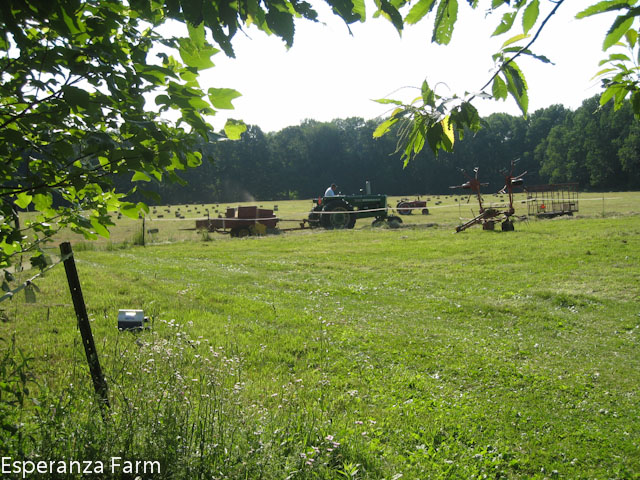
Two years ago, the Elliot in the foreground with the baler, the tedder is the piece unhitched to the right, a Farmall in the distance.
*Connecticut once produced shade-grown tobacco of a quality rivalling the famed Cuban strand. 

*I also stacked innumerable hay and straw bales at the farm where I worked.

*Wordpress’ spellcheck hates ‘Farmall’…that says something, doesn’t it?
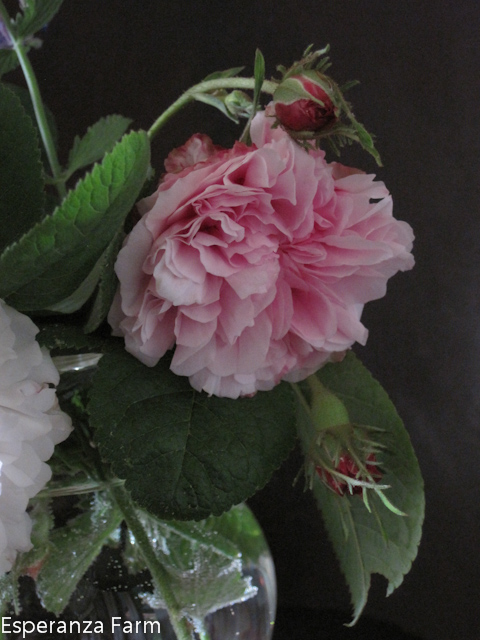
Centifolia Rose Sunday, Jun 10 2012 

On Fireflies Friday, Jun 1 2012 

Fireflies are a particularly cherished part of summer, possibly more so on the eastern coast of North America, possibly because of some unformed, vague memory of a novel I once read.  Nonetheless, the June nights when the moon is sailing high and the field grass whispers silver and green; in that rich darkness, fireflies float, pinpricks of light.  The light is nothing like that which we use, it is the white-green phosphorescence of fox-fire, lightening, and fireflies, the light of the unknown world, of magic and of wonder.

Fireflies are actually not all that good looking in the light of day, but at night…  They are also increasingly rare.  Fireflies need tall grass, goldenrod, and that host of meadow plants.  Leave a section of lawn unmowed, and the chances are very good that in New England, at least, you will have fireflies.  We are experimenting with leaving sections of lawn as meadow, as a form of visual structure, that the fireflies benefit is a pleasant benefit.*

*and the bats, the butterflies, the moths, the birds…but you know my opinion on Chem-lawn…

Sherbet! Monday, May 21 2012 

I have been staring at a particular view of the garden recently trying to figure out what the colours brought to mind, I knew it was something but couldn’t place it.  A trip to the grocery store finally resolved the question: orange sherbet and black raspberry ice-cream.  Say what?  Well, there is a nice backdrop of doublefile viburnums, a good pure white now fading towards ivory;  two Exbury type azaleas in front, one yellow/white and one the exact shade of orange ; and in front of that a border of Dame’s Rocket, the shade of raspberry ice-cream.  a pity the scheme won’t last more than a day or so more; it isn’t patriotic, but it sort of fits Memorial Day and the promise of summer.

Of hand tools Saturday, May 19 2012 

and the use thereof.  It was a genuine pleasure to cut the oat-grass, a cover crop for some perennial grass, on the dam.  Mostly because I chose to grab the grass scythe and do it, in less time than it would have taken to fuel the string-trimmer*, get it to start**, and then shatter the quiet of a beautiful afternoon.  A correctly sharpened and adjusted scythe makes very quick work of mature oat grass, laying it down in a neat windrow, too neat for this purpose as I had to go back and scatter it lest it smother the other grass.  It does less well on the native North American bunch grasses, but then scythes and the oat/hay grasses of Europe evolved together.  No doubt for thousands of years farmers encouraged the grasses that not only grew well but that cut well to the rhythm of a scythe swung about three inches above ground level, row upon row.

The scythe in question, or the snathe of it, was made by Derby and Ball in Waterbury, Vermont; once one of the largest manufacturers of scythes in the world.  The razor-sharp blade is a triumph of metallurgy, precisely curved in both profiles, and astonishingly hard for such a thin piece of metal.

*The joys of ethanol, I always run the tank empty before storing anything with a little, fussy engine.  How much money and energy do you suppose ethanol has cost in engine repairs/refits?

** fussy little, pull-start engine with ethanol in the spark plugs and a very finicky choke.  Actually, it starts very well.  But still…

A walk in the woods Tuesday, May 15 2012 

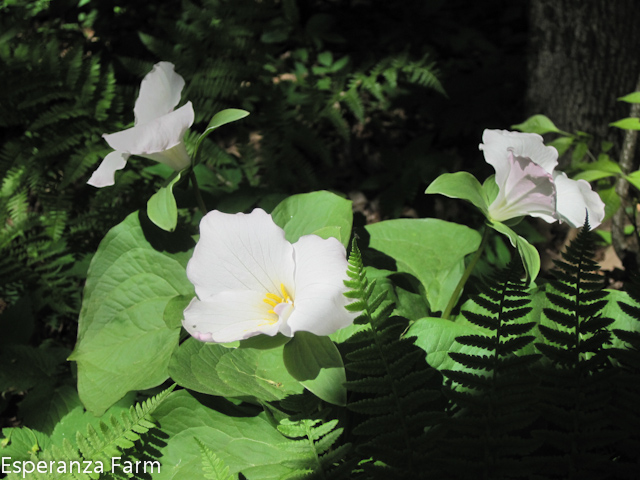
Trillium grandiflorum

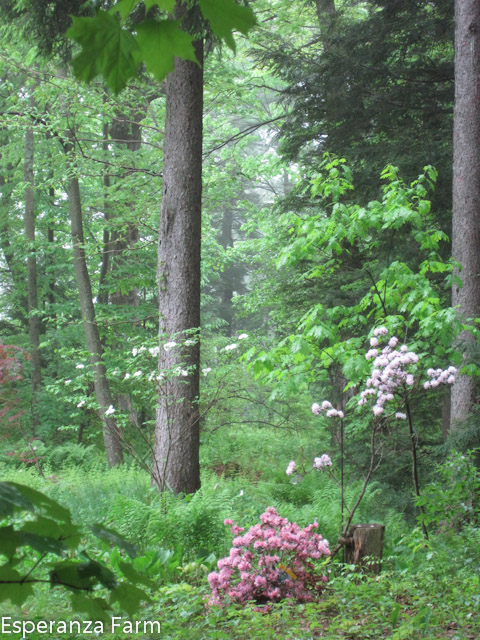
From left to right: young cornus florida, a nursery grown small leafed azalea, a tall, old ‘Windbeam’ Rhododendron.  The tree trunks are Norway spruces, the fern is predominantly Eastern Hay Scented and members of the Male fern genus.

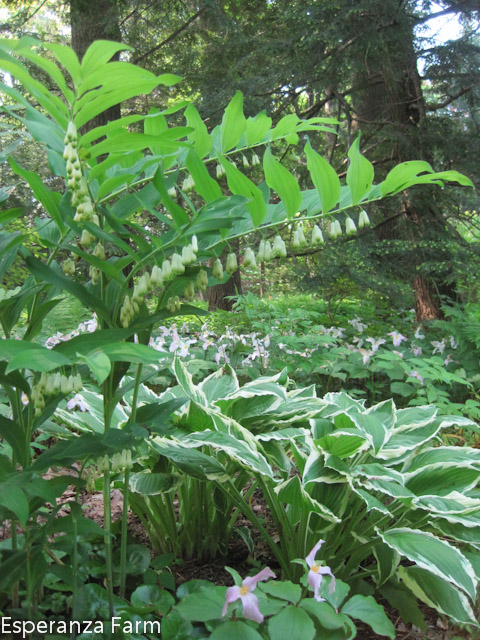
Giant Solomon’s Seal, Trillium grandiflora, an unknown hosta, European wild ginger (just visible beneath the Solomon’s Seal).

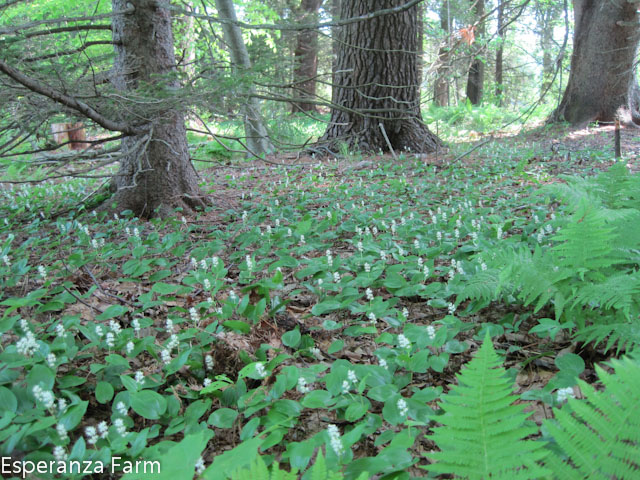
Native Mayflower, also known as Canadian Lily of the Valley beneath Hemlocks and Pines.

Also blooming in the woods: Starflower (or Twin flower), wild phlox, False Solomon’s Seal, Silky Dogwood, Swamp Azaleas, Viburnum tomentosum, Blue Star, Jack in the Pulpit, Sasparilla, English Bluebells, and many others!


On the mowing of lawns Tuesday, May 8 2012 

Lawns, and the mowing thereof, are a cherished American tradition.*  Esperanza has Lawn.  Lots of it.  It had more, but I am determinedly shrinking it.  However, Esperanza’s lawns would be a nightmare for any lawn care company or a dream come true for any chemical lawn care company.   Why?

Two reasons: first, at no point does the lawn conform to a nice steady mowing pattern.  It is composed of low-hanging trees, rising foundation walls and roots that can only be driven over in one direction, wildflowers to cut around, sections that are mowed on a different schedule, steep banks…

Second: only about 60% of the lawn is lawn.  The rest is: speedwells, creeping jennys, moss (oh the horror!), gill-over-the-ground, bluets, violets (at least five types), Indian paintbrush, daisies (English and Ox-eye), pussy-toes, native sedges, buttercups, dandelions, wild strawberry, cinquefoil, barren strawberry, plantains, sorrel, thyme, and those are just what I can identify (and remember).   Never mind the sections that have reverted to woods and are now dominated by wood asters, ferns, phlox, forget-me-not, etc.

Two large sections are only cut in late summer.  Right now they are a blaze of red/purple grass with touches of dusky lavender (early English daisies), white bluets, pussy-toes, and a floating crown of pure gold from the buttercups. 

What is interesting is that having these uncut sections actually makes the genuine lawn far more beautiful.  The pure green ‘pops’, to use designerese, far better when set against such a background.  Besides, we will have lightening bugs, phoebes, bluebirds, robins, swallows, bats…the list goes on.


*That lawns actually represent one of the biggest ecological disasters of our time is conveniently ignored.  A monoculture of an invasive species forming a close to impervious surface carefully tended by tons upon tons of insecticides, herbicides, and petroleum.

Carlesii viburnum flower Friday, May 4 2012 

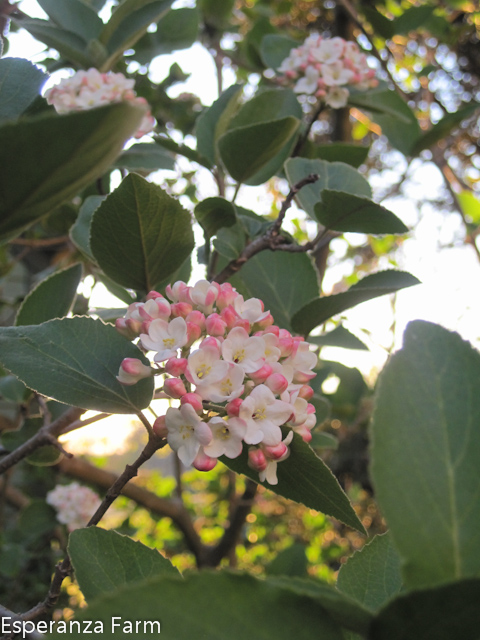
Carlesii viburnum in bloom.  The shrub is full sized, at about fifteen feet in height; it is currently an arc of white blossoms against the moss-green of the cottage, Minnietrost, and in the evening (as in this photo) it is backlit by the sun slicing between the building and the big yew to the north.  But such lighting only occurs in May and again in late September, both are times when the viburnum is at its peak, either in flower or foliage.  A happy accident.

« Previous Page