Underappreciated Plants: Autumn Clematis Sunday, Sep 2 2012 

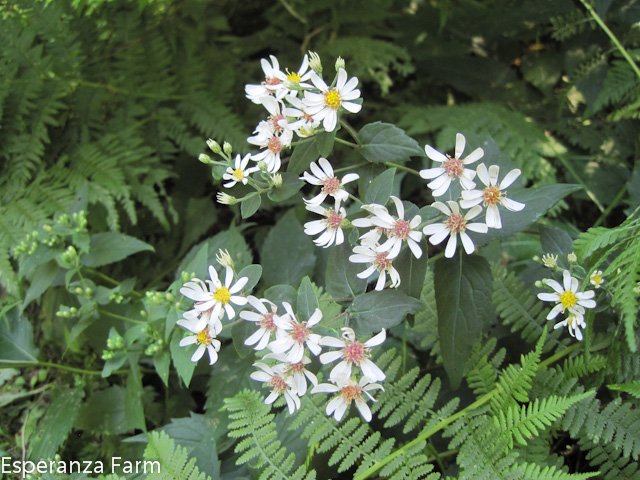
Garden for any length of time, and one quickly racks up a list of plants that, one feels, people ought to use more.  Right near the top of my list is the (Sweet) Autumn clematis, also known as Old Man’s Beard.  This fall! flowering New England native is fast growing, capable of hitting thirty feet, able to withstand mild drought, heat, and -20F winters without die-back.  And if it does die back, gets broken, accidentally mown, or pruned by default because it is another plant that must be pruned?  It is capable of coming back up from the base and blooming on new growth.  The flowers are sprays of pure white with a powerful, sweet scent reminiscent of grapes.  It starts blooming at the end of August and will continue throughout September.  The various pollinators love it but I have yet to see anything eating it (though it clambers over a rose routinely defoliated by aphids and Japanese Beetles).  About the only thing it likes is shady feet, but even that is something one can work around: I planted a seedling (about three inches in height) in full sun this spring, before this wickedly hot and dry summer; it took a little while, but it is already three feet tall.  Why it isn’t used for privacy screens, patio fences, and a multitude of other hard uses?  A mystery.
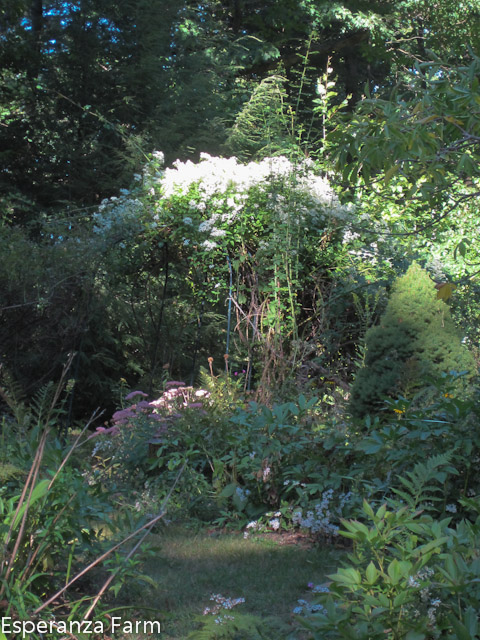
On an 8 foot tall arbor, the last bit of sun just hitting it.  The pink below it is a big sedum, the blue/white flowers are white wood asters.  This clematis is about eight or nine years old and has gotten cut down at least once (accidentally!).
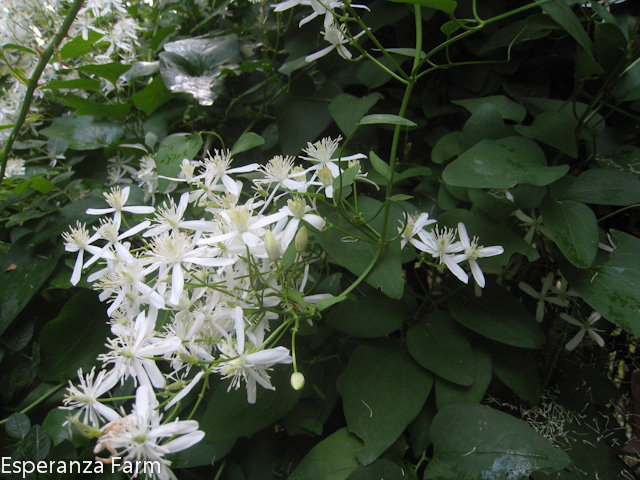
A detail of one of the sprays.

Volunteer plants Saturday, Sep 1 2012 

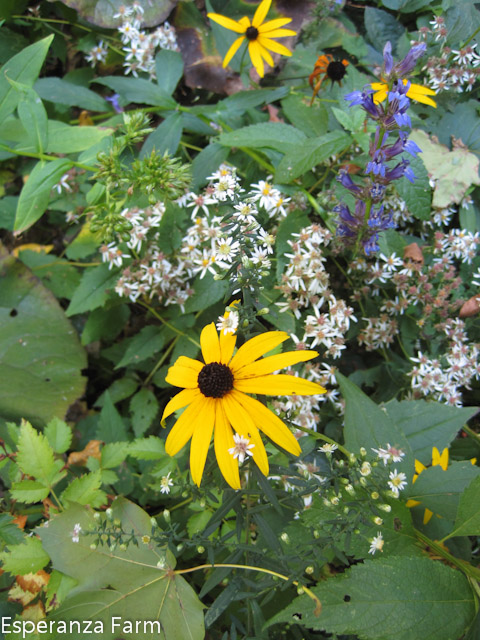
I like volunteer plants.  At this time of year the most prolific volunteer is the heart-leaved wood aster.  Actually verging on an aggressive weed, it blankets whole swathes of the property.  In good years, the old tennis court and the area southeast of the house are covered in a billowing white carpet.  We are removing it from the garden proper though, spreading by running roots it will bury most other plants.

Here it is with several other volunteers: black-eyed susans, blue lobelia, and ferns; the lower picture also shows a small sprig of calico aster in the foreground, identifiable by its narrow, needle shaped leaves.

Wild Grapes Sunday, Aug 26 2012 

There is something indescribable about the taste of wild, New England grapes.  There are two types, the small red and the small blue (the ancestor of the Concord).  Both are no larger than a penny, thick skinned, and heavily seeded.  Absolutely nothing like your typical grocery store grape.  The sharp flavour is so intense that eating more than a few is unlikely.  The taste is closest to a port wine or the heavy, dry wine I had once from the isle of Santorini, Greece, where the grapes grow in a poor, dry climate creating a naturally high concentration of sugars. A sweet tartness, smoke, sun, and the wild.

The titmouse wasn’t terribly happy about me running off with several clusters though…

Sunflower Saturday, Aug 25 2012 

Comptonia peregrina and science Wednesday, Aug 22 2012 

I was planting two Comptonia peregrina (better known as Sweet Fern) today, and consequently did a bit of research first.  Sweet Fern is undeservedly, in my opinion, poorly known.  Finding the plant in a nursery is uncommon.  This has always struck me as odd: here is a plant that grows in disturbed, hot, sandy/gravelly, poor soils.  It should be an ideal foundation plant, especially with its fragrant leaves (somewhere between citronella, pine, and rosemary), short habit, and not unpleasing (if not spectacular) winter and summer appearance.  It is a distinctive New England/Mid Atlantic plant, growing wherever road cuts, sand banks, or pine forests exist.  Summer in New England, especially in coastal areas, is linked in the minds of many people with its heady scent.

Well, it turns out there is a reason for its rarity in the nursery trade.  First off, it will not transplant bare-root.  Secondly, getting its seeds to germinate is extremely difficult.  Cuttings are the best way to get another plant but that art has only become common in the last fifteen years or so.  But then, the question arises: if the seeds don’t easily germinate, how does it pop up where-ever a clear-cut has been done?  As it happens the seeds are sensitive to soil disturbance and have the ability to remain dormant and viable for upwards of seventy or more years.   See the linked article for more:  http://arnoldia.arboretum.harvard.edu/pdf/articles/445.pdf

This got me thinking about how little we know…we routinely search for ways to protect both organic and inorganic materials from decay…here is a plant that has developed a chemical barrier that allows for indefinite protection of a highly vulnerable organism (a seed embryo) in harsh conditions of freeze/thaw cycles while partially buried in an environment prone to moisture and generally fairly acidic.  It is the sort of thing, if I was a scientist, I’d pay attention to…


Summer Kitchen Wednesday, Aug 15 2012 

A  A photo from last year, though much to my surprise I have been canning some tomatoes today, only three and half quarts so far, but something!

High Summer Monday, Aug 13 2012 

Warning: This is a rant Saturday, Aug 11 2012 

(well as much as I ever rant)  Those who know me, know I hate summer.  As far as I am concerned, northern Scotland is my ideal climate: never above seventy and usually dark with a constant wind.*

This summer has been especially un-endearing, what with the heatwave and the lovely combination of drought and high humidity (how, the H— does it manage that?).  Needless to say the tomatoes and peaches, both of which had such glorious promise, have succeeded in rotting on the vine/tree…while green.   So much for canning tomatoes, which I was rather counting on doing.  Gah. 

Then there is the house….waterfalls of condensation on the windows and everything that might conceivably have to do with plumbing has a certain morbid entertainment level.  But I could do without the humour.  And the spiders…usually I get rid of the cobwebs but don’t enthusiastically chase the spiders when I clean…not this year.*


*I’ll spare you the physical details, suffice it that those thousands of British colonials who died lingering deaths from complications of skin ailments in the tropics or quick deaths of heatstroke? I’d be one.

*I’m neither the world’s worst nor best housekeeper.

What’s blooming Friday, Aug 10 2012 

Usually August would include Oriental lilies, daylilies, and hostas but this year those went racing past in July.  The current colour scheme is heavily weighted towards ‘hot’ lots of yellow, hot pink, red, white.  There is some blue, and some of the dusky fall colours: ivory, old gold, rose, dusky blue, mauve are starting up.

Hydrangea: the big Pee-Gee, also known as grave-yard hydrangea, is just spectacular this year: a waterfall of ivory shading to rose almost fifteen feet tall and completely hiding a staircase.  The Endless Summer blue and the Twist-n-shout blue/pink are less happy this year, I think the wonky spring didn’t help, but they are usually a clear blue cloud in the orange/pink/white of the garden.

Garden Phlox: mostly the reverted wild pink, but the white ‘David’, along with ‘Bright Eyes’; it is everywhere here.

Shasta Daisies

Joe-Pye weed

Early goldenrod

Ligularia

Red and blue cardinal flower

Sunflowers

Echinacea

Globe thistles

Yarrow: generally rose/gold shades and a fair amount of wild white

Morning Glories: ‘Grandfather Ott’ purple

Black/Brown eyed susans (Rudbeckia hirta)

Wild thyme

Wild greek oregano

White wood aster (very early for this)

Bergamot: hot pinks/reds

Petunias

Verbana

Cosmos

California Poppies

Jerusalem artichokes

Queen Anne’s Lace

Chicory


The house, hiding Thursday, Aug 2 2012 

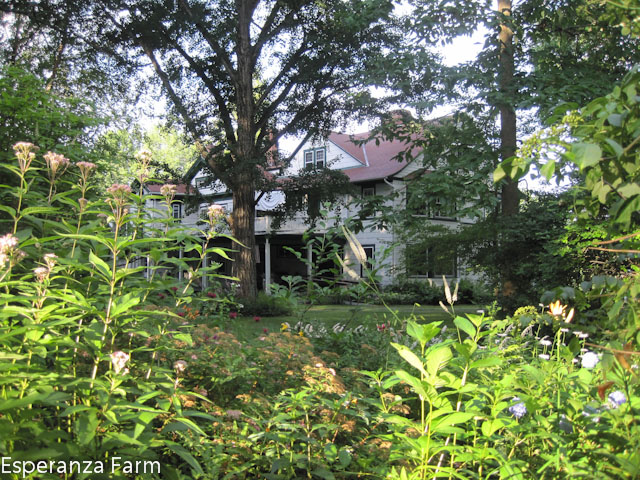
For the gardeners, left to right: Joe-Pye Weed, Spirea, Monarda, Goose-neck, Cimicifuga racemosa, Shasta Daisies, Hydrangeas, (also Daylilies, Black-eyed susans, and Turks-cap lilies) are all visible.  The tree is a Gingko, about 110 years old, the closer trunk is a young (fifty years old) Cucumber Magnolia.

« Previous PageNext Page »