Fall bulb planting, 1873 Saturday, Nov 3 2012 

Julie writing to Helen, fall 1873:

“That abominable little white rabbit has eaten up half the tulips. The wretch picks them out and sits down and nibbles them before our very eyes, ungrateful animal!  When the bed in which they are planted cost Fanny such hard work, she picked 300 stones out of it.”

Some things don’t change, still planting tulips, still picking stones, and still pondering how best to deal with rodents.  Though it rather sounds as if the white rabbit was a supposed pet….

Fall cleanup Friday, Oct 26 2012 

Continues apace, I have a bucket of Morning Glory vines taken from the arbor, which hopefully should yield a nice amount of seed.  The statues are in, being an uncertain zinc alloy, we don’t think the freeze thaw cycle would be great, especially since water may be able to get in them.  All the bulbs are planted, including a number of white daffodils under the fence line, in amongst the blue crocus.

We are exploring the idea of not removing all the leaves from the north lawn. The grass is a type that should handle a light leaf cover, while the winter wind will probably blow most away. The gingko will have to be picked up though, its leaves mat and flatly refuse to decompose.  The problem is, of course, that the big perennial garden is downwind, and we don’t want major leaf drifts on it.

experiments!

Croci! Thursday, Oct 18 2012 

Around about a thousand or so….Actually, I only got 500 in the ground today.  This is a continuation of the fence-line project, which is about 120 feet of fence at the top of the meadow planted out with daylilies.  Last fall I put in a 1000 crocus, but I soon determined that wasn’t enough.  So double it…  It appears that daylilies and crocus will happily coexist; but that the common violets, which hitched a ride with the daylilies, are greedy buggers.  Anywhere there was a mature clump of violets, I could count on there not being any crocus directly underneath.  And I do mean ‘clump’, violets form a solid ball of rhizomes about the size of a base-ball if they like the spot.  I am letting some violets continue, of course, for the butterflies; but I’ll be keeping a closer watch on them.  I am also planting the spine of the bed with white daffodils, of the poeticus and tazetta types.   We will see how they behave.  In the daylily/daffodil bank they have overtaken the lilies quite completely.*

Hopefully, it will eventually be a river of lavender with points of white and blue, and a rare flash of gold from a mixed crocus vernus collection.  Of course…one does wonder,  why?  There are only three people likely to see it in person. Our infrequent guests never appear in March!  But then, one doesn’t garden for that reason.

*Those however are the mystery daffodils: I dug several bushels of what I was sure were Poeticus type (judging by the very few flowers) from the woods, but were mostly clumps of over-crowded bulbs planted well over a century past….I ended up with a bank of pure gold trumpet daffodils, nary a Poeticus in sight.  They may be true King Alfreds, so no complaints.

Summer’s last flowers Monday, Oct 15 2012 

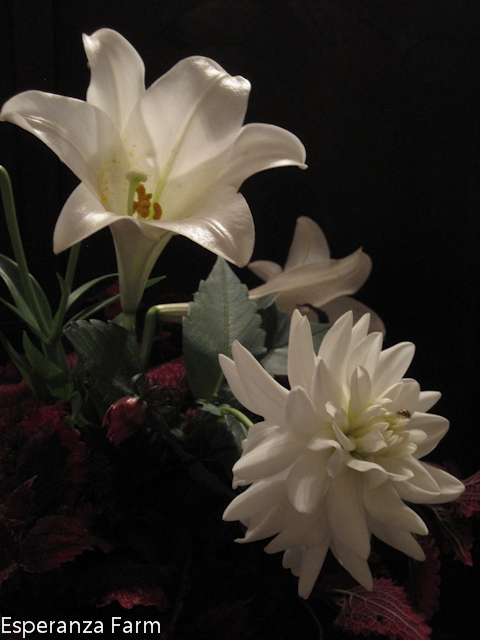
There are, of course, plenty of asters, mums, and other hardy perennials still going.  But the first frost was a killing one, so dahlias, coleus, and a confused Easter lily (on its second round of flowers for the year) got cut for a bouquet.

New tree! Friday, Oct 12 2012 

Well, not really.  At the south end of the Yellow Mountain swamp, really a bog, I have often watched various birds.  The bog is caught at the top of the watershed and perched on the top of the hill, it actually drains to the north, in between two steep ridges.   While cold, the ridges protect the area from the wind, and most of the surface water is collected, unable to penetrate the bedrock of the ridges.  This protected habitat shelters birds, while the bog prevents tree cover leading to an impenetrable tangle of blueberry, dogwood, and ilex.

In any case, I haven’t paid much attention to the trees I was under.  About twenty feet tall, with the overall appearance that many understory tree/shrubs take on: incredibly slow growing trunks only a few inches in diameter but decades old, arching and bending to reach the light.  But I noticed them this time.  Instead of the ubiquitous yellow of witch-hazel (the dominant, next to laurel, understory tree), these were a fluorescent orange shading to red. 

So I look a bit closer, poke at the bark a bit, ponder this….grab a leaf for further identification.  I thought I knew, but I wasn’t sure… continue on my way.  Note several more trees of this type, some a bit larger, all in the protection of the ridge but at the sunny edge of the bog.

My initial, ‘but it can’t be’, identification turned out to be right: Nyssa Sylvatica, also known as Black Gum, Tupelo, or Pepperidge.  A bit farther south this is a spectacular and immense tree, rivaling oaks in stature.  It has beautiful fall colour, birds and bees Love it, and it is as tough as the proverbial nail*; but while I have two nursery grown babies that are beginning to take hold…now that I have moved them out of the wind…I thought that Fairfield County was its northern natural extent, with maybe a few in the major river valleys farther to the north.  But on further research, it turns out that ‘cold mountain swamps’ are another of its natural habitats, extending its range to Ontario, if there is enough water and enough wind protection.  I feel a bit stupid, but very happy!

*Naturally, it has been completely ignored by the nursery trade in favour of invasive and/or far less elegant species

What were we thinking? Wednesday, Oct 10 2012 

Plant orders have a tendency to have a long lag time, often several months.  This can cause mild consternation at times, because what seemed perfectly obvious and well thought out in July may not be the gardener’s inclination in October.  (I know, one is supposed to have Master Plans, yeah right) 

I know we thought out the tulip order.  We spent several mornings on it.  What I can’t remember is why the plan ended up heavily weighted towards hot pink.  It is a logical design, but it is the starting point of a strong colour palette as opposed to a pastel palette which is a puzzle, since we don’t usually head in that direction. It should be very pretty; but it came as a surprise to recall it!

Maybe this year the tulips will last more than a season.  I dislike the trend towards breeding, growing, and treating tulips as annuals intensely.

Growing Grass Tuesday, Oct 9 2012 

Fall is, as anyone who has had to transplant things, a very good growing season.  Spring and Fall are far kinder to plants than either Summer or Winter.  In the cooler, usually wetter, months of September and October, root systems can really take hold.  We cut the long grass of the west lawn, an experiment, down in late August.  This sacrificed the asters and goldenrod (which are nicely flowering in another patch that will be cut later).  In exchange the wild thyme, bunch grasses and sedges have rebounded.  What was a browned off, dusty patch is carpeted with tufted grasses, thyme, sorrel, and other plants such as wild sedum.  This is very important for the thyme, in order to avoid winter kill it needs to be short and growing with vigour.  If it gets to lanky, the loss of the entire plant is possible.

In theory the taller grasses should also benefit the insects, and thus the birds.  What is particularly interesting, however, is that the taller grass shows no sign of grub damage…unlike the areas that are kept as traditional lawn turf.  Whether the grubs don’t like the tall grass or the damage doesn’t show isn’t clear.  But I lean towards the former.  Our grub eater par-excellence, the skunk, is not digging in the long grass areas, which suggests the grubs aren’t there.  Another strike against the traditional lawn?

Contemplative Gardening Monday, Oct 1 2012 

I am currently blessed with too much free time; this gives me the opportunity to garden at a slower pace.  I could have  cleaned/weeded the currant bed with a hoe; it would have been marginally faster.  I am sure I could buy some sort of obscenely loud and expensive equipment to do it even better…

Doing it by hand though…I observed the root systems of various weeds, sorted out some baby foxgloves and mulleins for transplant when it is raining, avoided a young dogwood seedling (also to be moved), considered the repulsive but compelling scent of some sort of morel type fungus growing in the bark mulch, watched the chickadee watching me, avoided harming the salamander that I disturbed (he thought my warm hand was rather nice when I picked him to move to an already worked spot), and so forth.

The currant bed isn’t a just a piece of work or a piece of landscaping to take pride in (or not as the weeding goes).  The image in my mind is far deeper, far wider than that.  It encompasses a summer’s growth and decay, dozens of plant and animal species, scents, sounds, textures.  What’s not to like about that?

Photo of the Day Monday, Sep 24 2012 

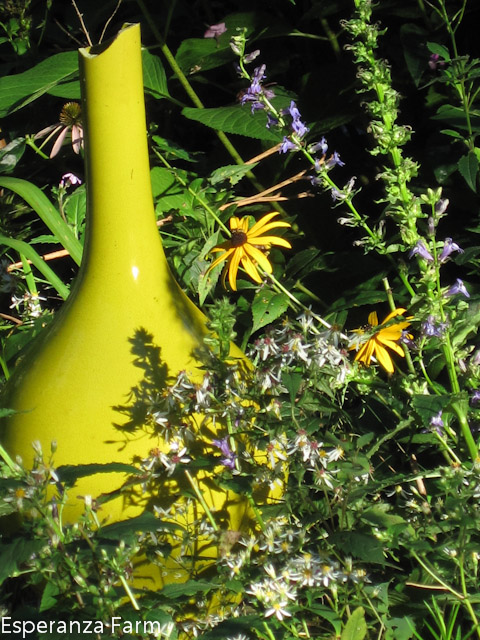
What one does with a badly broken jar; the flowers are blue lobelia, white wood aster, black-eyed susans, and coneflower

What’s blooming Friday, Sep 14 2012 

We are just starting to see fall colour, mostly in the ashes and the stressed trees.  Still, there is plenty of colour:

Certain annuals are still going:

Nasturiums

Morning Glories: ‘Grandfather Ott” a starred purple

Petunias

Sunflowers

Jewel weed (short orange and tall yellow)

Perennials

Black-eyed susans (Rudbeckia hirta and triloba)

Lobelias (Red and Blue)

White wood aster

Blue wood aster

Calico aster

Helenium

Helianthus

Lingularia

Toad lilies

Sedums (mostly Autumn Joy)

Anenome Robutissima

New England/New York asters (a tall pink, blue ‘October skies’, ‘Alma Potschke’, a wild tall blue)

White boltonia

Goldenrods (at least five types)

Garden Phlox

A second flower stalk of several Easter lilies

Vines/shrubs

Pee-Gee Hydrangea

Caryopteris (fluffy true blue flowers)

Autumn clematis

other….  a mix of pastel or dusky pinks, blues, whites with really good yellows, reds, and blues.

*pardon any misspellings, typing this on the way out the door…


« Previous PageNext Page »