The turning wheel Saturday, Nov 23 2013 

We all have specific calendars we pay attention beyond the standard calendar: school, gardening, theological, tax, politics, so forth.  I am ‘tuned’ to only two, gardening and theology. (tax and politics can go hang)  They are not in conflict in the way school (new year in the fall) and gardening (new year in the spring) are, but rather offset in such a way that they work together.  The theological calendar starts its new year in December for me, at the time when the garden is done for the year and I am looking ahead to the coming year.  Theologically, the calendar peaks in Spring, with the long summer stretching out ahead in a fairly stable pattern.  The same with the garden.

This, of course, is hardly accidental: the early Christians paid close attention to the climate in the Roman Empire, and the seasonal cycle for that bit of the world is roughly the same as it is in northeastern North America, if much milder.*

Consequently, I would have a horrid time adjusting my internal clock to Australia or South America.  All of this came to mind talking to my farrier on bitterly cold and windy morning, commiserating on holding horses in the winter and holiday plans.  He is originally from LA, and commented that he much preferred New England in the holiday season: ‘everything makes more sense’  (referring to Christmas trees, turkeys, and all that).  Obviously, one can have an excellent Christmas in Rio, or Melbourne, or Wellington.  But it is rather nice to be able to look forward to the holiday season, it takes the sting away from the fact that it is cold out there! And dark, and cold, and you can’t do anything outside that is constructive and dark and cold and…

Winter is closing in, but next year is already coming.**

*aligning the two calendars was as much about using the natural world as an object lesson/mirror as it was about politics/historical accuracy.  One need not get into the tangle of whether it was human manufacture or divine intent plus human manufacture

**I just hope winter holds off a little, as sexton of the nearby cemetery, I have a funeral that is coming up, and this cemetery follows New England tradition if there is snow or the ground is frozen one waits till spring, which is a little hard to explain to people these days. It looks like it will just squeak in.

Entirely off topic Friday, Nov 22 2013 

Southern New England has an odd culture.  Vermont, Maine, and New Hampshire have solidly claimed what people think of as ‘New England’ culture (stone walls, maple syrup, white churches, village greens, etc, though actually those are or were more common in Southern New England originally).  And then there is Boston and New York….  We aren’t that either, even if they are the only things we mean when we say that we are going to the city.

Just what is it?  Music is often a short-hand for recognizing a location.  In this day of the Mp3 and Youtube, it is less about where the artists reside and more about the style and mood.  If I had to pick something that fits though, I’d go with that thing sometimes labelled as Urban Folk, which ends up with a range of artists stretching from Peter Ostroushko, to Lucy Kaplansky, to John Gorka, to Bill Staines, and so on. The difficulty is creating a weird balance between the original rust belt cities of the northeast* and the classic white church on the hilltop green, between the Irish, Italian, Jewish, Slavic immigrants, coastal Portugese/Gaelic, and the original WASP’s, between the glittering promise of the cities or open land somewhere else and the conviction that this is the center of the universe despite all contrary evidence. A good starting point, is any anthology compiled by the Red House label.   The label isn’t exclusive to the Northeast (it actually is from Minnesota) but it certainly has a tendency to collect artists who have some sort of connection to that odd concept of Urban Folk.


*I grew up assuming that all towns had massive abandoned brick factories in their center…

Moon and tree Wednesday, Nov 20 2013 

There are certain landscape elements that are spectacular.  The rising moon is always impressive, regardless of the location.  However, watching it rise over the hill, half hidden by towering Norway Spruce and oak in late November touches on certain cultural tropes.  How many dramatic scenes involve a great, blue-white moon behind black trees in the hills, perhaps with a few high and cold clouds? Almost too many.  It may be culturally over-used, but in reality it still makes one stop and look!

Turn the Furnace on! Tuesday, Nov 19 2013 

It is on, of course.  It also is in the basement right beneath these two….  A and B, brother and sister.  B is the one on the right. They spend most of the winter right there. Not the most social of animals, but quite good at mouse patrol.

IMG_4345

Road to …? Sunday, Nov 17 2013 

IMG_9281

Doggerel Saturday, Nov 16 2013 

New England Cathedral

The cathedral of the trees

Soaring, living, singing

Has as its veiled ceiling

Heaven’s blue vault

Unshadowed by stain

Life rests untorn

Anchored upon enduring stone

Where fault and pain

Are, with mute patience born,

Awaiting the undestroyed fire

Asleep in the world’s tomb

From the Guestbook Friday, Nov 15 2013 

IMG_9562

‘Sketch of G.B. Bodwell engaged in playing whist; from the foreground.

July 5, 1879.  WWE (William Webster Ellsworth)

Fiddling Thursday, Nov 14 2013 

I have too many transcription projects that I want to play with….at the moment I have four different ones ranging from the 1840’s to 1918, from New England farmers, to genealogy, to travel, to World War I.

Attention span of a gnat!

The Problem of Scale Tuesday, Nov 12 2013 

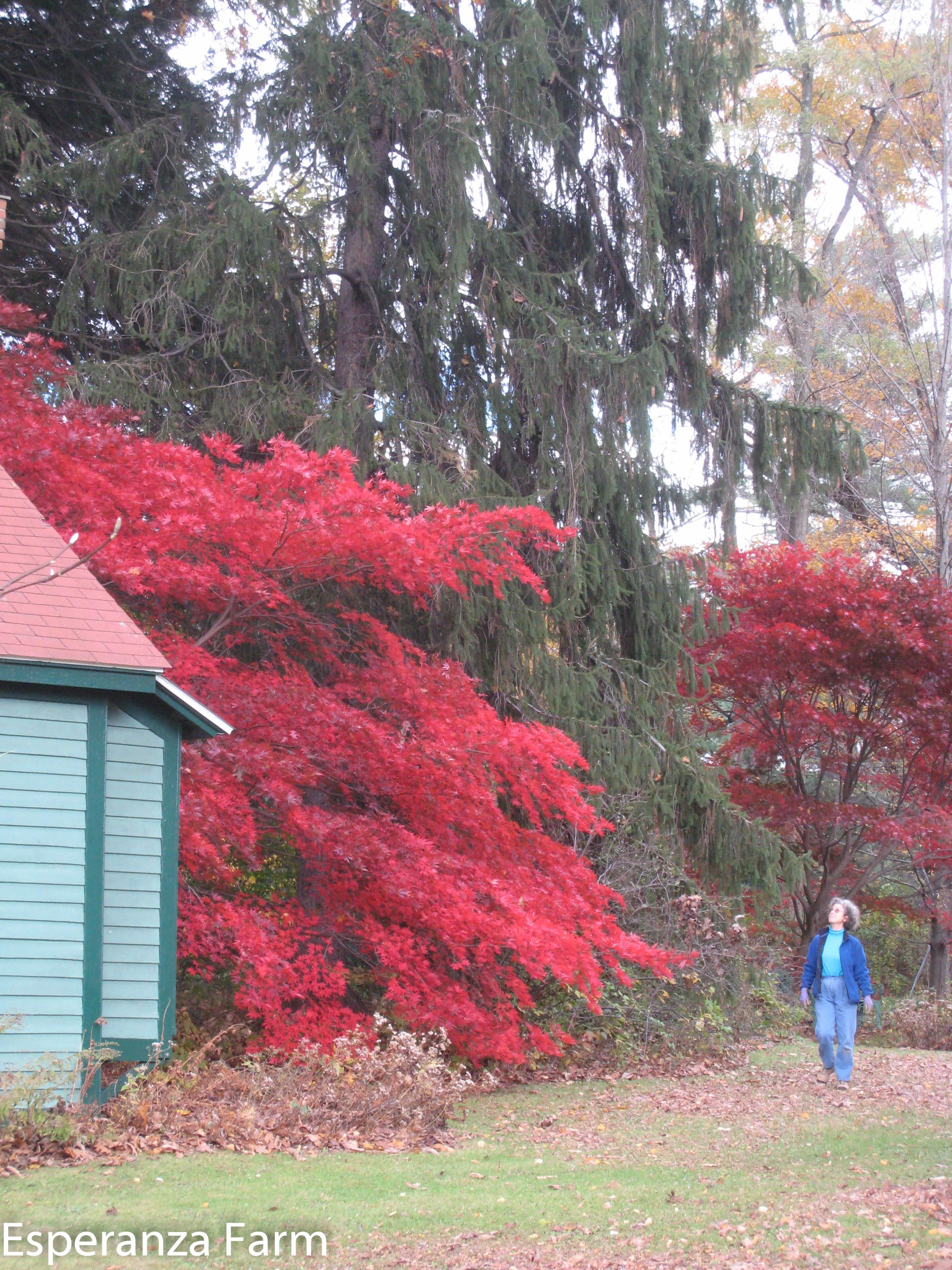
One of the more common problems with projects around here is the ‘everything is Bigger’ one.  In the house this cropped up recently with the discovery that the ceiling in one room was not 15 feet, but more like 17 plus to the peak….of course in some other rooms it is less than seven, so no guarantees.

It is fairly typical to hit this with trees, usually when we try to prune them.

The scale of the place is rarely conveyed in photos, since I hate taking photos of people and most people around here have no desire to have their photo taken.

This rare shot helps illustrate scale. (my apologies to the model! ) 🙂 Consider it in relation to the Japanese Maple photo of a few days, which shows the same trees.

IMG_2263

11 a.m. November 11 Monday, Nov 11 2013 

23 November 1918

La Neufor (near St. Menehould, France.)

My Dear Dad and All:

It seems strange to start a letter by naming a town, and stranger still this town, for this is where we started the great drive through the Argonne Forest to the Meuse, which we had crossed when the Boche quit.

…Since August 10th this regiment has slept under the open sky, right up until the 11th of November. On August 10th we went in on the Vesle River and scrapped there and to the Aisne. As soon as the Aisne was reached we came here, or rather to Givry in trucks, and started the greatest forest fighting in history.

…We have not had the publicity or the limelight of some others but Gen’l Pershing has said, “there is no better in the army and none that can be banked on to accomplish its task as well as the 77th.” That’s praise enough for us, and history will tell the story someday.

…Sept. 20th at 5 A.M. was the start of the attack with artillery. Lordy! How they did roar. Some days we would nibble off a kilo (kilometer), other days not a foot, but never could the Boche make us give way a foot. The Argonne is as thick a woods as you have ever seen; steep ravines covered with thick underbrush, and it was defended by the 120th division Landwehr troops, who had been in these same woods for eighteen months. They were a first-class division, and made up of woodsmen who knew every path and trick in those damnable woods…

I’ll never go into the woods again or underbrush without my heart in my throat. It was literally impossible to discover a machine gun nest except by the sudden cutting down of yourself or someone else. The manual says that machine gun nests shall be destroyed by ‘flank attacks and by the use of hand and rifle grenades and the 37 mm. gun” Oh Jay! The man or board who wrote that knows nothing. Did he ever try to throw a ball and have his arm caught by brush? Or fire a rifle grenade which would be stopped by woods in ten feet? Or pull the lanyard on a 37mm gun knowing that the shell would explode as soon as it left the muzzle? You can bet something he wasn’t thinking of the Argonne. ‘Use your auxiliary arms” Another joke. The arms you used were your own and twenty-two days of hand to hand fighting was what we got. The regiment got just that and ended up with the brilliant and expensive taking of St. Juvin and Hill 182. That was in the open, wide open, and it was this that carried men forward who were so worn and weary that they would sleep when halted under the heaviest kind of shell fire. It was the relief after being stifled by underbrush and woods that made us take that hill and carried two and part of another battalion against three regiments of Germans – youngsters this time of a Guard Division – and we licked them to a standstill. Two regiments of Hell’s children counter-attacked…and they were literally beaten to death, those that didn’t get by as prisoners.

I’ll never forget the days of October 10th and 14th. It took twelve of my best friends in the regiment that one afternoon of the 14th, but they died the most glorious death in the world and we mourn them not….

Right after St. Juvin we were relieved for fourteen days, staying just behind the lines for replacements and equipment, preparing for the push to the Meuse…and then back for another go at the Hun. We started almost exactly where we had left off…We jumped off Nov. 1st and crossed the Meuse near Stenay-Autrecourt on the night of the 6th and held there under the Boche’s nose until the armistice went into effect.

…As for staying in the army, no. I’ve done enough. I’m tired, so damned tired I’ll never get rested it seems to me…Personally, the war has brought me knowledge of men and things, what they think even without their speaking. It has brought me a greater love for my country, it has brought me the satisfaction of doing my job well.…and Dad, I’m through.

Will see you soon

Your affectionate son,

Bradford.

(Captain Bradford Ellsworth, Intelligence Officer, 306th Regiment, 77th Infantry Division)

Bradford was the son of William Webster Ellsworth and Helen Yale Smith Ellsworth.

« Previous PageNext Page »