Random musings on getting wet Thursday, Aug 25 2011 

Specifically, getting wet while pulling the fence that keeps the old horse off the hayfield through the summer.  He now has a thoroughly decadent 12 acre field to play in for the time, and sometimes in that great stretch of green grass he shows that he is a descendant of Kentucky royalty, even at age 26 with two bad legs.  But I timed it poorly, and got to the farthest corner as the rain came down, in buckets.  Now, I don’t run.  And getting wet, well that really isn’t worth the effort.  So I continued on and got very wet indeed.

Having decided that you are going to be wet, it ceases to be an issue.  You won’t melt, unless you’re one of Mr F.L. Baum’s unpleasant witches.  If you aren’t going to be out too long, getting cold isn’t a serious concern.  So you get wet, watching the low grey clouds come up over the hill and the mist rise from the fields, and consider time.  Because really, you are already wet, why hurry?

stacking wood Wednesday, Aug 24 2011 

Today a somewhat meditative exercise in spatial arrangement to see just how tightly a bin could be filled, while listening to the wind and the tractors in the field. Could be worse.

Second cutting Tuesday, Aug 23 2011 


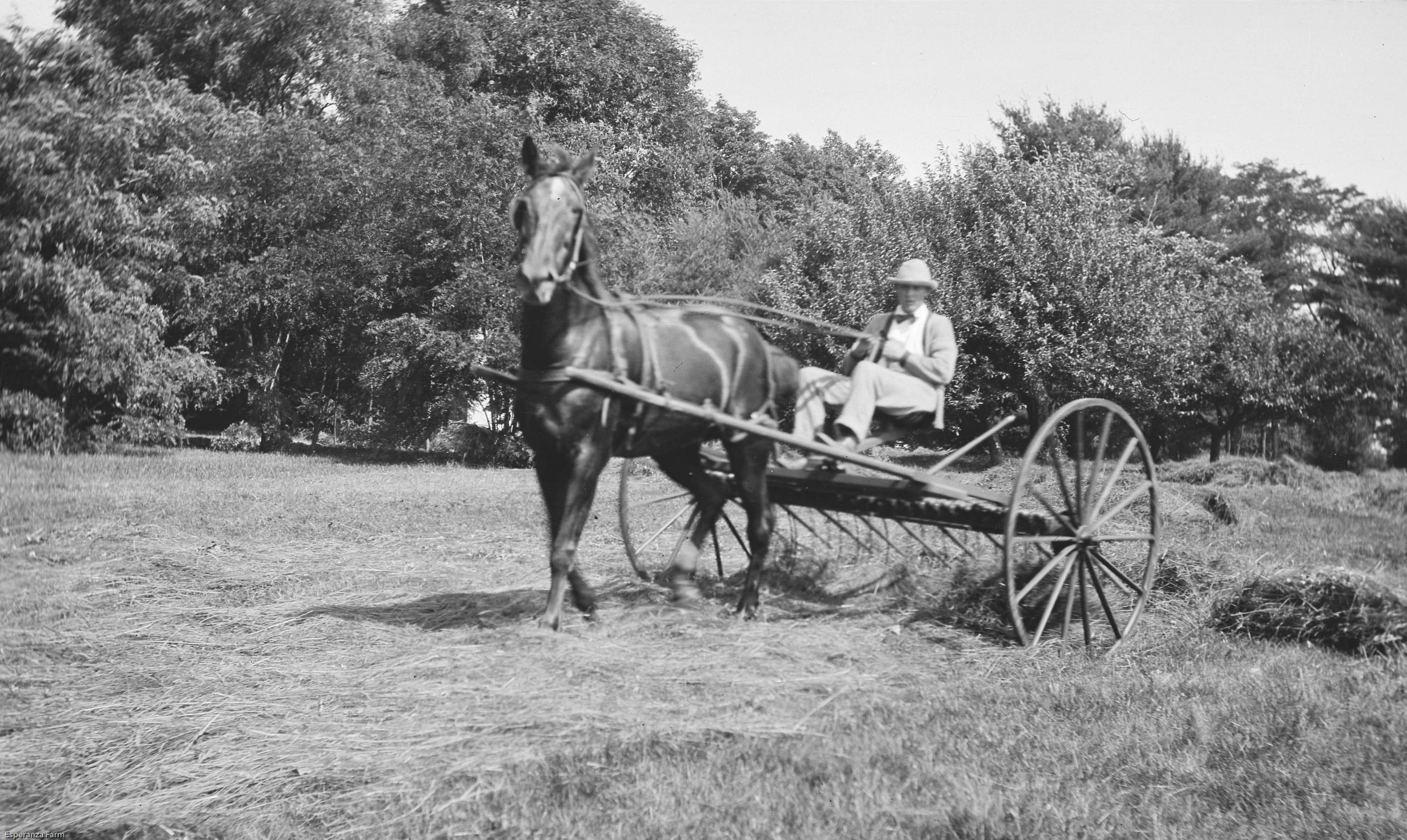
Tedding hay 1911

 Esperanza has always produced hay, for most of its history it was for its own use.  The picture above was probably takn of a second cutting of hay.  I don’t know who is driving the horse, but I do know that the horse is Kentucky Chief, one of a matched pair of medium weight driving horses.  He would have been well suited to handling a light tedder and would have been much faster than using one of the Percherons, who would have been used to bring the hay in.  The farm also had a team of oxen.

  Today I take 75 bales and the rest is taken by the farmer who cuts it.  That the field has a reputation for being the best in town is a source of pride. (even if the competition is small these days)  The field easily breaks a 1000 (est. at 50lb bale, much less when he does round bales) a year, which isn’t bad since only 12 acres are in hay at the moment.

There is always a way to these things.  The first cutting traditionally comes in early June, Belmont weekend when the grass turns from silver to gold.  Really, the color changes when the wind bends the grass, gold is fully mature seed heads.  Brown is too late.  Most years, this one was no different, this is the worrisome cutting.  The larger and more valuable of the two, it comes at a time of year prone to uncertain weather.  It is also the cutting, because of the tall grass height and seed heads, that is more easily ruined.  Because it is higher quality grass it is generally considered horse hay, but this also increases the risk for horse hay must be dry.   Hail storms beating the grass down before it is cut, rain when it is down can turn it from 6 dollar horse hay to 2 dollar construction hay. 

The second cutting happens any time from mid August to before the frost, so end of September. This period has more predictable weather.  The cutting is smaller often half the size, unless the summer has had lots of rain, and easier to handle.

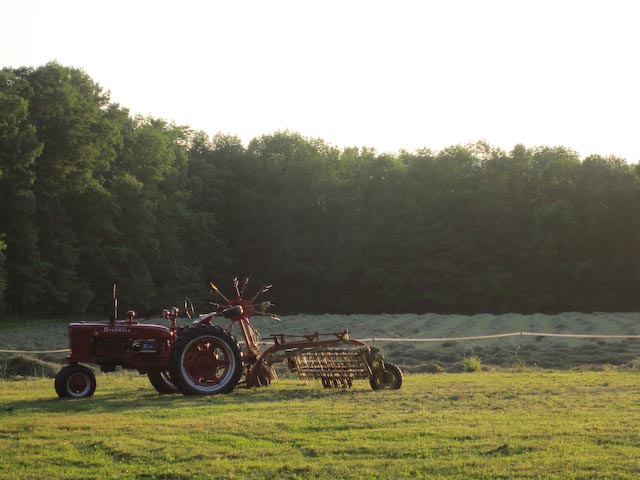
Hay tedder 2011

This picture was taken in June.  You can tell by the size of the windrows that this is a first cutting.  While the tractor qualifies as an antique, and has another career at tractor shows, the rakes are more modern and of a typical size for New England haying equipment today.  Like all farm machinery they are elegant, functional and lethal.

Turning weather Monday, Aug 22 2011 

One of the things that I missed when I wasn’t living in New England was the seasons.  If you live here long enough, you start to figure out what the early signs are for the changing seasons.  August is still summer here, but it is late summer as opposed to July, high summer.  Some things that we associate strongly with New England summers belong to August: sweet corn, peaches, tomatoes (everyone wants to push them earlier…but they just don’t).  Other things belong to fall, white and blue wood asters, onions, apples.

The last 24 hours have shown both of August’s faces.  Yesterday dawned hot, muggy and with building clouds.  The end of a spell of weather that makes one want to stay far away from New England in the summer.  Everything sticky feeling with humidity, but everything wilting because there was no water.  By noon, the wind was rising and the clouds darkening, the cats were edgy, the birds suddenly active.  Mid-afternoon the thunderstorm rolled through, the sort of big thunderstorm that August creates, you know it is coming for hours and then there is cold rain with wind.  The night cleared, the crickets were in full song by the thousand thousands.  And today, partly cloudly, a cool morning, with the high dry wind and sun, about seventy at noon.  No bugs, no humidity.  A day when it feels like you could do anything and you wouldn’t want to be anywhere else.

Cercis Canadensis Saturday, Aug 20 2011 

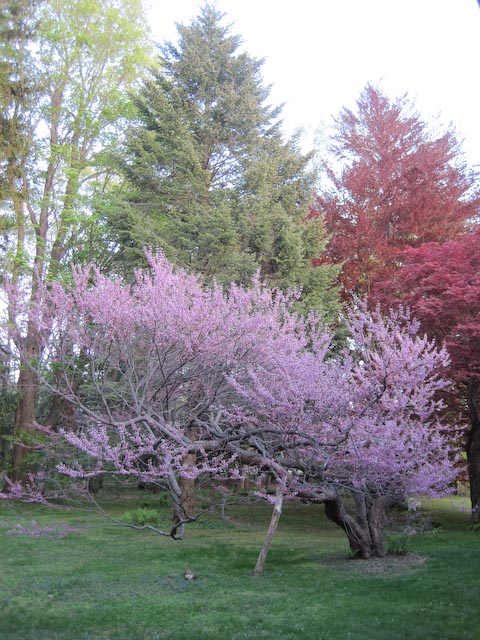
cercis canadensis

Cercis Canadensis is better known as the Eastern Redbud, also known as a Judas tree or Spice tree (more on that later).  It ranges naturally from New Jersey to central Florida, west to Michigan and eastern Nebraska.  A variant, the Mexican Redbud, ranges down across Texas and into Mexico.  This official range is somewhat inexact, I have seen it as far west as Wichita County Kansas, north through New York state, and of course, it grows quite happily here in Connecticut (hence this entry). 

It is perhaps most spectacular in the mid-range.  As a medium height, understory tree with a spreading and dramatic habit, it is spectacular in the spring in West Virginia and the Delaware Gap region; where it frames many roads, and in bloom is a vibrant pink spray of flowers against the rugged rocks and green river valleys, nicely complimented by the white dogwoods.

It is not a tree of great height, rarely forty feet. It is, however, very fast growing (see below picture).  But what it often does is branch near the ground creating a wide spreading tree with fantastic branches.  The wood is fibrous and hard, but weak.  The bark is an attractive red-brown.  It withstands rot and is not bothered by partially torn limbs, which is good for ice damage is common.

The pink flowers bud out along the branches in a unique fashion, before the leaves and last nearly a month.  These flowers are followed by seed pods that look exactly like snow peas.  Birds love them, especially chickadees and goldfinches.

The green twigs can be used for flavouring game, hence the Spice tree.  The flower buds can also be pickled for use as a condiment.  The other name, Judas tree, more properly belongs to its European cousin, Cercis siliquastrum.  This tree growing from the mountains of Israel up through Iran and Turkey, was historically known as the Judean tree.  The corruption of that name may account for the name Judas tree.  However, the more common legend is that Judas Iscariot hanged himself in a redbud.

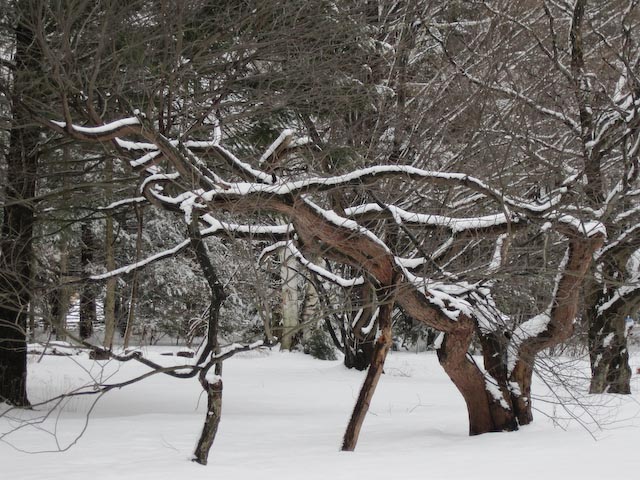
And so, Esperanza’s redbuds: the image at the top is the original one, planted c.1977.  It was planted by my grandfather, Newman, who remembered fondly those in the Shenandoah and Ohio River regions, where his family was from. It has a sheltered location east of the house, with plenty of water.  In recent years several young redbuds, volunteer offspring have been encouraged elsewhere.  However, they do not prosper in areas on the property that have high wind loads, suggestings that this is a northern end of their range. Notably, those in the mid-west also tended to be in locations with lower wind loads.
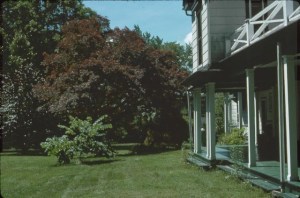
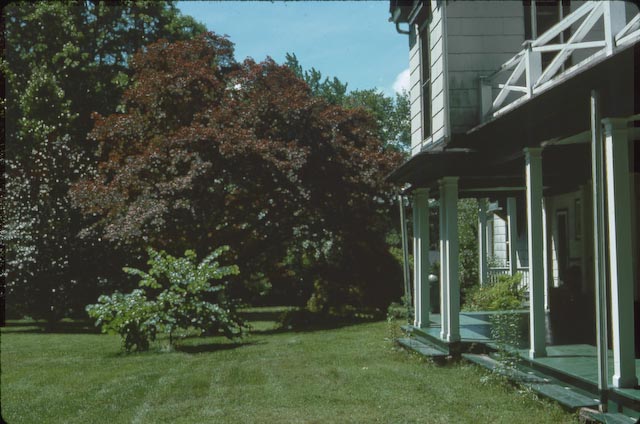
This picture, taken in 1978, shows it as a young tree. One of the benefits of the redbud is that it is a fast growing, disease resistant tree, that also happens to be extremely elegant.

Taken last year, this shows its low branching and dramatic structure. Note the supports.

Cleaning the barn Friday, Aug 19 2011 

One of the double edged gift swords of this place is that it has never been moved out of; generation after generation has left their traces, some faint and some not.   The positive is that truly accurate impressions can be gathered, as opposed to the prettified and censored concepts of the past that are more common.  But it also means there is a lot of stuff and some is junk; that the last two generations have refused to tender their oblations to the god of consumerism means there is less than there might be.  But there is a lot.

In any event, clearing space in the barn for the recently reacquired gigs and sleighs means an opportunity for reorganization, re-evalution and reflection.  One truck load has already gone to the dump, another is organized for it.  But what is the value of can of pre-war (WWII) Lincoln car wax?  It evokes a car only seen in a few pictures, a different world of manufacturing (everything in the depths of the barn is either UK or American manufacture, even car wax), a different aesthetic.  But is its value as an historical artifact transient? Does it have meaning to me only because my father could tell me about the car, because I recognize fondly the remnants of a bygone era (warts and all)?  Would someone else have even looked/ Should they have even looked?  Would it have meaning tomorrow? 

Difficult questions, and the car wax was the least; there were and are lots more questions.  Benign neglect has a value when it runs for generations; but at some point it has to stop…and apparently it is starting to apply the brake.

Japanese Maple just after dawn Wednesday, Aug 17 2011 

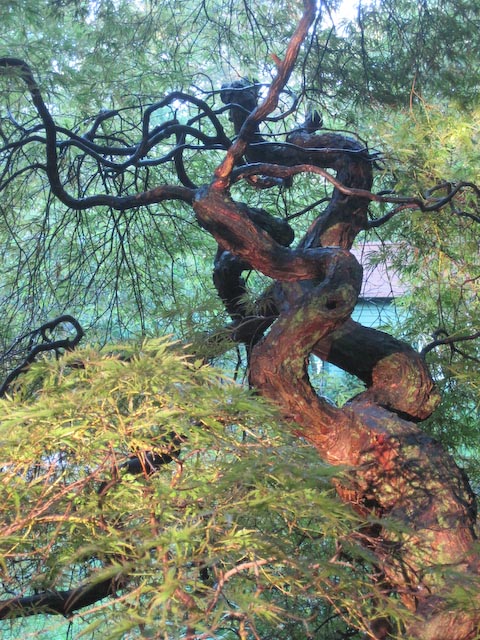
Cut leaf Japanese Maple

I clearly ought to get up early and wander around with the camera more often.  This is the smaller of the two original Japanese maples, a fine cut-leaf type.  I believe they were somewhat common in early twentieth century landscaping, I saw two specimens, not as big, on an estate in Norwalk.  Tends to be sort of life-size bonsai if that makes sense.  It has, for all intents and purposes, stopped growing; although it is clearly larger than it was in photos from the 1950’s, but the essential shape is unchanged.

The chipmunks and red squirrels love it.


Disease and Insect Control part two Wednesday, Aug 17 2011 

I mentioned the value of stuff that works, be it organic or inorganic.  The organic example, also going to go on today if the wind stays down, is Milky Spore Disease.  This nasty little bacterium goes after Japanese Beetles, or more correctly their grubs.  It tends to remain active for about five years, before the number of incoming un-infected beetles out numbers the infected ones.  Most grubs die immediately from it.

This nice example of a very specific predation is what one would like to find for all those introduced pests.

Of course, the space alien baby squash bugs (I swear they look like a cross between a tick and a spider) I am just squishing.

Disease Control Wednesday, Aug 17 2011 

There is a guy wandering about in our woods right now spraying our hemlocks for adelgid and scale.  We use a lot of hemlocks here, mainly as screening from the road, but several are major specimen trees.  Wooly adelgid and scale have both turned into chronic issues in Connecticut, capable of knocking out even very large trees.  In areas along the coast the adelgid has killed almost all hemlocks. 

Now I have never pretended to be a devotee of the organic way, though it has its points; I like to use what works, if it is organic wonderful, if it isn’t also wonderful.  The little Pyrethin molecule (quite capable of killing just about anything) doesn’t know after all if it was distilled from a marigold or made in a lab.   The insecticide being used is somewhat close to black magic.  Highly water soluble, the stuff is sprayed on the trunk and is absorbed into the tree; if it rains and washes into the ground it is absorbed through the roots.  From there the only critters affected will be insects chewing on the needles. Upsides: reduces the potential drift problems (hence reducing the number of other insects that are unintentionally killed), works on our eighty foot monsters, reduces the amount needed; downsides: not cheap, and for God’s sake don’t dump it into any watercourse.   There is a place for correctly used, nasty tools.

Water, water everywhere! Monday, Aug 15 2011 

It has been raining here, a welcome bit of weather on the whole.  But sustained rain events do tend to illustrate one of the often overlooked points of the landscape, that is to say the shaped environment within which the house sits.  Namely, that it is engineered. 

The house sits on the crest of the hill, and so water would not seem to be an issue, and certainly it is not one in the catastrophic sense that one finds in the river valleys.  Hilltops tend to be somewhat difficult to flood.  However, anyone who spends time in the region’s woods learns that bog, streams, and other damp bits can happily perch on hilltops.  (a stellar example of one such bog will undoubtedly be the subject of posts here)  Therefore, if one wishes to build a house, one is advised to consider what the water wants to do. 

In general modern house lots don’t worry too much about major drainage, generally we have already done unto the water in the area and the wetlands don’t exist.  Or if wetlands do exist, you usually aren’t permitted to build there.  But Esperanza’s lot wasn’t fiddled with before the current house was built, so the original design is still extant.  Basically, it is a two-pronged approach: divert as much as possible: two massive tile drains to the east of the house drain the slighly higher (but wetter!) ground to the north and east. Secondly, accept that the water will be there: the foundation and basement are designed to allow water to flow through the north wall built of loose fieldstone, into open channels running the length of the basement and out the south end.  One of the tile drains, the house’s roof and the basement all drain into a set of cisterns that were previously used for utility water. 

You do have to accept a somewhat soggy basement at times (and yes it Is soggy than it ought to be currently but that is a different topic).  However, if the cisterns were cleaned out, grey water would be readily available.  Sensible that.

« Previous PageNext Page »