Carlotta (Julie’s daughter) gardening, August 1908. I don’t believe that watering can exists anymore, but we have similar (riveted tin). The bench still exists. Several interesting things here: note the fitted apron, I think blue and white, the glove apparently only on one hand, the hat! and brooch. It looks to me like she is watering breadbox poppies, the ones that create poppy seed. And I am intrigued by the tall ornamental grass in the background; we tend to think of that as a modern gardening accent, but it clearly isn’t.
Crocus! Friday, Aug 12 2011
It being a gorgeous August day when the wind is from the North Land…I am contemplating spring flowers. Landscapes are good for long term planning. Anyway, I just ordered some 1200 crocus, intended for the West Meadow fence line. I hope they will tolerate being interplanted with the daylilies. So blue, purple, white and gold in the spring and orange in the summer. Sounds good!
Eeny Meeny Miny Moe Thursday, Aug 11 2011
Projects 13:39
Finally settled on creeping red fescue (festuca rubra) for the top of the repaired dam on Julie’s Pond. Whether or not it is the same grass that is still found in the Spring Lot is unknown; identifying grass seems to be something that I have neither the talent nor the patience for. It is native here, tolerant of dry shade, grows to the correct height, tolerant of foot traffic and is affordable…so.
The pond is definitely one of ‘those’ projects: a great opportunity both for recreating an historic landscape and in creating a native habitat, but also a great deal of work. Still, we are getting there! It actually has water again, furthermore water that isn’t growing algae and duckweed and is growing frogs by the thousands. A far cry from last year at this time.
Comments Off on Eeny Meeny Miny Moe
Philosophy of Restoration Part 1 Tuesday, Aug 9 2011
Uncategorized 13:07
There are three fundamental approaches: prevent further damage and leave ‘as is’; restore to original ‘showroom’ quality; restore for use accepting that there will be modifications and compromises in material and method.
The first is the most popular for several reasons: it is the least labour intensive, preserves the most historical information, and for those whose collections are investments is the least likely to reduce sale value because of the emphasis on ‘all original.” (Nobody collects the Irishman’s hammer) Often, however, this method means the object cannot be used.
The second trades the ‘personal’ historic information of the artifact for giving an accurate picture of what it looked like when it was created. This can be very useful, but also very disturbing: a Classical marble statue painted in the polychrome style is jarring. It is generally the most expensive in labour and material. It also has the serious pitfall that the restoration is always an interpretation. Get it wrong and not only is it wrong (while masquerading as ‘right’), but you have lost the historical information.
The last is least popular. It is an approach that presumes that the object doesn’t have to be locked away, can be used and should be used. My best example is an Oriental rug in everyday use in the house: I recently rewhipped the edges using matching colour wool, as my great-grandmother had done before me. This protected the edge cording and maintained the tension of the weave. Without doing that the rug would have had to have been taken out of use. In making the repair, however, I was forced to use a slightly different type of wool in a slightly different stitch. It is now a ‘repaired’ rug not an ‘all original’ rug. Price wise I am sure there is a difference, but on the other hand the rug is stabilized, can stay in use and can be enjoyed. In this method, interpretation is an accepted fact: I have continued the object’s story rather than stopping it or erasing it: the original weaver, my great-grandmother, and I have all contributed to the object.
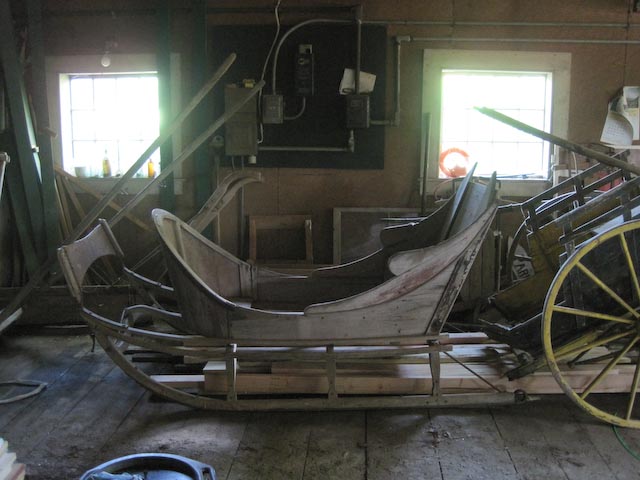
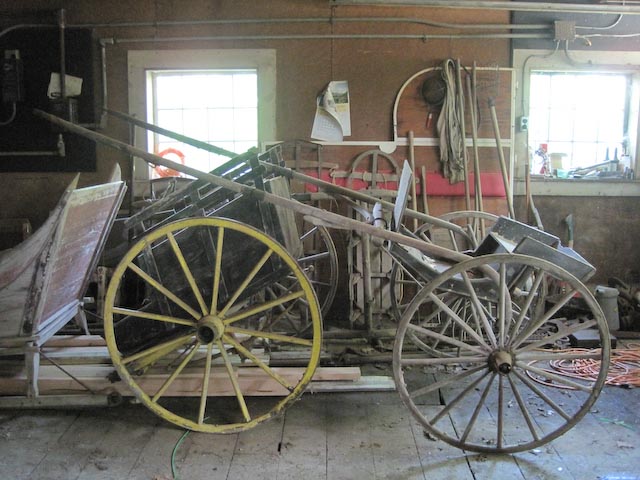
The carts and sleigh today Tuesday, Aug 9 2011
The sleigh is of an unknown age, the only known reference to a sleigh is by Julie in the 1870’s. It was originally red and black and is missing upholstery, a seat and the top of the back (should be a complete arch). The sleigh is also a rather unusual type, and I have yet to pin it down; although references to a ‘slipper-bath’ style do pop up in literature concerning the mid 1800s in rural New York state and in Quebec.
The two carts, skeleton gig types. The yellow and black one does have its shafts as well. The other was originally red and black. Both use iron leaf springs and have iron rimmed wheels.
Flowers of August and a new generation Monday, Aug 8 2011
Esperanza and Modern Photos 15:31
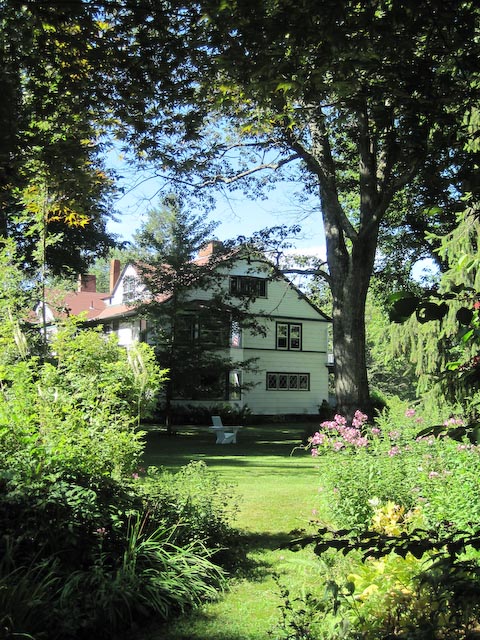
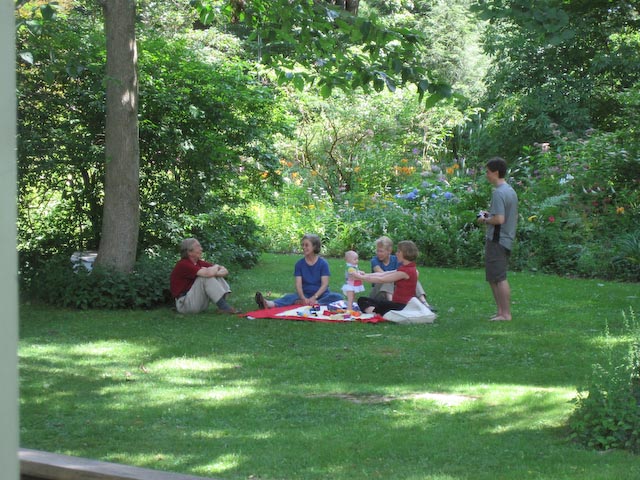
For those that know the house, you can see the new paint looking just as it ought on the gable.
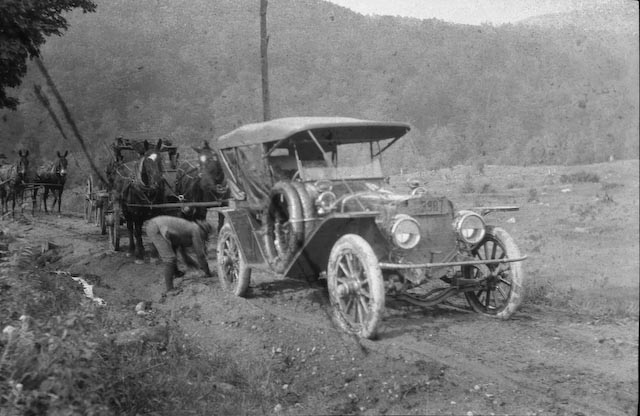
Traffic Jam Monday, Aug 8 2011
Historic Photos 10:00
Black Locust Sunday, Aug 7 2011
Black Locust, north of Happy Thought, when it was measured it was the biggest in the state.
Rain and spaces Sunday, Aug 7 2011
Uncategorized 13:47
Finally! A wing of a tropical storm I think, nice soaking rain. Rather useful, somewhat dubious timing since we had guests for lunch, but that is why the house has a nice large porch.
What is interesting to watch with a heavy rain storm is what happens afterward, the butterflies and moths start to dry themselves out. From what I can tell the butterflies, at least the big swallowtails, need access to a good quality conifer for shelter. At least they came down and out of the big hemlocks and spruces once the rain passed. A good example of the complex requirements that a species can have.
Comments Off on Rain and spaces
One hundred years to the day Thursday, Aug 4 2011
Esperanza and Historic Photos 12:41
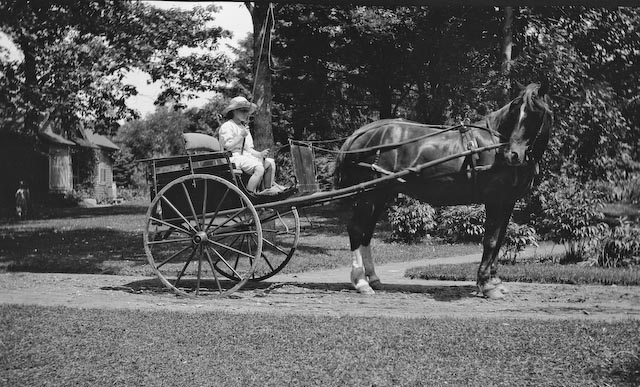
One hundred years to the day of this photo, and a bit worse for wear but it rolled on and off the truck, we got the cart back (with two others). Now, anyone know how to restore them?