Memorial Day Monday, May 28 2012 

The poppies, blood rubies

Of crimson memory,

Shocked the eye

Caught between the lush, green fields

And the storm driven steel of the sky

This was not the red of fire

Nor yet the red of fall

But the heart’s red

Flower on the solemn ground

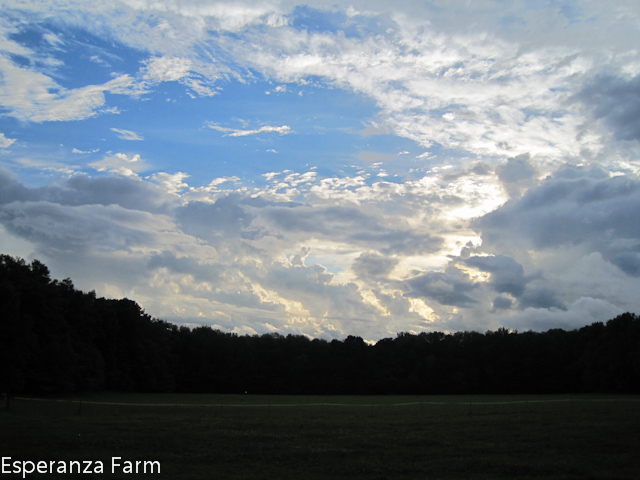
Sky Saturday, May 26 2012 

What is that purple thing in the tree? Friday, May 25 2012 

Most people driving around Connecticut, Massachusetts, and New York have probably seen a bright purple box, about two feet tall, hanging in a tree, usually about thirty feet up.  If they are very observant they will have noticed that the box is usually hung in an ash tree, preferably one in decline.  What are they?

The boxes are traps for the Emerald Ash Borer, a nasty beetle that hitched a ride from China to the Midwest some years back.  This bug has been inexorably making its way east across North America.  It eats, and kills, ash trees at a good clip.  Since ash is a valuable lumber tree, critical wildlife habitat, and makes up the majority of forests in many regions….this is cause for concern. 

The traps are not designed to catch all of them.  Nor will they attract them from more than about a hundred feet away, so they Will Not lure them into an area that doesn’t have them.  They are merely there to allow the USDA, USFS, DEP, UCONN*, and others to track the bug’s progress so as to learn what slows it down and what doesn’t.  Last year there were about 950 traps in Connecticut, on a square kilometer grid system.  This year there are about 450, over more of the state but not in all areas.*  So far, the emerald ash borer hasn’t been found in the state…yet.

What does this have to do with Esperanza?  Well, we are an ideal location for the trap, so for the second year there is one in the hedgerow; may it remain just as empty as last year’s!

*and other alphabet agencies and universities

*Finding an ash tree in the middle of a city was apparently hard, it was also hard to convince the majority of private citizens to allow someone from the government on to their property, it was equally impossible to convince the government body in charge of nuclear power plants, dams, and other bits of infrastructure to allow another government body access…

Concerning architectural styles Thursday, May 24 2012 

I’ve been somewhat focused on plants recently, tending to ignore what all those plants surround: namely, the house.  This will be a quick introduction to what should be many, many posts.

To an architectural historian the house presents a bit of a puzzle.  Like every other classification scheme dreamed by man, architectural styles promptly sprout exceptions to fly away on, Esperanza is one of those exceptions.  In North America, the vast majority of houses are built in one go, or, when there are additions, they either remain as smaller, distinct parts or are built to match.  In Europe, where building sites have been occupied for much longer, rambling houses with wings for each century occur more frequently; and not infrequently these wings are as large as the original, or larger.  Consequently, dealing with multiple styles in one building is more common than in North America.  Generally, North American historians* try to place a house in one style: Queen Anne, Colonial Revival, Federal, Mission, Dutch, 2nd Empire, etc.  Sometimes these categories are suspiciously large, usually amended by the word ‘vernacular’ or ‘folk’; and some styles, such as Queen Anne or the wonderfully accurately named Victorian Eclectic style, are by their own nature more flexible. 

Esperanza succeeds in being both European and American.  By European standards it is, of course, young and quickly built: 1790*-1893.  By American standards it rambled, with no less than five major additions and modifications.  We have the center section: built in 1790-1810 as a bog-standard New England colonial farmhouse; then comes a nearly complete remodel and expansion circa 1830 in the Greek Revival style which adds a kitchen extension*; then in the 1870’s doubling the house’s size with the south wing by re-using an old post and beam barn that is disguised as Victorian; at the same time, the original house’s facade gets reworked with a late Victorian eclectic style porch and associated room; finally, the entire facade is re-worked and the house again doubles in size as the 1893 north ell is created in an early expression of the Shingle Style.  While modifications continue to occur after this, they are largely cosmetic repairs and not reworkings.

Perhaps the most ephemeral of the lot is the Victorian, 1870’s, facade additions as they were superficial and removed in 1893; though the porch room with its round, stained glass window, remains one of the house’s most recognizable features.  However, it is no longer part of a Victorian porch.

Ironically, the house is classified on the tax card as Queen Anne, while the National Register of Historic Places classifies it as Shingle Style.  But it really doesn’t quite fit that either; because if you look at it hard enough, there is that rock-solid colonial/Greek Revival…

* It is less the historian’s fault and more the form’s fault: if the thrice-blessed, computer generated form only allows one to check off a single style…the tyranny of the form!

*1790 or 1810? It depends on who you talk to and whose evidence you believe. 

*It is possible that there was a fire, but it didn’t burn to the ground.

*Think gingerbread.

Someday I am going to… Tuesday, May 22 2012 

do an inventory of the place that goes beyond the current one, which doesn’t include individual books.  On the other hand, it would take away the surprise of randomly pulling a book off the shelf, assuming it was a collection of Scott’s poetical works,* and finding not only that it wasn’t, but that it ranked in the top five of the ‘oldest book in the house’ competition, or at least the ‘oldest Known book in the house’ competition.** It wasn’t, however, very interesting otherwise; so it went back on the shelf.  This house seriously warps one’s approach to history and historical objects. 

I work at a museum, where white gloves are required for touching anything, actually touching is pretty much verboten unless you are a head curator.  Now, they have good reason there: the objects and art fall into the ‘priceless’ category.  But, the house they are in is younger than this one by a decade and there are major similarities in the lesser furnishings and the library.  So it is always jarring to be in their library and be contemplating from a respectful distance the same book that you had casually been reading on the porch the other day.

*It was a logical assumption, we have umpteen copies of good old Walter.

**1793, there is a Bible that beats everything by quite the margin; a few books clustered in 1790-1800, a gradually increasing number starting around 1830, and then a massive spike between 1890-1930.

Sherbet! Monday, May 21 2012 

I have been staring at a particular view of the garden recently trying to figure out what the colours brought to mind, I knew it was something but couldn’t place it.  A trip to the grocery store finally resolved the question: orange sherbet and black raspberry ice-cream.  Say what?  Well, there is a nice backdrop of doublefile viburnums, a good pure white now fading towards ivory;  two Exbury type azaleas in front, one yellow/white and one the exact shade of orange ; and in front of that a border of Dame’s Rocket, the shade of raspberry ice-cream.  a pity the scheme won’t last more than a day or so more; it isn’t patriotic, but it sort of fits Memorial Day and the promise of summer.

Of hand tools Saturday, May 19 2012 

and the use thereof.  It was a genuine pleasure to cut the oat-grass, a cover crop for some perennial grass, on the dam.  Mostly because I chose to grab the grass scythe and do it, in less time than it would have taken to fuel the string-trimmer*, get it to start**, and then shatter the quiet of a beautiful afternoon.  A correctly sharpened and adjusted scythe makes very quick work of mature oat grass, laying it down in a neat windrow, too neat for this purpose as I had to go back and scatter it lest it smother the other grass.  It does less well on the native North American bunch grasses, but then scythes and the oat/hay grasses of Europe evolved together.  No doubt for thousands of years farmers encouraged the grasses that not only grew well but that cut well to the rhythm of a scythe swung about three inches above ground level, row upon row.

The scythe in question, or the snathe of it, was made by Derby and Ball in Waterbury, Vermont; once one of the largest manufacturers of scythes in the world.  The razor-sharp blade is a triumph of metallurgy, precisely curved in both profiles, and astonishingly hard for such a thin piece of metal.

*The joys of ethanol, I always run the tank empty before storing anything with a little, fussy engine.  How much money and energy do you suppose ethanol has cost in engine repairs/refits?

** fussy little, pull-start engine with ethanol in the spark plugs and a very finicky choke.  Actually, it starts very well.  But still…

Contemplations of a bibliophile Friday, May 18 2012 

Personal libraries tell the keen observer a great deal about someone.*  Esperanza’s library, of course, covering multiple generations and households is a bit harder to decipher than a single person’s collection.  One of the interesting things is the opportunity to examine the very early pieces of the library.  I was just down looking at Henry Norton’s set of Harper’s Personal Library, published 1834-1840.  This set of fairly cheaply bound, but not poorly bound…shall we say solid middle class?…volumes displays a daunting level of erudition.  Included are histories of Ireland, Italy, Palestine, India under the British Empire, Napoleon, Cromwell, Peter the Great, the Crusades, Great Women (2 vol.s) the Jews, Arabia and Islam (2 vols.) the Bible (3 vols.), general histories of Britain and/or the world and/or the classical world, etc.; scientific descriptions of Africa, the Polar regions, South America, global explorations, Isaac Newton, astronomy, general science, fine art and sculpture; Samuel Johnson’s writings (2 vols.); the list goes on.  All clearly read.

Harper’s probably published a great many of those series.  It is the sort of thing a person wanted to have on their shelves, even if the cynic suggests the books were not always read.  A generation, or two, ago, the same was true of the Encylopedia Britannica.  Is there anything comparable today? Or at least anything comparable that is aimed at the general populace?  Oxford’s series and Penguin’s come closest, but they are hardly something the GP tends to collect to display their learning and refinement.  Does our society want to display learning anymore?

*An interesting gap that e-publishing is creating.

Foggy woods Wednesday, May 16 2012 

I don’t like sun very much, you’ll not catch me sunbathing or even wearing a pair of shorts anytime soon.  I do, however, love foggy days.  This morning was an especially pleasant one, just right for a hike up the mountain.  After several days of rain, the deerflies and mosquitoes hadn’t dried out yet but the birds, especially the migrating warblers, were making up for lost time.*  Meanwhile the saturated ground muffled my steps entirely, so I could hear the other animals and they continued their business unbothered by the clutzy human.**   Forests in dense fog spook a lot of people; and I can understand why, it is easy to get lost or to misjudge just how much longer it takes to go from one point to another while navigating a laurel hell.  Yet, I find them beautiful, especially at this time of year when there are so many spring ephemerals, mosses, lichens, and trees in full growth.  The bog, of course, was full of frogs and salamander eggs and nicely full of water, the early drought clearly didn’t bother it; it does have a spring (s) in it, but it also takes the runoff from the surrounding hilltop.  The laurel, especially along the clearcut, where it is regrowing nicely, is about to bloom.

And back just in time, as the temperature is going up and the sun is coming out.

*Don’t ask me to identify them.

** the clutzy human was doing a complicated dance around the umpteen orange newts, which absolutely refuse to move when something large comes along.

A walk in the woods Tuesday, May 15 2012 

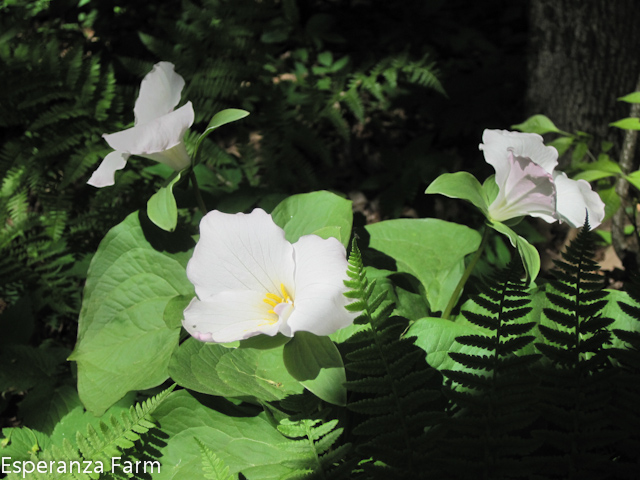
Trillium grandiflorum

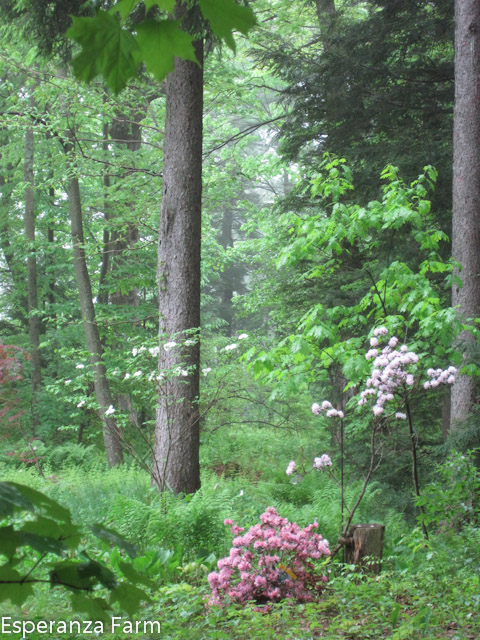
From left to right: young cornus florida, a nursery grown small leafed azalea, a tall, old ‘Windbeam’ Rhododendron.  The tree trunks are Norway spruces, the fern is predominantly Eastern Hay Scented and members of the Male fern genus.

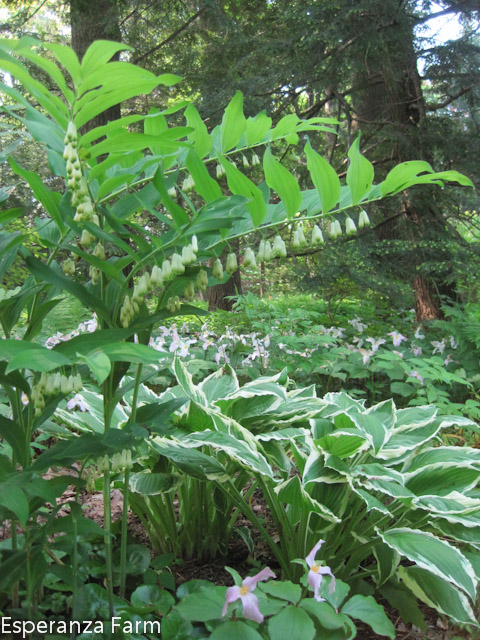
Giant Solomon’s Seal, Trillium grandiflora, an unknown hosta, European wild ginger (just visible beneath the Solomon’s Seal).

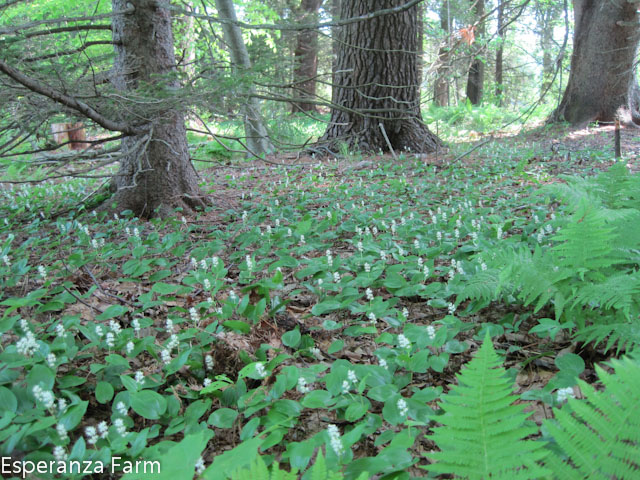
Native Mayflower, also known as Canadian Lily of the Valley beneath Hemlocks and Pines.

Also blooming in the woods: Starflower (or Twin flower), wild phlox, False Solomon’s Seal, Silky Dogwood, Swamp Azaleas, Viburnum tomentosum, Blue Star, Jack in the Pulpit, Sasparilla, English Bluebells, and many others!


« Previous PageNext Page »