Returns Monday, Jun 11 2012 

Esperanza has always been a place that people return to, very few of the people who have called it home have been born here.  It has also been a place where objects return; generation upon generation has closed down other houses or flats and in doing so they have stored things at Esperanza, sometimes temporarily sometimes permanently.  This, of course, makes for an amazing jumble. 

In any event the latest, thoroughly unexpected, return was rather large and rather heavy.  A cousin called us up, they were cleaning out their shed and had run across one of the cast-iron urns from Esperanza, would we like it back?  Well, yes.  We assumed that it was one of the missing pillar urns, because out of the original three, one was smashed and two ‘vanished’.  Well no….  Much to our surprise, it was a mate to the Large urn that stands on the eastern stone stairs.  It had originally been at the cottage, before it was sold in the early ’70’s.  At two feet tall, nearly three feet wide, and made of half inch thick cast iron, plus Victorian ornamentation…they are something else again.  It came home in the trailer of the little tractor, thundering down the highway to the amusement of all and sundry, since getting it into a pickup was beyond our lifting abilities.  Of course, what precisely will we do with it?  Place it on the other stairs perhaps?

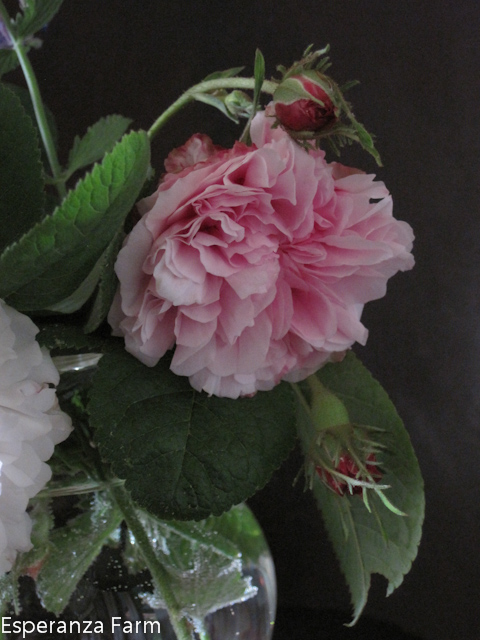
Centifolia Rose Sunday, Jun 10 2012 

On Fireflies II Saturday, Jun 9 2012 

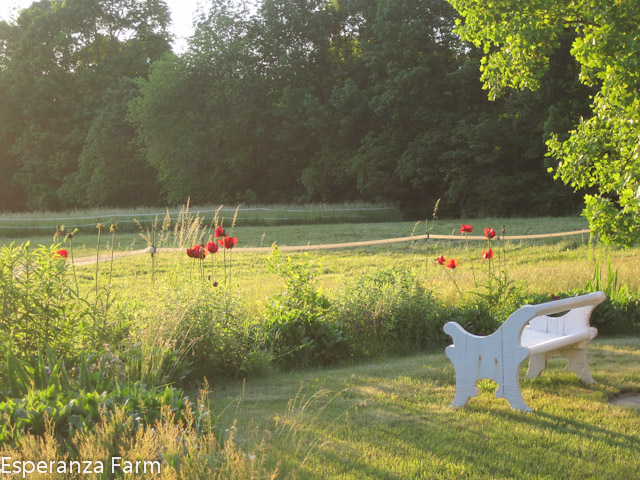
Last night was cool with a rising wind, but the fireflies were still glorious.  It was interesting to observe them from the second story, looking out over the hayfield.  They tended to cluster around several of the younger trees, especially the persistently ill chestnut, to the point where you could see the outline of the tree when they flashed in sync.  This is not surprising.  The chestnut is always a buggy tree, at least judging by the worm-eating birds that flock to it.  However, they also clustered around the young ash, which also stands in the field on a fence-line.  A few had staked out the fence itself, a little string of stationary lights all at the same height.

They also drifted down out of the big magnolia and, to a lesser extent, the big hemlock.  Stars in the dark.

‘Always there has been singing’ Friday, Jun 8 2012 

Excerpt from ‘The Story of Our Esperanza’ by Lucy Creevey, 1959

“There is another picture in my mind. I have thought of it so often. Clara Louise Kellogg had come to New Hartford and she and her husband built a lovely house on a hill near the village. She was having a house-warming, and of course the Esperanza house-party was invited. And of all the vehicles in the barn, they chose to drive down in the two-wheeled ox-cart. Mr. Rood drove up to the mounting block with his immaculate team of oxen, Berry and Bright. The cart was painted a beautiful cerulean blue, and scrubbed to the last inch. A framework had been built from which dangled a dozen Japanese lanterns, ready to light their homeward way. The Esperanza people climbed in with much laughter. Mr. Rood flicked at the oxen, and they pushed into their yokes and swung off. I remember that the little brass knobs on the ends of their horns reflected a quick gleam of light from the setting sun. I watched it all spell-bound. The cart lumbered along with its unusual burden, and just as they disappeared over the brow of the hill I heard them swinging.”

This was probably in the late 1880’s, when Lucy was around ten years old.  Clara Louise Kellogg was one of New Hartford’s more notable residents.  The Kellogg’s were one of the oldest and largest families in town, Pine Meadow (one of the small villages) was originally Kelloggsville.  They had owned and farmed numerous tracts of land throughout the town, including a portions which would become parts of Esperanza and Yellow Mountain, and had also run several taverns and inns.  Clara was an opera singer, and one of the first American sopranos to earn acclaim in Europe.  No small feat.

Mr. Rood and his family ran the farm from the 1880’s into the early 1900’s.  The Rood children were schooled alongside the family in the summer, and there are a number of pictures of them together.

Summer’s Promise Wednesday, Jun 6 2012 

Compilation versus analysis Tuesday, Jun 5 2012 

Information overload is a fairly common problem these days and history is no less prone to it than any either field.* If one does any amount of work in historic preservation, one quickly encounters a Byzantine series of standards and guidelines designed to ensure that the information will be preserved in perpetuity.  Reams upon reams of paper, both real and digital, are collected.  As something of a cynic, I have to wonder…does any of this ever actually get read and used?*  Or, are we dragons upon a hoard?

The thing is, data, by itself, isn’t very useful.  It is what we, by our study of the data, create that is useful.  This goes beyond collation, it goes beyond even analysis, straight to creation.  All the information in the world, neatly collated, organized, and fully searchable will not tell us the meaning of life.  It will tell us What it is, but not how we should, as humans and not computers, relate to it. 

Information overload, of course, is the difficulty with a place such as this.  It is a mountain of data, but lacks either narrative or analysis.  It also lacks the organization.  The trick is to work on the narrative/analysis at the same time as the organization…sigh.  I don’t know about creation, though, I am not a terribly creative individual.

*At least it isn’t the environmental sciences, where the amount of money spent studying a problem rather than, you know, Fixing the problem often appears to be out of balance.

*I always remember a comment that would enrage most archeologists: ‘if the only thing left of a civilization is some smashed pottery, perhaps it wasn’t all that interesting of a civilization.’ 


Those were the days… Sunday, Jun 3 2012 

A statement that makes us in the PC, 21st century distinctly uncomfortable, but I will not digress nor apologize for the dead. 

In any event, those were the days!  Whilst looking through the first guestbook, an admittedly over the top summer day at Esperanza in the summer of 1878.*

Order of the Day

Reveille by Lucy on a horn – 6 AM

Traveller’s Breakfast – 6:30 AM

“All aboard that’s g’wine!” – 7 AM

Lazybones’ Breakfast – 8:30 AM

Walk to Minnietrost by ‘Cherubini’  (the children, for summer lessons) – 9 AM

Gin and tansy for the ‘Widow Goldsmith’ (Julie P. Smith) – 10:30 AM

Mint Juleps, omnes, specially for Mrs. Capt. Jim Smith – 11 AM

Lunch – 12 PM

St John XX:1-3 – 1 PM

Dinner with Claret and olives – 3 PM

Travellers return, reception for G.W. Ellsworth – 6 PM

Currant Ice by the ‘Queenly Carlotta’ – 9 PM

Twenty Questions – 9 PM to 12 AM

Night Cap – 12 AM

Break Down dance by G.W. and wife – 12.15 AM

*Appearances or Carpe Diem? Neither Julie’s writing nor Morris’ busines were going well, but they had a wonderful summer, which counts perhaps for more?

On Fireflies Friday, Jun 1 2012 

Fireflies are a particularly cherished part of summer, possibly more so on the eastern coast of North America, possibly because of some unformed, vague memory of a novel I once read.  Nonetheless, the June nights when the moon is sailing high and the field grass whispers silver and green; in that rich darkness, fireflies float, pinpricks of light.  The light is nothing like that which we use, it is the white-green phosphorescence of fox-fire, lightening, and fireflies, the light of the unknown world, of magic and of wonder.

Fireflies are actually not all that good looking in the light of day, but at night…  They are also increasingly rare.  Fireflies need tall grass, goldenrod, and that host of meadow plants.  Leave a section of lawn unmowed, and the chances are very good that in New England, at least, you will have fireflies.  We are experimenting with leaving sections of lawn as meadow, as a form of visual structure, that the fireflies benefit is a pleasant benefit.*

*and the bats, the butterflies, the moths, the birds…but you know my opinion on Chem-lawn…

Photo of the day Thursday, May 31 2012 

Contemplations on Windows Tuesday, May 29 2012 

An aside from Esperanza.

Working on a minor architectural history project today, documenting some windows in a potentially historic building before their replacement, got me to thinking about the ‘why’ question of historic preservation.  Not too surprising, given that the building in question is a gym and the people I was dodging in their devotions to the gods of exercise wanted to know what I was doing.

There are a number of possible answers, all more or less applicable depending on the circumstances.  These may be long-term economic considerations, environmental considerations, sentiment, aesthetics, or the inability of the modern age to rebuild a replica (cost, rarity/or complete lack of material, and the lack of the skilled labor).*

Now this building, already heavily modified on the interior, has a relatively low level of historic integrity and the windows are nothing unusual.  They are precisely what one would expect in a public building, in New England, built pre-1920.  They are big, double-hung windows using the pin and pulley system, with full arched fanlights above.  The fanlights are hinged at the bottom with the top of the fanlight swinging in.  The window is stopped by chains which are attached at the balance point located a bit below the middle of the curve, so that when one closed them (using a long pole hook) you never had to deal with the entire weight of the window.  Most of the fanlights are missing already, chopped out for air conditioners or hidden in a dropped ceiling, yet the chains and the top hook were still in place on two of the old frames, poignant reminders.  The pulley/pin system of the double-hungs, judging by the paint layers, had fallen into disrepair before the arrival of those air conditioners.

These utterly standard windows were an ingenious, mechanical, solution to the problem of ventilation.*  And here is where historic preservation, or at least good documentation, becomes valuable in this situation.  How does something work?  Not a question we ask as much as we should.  Ideally, if one didn’t want to, literally and metaphorically, close doors; a renovation or new construction could use that fanlight/clerestory window design, and maybe even in the double-hungs, in tandem with its modern climate control.  Historic preservation preserves Options as much as it does the past.  ‘Learn from history’, what a cliche!  Only, is it really?

The replacements will, of course, not open.  I hope the power stays on…

*It has been shown that, whether a window or a building, you triple your carbon footprint when you tear it down and replace it with one of similar size.  Basically construction of Building A, plus demolition of Building A, plus construction of Building B equals three buildings, and associated material/fuel costs.  Refit/Renovation generally has a carbon footprint of a half to one additional construction. It has also been shown that historic renovation/reuse is a much better economic engine than new construction in the short term and has long-term, indirect economic benefits as well.

*Yes, I realize that the air conditioner is a more effective cooling system…but what would the bill look like if you ran the AC during the day, and opened the windows when the ambient, exterior temp dropped at night(as it generally does in New England), or on other days?  Options, you wouldn’t have to, but you could…and in a builidng occupied around the clock, why not?

« Previous PageNext Page »