Swimming at West Hill Pond Monday, Jul 9 2012 

Until the big water company reservoirs were built in the 1930’s, New Hartford had only an assortment of small ponds and rivers to swim in.  Greenwoods pond served the town center admirably; it was a large mill pond (really at two miles long it was a lake) created by damming the Farmington River.*  There were other assorted mill ponds throughout town and deep curves of the Nepaug River, swimming holes in fact.  However, there was also West Hill Pond.  Although a dam added height, this was and is a natural pond of substantial depth.  Spring fed it is very cold and very clean, even today.  Pre World War II, there was almost no development on it (there is now!!).

The lake is on the next hill over, and a series of roads has linked Town Hill and West Hill since New Hartford’s founding.*  Until the early twentieth century there was a very direct road, since abandoned.  But even today along several twisting roads it is an easy ride with a horse.  Until the 1950’s/early 1960’s, Esperanza owned two large pieces of the shoreline: ‘Boys and Girls Points’.  These pieces were given to the Boy Scouts’ Camp Sequassen and remain part of the camp today.  Until that time, camping and swimming at West Hill featured prominently in the summer activities.
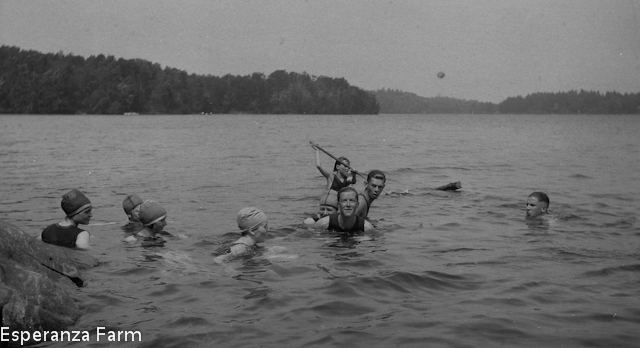
I can only identify the person paddling past on the log in the background: Eileen Creevey Hall.  The photo is circa 1920-23

*Greenwoods pond vanished entirely in March 1936: a flood took out the dam, which was 32 feet high and 200 feet long); along with the pond went a good chunk of the town.

*Yes, there is an East Hill!
 

Daylilies II Saturday, Jul 7 2012 

To go with the post below:

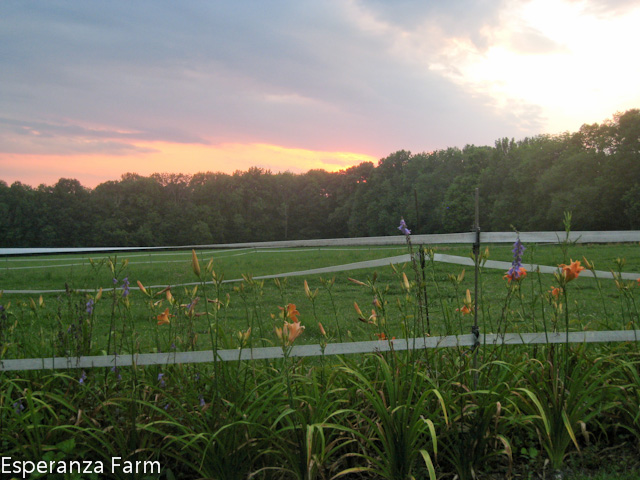
Taken about two days ago, showing a section, you can see all the flower spikes.

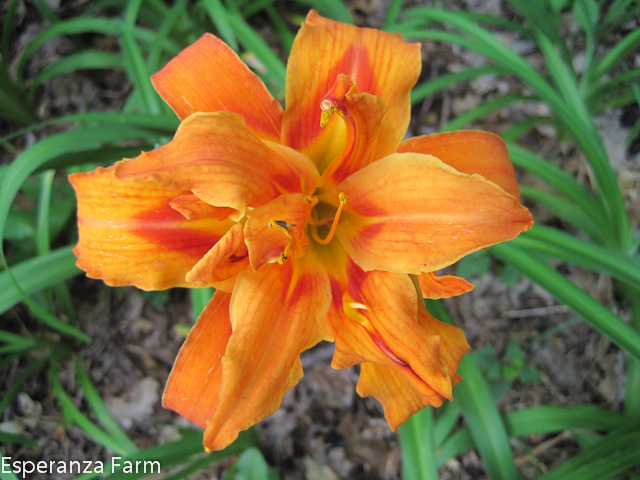
The double orange type.

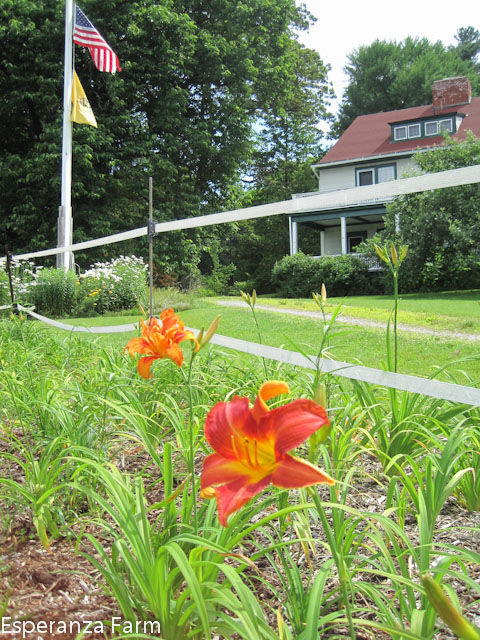
Last year, showing one of the red ones and a double orange.

Daylilies Saturday, Jul 7 2012 

Despite being under the fence struck by lightning, the daylilies are coming into their own.  The stretch is about 70 feet long and three feet wide, so it is a lot of daylilies.  The vast majority are the very tall, very bright orange, double ditch lily type.  Take the standard orange ditch lily and make it bigger, oranger, and doubled or tripled.  They most closely resemble a flock of gaudy birds hovering above the field.  It works because they are surrounded with green: 10 acres of hayfield as their backdrop, with a screen of green hedgerows/hills, and a front of green lawn; the arc of pure-white shasta daisies west of the flagpole also helps to balance the effect.

I am however, pondering moving some of the burnt-orange/red throated ones to the front of the line.  Somehow, most of them got on the west (field) edge.  Being slightly more incline to bend, shorter, and a darker colour, I think they might give a depth to it.  More digging!

On Lily Beetles Thursday, Jul 5 2012 

We have no shortage of pests in New England, the Asian Lily Beetle is one of the recent, truly nasty ones.  These voracious, almost impossible-to-kill beetles have taken lilies from being sure-fire garden staples to labour-intensive plants. 

What I have noticed, though, is preferences on their part.  While happily defoliating any member of the lily family; their preferred diet appears to be the bright yellow Asiatic lilies.  This is followed by the other Asiatics (although they don’t care for ‘Landini’, an almost black, purple Asiatic, appearing only rarely on it).  The Species lilies, especially Turks-cap ‘martagnon’ types are next, and last are the true Orientals.  However, defoliation occurs quickly on both the Species and Orientals, and the plant doesn’t seem to be able to survive it.  So, a mild dislike on the beetles’ parts doesn’t perhaps mean much.  Still it is interesting to note this.  Of course, seeing as the critter is here…not planting yellow/yellow-based Asiatics probably wouldn’t help the matter.

At least I am not squeamish about squishing the larvae anymore….ick!

July 4th, 1913 Wednesday, Jul 4 2012 

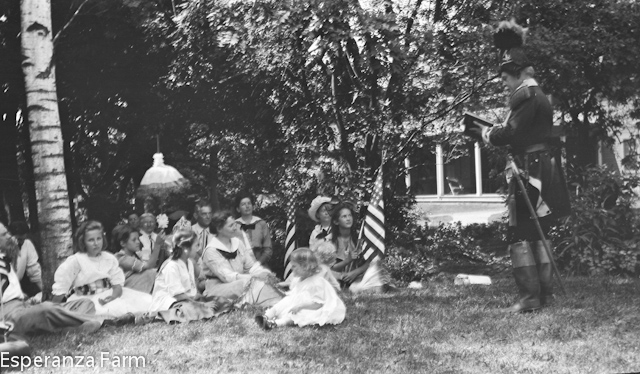
Celebrating the Fourth in 1913, a reading of the Declaration perhaps?, in an antique uniform, sadly since vanished (except for the sword).  Who all is involved, I couldn’t quite say.  However, the moustache strongly suggests that the reader is William Webster Ellsworth.  He would be the natural choice, as the family’s elder statesman, a gifted orator, and descendant of those worthy Wolcott, Ellsworth, Webster…ad infinitum. 

I do like the parasol.  The house is just visible, today, where they are sitting is a shady garden bed.

Brief Meditations on a Barn Tuesday, Jul 3 2012 

Esperanza’s barn, the barn that is still part of the property that is, is actually two structures: a purpose built horse barn and a standard, English style, barn now used as a garage.  The two are attached to each other, the dates are entirely uncertain.  The carriage/garage section could be anywhere from 1800-1875, without careful examination I wouldn’t care to guess; the horse barn (despite family lore) is almost certainly 1873.  Dating barns is hard, recycled timbers were the order of the day and styles for general purpose barns changed only slightly.

In any event,  having reason to wander in the horse barn, I amused myself by examining the actual structure.  It is a post and beam build, and a big one.  Three east-west beams carry the hayloft: at 48 feet long, and 8inches by 8inches.  The barn floor is carried by another three beams of the same length, but closing in on 12 inchx12inch dimensions.  There are a another set of north-south sills, close to thirty-five feet in length, plus two floors of joists: 38 to a floor, thirty-five feet long, three inches by ten…plus corner/side posts….and the sheathing, and the flooring…in no case can you drive a heavy and very sharp knife in more than two or three millimeters, even with one’s full body weight behind it.

You can’t build them like that today…

From the Guestbook Monday, Jul 2 2012 

Esperanza had, during the late 1800’s to pre WWI, any number of guests; happily, they also maintained a guestbook.  These books are a treasure trove of commentary, signatures, photos, and sketches.  The sketches are usually done in the style of the time: half-caricature, half-line drawing.*

Two entries, from a random page:

“Walter Booth Adams,

Syrian Protestant college, Beyraut, Syria

‘Coffee equal to Syrian coffee, what further praise can I give to the good dinner?’


Adelaide G. Richetts

‘Who came to Esperanza Farm June 10th 1899, carrying a cane and weighing 110 pounds. She left August 3rd, said cane in the bottom of her trunk and her weight was 132.5 lbs. ‘Nuff Said.”

*The only example of the style I can put my hand on is the illustrations by Jean Webster, in her books Daddy LongLegs and Dear Enemy…published in 1915, not much help there.   Jean Webster did visit the place.

Catbirds Sunday, Jul 1 2012 

can be foiled! A complete netting, bamboo frame/bird netting, and it looks like we just might get some currants for once.  We have entirely too many catbirds, while they are fascinating to  watch, they are also a bit of a pest in the garden.  I just hope we can get some peaches, since the tree is much too big to even consider netting…Actually, the titmice are the biggest threat to young peaches, they like to take out the kernel of the pit while it is still soft.

Zap! Friday, Jun 29 2012 

We have had several vigourous thunderstorms recently, with ground strikes near the house.  One strike took out the barn’s lighting, another we knew had hit close by (if the window goes white with light….sort of a dead giveaway).  But we couldn’t decide where, as there was no visible damage. 

Then I noticed that the daylilies…those gorgeous daylilies with at least one bud stalk for every fan…beneath the West Meadow fenceline looked oddly brown today.  The fence is electric wire, the gate is a metal t-post, as is the corner post, and the daylilies run between those two and have grown up above the bottom wire, which is not live*.  I think you can guess the rest.  It is the oddest thing, though.  It looks exactly as if a six inch wide band of herbicide was applied, with the bottom wire in the middle.  Anything within three inches is brown, anything that was directly touching is crispy, charred, and otherwise carbonized. 

*Usually!

Down the Garden Path Thursday, Jun 28 2012 

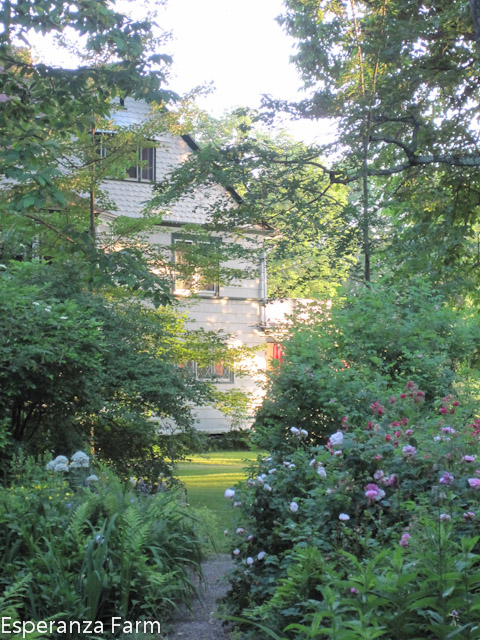
(or, down A garden path…multiply by ten around here…)  The white/pink flowers that are visible are all old centifolia roses, no younger than 75 years of age.  Scale is difficult in this photo, but the house peak is about forty feet, if that helps.

« Previous PageNext Page »