Cimicifuga racemosa Monday, Jul 23 2012 

Also known as Actaea racemosa, Black Cohosh, or Bugbane is one of the Northeast native plants that deserves much wider use.  It happens to be one of my garden favourites, so perhaps I am biased.  Blooming in late July into August its towering candles of ivory add an incredibly dynamic element to the garden as they often bend and twist, earning it the local name: Black Snakeroot.  The various pollinators, from bees to beetles, adore it.  Its flowers can easily last several weeks with the seedheads remaining through the winter as architectural elements, while its heavily cut foliage works as a good backdrop for smaller plants.

It happens to flourish in the heavy, poor draining, partially shaded clay of this area.  In this it is unlike almost every other garden plant out there!  A big specimen should be treated as a herbaceous shrub, as they can easily be 2+ feet tall and as wide, with the flower stalks hitting seven feet.  It is also very long lived.  Conversely, it is also slow to reach flowering maturity, expect to wait several years when starting them from seed. It is drought and rain tolerant. About the only thing it doesn’t tolerate is a heavy winter mulch layer on its crown, treat it like a fern.  It can be very late in coming up in the spring. 

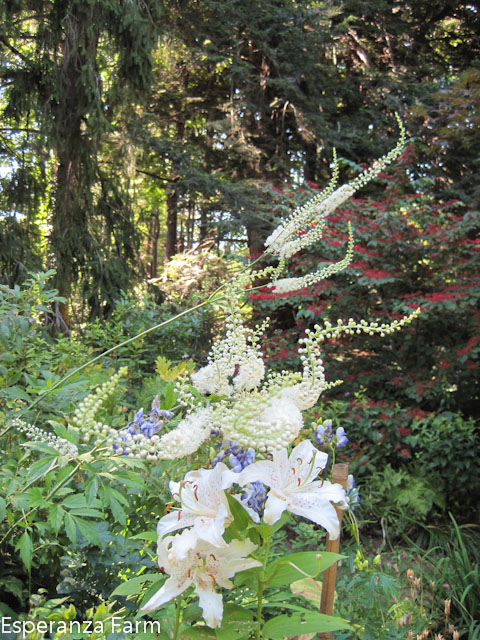
Here is a small one in amongst an Oriental lily and some monkshood, the red in the background is a double-file viburnum:
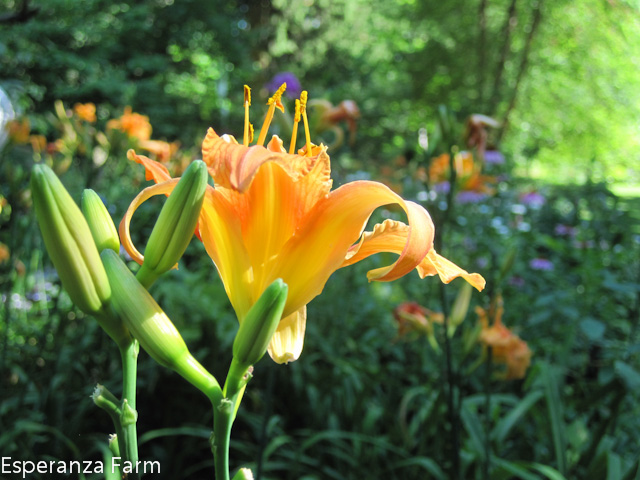
Orange Daylily Sunday, Jul 22 2012 

Perceptions of space Saturday, Jul 21 2012 

Esperanza is a large house.  However, it is also an old house and the size is sometimes deceptive.  There are a lot of windows, doors, interior trim, and immovable mirrors*, bookcases, or pieces of furniture.  The end result is surprisingly limited wall space.  This was brought home the other day following a visit to an artist in a very modern studio: cathedral ceiling and no interior trim.  In her space large paintings (3 feet by 2 or bigger) looked reasonable in size.  The same painting would be impossibly large in this house.  There isn’t the wall space or the ceiling height.  Yet, you don’t realize that most of the pieces of art are fairly small in Esperanza because they are in proportion to the house.  It is an interesting aspect to the problem of figuring out why something looks correct in one space and not another.  And why double-checking is always a good idea…

*There are six mirrors that are full height or more.  There are at least three other mirrors that are both large and critical for boosting light levels in rooms, plus various dresser mirrors…

Architectural definitions Friday, Jul 20 2012 

Sometime back I gave a rapid introduction to the house’s architecture: https://acairfearann.wordpress.com/2012/05/24/concerning-architectural-styles/

I am most amused, the tax assessor has given up on classification.  Queen Anne wasn’t correct, nor Shingle Style, nor Greek Revival….so…. ‘Antique’ it is!  I can’t recall encountering that as a building description before.  Furniture, yes, buildings, no.

After the Storm Wednesday, Jul 18 2012 

No, not from this year…just a random photo for the day.


I shouldn’t complain Tuesday, Jul 17 2012 

Compared to the Mid-west, we have plenty of water.   According to the U.S. Drought monitor, we are merely ‘dry’. http://droughtmonitor.unl.edu/DM_northeast.htm  Well, I have my doubts about the accuracy of their monitoring for this region.  It isn’t, after all, a major agricultural center and the water rights for the cities are ample, well protected, and unchallenged.*  So, why should they monitor it closely.  Besides their fine print does say that it may not be accurate…

So my doubts….Stub Hollow’s brook is only barely flowing, and really only below the old Stoney Lonesome pond, which is spring fed and controlled by a dam.  Stub Hollow’s headwater marsh, which is mostly a point of surface water collection about half a mile above the pond, isn’t producing much water.  Usually, the brook has a significant year round flow, sufficient that you will have to either wade or be very agile at rock hopping, and has fish.*  The big swamp on Maple Hollow has only a center channel, mud that should be 4 to 8 inches under-water is growing grass.

Julie’s Pond, spring-fed, is holding water; but the outflow is down to essentially a seep.  As opposed to about ten gallons a minute in a normal year.

And its only mid-July…

*The various city water companies own huge swathes of Connecticut, Massachusetts, and New York; they are routinely overlooked property owners.

*the unbiquitous little fast moving minnows, never more than about four inches in length.  but fish nonetheless.

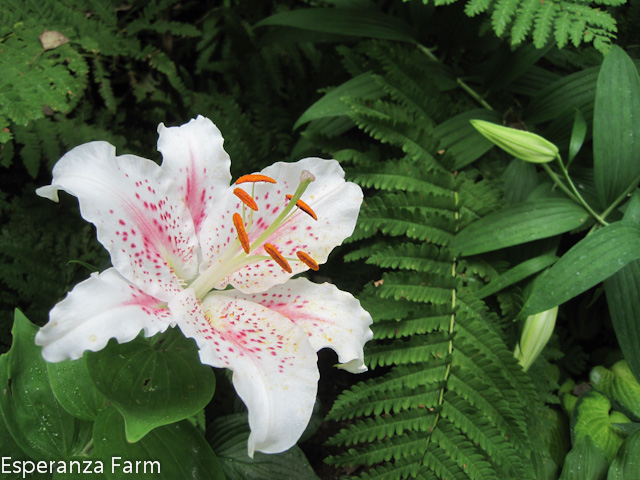
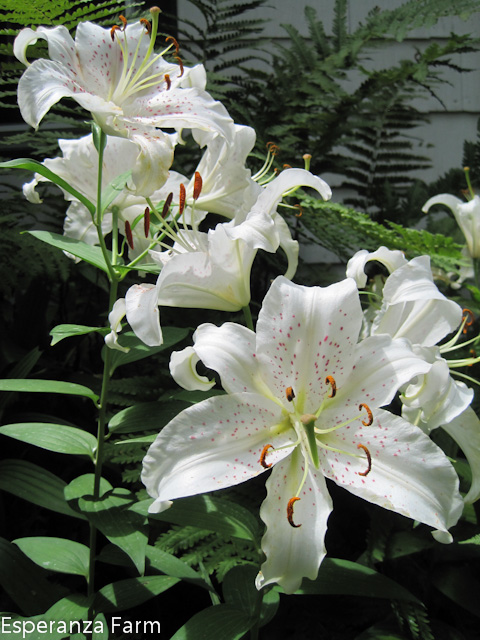
Stargazer Monday, Jul 16 2012 

lilies:

There is no excuse Saturday, Jul 14 2012 

for not knowing.  Out of curiosity I looked up Walter Booth Adams, he of the random guest-book entry.  What would have been a nearly impossible quest thirty years ago, took only the time required for my search engine and computer to respond. 

Born in 1864, he graduated in 1890 from New York University.  From 1890 to 1924  he was a professor of pharmacology and dermatology at the American University of Beirut and helped establish at least some other medical posts in Syria.  He was also a Freemason and given to writing occasional poetry about the landscape of the region.  He died in 1928 in Syria.  I also found a portrait and information about his parents, son, etc.

Of course…what I did Not find was his connection Esperanza.  Was it through medicine and New York University? He would have known George Creevey from that, possibly quite well.  Most likely.  Less likely, was it through his poetry and his experience living and working in the mid-east, two of the great loves of WWE? Or, what?

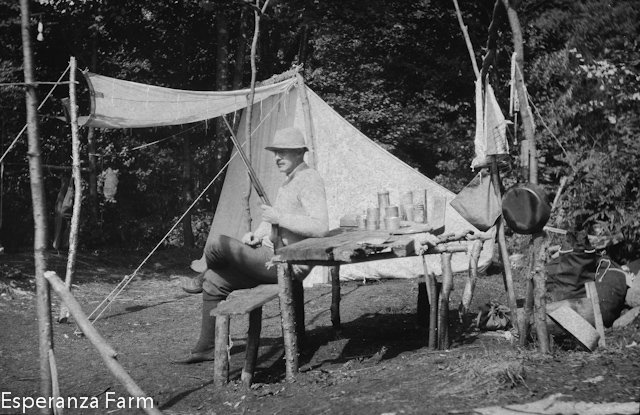
Camping, 1915 Friday, Jul 13 2012 

I think this is George Creevey, Lucy Creevey’s husband.   In real life, he was a well respected NYC surgeon.   Although filed in the West Hill Pond photographs, I suspect this was actually one of the road! trips into the Catskills.  Complete with converted ox cart as a trailer behind a Model A Ford.  Clearly, in that era, being handy with an axe and a bit of rope was a rather useful skill.

On Roofs Wednesday, Jul 11 2012 

One of Esperanza’s signature features is the use of red roof shingles, everything except one side of the barn’s roof (corrugated metal) and the flat porch roofs (rubber) is done in red, asphalt shingles.  Matching the red is a bit of a job, we never do things the easy way.  But it is much more elegant and interesting than acres (not literally, it just feels that way) of black.

However, earlier roofs varied.  Wood shingles, ideally of cedar but not necessarily, were in use well into the twentieth century.  The 1929 inventory of all the buildings records another, somewhat surprising, interlude.  Most of the barns/outbuildings listed have wood shingles.  A few sections of flat roof were made of tin.  But Esperanza, Minnietrost (one of the small cottages), the farmhouse, the help’s cottage, and Appleby all had paper roofs.*  In the photographs it is apparent that this gave the buildings’ profiles a distinctly raw, unfinished look.  Perhaps more our modern sensibilities, since tar paper was a common roofing material at the time.  Unfortunately, I can’t determine either the color or if it was actually paper or felt that was being used.  I do wonder how long they lasted.  It can’t have been long, since I don’t have, I believe, any other photos that show that…but then I haven’t really looked.

*The farmhouse had been Satis Bene, by the time of the inventory it was no longer given a name, though the other named buildings were.  That half of the property, which included the massive dairy barn, several other barns, a creamery, and the help’s cottage was sold in the 1960’s.  It is now a winery.  Appleby was sold by World War II, it is now in disrepair, but is an elegant c.1800 farmhouse.  At the time it had an apple orchard, hence the name.

« Previous PageNext Page »