The turning year Tuesday, Aug 7 2012 

Generally, we pay attention to the quarter marks of the solar year: solstices and equinoxes.  However, the seasons are offset from these markers.  At some point in early August, summer begins to move towards fall.  It is still summer with no question, here the corn and tomatoes (so strongly associated with summer) are only just getting going.  The Morning Glories are truly glorious.  Thunderstorms still walk across the hills.  Yet, the scent of the land has changed.  The trees have an olive cast, uncut grass is brown, the pastel colours of fall are heralded by the ivory Queen Anne’s lace, the dusky blues and mauves of chicory and Joe Pye weed.  The goldenrod has begun to bloom and the white wood asters.  The grasshoppers become almost deafening in the cooler nights.  And sometimes the wind has a sharpness.

August, like early February, hints at the coming change.  There is an aliveness, an anticipation which July, somnolent in the heat, lacks.

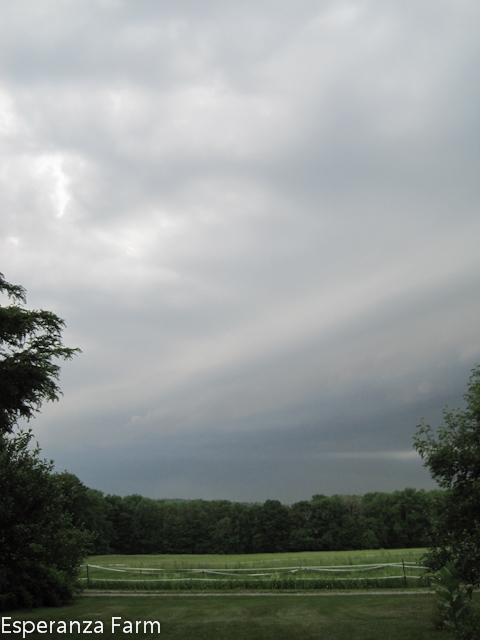
Storm Coming Monday, Aug 6 2012 

Letter reading Saturday, Aug 4 2012 

As most readers of this blog know, Morris Smith and Julie Palmer met in 1842 and were engaged in 1848, remaining married until her death in 1883.  Throughout their lives, letters formed the backbone of a relationship that was truly a long-distance one for over a third of the time.  Generally, there are gaps each summer in the letters; which is frustrating for the historian as a great deal must have happened.  However, a more frustrating gap is caused by several missing letters from 1847. *

In 1846 Julie left New York City, returning to Brockport.  Morris remained in NYC.  Two years later they were engaged.  Yet, this is where the art of reading between the lines becomes tremendously difficult.  We have about twenty letters from those two years when they never met in person, but are missing two to four.  These long letters are filled with discussions about, and requests for, books, as well as descriptions of activities and discourses on philosophy.  They are also entirely opaque.  Morris was struggling to build a business, at age nineteen, but was also plagued by health problems, with his doctors telling him he wouldn’t make thirty, he repeatedly and adamantly says he will not marry (and is clearly not considering Julie, or at least appears to not be considering her).  Julie, with many veiled remarks, hints at a serious relationship, if not engagement, with another man who can only be tentatively identified.  At the same time Morris and Julie carry on a correspondence which spirals from platonic love to outright vitriol* and then somehow ends in their engagement.

Those missing letters appear to be the ones that fall exactly on either side of the lowest point in their relationship.  Naturally.

*Ignoring the gap created during a certain historical event between 1860-65…one person living in New Orleans, one living in Hartford, writing back and forth constantly…and not a word on the affairs of the day.

*Vitriol: Julie writing: “Now you are greatly more deficient in penetration than I believed if you really think I wish you to write to me or feel for me any love, save such as a brother might for a sister… (2 scathing pages)…Remember if you wish me ever to write to again you are to answer this by the next post.”  (Morris doesn’t write by the next post, in fact his next letter is nearly three months later, and completely ignores this one…which is one way of dealing with it.)


Running to the Sea Friday, Aug 3 2012 

I grew up reading Holling Clancy Holling’s spectacular books that detailed the story, both natural and man-made, of the great rivers of North America and of the sea.  The influence of those books was greater than I realized. 

Writing a comment on a local paper today about the Maple Hollow (also known as Stub Hollow) brook made me think.  I know that the water on this hill will flow down to the hollow, past Stoney Lonesome pond, past Brad’s pond, past Gray’s pond.  There in the floodplain swamp of red maple it will join the Nepaug River, then the Farmington River, then the Connecticut River, and then at last the Long Island Sound and the Atlantic, shining grey beyond the sand dunes. 

Of course, most of it will probably be diverted from the Nepaug reservoir to serve as drinking water for Hartford and the surrounding towns.  But still, knowing the water’s course gives me a connection to something indescribably beautiful.

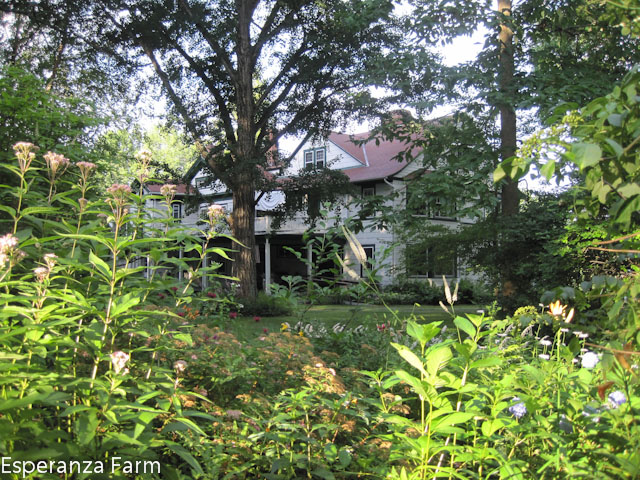
The house, hiding Thursday, Aug 2 2012 

For the gardeners, left to right: Joe-Pye Weed, Spirea, Monarda, Goose-neck, Cimicifuga racemosa, Shasta Daisies, Hydrangeas, (also Daylilies, Black-eyed susans, and Turks-cap lilies) are all visible.  The tree is a Gingko, about 110 years old, the closer trunk is a young (fifty years old) Cucumber Magnolia.

Scent Memory Wednesday, Aug 1 2012 

Summer, like all the seasons, has a distinct set of scents that are associated with it.  Smell is, it seems to me, an underappreciated sense, perhaps because of that it is often an extremely powerful trigger for the mind.  In any case, here in southern New England summertime is associated primarily with hot pine/tar and cut grass.  Other scents can be incredibly specific: oriental lilies outside a window at dusk or the sharp herbal bouquet from weeding an herb garden: sage, mint, thyme, chamomile.  The swamp forest’s mix of decay and growth, a hayfield’s sweet, dry scent, or phlox’s delicate floral scent.

Road Trip! Tuesday, Jul 31 2012 

From Nov. 1916 as reported in the New Hartford Tribune:

“Mr. P.J. van Loben Sels, of Oakland and Vorden Ranch, California arrived in New Hartford on Monday, November 12th, after an automobile journey alone (and he is sixty-five years old) across the continent. It will be remembered that Mr. van Loben Sels’ son married Helen Ellsworth, a daughter of Mr. and Mrs. William W. Ellsworth of Esperanza Farm on Town Hill….

Automobilists may be interested in the statistics of the trip…The journey was made in a light Buick six, latest model…From Oakland he went north to Seattle for the sake of the scenery, then east over the generally poor roads of Montana, North Dakota, and Idaho, sometimes being obliged to shovel his way through snow a foot deep on the level, with six or seven feet in drifts. And this in October….

The gasoline cost was 2 cents a mile, about 13.5 miles per gallon*…Within ten years, perhaps four or five, a transcontinental journey in an automobile will be a very common experience.

Mr van Loben Sels will sell his car and sail to Holland on the 21st….”


I may say, I would have liked to know P.J. van Loben Sels.  Anybody out there who wants to tell me anything?

*What great strides we have made, not.

Goldilocks Syndrome Sunday, Jul 29 2012 

It is too hot, too cold, too dry, too wet.  We finally have gotten a decent amount of rain, which of course brings a whole host of other complaints: tomato blight, slugs, mildew, damage to trees, etc.  What is perfect weather though?

Personally, I’ll take the stormy weather.  It has that edge to it, the potential that this beauty will be devastating.  Watching a line of thunderstorms roll over is truly inspiring.  The bases of the clouds so low and fast moving that one thinks one might touch them.  A great shifting tapestry of grey, blue, white and behind it all a wall of rain.

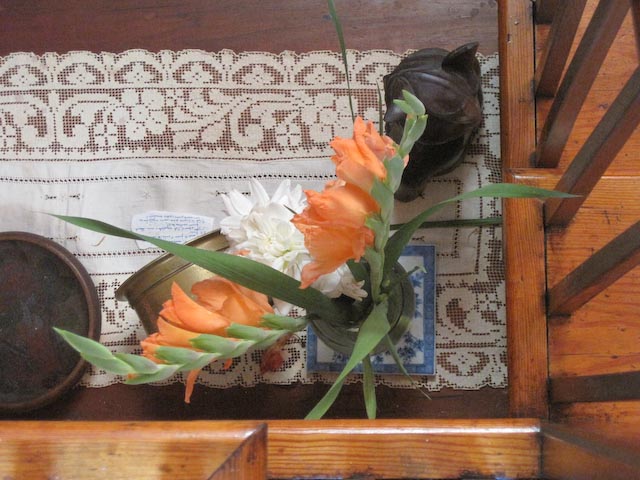
Still Life Thursday, Jul 26 2012 

sadly, not taken this year, as the bulbs got eaten.  Taken looking down from the first landing of the stairs.

Broader context Wednesday, Jul 25 2012 

in lieu of content, for those interested in the surrounding region’s history, do check out my other blog, updated weekly:  http://newhartfordcthistory.org/blog/

« Previous PageNext Page »