Volunteer plants Saturday, Sep 1 2012 

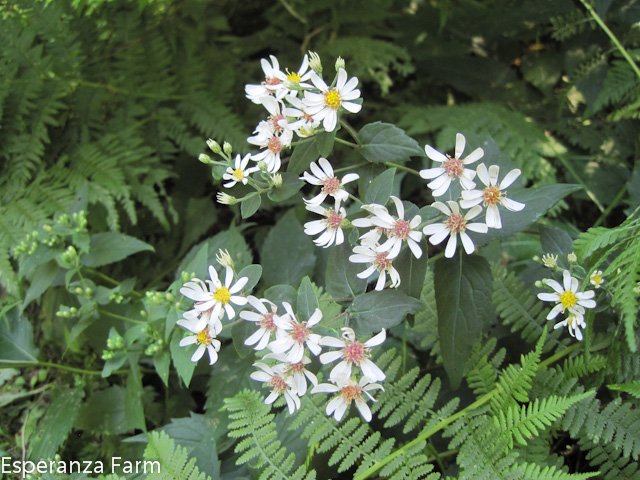
I like volunteer plants.  At this time of year the most prolific volunteer is the heart-leaved wood aster.  Actually verging on an aggressive weed, it blankets whole swathes of the property.  In good years, the old tennis court and the area southeast of the house are covered in a billowing white carpet.  We are removing it from the garden proper though, spreading by running roots it will bury most other plants.

Here it is with several other volunteers: black-eyed susans, blue lobelia, and ferns; the lower picture also shows a small sprig of calico aster in the foreground, identifiable by its narrow, needle shaped leaves.

End of an era Friday, Aug 31 2012 

For their entire 110 years, the north basement stairs have stored the kerosene lamps.  Through the 1920’s, WWE would get up in the morning, collect the lamps, and then clean and refill them on the stairs.  The shelves and the stairs are covered in tin sheeting to avoid spills from soaking into the wood; originally the double-hung window was operable and would have provided ample ventilation and light.  It was a convenient, but discreet, location for a necessary task.  Since the house was electrified, the area has gradually acquired an odd array of spare fire-place tools, lampshades, vases, and mysterious glass containers of liquid.  Actually, three of those containers made of very pretty blue glass with cork stoppers and No markings are carbon-tet fire extinguishers.*  The fourth, a massive gallon jug claimed to be bleach, we decided that bleach had no right to be a nice dark brown.

However, we have plants, lots of plants, and no particular need for kerosene lamps.  Some of those plants need a good, cool place to overwinter: scented geraniums, fuschias, begonias, passion flowers…  And, frankly, we were all tired of navigating the stairs, highly breakable vases, and oddments with loads of firewood. 

And so, the kerosene lamps, their accoutrements, the fire extinguishers, and the purported jar of bleach** migrated to the cabinet that is built into/next to the little parlor’s chimney base.  This dry, dark, out-of-the-way location seemed to be a reasonable location for storing such things.  The odd bits of electrical fixtures got put with the other odd electrical bits.  The vases got rearranged on some safer shelves on the stairs, another shelf got built, and the whole thing got vaccuumed.  The hanging array of fire-place tools and oddments remains, as does the ridiculously sharp fire-axe.  I daresay I will fill the space with plants in no time flat…

*worthy of a post on their own, liquid carbon-tet is very effective at putting out fires…that it (if the fire is hot enough) can also create phosgene gas while doing so is a less desirable quality.

**what else can one do with it?  I am not dumping such things in a public watershed, even on dark and stormy nights.

Turkey Vultures Thursday, Aug 30 2012 

Most people have favourite birds, though choosing one species from so many is nigh on impossible.  I have always had a particular fondness for turkey vultures.*  That they are a necessary and unmistakable sign of mortality perhaps plays into it.  But mainly it is something about those great, silent wings.  It was a moment of brilliance the other morning, one of those crystal mornings that portend the early fall when the sky is a clear, shining aquamarine and the sun is a white-gold star, to watch the building column that spiralled ever higher, swift shadows between the land and the sun.  It was a flock of perhaps ten, probably migrating, drawn to the hayfield to check out the mowing.  They are clearly intelligent, having long since learned that machinery in hayfield means food.  Unlike crows or gulls, there is never any sound, though I believe they do talk when eating or roosting, just the sweep of their wings.

*I would not care to have them roosting near my house though, by all accounts that is less than desirable

On love letters Tuesday, Aug 28 2012 

In an interesting difference from today’s tendencies; it was only after Julie and Morris were engaged in April 1848 that strong passion becomes as much a part of their letters as literary discourses or recounting of activities and the letters are openly labelled as love letters.   They remain very conscious of the medium of letters and the possible misunderstandings inherent to letters; both ask the other to tell them if a letter seems overly emotional or overly reserved.

Almost immediately after they were engaged, Morris headed out on various travels: Cleveland, back to NYC, and then to New Orleans where he began to establish his business. Julie remained in Brockport, caring for her parents and teaching.  They had no clear idea as to how or where they would eventually live together, only that they would.  It would be nearly two more years before they would marry, in the meantime they would see each other only once.

Julie’s confidence in the future is beautifully expressed here in a letter from 1848:

“Another day rest with those before the flood. Its cares, labors, and pleasures are numbered with things that were, but not its hopes. They float on brightly into the future. They lightened yesterday’s burden, still pointed onward today, and are nearer fruition now that the sun hath set again. Tomorrow will bring them more clearly in view, if we have tomorrow. God keep those in His care tonight, dear Morris, “Sleep on, and dream of me!” did ever you hear that pretty song? When we meet again, we will sing it together. And that won’t be very long. When we have counted a few more sunsets, we will sit together, and happier than we were before.”

Noteworthy events Monday, Aug 27 2012 

Unless one is under a rock, the fact that most of the U.S. is in one form of drought or another can hardly escape one’s notice.  Technically this bit of Connecticut is only unusually dry, which classification it has held since sometime in the winter, with periodic hiccups into moderate drought.  I have my doubts about this, and suspect that (like the rest of the Massachusetts’ Berkshires) it is probably a moderate drought.*

This suspicion was confirmed today.  Julie’s pond may have some seepage still from the spring (but the main pond water level is now dropping fast), however the old reservoir supply is, for all practical purposes, no longer flowing.  If we were relying on the reservoir for drinking water, it would be the first time since the 1930’s that the springs have stopped. 

Maybe the scientists don’t call it a drought, but I think I will.

*For good economic reasons, drought monitoring in the Northeast is hardly as comprehensive as elsewhere: the combination of highly localized, complex watersheds and relatively minor agricultural business and ample urban water supplies makes it less necessary and prohibitively expensive.

Wild Grapes Sunday, Aug 26 2012 

There is something indescribable about the taste of wild, New England grapes.  There are two types, the small red and the small blue (the ancestor of the Concord).  Both are no larger than a penny, thick skinned, and heavily seeded.  Absolutely nothing like your typical grocery store grape.  The sharp flavour is so intense that eating more than a few is unlikely.  The taste is closest to a port wine or the heavy, dry wine I had once from the isle of Santorini, Greece, where the grapes grow in a poor, dry climate creating a naturally high concentration of sugars. A sweet tartness, smoke, sun, and the wild.

The titmouse wasn’t terribly happy about me running off with several clusters though…

Sunflower Saturday, Aug 25 2012 

Mowing the Lawn, 1911 Thursday, Aug 23 2012 

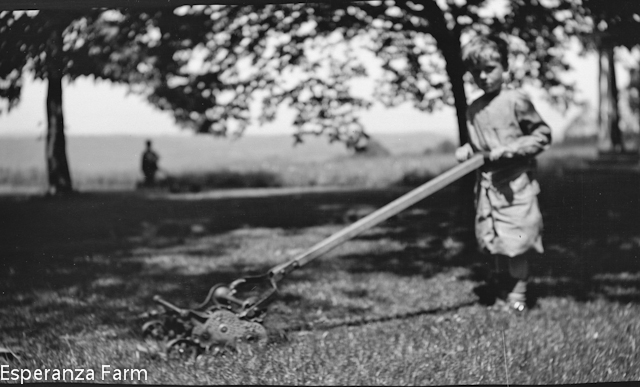
Sadly slightly out of focus; but probably Kennedy Creevey mowing the north lawn or at least trying to. While we still have another reel mower of the same vintage, the one in the photograph is no longer around….looking at it, I can’t say I mind…

Comptonia peregrina and science Wednesday, Aug 22 2012 

I was planting two Comptonia peregrina (better known as Sweet Fern) today, and consequently did a bit of research first.  Sweet Fern is undeservedly, in my opinion, poorly known.  Finding the plant in a nursery is uncommon.  This has always struck me as odd: here is a plant that grows in disturbed, hot, sandy/gravelly, poor soils.  It should be an ideal foundation plant, especially with its fragrant leaves (somewhere between citronella, pine, and rosemary), short habit, and not unpleasing (if not spectacular) winter and summer appearance.  It is a distinctive New England/Mid Atlantic plant, growing wherever road cuts, sand banks, or pine forests exist.  Summer in New England, especially in coastal areas, is linked in the minds of many people with its heady scent.

Well, it turns out there is a reason for its rarity in the nursery trade.  First off, it will not transplant bare-root.  Secondly, getting its seeds to germinate is extremely difficult.  Cuttings are the best way to get another plant but that art has only become common in the last fifteen years or so.  But then, the question arises: if the seeds don’t easily germinate, how does it pop up where-ever a clear-cut has been done?  As it happens the seeds are sensitive to soil disturbance and have the ability to remain dormant and viable for upwards of seventy or more years.   See the linked article for more:  http://arnoldia.arboretum.harvard.edu/pdf/articles/445.pdf

This got me thinking about how little we know…we routinely search for ways to protect both organic and inorganic materials from decay…here is a plant that has developed a chemical barrier that allows for indefinite protection of a highly vulnerable organism (a seed embryo) in harsh conditions of freeze/thaw cycles while partially buried in an environment prone to moisture and generally fairly acidic.  It is the sort of thing, if I was a scientist, I’d pay attention to…


Travelling Tuesday, Aug 21 2012 

I commented to someone recently that the beauty of old letters is their ordinary nature: people were and are motivated by the same concerns, whether this century or the last; they may be foreign but they are not alien.  But once in a while a letter will illuminate how things have changed.  I just drove down from Montreal, about seven hours rolling time*, by myself in a comfortable car.  Not, in this present time and country, an unusual trip.

Here is a description from a letter by Morris of a section of a stage-coach trip in New Hampshire in 1846: “We started from Plymouth (heading to Franconia Notch) with a stage filled with an incredible number of passengers- that is incredible for the accommodations of a stage- Twenty-Two, only nine inside, thirteen outside.  It was very warm and the horses pulled their heavy load slowly. In the evening the clouds obscured all light from above and we on top the vehicle using all our efforts to prevent being thrown off, striking our heads against the boughs of the trees, and the tops of bridges, earnestly entreated the driver to stop for the night.  He drove up at a small seven by nine tavern situated somewhere in the outskirts of Grafton. It was not a fit place to stop in, but necessity obliged us as it was now after midnight. With difficulty we found cribs where we could stow ourselves till daylight, and we all tried to sleep till five o’clock in the morn, when there was no use in trying anymore, for our driver with a loud voice told us the stage would start in five minutes.”


*that is not counting the near 2 hours at customs or the hour stuck in construction here and there…

« Previous PageNext Page »