Coming Fall Sunday, Sep 16 2012 

Old leaves, from summer’s  duty released,

Chase the wind,

The breaks of sun and cloud,

Across the forgotten meadows

Where, under a golden crown,

The grass bleaches to bone.

The old wooden fences

Are alight with living flame

Climbing ever higher to catch

The maples with fire.


What’s blooming Friday, Sep 14 2012 

We are just starting to see fall colour, mostly in the ashes and the stressed trees.  Still, there is plenty of colour:

Certain annuals are still going:

Nasturiums

Morning Glories: ‘Grandfather Ott” a starred purple

Petunias

Sunflowers

Jewel weed (short orange and tall yellow)

Perennials

Black-eyed susans (Rudbeckia hirta and triloba)

Lobelias (Red and Blue)

White wood aster

Blue wood aster

Calico aster

Helenium

Helianthus

Lingularia

Toad lilies

Sedums (mostly Autumn Joy)

Anenome Robutissima

New England/New York asters (a tall pink, blue ‘October skies’, ‘Alma Potschke’, a wild tall blue)

White boltonia

Goldenrods (at least five types)

Garden Phlox

A second flower stalk of several Easter lilies

Vines/shrubs

Pee-Gee Hydrangea

Caryopteris (fluffy true blue flowers)

Autumn clematis

other….  a mix of pastel or dusky pinks, blues, whites with really good yellows, reds, and blues.

*pardon any misspellings, typing this on the way out the door…


Concerning daguerreotypes Thursday, Sep 13 2012 

In today’s digital world, photographs of people are as ephemeral as the time of their taking.  Images are so common that the majority have little intrinsic meaning or value.  For Julie and Morris, images of the people they loved had a very different value.  They were rare, and given as tokens of affection and remembrance.  Ownership of the image was shared, the person might take it back if the relationship soured.  Because of the physical distance between Julie and Morris, images play an important role right from the beginning. 

In the course of their letters, they discuss miniatures painted on ivory and the daguerreotype, which had entered the stage in 1839.  It was still a very uncertain process, however, and rare.

In 1848, Morris writes: “Speaking of pictures puts me in mind of my daguerreotype. I have had four taken in my life time besides the two you have, and of those four, not one remains perfect. By some chance they have all come back to me and every one has been spoiled and discoloured by the air. I hope that those you have have not suffered a like fate. Yours is as when first taken. I wish that some more experienced artist would visit Rochester and make it his abode, that we might procure more perfect ones.”

I have not examined our collection of daguerreotype, but it is possible that those early ones still exist.  If ever there were miniatures on ivory, they have vanished, however.  I do find the Rochester reference an amusing foreshadowing.

Diffuse light Wednesday, Sep 12 2012 

As part of the project which has me working on a rug, Jamie has been beautifully redoing the dining room floor (note: do you realize we didn’t take a ‘before’ picture yet again?).  This is a both trickier and less work than one might suppose.  It is less work than a modern floor for several reasons.  The first is that the boards, long, narrow tongue-and-groove; are rock hard and absolutely not in need of any sanding.*  Secondly, they are shellac floors.  This means that striping them is neither needed nor desired.  Clean them, rub them down with alcohol once or twice, and then a new coat can be put on.  It is tricky, however, because a shellac floor is very hard to get evenly reflective.  In an area such as the dining room, where low angle sunlight is common, and where the eye has a large expanse of floor to look across, any mistake or miss is easily seen.

However, the end result is a floor the colour of dark amber, not a solid colour but a shifting array of hues with a mirror shine.  This of course brings one to the diffuse light thing.  Mirrors are a well-known method of bringing more light into a room.**  I have observed with other rooms that once the floors are redone, the light level goes up: the floor bounces a warm light back up.  It will be very interesting to see what the effect is in the dining room.  It should be even greater than other rooms, because the ceiling is a smooth white plaster, unlike the other rooms which are painted or coloured rough plaster.

*He who sands old floors (beyond more than a light hand sanding to remove) ought to be summarily disposed of. 

**This can be taken to far: there was a memorable entirely mirrored, entirely round bathroom in Graz, Austria that I encountered.  It would have been too much at any time of day…never mind on a night out.

On rugs Monday, Sep 10 2012 

We have a peculiar assortment of rugs here.  The majority are lumped into the ‘oriental’ group with a scattering of others.   Originally, there were fewer.  As always, each generation perpetrated rugs, moved rugs in from other houses, and so forth.  The Keeping room floor was first covered only with a thin, green jute rug.  This was easily rolled up and out of the way to accommodate dancing.  At some point around 1920, the massive (14′ x21′) wool rug came, which is rather difficult to roll up, but then dancing doesn’t exactly happen much these days.  The Dining room has a large, elderly oriental but I strongly suspect (given the wear patterns on the wood underneath) that this room also didn’t have a rug originally.  In fact, I wouldn’t be surprised to find that rugs were generally only in upstairs rooms.*  As a summer house, with many guests wandering in and out at will, rugs in the big rooms downstairs would have been surplus and a pain. Without a vacuum cleaner, regularly cleaning (or even seasonally cleaning) any rug over 3’x5′ becomes increasingly hard; and over 5’x8′ you really need multiple hefty people, especially with the heavy but floppy hand-woven types.  Unlike modern, industrial rugs, hand-woven rugs generally have no stiff backing: roll them up and flip them over your shoulder and they happily droop…if long enough (or you’re short enough) they hit the ground.  This gets worse with age and wear.  I am working on an elderly oriental rug at the moment that I think I could tie in a knot if it was a bit longer.

*Of course, you end up needing a lot of little rugs…  Or, as is evident in two rooms upstairs you can opt for the early style of wall to wall carpet: long strips tacked or whip-sown together.  Or, everybody wears bed-slippers.

Witches of the wind Saturday, Sep 8 2012 

At some point in late August or September, the wind shifts.  This is, perhaps, more metaphorical than meteorological.  Yet, a storm will come through and in its wind is the coming winter.  There is a sharpness to the wind, not of temperature, but air quality.  A wild, clean scouring brush…the witches’ broom perhaps?  I love fall, especially the wild darkness of November.  We aren’t there yet.  But, the aftermath of today’s thunderstorms is unmistakable.  No doubt, hot, humid weather will return.  But it is losing. 


Not a trick of the light Friday, Sep 7 2012 

The tulip tree on the edge of the west meadow is, due to its location, often silhoutted against the sky.  With a somewhat complicated branching structure, including a curving main trunk and lower branches that arch down to the ground, it is an important piece of the visual landscape. 

Last night, I happened to be wandering about just after dusk and it caught my attention.  I had noticed that it was turning colour a few days ago.  This is a bit early, and probably a reaction to water stress: sitting on the break of the hill, it is last in line behind all the other trees for surface water.   The leaves that are turning first on it are the weaker leaves, those on the inside of the tree.  Almost all of them have turned gold, while the leaves receiving the most sun remain green, a rather useful approach to stress. 

Consequently, last night it looked as if someone had lit the tree from the inside.  It was a beautiful glowing gold where darkness ought to have been, with the green leaves on the outer tips of the branches.  No shadows, just this appearance of diffuse golden light.  Very elegant and unusual.

1911 Dump cart Wednesday, Sep 5 2012 

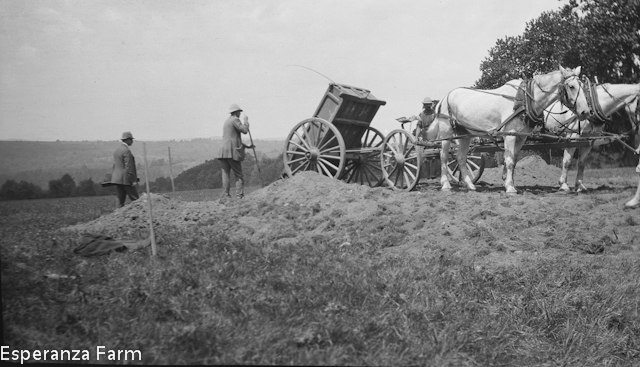
Building the tennis courts (now a nice pine grove, if entirely too well draining soil).  The team is the farm’s work team, probably Percherons or primarily of Percheron stock.  The cart appears to have a rather ingenious design: the actual dump-cart is balanced on the back wheels, which is actually a trailer.  It must have been very maneuverable, if tricky to load.  The wheels are wood, with iron frames and hubs.

Note the rather nice view over Beeney and West hills, the trees in the west hedgerow now obscure almost all of this view.  Note also that the men are wearing coats and hats, despite doing hard work in the full sun, in late August!

Workspaces Tuesday, Sep 4 2012 

A house such as this requires either oodles of cash or the DIY spirit.  Not even approaching the former, needs must that the spirit be cultivated.  The problem, of course, is that the variety of talents required is quite large, the original quality that needs to be matched is quite high, and I am hardly a talented individual.*  

Be that as it may, there are a few first principles inherent to any job.  One of those is good preparation of the workspace.  A workspace that is cleared of unnecessary items, organized, and contains all the known needed bits is a great advantage.  Taking five minutes to move a chair that is only ‘sort of’ in the way may save an hour of dancing around it, or many hours repairing its upholstery or finish when you bash it with a ladder. 

In the present instance, this means taking an oriental rug which I could work on in situ and setting up to repair it elsewhere.  I suspect I’ll get the job done much faster than the previous rugs, which I have always worked on without moving them.  Importantly, the workspace is dedicated, meaning I can leave the project without tidying it out of sight, maneuverability is increased, and rather than working on the floor I can work standing up.


*I can be defeated by a power drill.  Being something of a Luddite, a standard non-powered drill and screwdriver do not give me the same problems.

Underappreciated Plants: Autumn Clematis Sunday, Sep 2 2012 

Garden for any length of time, and one quickly racks up a list of plants that, one feels, people ought to use more.  Right near the top of my list is the (Sweet) Autumn clematis, also known as Old Man’s Beard.  This fall! flowering New England native is fast growing, capable of hitting thirty feet, able to withstand mild drought, heat, and -20F winters without die-back.  And if it does die back, gets broken, accidentally mown, or pruned by default because it is another plant that must be pruned?  It is capable of coming back up from the base and blooming on new growth.  The flowers are sprays of pure white with a powerful, sweet scent reminiscent of grapes.  It starts blooming at the end of August and will continue throughout September.  The various pollinators love it but I have yet to see anything eating it (though it clambers over a rose routinely defoliated by aphids and Japanese Beetles).  About the only thing it likes is shady feet, but even that is something one can work around: I planted a seedling (about three inches in height) in full sun this spring, before this wickedly hot and dry summer; it took a little while, but it is already three feet tall.  Why it isn’t used for privacy screens, patio fences, and a multitude of other hard uses?  A mystery.

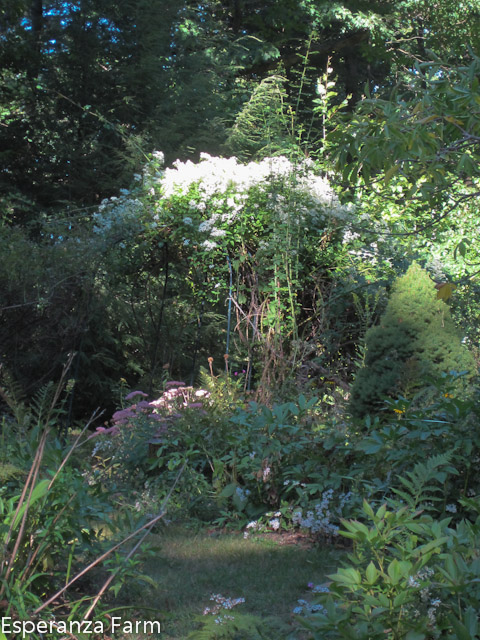
On an 8 foot tall arbor, the last bit of sun just hitting it.  The pink below it is a big sedum, the blue/white flowers are white wood asters.  This clematis is about eight or nine years old and has gotten cut down at least once (accidentally!).

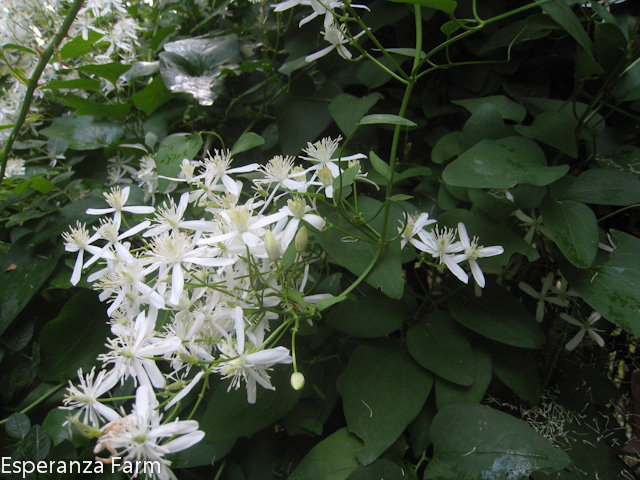
A detail of one of the sprays.

« Previous PageNext Page »