New tree! Friday, Oct 12 2012 

Well, not really.  At the south end of the Yellow Mountain swamp, really a bog, I have often watched various birds.  The bog is caught at the top of the watershed and perched on the top of the hill, it actually drains to the north, in between two steep ridges.   While cold, the ridges protect the area from the wind, and most of the surface water is collected, unable to penetrate the bedrock of the ridges.  This protected habitat shelters birds, while the bog prevents tree cover leading to an impenetrable tangle of blueberry, dogwood, and ilex.

In any case, I haven’t paid much attention to the trees I was under.  About twenty feet tall, with the overall appearance that many understory tree/shrubs take on: incredibly slow growing trunks only a few inches in diameter but decades old, arching and bending to reach the light.  But I noticed them this time.  Instead of the ubiquitous yellow of witch-hazel (the dominant, next to laurel, understory tree), these were a fluorescent orange shading to red. 

So I look a bit closer, poke at the bark a bit, ponder this….grab a leaf for further identification.  I thought I knew, but I wasn’t sure… continue on my way.  Note several more trees of this type, some a bit larger, all in the protection of the ridge but at the sunny edge of the bog.

My initial, ‘but it can’t be’, identification turned out to be right: Nyssa Sylvatica, also known as Black Gum, Tupelo, or Pepperidge.  A bit farther south this is a spectacular and immense tree, rivaling oaks in stature.  It has beautiful fall colour, birds and bees Love it, and it is as tough as the proverbial nail*; but while I have two nursery grown babies that are beginning to take hold…now that I have moved them out of the wind…I thought that Fairfield County was its northern natural extent, with maybe a few in the major river valleys farther to the north.  But on further research, it turns out that ‘cold mountain swamps’ are another of its natural habitats, extending its range to Ontario, if there is enough water and enough wind protection.  I feel a bit stupid, but very happy!

*Naturally, it has been completely ignored by the nursery trade in favour of invasive and/or far less elegant species

Photo of the Day Thursday, Oct 11 2012 

What were we thinking? Wednesday, Oct 10 2012 

Plant orders have a tendency to have a long lag time, often several months.  This can cause mild consternation at times, because what seemed perfectly obvious and well thought out in July may not be the gardener’s inclination in October.  (I know, one is supposed to have Master Plans, yeah right) 

I know we thought out the tulip order.  We spent several mornings on it.  What I can’t remember is why the plan ended up heavily weighted towards hot pink.  It is a logical design, but it is the starting point of a strong colour palette as opposed to a pastel palette which is a puzzle, since we don’t usually head in that direction. It should be very pretty; but it came as a surprise to recall it!

Maybe this year the tulips will last more than a season.  I dislike the trend towards breeding, growing, and treating tulips as annuals intensely.

Growing Grass Tuesday, Oct 9 2012 

Fall is, as anyone who has had to transplant things, a very good growing season.  Spring and Fall are far kinder to plants than either Summer or Winter.  In the cooler, usually wetter, months of September and October, root systems can really take hold.  We cut the long grass of the west lawn, an experiment, down in late August.  This sacrificed the asters and goldenrod (which are nicely flowering in another patch that will be cut later).  In exchange the wild thyme, bunch grasses and sedges have rebounded.  What was a browned off, dusty patch is carpeted with tufted grasses, thyme, sorrel, and other plants such as wild sedum.  This is very important for the thyme, in order to avoid winter kill it needs to be short and growing with vigour.  If it gets to lanky, the loss of the entire plant is possible.

In theory the taller grasses should also benefit the insects, and thus the birds.  What is particularly interesting, however, is that the taller grass shows no sign of grub damage…unlike the areas that are kept as traditional lawn turf.  Whether the grubs don’t like the tall grass or the damage doesn’t show isn’t clear.  But I lean towards the former.  Our grub eater par-excellence, the skunk, is not digging in the long grass areas, which suggests the grubs aren’t there.  Another strike against the traditional lawn?

Fall Mornings Monday, Oct 8 2012 

Are always elegant.  Just after the storm, the clouds are streaks of steel gray; they drop down to meet with the rising valley fog.  The trees, brilliant gold and copper in the rising sun.  The grass of the meadow a rich green, even richer than spring.  The horse, a bronzed shadow waiting for the day’s warmth.

Don’t Fall in II Sunday, Oct 7 2012 

Sky Holes Friday, Oct 5 2012 

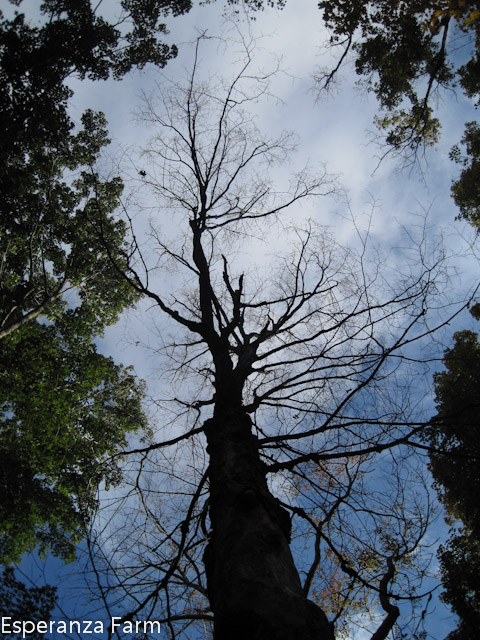
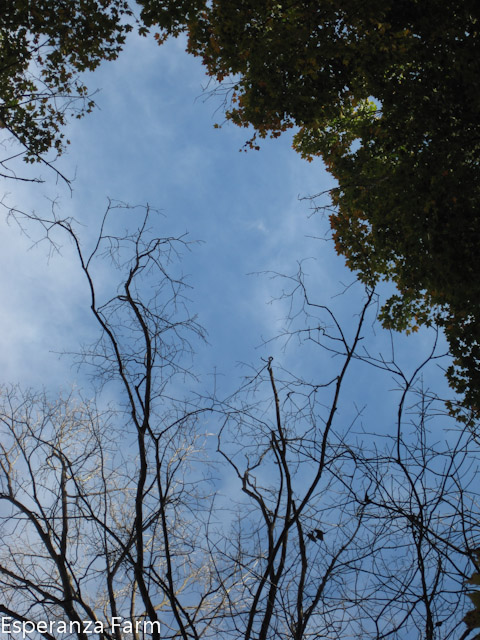
Usually a tree dies gradually, or falls over abruptly taking surrounding branches with it.  Rarely, therefore, is its space in the canopy easily viewed.  In the picture below, however, we have just such an instance.  This was an extremely healthy sugar maple until late last summer.  At that time it got struck by a major lightning bolt.  This blew bark off exposed roots, wilted the ground vegetation surrounding the tree, and left a foot to two foot wide spiral burn all the way down the trunk.  The burn was immediately obvious with patches of charred bark and exposed inner bark layers.  Because it was late in the summer, the tree’s early leaf drop was not immediately indicative of total death (in particular because Hurricane Irene had stripped many other trees).  It was, however, suggestive, as the leaves that dropped had a wilted appearance.

Taken about a week later, this shows the burn mark, some of the wilted ground vegetation, the creamy white object on the lower right in the bank is a root with the bark completely blown off.  The red is inner bark, the dark patches are actually charred sections.  Note the ash in the background has a healed lightning strike scar:

This picture, taken this summer, shows that the tree was immediately killed.  Buds are apparent on the highest branches, formed last summer, but never leafed out.  What is interesting is that many of the twigs are still there, by next year decay will have set in and the tree will have a ‘deader’ aspect, as opposed to the weird ‘winter tree in a summer scene’ appearance.   The dying branches beyond it belong to a large ash, which was already in decline.  It too has been affected by the strike and is far weaker this year.  The dead tips of the maple on the top right corner of the photo may have been caused by the strike, but may be due to the old age of the tree in question.

A close up:


Drip, drip Thursday, Oct 4 2012 

It has finally been raining steadily.  Actually, this is an excellent time of year for it, since it allows trees to really develop root systems.  It has also finally softened the ground up.  All summer the ground was hard, lacking in any give.  The soft soil is a good thing…I was not looking forward to trying to plant however many crocus and daffodil bulbs in bone hard soil.

On the other hand, I have a certain impatience for frost at this point.  The vegetable garden looks horrid.  The tomatoes succumbed completely a while back (with some help from yours truly yanking stakes for something else).  The beans are played out, the tomatillos are a disaster zone, the squash is gallant but ugly…and the thrice blasted caterpillars continue to infest the kale…   At least the chard, carrots, broccoli raab, peas, and parsnips all seem happy.  But I did finally break down and buy some lettuce today, guests coming.

Commentary on rug repair Tuesday, Oct 2 2012 

I am, slowly, repairing an oriental rug.  Now this repair goes far beyond a simple whipstitching of the edges…there are Holes, some actual ‘stick your hand through and wave’, some simply where the only thing left is a fragile patch of warp and weft looking a bit like screening.  I don’t know what on earth was done to; most are clearly places of heavy foot traffic, but there is one place about an inch wide and spanning the entire rug that is worn through…did someone fold it up and take a razor to it??

You will accumulate a multitude of needles, all threaded in a multitude of colours.

You will find that Plainsong music works best, failing that something in the folk genre that is singable.  So old, genuine folk music. Rock is out.

You will never have enough light.

A square inch an hour is doing well (the rug is about six and a half feet long)

There is a whole repetoire of tricks to get the new thread and knot in just right.

Repairing a warp/weft cord is possible.

If you were being paid, the number of hours you will spend would buy quite the rug.

You’re not sure why you’re doing this, but take a certain pride in it anyway.


Don’t Fall In Monday, Oct 1 2012 

« Previous PageNext Page »