Brothers (photo of the day) Tuesday, Dec 11 2012 

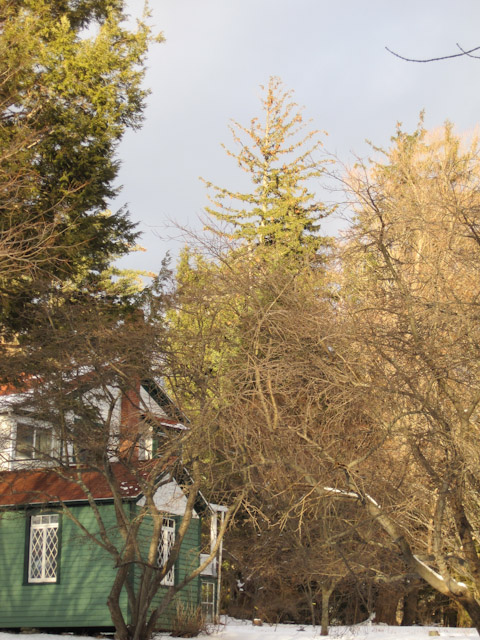
Sugar Maples by the West Meadow, why two of these grew in almost the same way is now hard to say.  The ones with the curving branches are probably around 150-180 years old; the others, just based on placement, may be a bit younger.

IMG_9278

Mud Season Monday, Dec 10 2012 

Fog and mud…not exactly what one has in mind for December; although highly appropriate for lowland Scotland….which this isn’t.

Still, I can’t mind.  What will no doubt be only one of my planting projects for next year showed up finally; a collection of slightly unhappy (thanks to the delivery service) bare root trees.  They are settled in for the winter in the vegetable garden, and this sort of warm, wet weather is just what they needed.  Several experiments in the lot.  I may be pushing the zone and microclimate with a Sweetbay Magnolia, but it would be nice to have and an ideal replacement for an overgrown Burning Bush.*  Two Carolina Silverbells, which contrary to name should grow this far north in cultivation, also replacing some Burning Bush.  Two Downy Serviceberries, location TBA but likely replacing…you guessed it: Burning Bush; I believe that they are the type that we had at the other house: a lovely tree that made a delicate lace cloud of hanging clusters of ivory blossoms followed by purple-red berries beloved of the birds.  A crabapple, precise location TBA, also hopefully of a type that the birds appreciated. 

*I am of two minds on Burning Bush…it can be structurally elegant when properly trimmed, the fall colour (whether pale salmon or crimson is spectacular), my grandmother loved it, the animals do use it….But, the stuff is wickedly invasive and entirely too common in the landscape here. It is also a labour intensive shrub needing yearly major pruning to look its best, and even then presents a rather coarse and boring outline.  It Only looks good or dramatic at least (not the same thing!) for a week or two in the fall, the rest of the time it is just a big shrub.  There are a few that will be kept, here and there, but they are gradually getting replaced.

Inventories Saturday, Dec 8 2012 

While rearranging my desk the other day, I came across two inventories for the house dating from the 1950’s and the 1960’s.  Neither are especially complete nor are they especially trustworthy, with several egregious errors on the first page alone of the professionally (?) done one from the 1960’s.  Deciphering them is made more difficult by the slow movement of objects so that none of the rooms match the descriptions of the inventories.

Inventories tend to go almost immediately out of date if they are organized by the object’s location, unless it is a static house museum.  But even there, every object has been given its own tracking number if the museum is serious about its work.  Ideally, every object gets its own card with a description and picture.  Every object.  Not sets.  This used to be a formidably expensive undertaking in paper and ink; the digital age has helped with that, though arguably it has meant an over-abundance of information without selection.

Still, both are very useful.  Most useful is the personal one compiled by Lucy Creevey in the 1950’s.  Uninterested in price, her inventory frequently gives the history of the object.  Unfortunately, figuring out which object she was discussing can be difficult.  The other one is mostly concerned about the price of the object and has those aforementioned errors; but still is interesting.

I suppose after 50 years…what an appallingly large project.*

*yes I know, First get the book/art one finished and off the non-working computer.  Pitfalls of digitized information….I can read the 1954 inventory, I can’t read the 2010 one because of the computer it is on…and yes I should have backed it up.

Don’t Fall In Thursday, Dec 6 2012 

IMG_9273

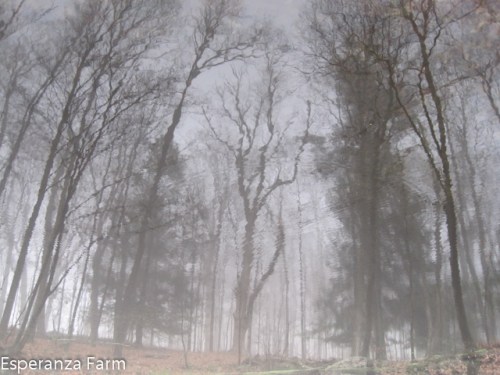
Julie’s Pond, on a foggy day; yes it is a flipped reflection!

letter excerpts Wednesday, Dec 5 2012 

Before magazines were common and well before the internet was even a fictional fantasy, letters were the form of communication.  We’d often like these to discuss the ‘great’ events of the day, those important to history.  The people writing them, however, were as human as we….  Fashion, weather, jobs, conversations, chance meetings, the little important events of lives.

Here Julie writing to her mother in 1845 gives her some information on NYC fashions:

“Dresses stand out as much as ever, stiff skirts are worn and very full indeed. Don’t have your silk made, wait till next year and then come down to New York, and we will go together to Connecticut.* Tight sleeves seem to be the reigning mode with all sorts of caps set into the armhole. Black straw hats are a good deal, trimmed with velvet scarves, mostly crimson. All sorts of fanciful head dresses, made of ribbon, lace, feathers, flowers, and everything else put in all imaginable forms. Hair is worn low and high and between. I have seen all this at the concerts and so on where I have been.”

*Hartford, Ct actually was a fairly important town at the time.  They could probably get clothes cut there in fashions close to that of NYC, but more reasonably priced.

Fog bound hills Tuesday, Dec 4 2012 

On days such as this, when the fog has settled on the hill top, one begins to understand how fog is such a powerful element in myth and story.  One knows perfectly well that the outside world exists, the road is still there, the paperwork is still there, yet the physical world beyond the fog fades.  Not into darkness as at night, but into an unreachable state.  Nothing seems to exist but the here and now. 

Rather pleasant in a way.  Here this sort of fog really only happens in the winter during warm, wet spells and can last for quite some time. of course it also means Mud.

Some chronology Monday, Dec 3 2012 

Always useful…early chronology of Esperanza, before it was Esperanza.

c.1795-1800: the first property deed to mention a house on the site of Esperanza.  The first deed is 1800, but the interior evidence in the house suggests it was built in preceding decade….or the lumber was cut then….

1802-1832: the house (then just the center section built in a typical New England vernacular style) is owned by the Reverend Amasa Jerome, pastor of the Town Hill Church.

1832-1849: owned by Rev. Jerome’s widow, it may have been rented out as a farm during this time.

1849-1859: owned by Rufus Rood, during this time there is mention of a fire causing severe damage and then immediate rebuilding.  It was probably at this time that the core of the southern extension was added.  Remains in use as a farm.

1859-1872: owned by Frederick Lyman.  Continues to be used as a farm.  However, farming in New Hartford (at least on the hills) had collapsed completely by this time: the Town Hill Church and over a dozen houses on the hill were vacant or abandoned by 1870.

1872: bought by Julie Palmer Smith, who had purchased the adjacent property the year before.  The other property had, in her opinion, a better house…but it burnt to the ground in late 1871.  It was cheaper and easier to buy the Lyman property as it meant that they could, as planned, spend the summer of 1872 in New Hartford.

November roads Sunday, Dec 2 2012 

IMG_7233

Taken down by Julie’s pond.

Photo of the day Saturday, Dec 1 2012 

Really, really big Christmas tree?  I still think we ought to put a star on the top and confuse the pilots on approach to the nearby airport, but I don’t think the FAA would go for it….

IMG_0030

Still standing, bit more ragged each year, about 109 feet tall.

‘Make your house as fair as you are able’ Friday, Nov 30 2012 

Something of an earworm that tune, due no doubt to having been practicing it.*

Still guests or no guests, it is sort of inevitable that this is the time of year when I really clean things.  Partially, it is because we do ‘trim the hearth’, partially because most outdoor things are fairly wound up.*

I actually enjoy certain types of cleaning, especially of furniture.  I find that it gives me a chance to think about other things, such as writing, or simply to have a chance to closely examine how the piece is made.  It can also be a form of meditation, if one is in the right mood.  Cleaning, as the tune suggests on one level of interpretation, is a chance to prepare so that guests, whoever they may be, are welcome.  Yet not just the guests, it also is a welcome to those who live there.  It is a chance to reflect on what one has and to at least try and give thanks for having it.  Though I confess, such saintly thoughts are not always foremost in my mind…especially when vacuuming.  Putting up seasonal decorations also demands reorganization; this allows one to clear away the extraneous, so that what is important has pride of place.  Over time, a mantle or a shelf fills with things that we simply don’t have a chance to put away.  Clearing it off for the seasonal decorations gives one a chance to evaluate what is on it, what needs to be on it, why things are on it, and should they change.  At any rate, before I wander too far into half-baked metaphors…

  Oddly, some of the pieces I most enjoy (assuming the right frame of mind here) are the pieces that most people find to be excessive. The house has a number of pieces of moderate but emphatically Victorian furniture.  It may be a Shingle/Queen Anne style house; but the furniture came from Hartford and the earlier Victorian era.  Modern it is not.  Most people can’t stand it.*   The pieces are large but not designed for large people, they never have squishy seats, and all those intricately carved roses, flowers, curlicues…well they Do catch dust.  And are utterly pointless in regards to function.  Personally, I can’t stand squishy sofas that make me feel trapped.  Hard, narrow horsehair seats and an upright back is just fine for me.  As for the dust.  Well, once you get it really clean and well waxed…which does take near on a day for one sofa, keeping it dust free simply requires the careful application of the vacuum followed by a soft cloth.  Yes the curlicues are pointless, but why not create simply to create?  They still look good, 150 years on, not bad craftsmanship there.

*It is the advent hymn: ‘People look East’, an almost annoyingly catchy tune set with almost annoyingly well rhymed words that I haven’t been able to get out of my head since choir on Tuesday.

*Not this year, I still have some exceedingly large chunks of tree out there.

*From what I understand, antique dealers won’t touch the stuff because no one will buy it.

« Previous PageNext Page »