Crows Saturday, Aug 18 2012 

I like crows sometimes, watching them (rooks and jackdaws actually) playing on the wind off the Salisbury Crags above Edinburgh gave me many hours of pleasure.  And I was glad when they returned here after being nearly wiped out by West Nile Virus.

The operative term there is ‘was’.  I could do without the daily conversation that occurs each nice morning as the sun begins to rise.  They talk for hours.  And for whatever reason they don’t do it while in one place.  The preferred method is one group in the big tulip tree, one in the hemlock, and one in the ashes by the barn.  It is nicely amplified by the corner of the house….where my room is.  On the other hand, they are effective at cleaning up the bugs in the barnyard and the lawn, and they don’t seem interested in the garden.

The turning year Tuesday, Aug 7 2012 

Generally, we pay attention to the quarter marks of the solar year: solstices and equinoxes.  However, the seasons are offset from these markers.  At some point in early August, summer begins to move towards fall.  It is still summer with no question, here the corn and tomatoes (so strongly associated with summer) are only just getting going.  The Morning Glories are truly glorious.  Thunderstorms still walk across the hills.  Yet, the scent of the land has changed.  The trees have an olive cast, uncut grass is brown, the pastel colours of fall are heralded by the ivory Queen Anne’s lace, the dusky blues and mauves of chicory and Joe Pye weed.  The goldenrod has begun to bloom and the white wood asters.  The grasshoppers become almost deafening in the cooler nights.  And sometimes the wind has a sharpness.

August, like early February, hints at the coming change.  There is an aliveness, an anticipation which July, somnolent in the heat, lacks.

Scent Memory Wednesday, Aug 1 2012 

Summer, like all the seasons, has a distinct set of scents that are associated with it.  Smell is, it seems to me, an underappreciated sense, perhaps because of that it is often an extremely powerful trigger for the mind.  In any case, here in southern New England summertime is associated primarily with hot pine/tar and cut grass.  Other scents can be incredibly specific: oriental lilies outside a window at dusk or the sharp herbal bouquet from weeding an herb garden: sage, mint, thyme, chamomile.  The swamp forest’s mix of decay and growth, a hayfield’s sweet, dry scent, or phlox’s delicate floral scent.

Goldilocks Syndrome Sunday, Jul 29 2012 

It is too hot, too cold, too dry, too wet.  We finally have gotten a decent amount of rain, which of course brings a whole host of other complaints: tomato blight, slugs, mildew, damage to trees, etc.  What is perfect weather though?

Personally, I’ll take the stormy weather.  It has that edge to it, the potential that this beauty will be devastating.  Watching a line of thunderstorms roll over is truly inspiring.  The bases of the clouds so low and fast moving that one thinks one might touch them.  A great shifting tapestry of grey, blue, white and behind it all a wall of rain.

Still Life Thursday, Jul 26 2012 

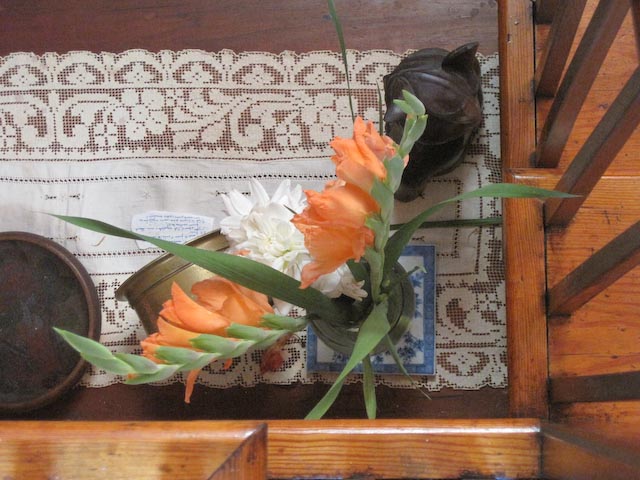
sadly, not taken this year, as the bulbs got eaten.  Taken looking down from the first landing of the stairs.

Thunderstorms Friday, Jun 22 2012 

are always a welcome break from a heat wave.  They are beautiful, aw-inspiring, and terrifying.  They are also a bit like very large, slow-moving car accidents…once they are under way, you can do nothing to stop them, and they just might change your life.  Unlike a car accident, you can’t do anything, more in the position of roadkill than a driver.

This one took out some branches, had a lovely light show, and some impressive wind and rain.  No hail, for which as a gardener I am very appreciative.  On the other hand nearly two inches of water in fifteen minutes does interesting things in the basement.  I was told that one wall had a nice little fountain, and it certainly made a lake.  But, the basement is designed for it, and it will all drain back out.  Just, don’t plug the table-saw in for a while, eh?

June days Sunday, Jun 17 2012 

The hay is cut, but still the roadsides gleam where uncut field grass shimmers green, gold, silver, and bronze.  The elderberries are crowned in ivory; the humble roadside ditch has the first few fire-orange sparks of the daylilies; and the trees have turned dark green against the blue sky where the swallows play.  Summer hurries this year and is nearly at its height now, when the sun is about to begin its turn that will take us towards the fall.

Contemplations on Windows Tuesday, May 29 2012 

An aside from Esperanza.

Working on a minor architectural history project today, documenting some windows in a potentially historic building before their replacement, got me to thinking about the ‘why’ question of historic preservation.  Not too surprising, given that the building in question is a gym and the people I was dodging in their devotions to the gods of exercise wanted to know what I was doing.

There are a number of possible answers, all more or less applicable depending on the circumstances.  These may be long-term economic considerations, environmental considerations, sentiment, aesthetics, or the inability of the modern age to rebuild a replica (cost, rarity/or complete lack of material, and the lack of the skilled labor).*

Now this building, already heavily modified on the interior, has a relatively low level of historic integrity and the windows are nothing unusual.  They are precisely what one would expect in a public building, in New England, built pre-1920.  They are big, double-hung windows using the pin and pulley system, with full arched fanlights above.  The fanlights are hinged at the bottom with the top of the fanlight swinging in.  The window is stopped by chains which are attached at the balance point located a bit below the middle of the curve, so that when one closed them (using a long pole hook) you never had to deal with the entire weight of the window.  Most of the fanlights are missing already, chopped out for air conditioners or hidden in a dropped ceiling, yet the chains and the top hook were still in place on two of the old frames, poignant reminders.  The pulley/pin system of the double-hungs, judging by the paint layers, had fallen into disrepair before the arrival of those air conditioners.

These utterly standard windows were an ingenious, mechanical, solution to the problem of ventilation.*  And here is where historic preservation, or at least good documentation, becomes valuable in this situation.  How does something work?  Not a question we ask as much as we should.  Ideally, if one didn’t want to, literally and metaphorically, close doors; a renovation or new construction could use that fanlight/clerestory window design, and maybe even in the double-hungs, in tandem with its modern climate control.  Historic preservation preserves Options as much as it does the past.  ‘Learn from history’, what a cliche!  Only, is it really?

The replacements will, of course, not open.  I hope the power stays on…

*It has been shown that, whether a window or a building, you triple your carbon footprint when you tear it down and replace it with one of similar size.  Basically construction of Building A, plus demolition of Building A, plus construction of Building B equals three buildings, and associated material/fuel costs.  Refit/Renovation generally has a carbon footprint of a half to one additional construction. It has also been shown that historic renovation/reuse is a much better economic engine than new construction in the short term and has long-term, indirect economic benefits as well.

*Yes, I realize that the air conditioner is a more effective cooling system…but what would the bill look like if you ran the AC during the day, and opened the windows when the ambient, exterior temp dropped at night(as it generally does in New England), or on other days?  Options, you wouldn’t have to, but you could…and in a builidng occupied around the clock, why not?

Memorial Day Monday, May 28 2012 

The poppies, blood rubies

Of crimson memory,

Shocked the eye

Caught between the lush, green fields

And the storm driven steel of the sky

This was not the red of fire

Nor yet the red of fall

But the heart’s red

Flower on the solemn ground

Of hand tools Saturday, May 19 2012 

and the use thereof.  It was a genuine pleasure to cut the oat-grass, a cover crop for some perennial grass, on the dam.  Mostly because I chose to grab the grass scythe and do it, in less time than it would have taken to fuel the string-trimmer*, get it to start**, and then shatter the quiet of a beautiful afternoon.  A correctly sharpened and adjusted scythe makes very quick work of mature oat grass, laying it down in a neat windrow, too neat for this purpose as I had to go back and scatter it lest it smother the other grass.  It does less well on the native North American bunch grasses, but then scythes and the oat/hay grasses of Europe evolved together.  No doubt for thousands of years farmers encouraged the grasses that not only grew well but that cut well to the rhythm of a scythe swung about three inches above ground level, row upon row.

The scythe in question, or the snathe of it, was made by Derby and Ball in Waterbury, Vermont; once one of the largest manufacturers of scythes in the world.  The razor-sharp blade is a triumph of metallurgy, precisely curved in both profiles, and astonishingly hard for such a thin piece of metal.

*The joys of ethanol, I always run the tank empty before storing anything with a little, fussy engine.  How much money and energy do you suppose ethanol has cost in engine repairs/refits?

** fussy little, pull-start engine with ethanol in the spark plugs and a very finicky choke.  Actually, it starts very well.  But still…

« Previous PageNext Page »