Sky Holes Friday, Oct 5 2012 

Usually a tree dies gradually, or falls over abruptly taking surrounding branches with it.  Rarely, therefore, is its space in the canopy easily viewed.  In the picture below, however, we have just such an instance.  This was an extremely healthy sugar maple until late last summer.  At that time it got struck by a major lightning bolt.  This blew bark off exposed roots, wilted the ground vegetation surrounding the tree, and left a foot to two foot wide spiral burn all the way down the trunk.  The burn was immediately obvious with patches of charred bark and exposed inner bark layers.  Because it was late in the summer, the tree’s early leaf drop was not immediately indicative of total death (in particular because Hurricane Irene had stripped many other trees).  It was, however, suggestive, as the leaves that dropped had a wilted appearance.

Taken about a week later, this shows the burn mark, some of the wilted ground vegetation, the creamy white object on the lower right in the bank is a root with the bark completely blown off.  The red is inner bark, the dark patches are actually charred sections.  Note the ash in the background has a healed lightning strike scar:

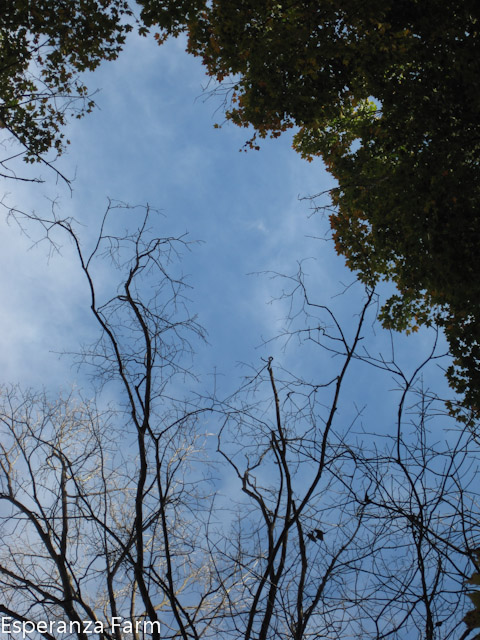
This picture, taken this summer, shows that the tree was immediately killed.  Buds are apparent on the highest branches, formed last summer, but never leafed out.  What is interesting is that many of the twigs are still there, by next year decay will have set in and the tree will have a ‘deader’ aspect, as opposed to the weird ‘winter tree in a summer scene’ appearance.   The dying branches beyond it belong to a large ash, which was already in decline.  It too has been affected by the strike and is far weaker this year.  The dead tips of the maple on the top right corner of the photo may have been caused by the strike, but may be due to the old age of the tree in question.
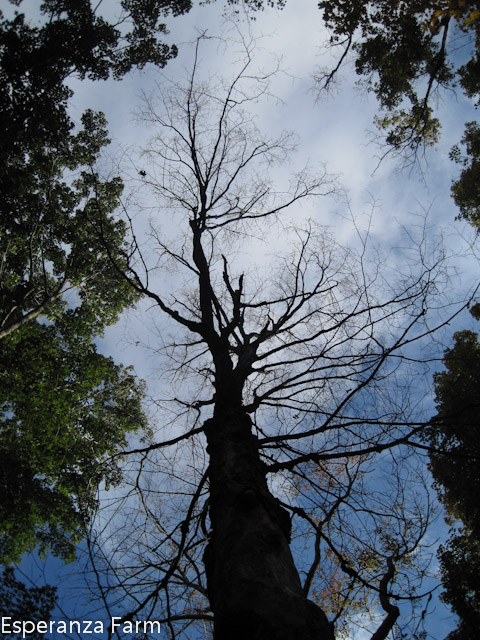
A close up:
 

Fall colour Friday, Sep 28 2012 

I’ve never quite figured out why leaf peeping is big business, though it is always a major conversation topic even amongst those with no aesthetic or financial interest in it.  Odd.

Still it is a spectacular sight!  This year the ashes just sort of dropped.  Some years, they are beautifully shading of purple/bronze amongst the still green maples.  The black birches are coming into their own though.  The two behind the big garden are a glorious golden canopy.  The woodbine is starting its creeping blaze, see yesterday’s photo.  The big woodbine will eventually turn the interior of the eighty foot hemlock by Minnietrost scarlet.  A few red maples have started to turn, a dull silvered red.  The silver maples are picking up caramel highlights.

Not a trick of the light Friday, Sep 7 2012 

The tulip tree on the edge of the west meadow is, due to its location, often silhoutted against the sky.  With a somewhat complicated branching structure, including a curving main trunk and lower branches that arch down to the ground, it is an important piece of the visual landscape. 

Last night, I happened to be wandering about just after dusk and it caught my attention.  I had noticed that it was turning colour a few days ago.  This is a bit early, and probably a reaction to water stress: sitting on the break of the hill, it is last in line behind all the other trees for surface water.   The leaves that are turning first on it are the weaker leaves, those on the inside of the tree.  Almost all of them have turned gold, while the leaves receiving the most sun remain green, a rather useful approach to stress. 

Consequently, last night it looked as if someone had lit the tree from the inside.  It was a beautiful glowing gold where darkness ought to have been, with the green leaves on the outer tips of the branches.  No shadows, just this appearance of diffuse golden light.  Very elegant and unusual.

Photo of the day Thursday, May 31 2012 

What is that purple thing in the tree? Friday, May 25 2012 

Most people driving around Connecticut, Massachusetts, and New York have probably seen a bright purple box, about two feet tall, hanging in a tree, usually about thirty feet up.  If they are very observant they will have noticed that the box is usually hung in an ash tree, preferably one in decline.  What are they?

The boxes are traps for the Emerald Ash Borer, a nasty beetle that hitched a ride from China to the Midwest some years back.  This bug has been inexorably making its way east across North America.  It eats, and kills, ash trees at a good clip.  Since ash is a valuable lumber tree, critical wildlife habitat, and makes up the majority of forests in many regions….this is cause for concern. 

The traps are not designed to catch all of them.  Nor will they attract them from more than about a hundred feet away, so they Will Not lure them into an area that doesn’t have them.  They are merely there to allow the USDA, USFS, DEP, UCONN*, and others to track the bug’s progress so as to learn what slows it down and what doesn’t.  Last year there were about 950 traps in Connecticut, on a square kilometer grid system.  This year there are about 450, over more of the state but not in all areas.*  So far, the emerald ash borer hasn’t been found in the state…yet.

What does this have to do with Esperanza?  Well, we are an ideal location for the trap, so for the second year there is one in the hedgerow; may it remain just as empty as last year’s!

*and other alphabet agencies and universities

*Finding an ash tree in the middle of a city was apparently hard, it was also hard to convince the majority of private citizens to allow someone from the government on to their property, it was equally impossible to convince the government body in charge of nuclear power plants, dams, and other bits of infrastructure to allow another government body access…

Claustrophobia by tree Saturday, May 5 2012 

When Spring finally occurs in New England, I always end up slightly claustrophobic.  The trees suddenly fill in, and because the young wood is extremely flexible and filled with moisture, branches are suddenly reaching down.  Yesterday, working around the biggest Japanese Maple and the Copper Beech was especially odd and it took awhile to understand why: not only had both trees fully expanded their leaves, they were also giving a red cast to the light.  By summer, one is accustomed to the red light beneath those trees, but in the spring, to go from no real canopy to a nearly solid red one is disconcerting.  It was, I think, especially noticeable because it was a cloudy day with diffuse light and no real shadows.

  The speed is the most remarkable aspect of the transformation.  For example, a young sugar maple by the barn has added four inches of height in about two days time.  That, when you think about it, is an impressive level of energy and cell division.

Given a chance, eastern North American forests regrow with astonishing speed.  The composition of early successional woodlands is, of course, radically different from climax forests.  However, in fifty years a Connecticut field can go from open meadow to a closed canopy of trees, many of which will be eight inches or more in diameter.  Nowadays, of course, it will also be an utterly impenetrable tangle of the big four invasives: barberry, winged euonymus, multi-flora rose, and Asian bittersweet.  Things grow, maybe not the things you want to have grow, but they do grow.

All things end Friday, Apr 27 2012 

For decades the north path wove its way past the garden shed, beneath the great locusts and hemlocks, and crossed into the garden between the great square boundary pillar and the twenty foot tall remains of the big cottonwood.  The tree had been nearly three feet in diameter, after it fell about twenty years ago years the remant snag was left.  Totally hollow, it fit the image of the slightly spooky, slighty romantic ruined tree trunk; the imagination could run rampant, maybe a parliament of owls, maybe a racoon family, maybe bats, weasels, snakes, maybe a person could hide in it?  It was an elegant ruin, visible from several places in the garden, adding a sense of age, memento mori. In later years it was crowned by woodvine, crimson in the fall.  And it was the woodvine, which held it together, that in the end probably pulled it over.

I went out the other day to find that it had toppled, quietly, without fanfare, falling towards the heaviest weight of the woodbine, away from the path.  The shell had mostly crumbled, though it fell on soft ground.  The largest piece, about a third of the trunk, had fallen on a young conifer; but it was so light and thin that I could roll it off the little tree, which had only been bent.

From the path, it fell to the right, the young conifer is behind the locust’s trunk in the photo.

You can just see the trunk, directly above the middle of the viburnum (white shrub!) in this picture.

It rained! Monday, Apr 9 2012 

A little bit, but still classified as a moderate drought.  For a fascinating map see: http://droughtmonitor.unl.edu/monitor.html    We are much, much better off than many other areas of the country though.  However, the woods are quite dry, rather crunchy when you walk through them.  The pond’s flow is minimal, which isn’t helping our little algae problem; though I was pleased to realize that much of the stuff floating on the surface of the pond is not, in fact, algae.  Instead, it is an uncountable number of frog eggs.  They weren’t very loud this year, but they certainly did spawn. 

I ought to be sowing some grass seed, I think the forecast has a chance of some more showers.  Naturally, I didn’t get to it yesterday.

Camouflage Tuesday, Mar 6 2012 

One of the largest landscaping headaches at Esperanza is the presence of a state highway running across the front of the lot.  Although this road was moved about fifty feet away from the house in the 1930’s, the massive increase in traffic makes it a constant presence in the landscape.  One of the goals, therefore, in the landscaping is to build a barrier between the house and the road.  Now, you might ask: why not build a fence?  Two reasons: number one, a truly effective sound/light barrier is costly.  Number two is that a fence which can’t be seen through is an attractive nuisance.  People decide that there must be something interesting behind it, something that makes trespassing inviting.

So trees it is.  Besides I prefer trees.  It is a Slow process, but if you drive past at 60 and are not actively looking, you probably won’t see the house.  We still hear and see the traffic, but there is an illusion of distance.  I count as a success the bicyclists, who I recognized as having gone past all summer, suddenly yelling “there is a house back there’ one day in the fall.  I also count as a success the state highway truck that refused to believe the drive was a drive.  I say nothing about the individuals’ situational awareness.  In general, one can safely assume that people don’t see things.  But there is a trick to this, the trees can’t look ‘planted’; they have to read as a forest, which means it has to be a forest.  In this case, it appears to be a mature mixed hardwood forest with a strong evergreen component.  Furthermore, because we want to keep the concept of distance, the dense planting must be close to the road, with a mixture of trees, understory, and strategic but visually pleasing clusters closer to the house.* 

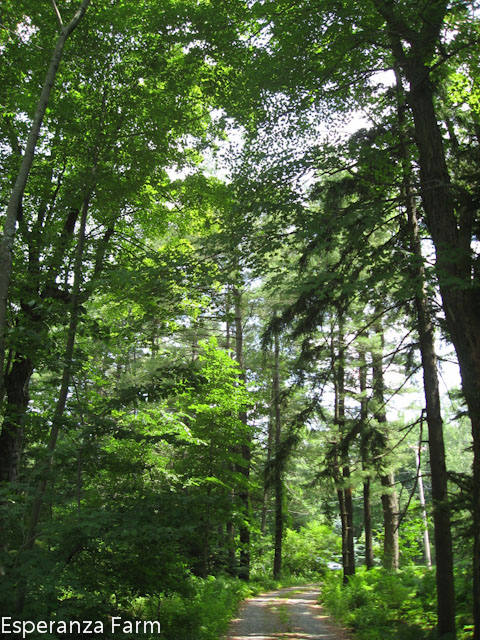
It is very complex section of the property, the description of which I won’t bore you with, but an idea is given by these photos which were all taken on the drive.  We obviously have the advantage of a century here for the large trees, but the strategic understory is a creation of the last decade. 

In the summer, the view from the drive entrance:

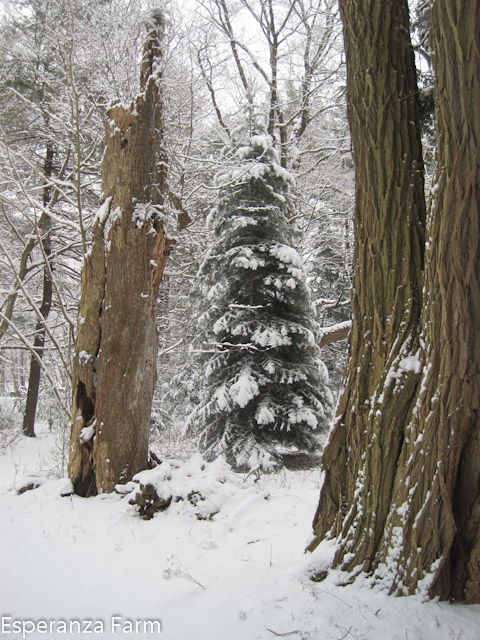
In the winter, looking out the drive from the pillars, at just about the farthest point of the drive in the summer picture. Here you can see how the barrier is still quite thin, the loss of one hemlock created that hole just to the right of the plow truck, the trees you see beyond are actually on the other side of the road:

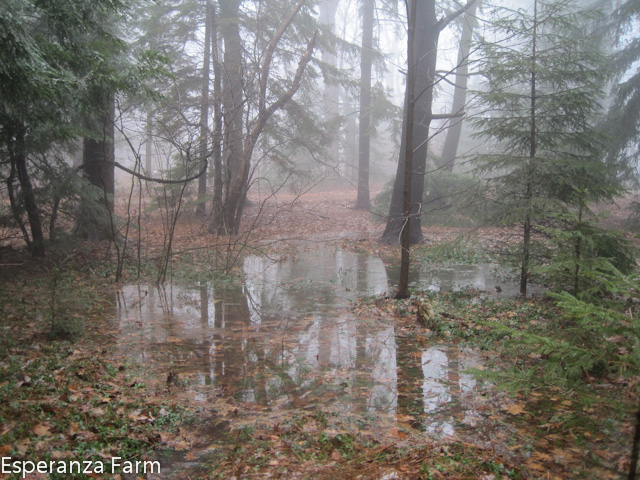
And a view from in the woods, looking at the road but in fog, showing rather well the varied ages and spacing, much of which comes from nature being allowed to run its course:


*Mercifully, trees want to do this, forest edges form dense thickets, while areas under closed forest canopies tend to be open.  Transitioning the edge from ineffective, ugly and invasive Norway saplings to native, or non-invasive species, is a bit harder though.

Typhoid Mary Wednesday, Feb 29 2012 

Most people who are interested in eastern North American forests are all too aware of the woolly adelgid.  This little critter was introduced from Asia sometime in the 1940’s (possibly earlier).  It didn’t become a significant problem until thirty years ago.  At that time major infestations were recorded in the Mid-Atlantic area; in the ensuing decades it has relentlessly spread along the Appalachian Mountain chain, with all of the Connecticut counties recording it for over twenty years.  Adelgid can kill a full grown hemlock in under five years.  The eggs and the insects easily travel from one stand to another on the wind, or by birds, deer, and other contact, especially human activity.  It is aided in its destruction by the presence of elongated scale, also an Asian invader, which doesn’t kill the tree outright, but substantially weakens it.  The increase in scale probably goes along with the increase in adelgid.

The only completely effective controls currently are some of the nasty insecticides, or if the entire tree can be reached, horticultural oil spray which suffocates the eggs.  Some biological control through the introduced predators of the adelgid is also possible.  But the predators are hard to bred and do not survive well in all areas. *  Thankfully, in northern areas (and just barely Connecticut) extremely cold, dry winters can substantially reduce infestations of adelgid, though not of scale.  However, in much of the Applachian range, the hemlock is going to become much rarer, if not locally extinct.**

All of which means that keeping a close eye on the hemlocks is very important.  For better or worse, Esperanza’s landscaping relies heavily on this tree.  Last year, the big trees were treated with insecticide and the smaller trees with oil.  Technically I ought to have the tree company come every year.  But, finance rules, and this year’s tree budget (we try for Balanced budgets around here, not being a government) is earmarked for the Japanese maples.  Although, I probably will spray the small trees myself.  I am reasonably happy with this decision, because while inspecting the hemlocks today, I found only one set of trees that clearly had adelgid.  It was probably brought in one someone’s clothes, or by a deer or bear, as the infestation was primarily on branches of the same height, weaving through the stand.  It looks quite pretty, by the way, when a branch is heavily infested with eggs: sort of like little white pearls or cotton balls at the base of every needle, a bit like artificial snow sprayed on a winter diorama.  These branches were clipped off and put in the trash.  Hopefully, we caught it in time. 

Now if I could only train a squirrel to check the tops…

*one is also, of course, introducing another alien…which tends to have unexpected problems…

**Ironically, it probably was originally a much less common tree in southern New England and farther south before the nineteenth century.  It was never a popular lumber tree, which meant it was left, and its seedlings could compete in the second or third growth forests easily, as it will grow in both sun and deep shade.

« Previous PageNext Page »