I shouldn’t complain Tuesday, Jul 17 2012 

Compared to the Mid-west, we have plenty of water.   According to the U.S. Drought monitor, we are merely ‘dry’. http://droughtmonitor.unl.edu/DM_northeast.htm  Well, I have my doubts about the accuracy of their monitoring for this region.  It isn’t, after all, a major agricultural center and the water rights for the cities are ample, well protected, and unchallenged.*  So, why should they monitor it closely.  Besides their fine print does say that it may not be accurate…

So my doubts….Stub Hollow’s brook is only barely flowing, and really only below the old Stoney Lonesome pond, which is spring fed and controlled by a dam.  Stub Hollow’s headwater marsh, which is mostly a point of surface water collection about half a mile above the pond, isn’t producing much water.  Usually, the brook has a significant year round flow, sufficient that you will have to either wade or be very agile at rock hopping, and has fish.*  The big swamp on Maple Hollow has only a center channel, mud that should be 4 to 8 inches under-water is growing grass.

Julie’s Pond, spring-fed, is holding water; but the outflow is down to essentially a seep.  As opposed to about ten gallons a minute in a normal year.

And its only mid-July…

*The various city water companies own huge swathes of Connecticut, Massachusetts, and New York; they are routinely overlooked property owners.

*the unbiquitous little fast moving minnows, never more than about four inches in length.  but fish nonetheless.

Bats in the belfry Monday, Jun 25 2012 

Unless you have been living under a rock, if you are at all interested in environmental news from eastern North America, you know that bats are in serious trouble thanks to a distinctly nasty fungus.  White nose syndrome has killed between 5.7 and 6.7 million bats since 2007; when that is combined with the tendency of people to eradicate colonies at the drop of the hat, habitat loss, and light pollution…well the news isn’t good for bats.  Despite the fact that the little guys are a free and effective form of bug control.  (I also think they are cute)

Happily, Esperanza is doing its part in environmental community service*.  We knew from ground evidence/plus seeing them that there were bats in the porch and that there were bats in the south end roof, and that there must be bats in the barn (the mystery is that we never see the bats in it, but the pattern of droppings** is impossible for mice without wings).  We didn’t know that there are at least forty in the northwest corner of the roof.  Last night, we happened to be at the right place, and they popped out as bats do from roofs: one at a time with a great squeaking and scrabbling.    Rather nice to see.  But I do wonder what the total count for the house and outbuildings is?

*Because it is the right thing to do…pity that doesn’t translate to the finances.

**the squeamish would perhaps liken it more to a carpet…

On Fireflies II Saturday, Jun 9 2012 

Last night was cool with a rising wind, but the fireflies were still glorious.  It was interesting to observe them from the second story, looking out over the hayfield.  They tended to cluster around several of the younger trees, especially the persistently ill chestnut, to the point where you could see the outline of the tree when they flashed in sync.  This is not surprising.  The chestnut is always a buggy tree, at least judging by the worm-eating birds that flock to it.  However, they also clustered around the young ash, which also stands in the field on a fence-line.  A few had staked out the fence itself, a little string of stationary lights all at the same height.

They also drifted down out of the big magnolia and, to a lesser extent, the big hemlock.  Stars in the dark.

On Fireflies Friday, Jun 1 2012 

Fireflies are a particularly cherished part of summer, possibly more so on the eastern coast of North America, possibly because of some unformed, vague memory of a novel I once read.  Nonetheless, the June nights when the moon is sailing high and the field grass whispers silver and green; in that rich darkness, fireflies float, pinpricks of light.  The light is nothing like that which we use, it is the white-green phosphorescence of fox-fire, lightening, and fireflies, the light of the unknown world, of magic and of wonder.

Fireflies are actually not all that good looking in the light of day, but at night…  They are also increasingly rare.  Fireflies need tall grass, goldenrod, and that host of meadow plants.  Leave a section of lawn unmowed, and the chances are very good that in New England, at least, you will have fireflies.  We are experimenting with leaving sections of lawn as meadow, as a form of visual structure, that the fireflies benefit is a pleasant benefit.*

*and the bats, the butterflies, the moths, the birds…but you know my opinion on Chem-lawn…

Claustrophobia by tree Saturday, May 5 2012 

When Spring finally occurs in New England, I always end up slightly claustrophobic.  The trees suddenly fill in, and because the young wood is extremely flexible and filled with moisture, branches are suddenly reaching down.  Yesterday, working around the biggest Japanese Maple and the Copper Beech was especially odd and it took awhile to understand why: not only had both trees fully expanded their leaves, they were also giving a red cast to the light.  By summer, one is accustomed to the red light beneath those trees, but in the spring, to go from no real canopy to a nearly solid red one is disconcerting.  It was, I think, especially noticeable because it was a cloudy day with diffuse light and no real shadows.

  The speed is the most remarkable aspect of the transformation.  For example, a young sugar maple by the barn has added four inches of height in about two days time.  That, when you think about it, is an impressive level of energy and cell division.

Given a chance, eastern North American forests regrow with astonishing speed.  The composition of early successional woodlands is, of course, radically different from climax forests.  However, in fifty years a Connecticut field can go from open meadow to a closed canopy of trees, many of which will be eight inches or more in diameter.  Nowadays, of course, it will also be an utterly impenetrable tangle of the big four invasives: barberry, winged euonymus, multi-flora rose, and Asian bittersweet.  Things grow, maybe not the things you want to have grow, but they do grow.

Camouflage Tuesday, Mar 6 2012 

One of the largest landscaping headaches at Esperanza is the presence of a state highway running across the front of the lot.  Although this road was moved about fifty feet away from the house in the 1930’s, the massive increase in traffic makes it a constant presence in the landscape.  One of the goals, therefore, in the landscaping is to build a barrier between the house and the road.  Now, you might ask: why not build a fence?  Two reasons: number one, a truly effective sound/light barrier is costly.  Number two is that a fence which can’t be seen through is an attractive nuisance.  People decide that there must be something interesting behind it, something that makes trespassing inviting.

So trees it is.  Besides I prefer trees.  It is a Slow process, but if you drive past at 60 and are not actively looking, you probably won’t see the house.  We still hear and see the traffic, but there is an illusion of distance.  I count as a success the bicyclists, who I recognized as having gone past all summer, suddenly yelling “there is a house back there’ one day in the fall.  I also count as a success the state highway truck that refused to believe the drive was a drive.  I say nothing about the individuals’ situational awareness.  In general, one can safely assume that people don’t see things.  But there is a trick to this, the trees can’t look ‘planted’; they have to read as a forest, which means it has to be a forest.  In this case, it appears to be a mature mixed hardwood forest with a strong evergreen component.  Furthermore, because we want to keep the concept of distance, the dense planting must be close to the road, with a mixture of trees, understory, and strategic but visually pleasing clusters closer to the house.* 

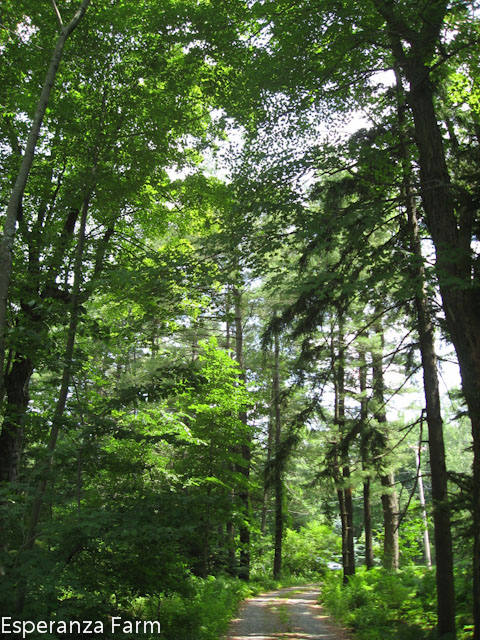
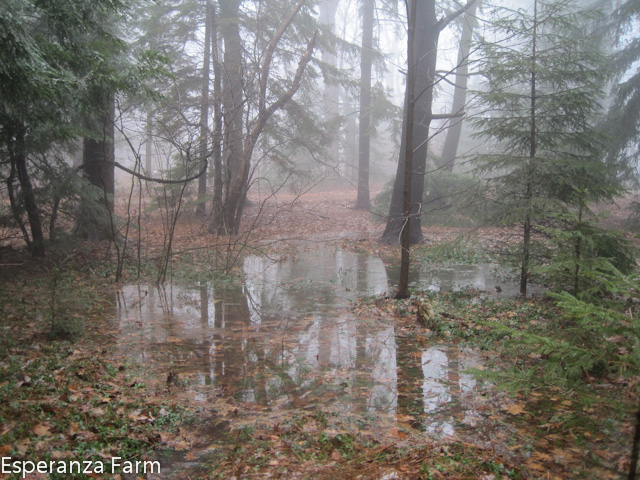
It is very complex section of the property, the description of which I won’t bore you with, but an idea is given by these photos which were all taken on the drive.  We obviously have the advantage of a century here for the large trees, but the strategic understory is a creation of the last decade. 

In the summer, the view from the drive entrance:

In the winter, looking out the drive from the pillars, at just about the farthest point of the drive in the summer picture. Here you can see how the barrier is still quite thin, the loss of one hemlock created that hole just to the right of the plow truck, the trees you see beyond are actually on the other side of the road:

And a view from in the woods, looking at the road but in fog, showing rather well the varied ages and spacing, much of which comes from nature being allowed to run its course:


*Mercifully, trees want to do this, forest edges form dense thickets, while areas under closed forest canopies tend to be open.  Transitioning the edge from ineffective, ugly and invasive Norway saplings to native, or non-invasive species, is a bit harder though.

‘I was here first!’* Friday, Feb 17 2012 

In a certain sense one can regard Esperanza, as deeply uncomfortable as it is, as a forerunner of the McMansions.  It was built as a second home, on a hilltop, with a commanding view, and is large…  The differences, of course, are a) it wasn’t built on an ingenious scheme of credits and mortgages but on hard cash; b) it was architecturally designed for its location; and c) the size comes from being designed to house a multi-generational family as opposed to DINKs (lovely acronym that).  It has also stayed in the same family for 140 years, rather than being abandoned after a decade for sunny Arizona/Florida.  Age creates respectability.  Or something.

Still, it was a little shocking today to realize that the people on the next hill over have cut down quite a number of trees, thus giving them and us entirely uninterrupted views of each other.  The property in question is a hay-field currently (it looks like they took out a hedgerow), but it could easily sprout a house or five.  This would be exceedingly unfortunate from our point of view, but my selfish side must wage war against my philosophical side: it is their property, and their right after all.   That I think it would be criminal to turn a ridgeline hayfield, a rarity these days, into houses is my opinion only.  (I’ll still whine) 

Might consider some strategic white pines…

* Or not, several generations of settlers, and several Thousand years of Native American settlement demolish that conceit.

Ease of Access Wednesday, Feb 1 2012 

Landscape design appears to revolve around the point of visual aesthetics.  However, as any good gardener, architect, stage designer, etc. can tell you function trumps beauty.  They can coexist, of course, as equals; but if it doesn’t work…you probably ought’nt build it.  

Well, ok, but what does that mean?  For landscape design around a house* it means several things: first, all sides of the house need to be accessible with a long-bed pickup truck: that means a path eight feet wide and at least eight (ideally ten) feet tall that is driveable.  No retaining walls, no low limbs, no shrubs.  The path can be meandering, but it needs to be there.  Why?  Because someday the roof will need to be redone and they will need to put scaffolding up.  You don’t need access to all of the side, but at least to a corner. 

Secondly, all garden beds need to be accessible with a small lawn tractor, they also need to be designed so that the radius of curves and the widths of the paths are at least the width of the lawn mower…not an inch less than the width.

Third, emergency vehicle access (also the same as UPS truck access).  Yes that may be a very pretty tree limb romantically stretched across the drive.  However, it will be a pain if UPS refuses to scratch up their paint job and drops the package on the roadside, it will be more than unfortunate if it blocks the fire engine.

There are other things of course…. 

But the above explains why I spent some time carefully trimming the River Birch, the climbing Euonymous, the Burning Bush, the Wayfaring tree, and the Cucumber Magnolia along the drive…in order that the UPS truck would cease its peregrinations upon the lawn…only to watch them stop by the road (at least they walked in with the package though).

* Please note, I am thinking a house of this size and complexity…a small bungalow or ranch may well be a different proposition.

Trace sign Tuesday, Jan 24 2012 

While working on a lecture concerning conservation for a garden club, I had occasion to consider soil types.  For many people in suburbia, the history of the ground has little reason to intrude upon their conscious.  The North American appetite for the bulldozer means that most house lots created after 1950 have been regraded with topsoil taken away and/or added.*  This tends to create a uniform surface, the whole lot is one type of soil.**

However, Esperanza has generally lacked in the bulldozer department and it also happens to have a rather large lot and a fairly complex history.  This history is recorded in the soil and does not vanish.  The soil is predominantely a heavy clay till with a good scattering of rocks.  However, there are other pockets. The old abandoned road-bed is a compacted sand/gravel mix, well draining and low in organic material, despite the surrounding area growing up to trees this road-bed remains open. On the other hand the two old tennis court areas demonstrate very different tendencies. The most recent one is a fast draining sand/clay mound created artificially and abandoned circa 1930, that has happily regrown as pine trees.  But the early one was a packed clay court, probably created simply by rolling the native clay, and it reverted to Norway maples and multiflora rose, both invasive species capable of dealing with that type of compacted clay.  It continues to be a difficult area to grow plants on, despite over a century of organic material having been laid down.  Elsewhere, the less disturbed soils tend to revert to oak and birch, with cherry, red maple, and cucumber magnolia also appearing.

And then in the hayfield…the two ploughed sections, the horse’s paths, they will probably continue to show up on Google Earth’s imagery for decades.


*yes, I actually saw one house lot where the builders took away the soil, and the house-owner later (no doubt at great cost) re-imported soil.  Someone’s genuis at work there.

**For those of us with a bent towards archeology, it is also somewhat worrisome: one bulldozer can, in a matter of minutes, remove thousands of years of stratigraphy, leaving one with a blank slate, no doubt appropriate for today’s culture.

Tile Drains Wednesday, Dec 28 2011 

Rearranging the drainage of land has an old history.  It was one of the hallmarks of the High Medieval period in northern Europe, opening up hundreds of thousands of acres of former wetlands for cultivation across France, the Netherlands, and Great Britain.  Creating drainage varies from the reclamation of land, taking impassable swamp, as it might be in the fens of England, and turning it into land that is consistently workable surrounded by ditches and dykes or it might be a matter of carefully choosing how to plough so that over time the land drains faster. 

North America also has seen the wholesale rearrangement of drainage.  One of the problems with New England was the combination of rock and water.  The Berkshire hills are a mixture of bedrock outcroppings, glacial debris, swamp, and the occasional hillside and valley of extremely fertile soil.  There is a reason why Connecticut farmers left in droves for the mid-western region in the 1800’s.  The Connecticut valley may have some of the best soil on the continent (now mostly buried under shopping malls) but it isn’t a large area, and the land in the hills requires hard work to even get a usable field.

You can, of course, find those fields.  We have an extremely good small hayfield of about 15 acres.  A west-facing, stepped hillside, the bedrock outcropping is some way from the surface and two centuries of cultivation have reduced the rocks (reduced only, if you plough it the average is about one fist sized or bigger rock per yard…every year).  But, it is also a good field because a big tile drain angles across the middle, draining the upper half.  The lower half has no such drain, and the lowest corner is permanently wet to the point where it cannot always be mown.  Head down the hill another hundred feet or so and the bedrock comes nearly to the surface. 

This drain was put in place sometime in the late 1800’s and takes mostly subsurface water, which would otherwise collect and stand at the bottom of the first steep section of the slope.  This would make about a third of the flattest section of the field unusable.  It is a tile drain, sections of terracotta pipe with open joints, beginning on the neighbouring property and daylighting on the lane where it joins the lane’s ditch.  Unfortunately, the joints have gradually shifted farther apart.  So, I spent today filling the gaps with rocks.  Why? Not for the tractor I assure you.  Rather, for the horse.  A depression might cause a stumble, a hoof-sized hole dropping down six inches to two feet…well, better not to consider it.  It isn’t a permanent fix, but it is better than it was!

« Previous PageNext Page »