Finally! Monday, Apr 29 2013 

This is an odd spring, very slow, cold and dry. The redbud tree, which usually dominates the east lawn from mid-April has yet to come into flower. On the other hand, the peas are finally up.
We are always the last on the hilltop for things to break bud. I rely on the star magnolias as a gauge, ours is two weeks behind the valley and almost a week behind the other two on the hilltop. The same holds for our saucer magnolia. It doesn’t really make sense, except to demonstrate how complicated the micro environments are. If we look at the saucer magnolias, ours is located on the north lawn in the garden. So it has western exposure, wind/sun block to the east, and is in part shade (almost full sun at the moment, due to the number of deciduous trees). It is also in heavy, wet clay soil in an essentially ‘unimproved’ setting (shrubs, perennials, uncultivated and undrained). The other two magnolias, belonging to a neighbour at the same elevation, also have the same western exposure. To the east they have a wind/sun block, but it is a house rather than trees. The magnolias are also in a heavily fertilized, manicured, turf lawn in full sun. The soil in that area has been improved, cultivated, and thoroughly drained.
Now then, what is the deciding factor? Is it the full sun? Is it that a modern turf lawn heats up much faster so the soil warms faster so the plant blooms that much earlier? If that is the case, then some interesting variables arise concerning heat islands and the commentary about plants blooming earlier than they used to….no question that they are a little earlier, but the accompanying questions are which plants, where, and what has changed in that location?

Eventide Tuesday, Apr 23 2013 

IMG_0296

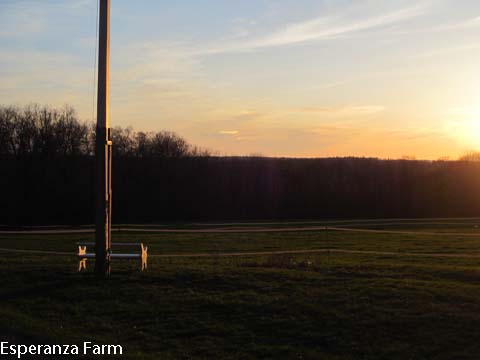
Late April evening at the flagpole bench.

Water Wars Wednesday, Jan 30 2013 

Nice, foggy, rainy weather….lots of water….the ground is frozen rock hard.   Entirely too much of that water is going to go running off into the rivers.  Actually, the rather interesting things, for those of us interested in this sort of thing, is that the ground is not frozen solid in the woods.  It is frozen of course, but it retains some ‘give’.  That is to say, anywhere with deep leaf litter has the capability to absorb the water connected to this warm spell despite the extreme cold that came before.  Lawns, hayfields, bare fields; those all might as well be impermeable bits of pavement right now.  Today there are no puddles in the woods, there are on lawns.*  There is also plenty of run-off from the frozen lawns, if there is any slant at all.  Eventually, of course, the sponge quality of the woods will be filled up and the intermittent streams will start to run; but it will take much more water to create an intermittent stream in the woods than one bordering a field, subdivision, or road.

We know that forests are better at recharging ground-water than developed areas.  The immediate assumption is that is solely due to the developed areas using the immediate water and having more impermeable surfaces such as roofs, patios, parking lots, etc.  But it is also due to the fact that forest areas are genuine sponges.  It would be interesting to do a storm-water comparison of two identical house-lots, with identical houses, and the only differences being that one has retained over half of its original tree-cover/topsoil and the other has it stripped to lawn.  I think the result would be sobering.

Water companies used to buy watersheds in this area to protect the water quality.  Inadvertently, and happily for all concerned, they have also helped to protect the amount of water available by doing that.   Of course, it still isn’t nearly sufficient; but it helps. 

Do water-wars exist in the east as well as the west?  Oh, yes indeed!  google: farmington, mdc, uconn, mansfield, etc. to see one in action.

*unless of course your lawn has decided to establish some nice colonies of what look like sphagnum moss, in which case the puddles disappear.

Forest? Monday, Jan 21 2013 

IMG_9862

This is a somewhat deceptive photo of perhaps one the most important features of the place.  From its purchase in 1872 Julie began planting trees in front of the house, between it and the then sleepy road.  She added to the already extant group of two Sugar maples and two Norways, with a grouping of Norway spruces, and a line of maples along the road.  By the 1880’s a commentator noted that it was going to become a ‘lovely grove’ in front of the property.  Such natural landscaping, while all the rage in the cities where the first great landscape parks were being created, was unusual in an area dominated by open fields, charcoal wood lots, and the picturesque but rigid lines of sugar maples along hedgerows.  Over the century this grove has gradually been bulked up with more trees.  And more distance.   And, of course, size: many of the trees are between 70 and 90 feet in height. The maple in the foreground was orginally planted on the road edge.  Mercifully, when the state highway was created in the 1930’s, it was moved away from the house.  It is actually visible in this photo, at the center back.  The road, like the house, runs north-south; this photo was taken looking directly northeast.

Today, this area, 500 feet long and between 40 to 100 feet wide, acts and looks like a piece of undisturbed forest.  Over time, some of the native wildflowers have recolonized it: starflower, trillium, canadian lily-of-the-valley, wood aster, princess-pine, etc.  Many of these have had help in first getting established, but are now genuine colonies.  However, it is aggressively managed: both in the removable of undesirable plants and the planting of new trees and shrubs to continue to block the road, to add to the wooded nature, and to ensure that in another century it might still look like a forest.

Late night snow Thursday, Jan 17 2013 

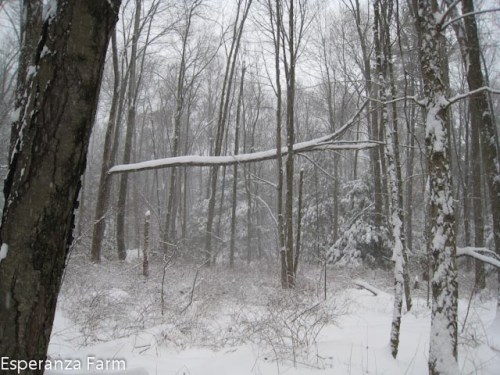
Yesterday’s little snowstorm was very elegant.  It was nasty wet weather, so its beauty is really only appreciable from the standpoint of being able to retreat to ‘warm and dry’.  But, about four inches of wet snow, sticking to all the trees makes for a lovely picture, especially this morning with the sun peeking out.  The ice on top ensured that it really Stuck.

It was also lovely driving home last night, the hemlocks and pines were great white curtains, arching over the road.  The crescent moon, low in the sky, had broken out of the clouds.  And while the landscape was a pale, white-blue; it was a sharp, shining gold arc in an ink black sky.

Blue hills Monday, Jan 7 2013 

The winter view from Esperanza is, as always, dominated by the low ranges of hills that roll off to the west, neither high nor dramatic but very much there.  Currently, the primary colour for the distant hills is a deep purple brown.  On a day such as this, with light clouds, this blue colour is offset by sun spots.  In the distance this colour is a brown-silver, on the closest hill the snow beneath the trees makes it almost white.  When the sun comes out fully, much of the blue colour will vanish, but not all and shadows will outline the hills.

This is very different from what it would have looked like a century or more past.  It is the trees that impart those colours, those shadows, and the sense of depth.  When the trees were not there, and all the hills were fields; white would have been the dominate colour.  Even with the oddly shaped fields, a more geometric and sharper landscape would have appeared.  Quite interesting, no doubt, but quite different! It also had a much bigger view, Esperanza’s hedgerows were shorter; today hills to the north and south are completely hidden, as is the first small hill to the west, all were very visible a century ago.*

In a century….houses I suspect.  A discussion to do some major cutting and then replanting with pine along the bottom property line of the house lot in order to avoid being able to wave at more neighbours sometimes arises.  It would be a rather dramatic change…not that those discussing it would be alive to see the end result of course!  Which perhaps makes it a weightier decision.

*It’s awkward, I am realizing that the shorthand of ‘century’ doesn’t work for some things, but writing ‘a century plus’ doesn’t have the same ring.

*The eastern view (which if you are a squirrel you can see from the top of biggest Norway spruce)  vanished by 1880: Julie added to the maples and Norway spruces already in place, and photographs show that the house’s eastern front was already largely hidden by trees by that time.  Today, trees and houses to the east ensure that it is entirely hidden.

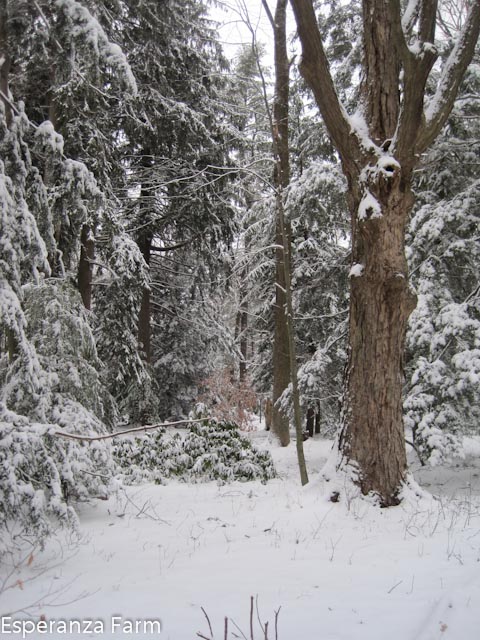
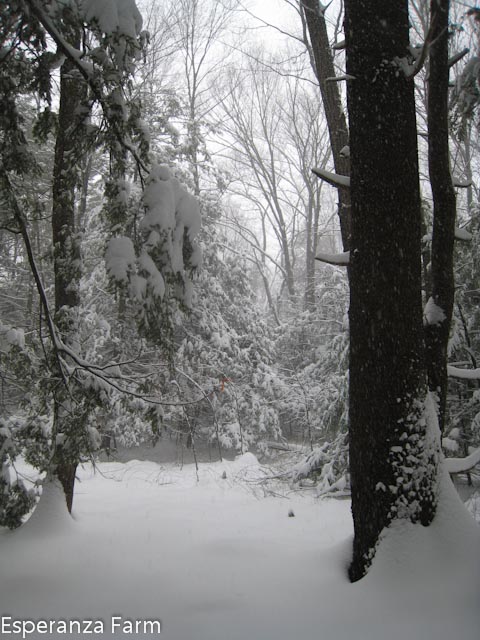
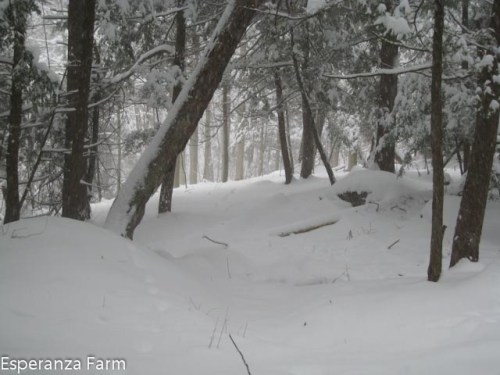
Connecticut woods in winter Monday, Dec 31 2012 

IMG_3951


IMG_3958


IMG_3964


IMG_3965

Fall colour Friday, Sep 28 2012 

I’ve never quite figured out why leaf peeping is big business, though it is always a major conversation topic even amongst those with no aesthetic or financial interest in it.  Odd.

Still it is a spectacular sight!  This year the ashes just sort of dropped.  Some years, they are beautifully shading of purple/bronze amongst the still green maples.  The black birches are coming into their own though.  The two behind the big garden are a glorious golden canopy.  The woodbine is starting its creeping blaze, see yesterday’s photo.  The big woodbine will eventually turn the interior of the eighty foot hemlock by Minnietrost scarlet.  A few red maples have started to turn, a dull silvered red.  The silver maples are picking up caramel highlights.

Of weddings Sunday, Sep 23 2012 

Esperanza has seen several family weddings, though none in living generations.  It has also seen its share of funerals.  Equal measure.

From September 1906, a newspaper clipping describing the wedding of Lucy Morris Ellsworth and George Mason Creevey:

“One of the most elaborate out-of-door weddings to take place in this State that has taken place for some time…Lucy Morris Ellsworth, daughter of William Webster Ellsworth of the Century Company of New York, was married to Dr. George Mason Creevey of New York. The wedding took place under the trees fronting the house on Esperanza Farm, Mr. Ellsworth’s summer home….. (genealogy)…(guest list)…the wedding was perfect in every detail. The house was draped with greens, with here and there decorations of goldenrod.  The trees were hung with gaily coloured ribbons of many different hues. An orchestra occupied a retired spot on a side veranda and furnished the music. The ceremony took place in a small wooded bower, twenty bridesmaids lining the pathway from the house….

so forth through a description of the dress, list of bridesmaids, gifts etc.

The bower is still there in part.  Of the two massive Norway spruces that made the front frame, only the south one survives at 109 feet in height.  Beyond though is a veritable cathedral grouping of several more Norway spruces and pines, all at well over 80 feet in height.  Now if only I could get rid of the road…


Running to the Sea Friday, Aug 3 2012 

I grew up reading Holling Clancy Holling’s spectacular books that detailed the story, both natural and man-made, of the great rivers of North America and of the sea.  The influence of those books was greater than I realized. 

Writing a comment on a local paper today about the Maple Hollow (also known as Stub Hollow) brook made me think.  I know that the water on this hill will flow down to the hollow, past Stoney Lonesome pond, past Brad’s pond, past Gray’s pond.  There in the floodplain swamp of red maple it will join the Nepaug River, then the Farmington River, then the Connecticut River, and then at last the Long Island Sound and the Atlantic, shining grey beyond the sand dunes. 

Of course, most of it will probably be diverted from the Nepaug reservoir to serve as drinking water for Hartford and the surrounding towns.  But still, knowing the water’s course gives me a connection to something indescribably beautiful.

« Previous PageNext Page »