Meditations on late summer Thursday, Aug 16 2012 

From a letter by Julie to Morris, written in 1846 when she had returned to Brockport and he was in NYC:

“While you have been wandering and toiling in search of pleasure, I have found it in study and occupation and I have been happy. Time has trodden softly, so softly that I have scarcely heard his footfalls; and did not the lengthening shadows and whispering leaves whisper to me that summer was leaving hence her treasures? I could scarcely believe that her gentle mission was accomplished. But so indeed it is, and soon we mortals must look for cold and storms to take the place of soft sunshine and calm twilight. But first shall come glorious Autumn with his gorgeous coloring and rich fruits, we will rejoice in the good and forget the evil.”


Letter reading Saturday, Aug 4 2012 

As most readers of this blog know, Morris Smith and Julie Palmer met in 1842 and were engaged in 1848, remaining married until her death in 1883.  Throughout their lives, letters formed the backbone of a relationship that was truly a long-distance one for over a third of the time.  Generally, there are gaps each summer in the letters; which is frustrating for the historian as a great deal must have happened.  However, a more frustrating gap is caused by several missing letters from 1847. *

In 1846 Julie left New York City, returning to Brockport.  Morris remained in NYC.  Two years later they were engaged.  Yet, this is where the art of reading between the lines becomes tremendously difficult.  We have about twenty letters from those two years when they never met in person, but are missing two to four.  These long letters are filled with discussions about, and requests for, books, as well as descriptions of activities and discourses on philosophy.  They are also entirely opaque.  Morris was struggling to build a business, at age nineteen, but was also plagued by health problems, with his doctors telling him he wouldn’t make thirty, he repeatedly and adamantly says he will not marry (and is clearly not considering Julie, or at least appears to not be considering her).  Julie, with many veiled remarks, hints at a serious relationship, if not engagement, with another man who can only be tentatively identified.  At the same time Morris and Julie carry on a correspondence which spirals from platonic love to outright vitriol* and then somehow ends in their engagement.

Those missing letters appear to be the ones that fall exactly on either side of the lowest point in their relationship.  Naturally.

*Ignoring the gap created during a certain historical event between 1860-65…one person living in New Orleans, one living in Hartford, writing back and forth constantly…and not a word on the affairs of the day.

*Vitriol: Julie writing: “Now you are greatly more deficient in penetration than I believed if you really think I wish you to write to me or feel for me any love, save such as a brother might for a sister… (2 scathing pages)…Remember if you wish me ever to write to again you are to answer this by the next post.”  (Morris doesn’t write by the next post, in fact his next letter is nearly three months later, and completely ignores this one…which is one way of dealing with it.)


Road Trip! Tuesday, Jul 31 2012 

From Nov. 1916 as reported in the New Hartford Tribune:

“Mr. P.J. van Loben Sels, of Oakland and Vorden Ranch, California arrived in New Hartford on Monday, November 12th, after an automobile journey alone (and he is sixty-five years old) across the continent. It will be remembered that Mr. van Loben Sels’ son married Helen Ellsworth, a daughter of Mr. and Mrs. William W. Ellsworth of Esperanza Farm on Town Hill….

Automobilists may be interested in the statistics of the trip…The journey was made in a light Buick six, latest model…From Oakland he went north to Seattle for the sake of the scenery, then east over the generally poor roads of Montana, North Dakota, and Idaho, sometimes being obliged to shovel his way through snow a foot deep on the level, with six or seven feet in drifts. And this in October….

The gasoline cost was 2 cents a mile, about 13.5 miles per gallon*…Within ten years, perhaps four or five, a transcontinental journey in an automobile will be a very common experience.

Mr van Loben Sels will sell his car and sail to Holland on the 21st….”


I may say, I would have liked to know P.J. van Loben Sels.  Anybody out there who wants to tell me anything?

*What great strides we have made, not.

Broader context Wednesday, Jul 25 2012 

in lieu of content, for those interested in the surrounding region’s history, do check out my other blog, updated weekly:  http://newhartfordcthistory.org/blog/

There is no excuse Saturday, Jul 14 2012 

for not knowing.  Out of curiosity I looked up Walter Booth Adams, he of the random guest-book entry.  What would have been a nearly impossible quest thirty years ago, took only the time required for my search engine and computer to respond. 

Born in 1864, he graduated in 1890 from New York University.  From 1890 to 1924  he was a professor of pharmacology and dermatology at the American University of Beirut and helped establish at least some other medical posts in Syria.  He was also a Freemason and given to writing occasional poetry about the landscape of the region.  He died in 1928 in Syria.  I also found a portrait and information about his parents, son, etc.

Of course…what I did Not find was his connection Esperanza.  Was it through medicine and New York University? He would have known George Creevey from that, possibly quite well.  Most likely.  Less likely, was it through his poetry and his experience living and working in the mid-east, two of the great loves of WWE? Or, what?

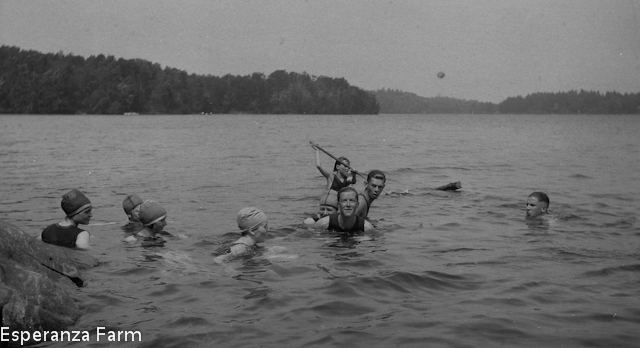
Swimming at West Hill Pond Monday, Jul 9 2012 

Until the big water company reservoirs were built in the 1930’s, New Hartford had only an assortment of small ponds and rivers to swim in.  Greenwoods pond served the town center admirably; it was a large mill pond (really at two miles long it was a lake) created by damming the Farmington River.*  There were other assorted mill ponds throughout town and deep curves of the Nepaug River, swimming holes in fact.  However, there was also West Hill Pond.  Although a dam added height, this was and is a natural pond of substantial depth.  Spring fed it is very cold and very clean, even today.  Pre World War II, there was almost no development on it (there is now!!).

The lake is on the next hill over, and a series of roads has linked Town Hill and West Hill since New Hartford’s founding.*  Until the early twentieth century there was a very direct road, since abandoned.  But even today along several twisting roads it is an easy ride with a horse.  Until the 1950’s/early 1960’s, Esperanza owned two large pieces of the shoreline: ‘Boys and Girls Points’.  These pieces were given to the Boy Scouts’ Camp Sequassen and remain part of the camp today.  Until that time, camping and swimming at West Hill featured prominently in the summer activities.

I can only identify the person paddling past on the log in the background: Eileen Creevey Hall.  The photo is circa 1920-23

*Greenwoods pond vanished entirely in March 1936: a flood took out the dam, which was 32 feet high and 200 feet long); along with the pond went a good chunk of the town.

*Yes, there is an East Hill!


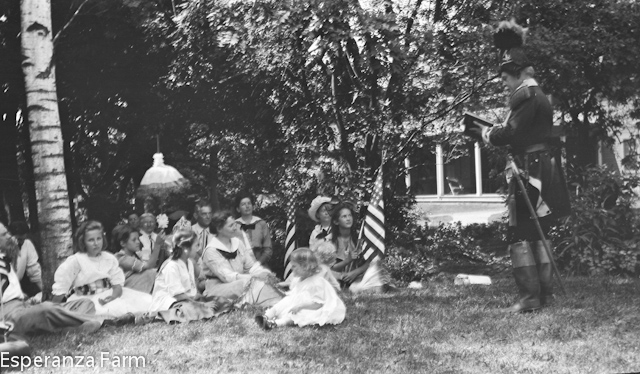
July 4th, 1913 Wednesday, Jul 4 2012 

Celebrating the Fourth in 1913, a reading of the Declaration perhaps?, in an antique uniform, sadly since vanished (except for the sword).  Who all is involved, I couldn’t quite say.  However, the moustache strongly suggests that the reader is William Webster Ellsworth.  He would be the natural choice, as the family’s elder statesman, a gifted orator, and descendant of those worthy Wolcott, Ellsworth, Webster…ad infinitum. 

I do like the parasol.  The house is just visible, today, where they are sitting is a shady garden bed.

From the Guestbook Monday, Jul 2 2012 

Esperanza had, during the late 1800’s to pre WWI, any number of guests; happily, they also maintained a guestbook.  These books are a treasure trove of commentary, signatures, photos, and sketches.  The sketches are usually done in the style of the time: half-caricature, half-line drawing.*

Two entries, from a random page:

“Walter Booth Adams,

Syrian Protestant college, Beyraut, Syria

‘Coffee equal to Syrian coffee, what further praise can I give to the good dinner?’


Adelaide G. Richetts

‘Who came to Esperanza Farm June 10th 1899, carrying a cane and weighing 110 pounds. She left August 3rd, said cane in the bottom of her trunk and her weight was 132.5 lbs. ‘Nuff Said.”

*The only example of the style I can put my hand on is the illustrations by Jean Webster, in her books Daddy LongLegs and Dear Enemy…published in 1915, not much help there.   Jean Webster did visit the place.

On kitchens Sunday, Jun 24 2012 

From the recollections of my grandmother, Eileen Creevey Hall, who was the great-grand-daughter of Julie P. Smith, whose letters I often take excerpts from.   Eileen grew up spending summers at Esperanza, along with Carlotta and Kennedy, her two siblings.  The following events are from the 1910-1925 era.

“There was only one part of the house which was strictly off limits to us. That was the area south of the dining-room door which led into the domain of The Cook. No children to run about and get in her way! And no wonder! She was responsible for three full meals a day, plus the tea. As there often ten or more people in the dining room, and four maids, and a coachman to be fed, you can easily imagine that she was completely occupied all day.*  The big iron range was never cool and it must have been a difficult job to do all that work. And we had to be prompt!”

The kitchen is on its third or fourth iteration since 1893.  The big iron cook stove is long gone, unless it is the thing lurking in the basement?,  the kitchen put in by Eileen’s mother, Lucy, post WWII lasted with only some changes to the stove and fridge until c.2004.

*Often more; that count only included the ten people who stayed all summer on a routine basis, it didn’t include other guests who might stay anywhere from one night to several weeks.

‘Always there has been singing’ Friday, Jun 8 2012 

Excerpt from ‘The Story of Our Esperanza’ by Lucy Creevey, 1959

“There is another picture in my mind. I have thought of it so often. Clara Louise Kellogg had come to New Hartford and she and her husband built a lovely house on a hill near the village. She was having a house-warming, and of course the Esperanza house-party was invited. And of all the vehicles in the barn, they chose to drive down in the two-wheeled ox-cart. Mr. Rood drove up to the mounting block with his immaculate team of oxen, Berry and Bright. The cart was painted a beautiful cerulean blue, and scrubbed to the last inch. A framework had been built from which dangled a dozen Japanese lanterns, ready to light their homeward way. The Esperanza people climbed in with much laughter. Mr. Rood flicked at the oxen, and they pushed into their yokes and swung off. I remember that the little brass knobs on the ends of their horns reflected a quick gleam of light from the setting sun. I watched it all spell-bound. The cart lumbered along with its unusual burden, and just as they disappeared over the brow of the hill I heard them swinging.”

This was probably in the late 1880’s, when Lucy was around ten years old.  Clara Louise Kellogg was one of New Hartford’s more notable residents.  The Kellogg’s were one of the oldest and largest families in town, Pine Meadow (one of the small villages) was originally Kelloggsville.  They had owned and farmed numerous tracts of land throughout the town, including a portions which would become parts of Esperanza and Yellow Mountain, and had also run several taverns and inns.  Clara was an opera singer, and one of the first American sopranos to earn acclaim in Europe.  No small feat.

Mr. Rood and his family ran the farm from the 1880’s into the early 1900’s.  The Rood children were schooled alongside the family in the summer, and there are a number of pictures of them together.

« Previous PageNext Page »