After the tennis game
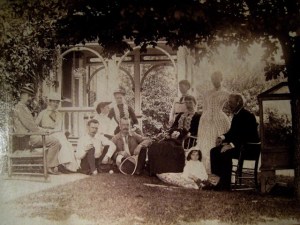
This is one of ‘those’ photos wherein identification is difficult. The man seated on the far right is Morris Smith, Julie’s husband; interestingly, he almost always appears in photos seated and in profile, he clearly didn’t care for informal photographs of himself. The woman seated in front in the dark dress is Carlotta Norton Smith, with a hat in her lap. Beyond that, things get difficult. The guest book does tell us that in the few days before the 14th, William Gillette (of Gillette castle fame), Helen Foster (a close family friend) and two men with the last name of Bartlett, one from Hartford and one from New Orleans so presumably business associates of Morris or friends of Carlotta, came to visit. It doesn’t tell us how long they stayed. And there were any number of other people visiting in July of that year according to the guest book….no doubt if I work at it, I will figure it out a bit more…sort of like those infernal puzzles about the girl in the blue house has pet x and the boy with the dog lives in the house of y colour. (all of which assumes the date on the negative is accurate)
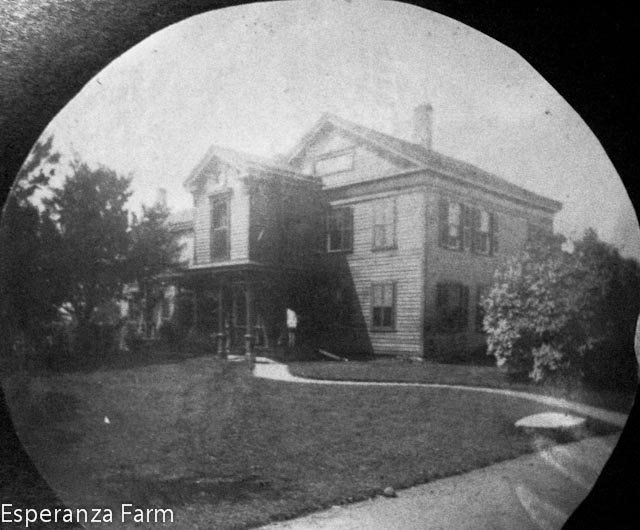
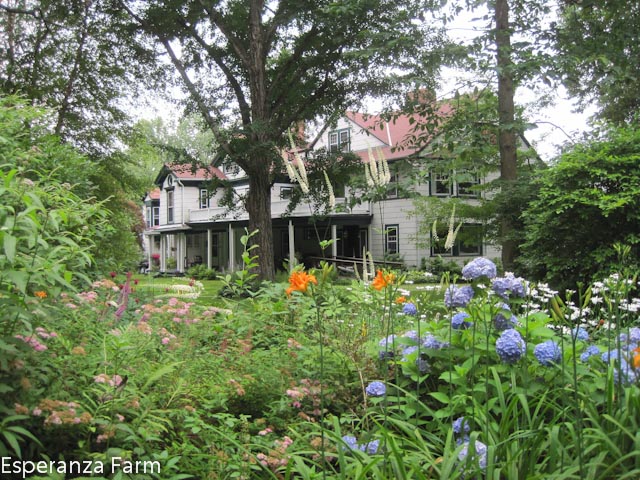
So what else? Well, corsets, bustles and hats were clearly in fashion. Women’s hair was always up. Tennis was played with a tie on. Note the terrarium on the right, a wonderful Victorian piece of furnishing. Note the impeccable edge of the path and the lawn… Now, where are we? Believe it or not, they are sitting just about where today the grill is just outside the dining room, where the current east porch narrows. The porch in the photo is Queen Anne style, and was added in the 1870’s. It appears to have been at least two different colours, though what we don’t know.* The porch and the room above it were extended out and above the old, original farmhouse entrance, which was a very simple Greek Revival house.* The Queen Anne porch had a short life, in 1893 the north ell is built and the east facade gains its current appearance with classically inspired square pillars without ornamentation on the nearly full length porch. The tree is long, long gone. It looks like it was a member of the buckeye/horse chestnut family. Since then an elm, and now a Japanese maple have occupied that spot.
*The choices include Pink. Slightly unbelievable, but one of the cottages was originally painted in pink and cream…
*This is one of the headaches of the house’s history. It appears that the facade when they bought the house in 1873 was Greek Revival, an architectural style which is generally dated as beginning around 1825. However, the deeds and interior evidence firmly date the house to 1805-1810 or 1790-1800. Why two dates? Well, an 1805 deed doesn’t mention the house, an 1800 and an 1810 deed do. So? Why is the facade wrong for the date of the house? What is wrong with the deeds? Something, somewhere is askew in the history.
4 Responses »


 Acair Fearann