Watching the Game Saturday, May 4 2013 

1920c013

early 1920’s. The tennis court doesn’t look like that anymore (which is fine, none of us play tennis). For the plumber, note the spigot there in the lower right, now which mystery pipe do you suppose That is?
The only positively identified individuals are the three closest: George Creevey in the rocker with the most impressive pipe, William Webster Ellsworth with the white moustache, and Eileen Creevey closest to the camera on the bank (shorts and glasses), the boy looking at the camera might be Kennedy Creevey, but he could easily be the boy looking away too.
I should add, that according to the series, the people playing tennis also dressed in the same fashion, actually one has a tie and a hat on…

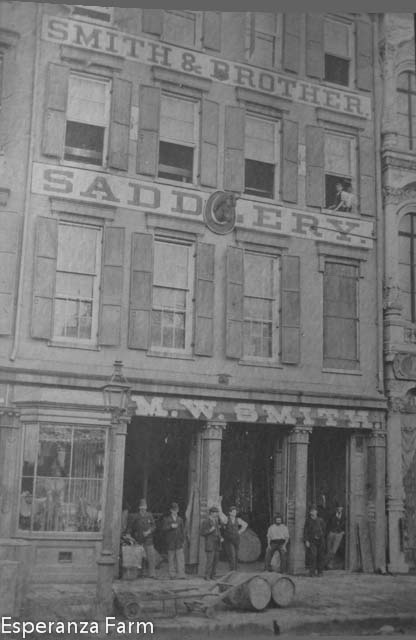
84 Canal Street, New Orleans Saturday, Apr 13 2013 

I have periodically mentioned the New Orleans connection. Morris Smith’s other headquarters were located in New Orleans from the late 1840’s through the 1890’s. Subsidiary stores were in Tennessee and Kentucky. Hartford seems to have been the only New England store.*
Morris never owned a house in New Orleans, when the girls joined him down there they took rooms; but otherwise he stayed either with his partners or at the office itself.
This is the only known picture of Morris’ store, the date is unknown:
IMG_8963

It Does Not look like that anymore!

*I have yet to do any research on the company, which is a pity as the little I know is fascinating. For all I know there is loads of information somewhere, but not here.

Photo of the day Sunday, Mar 31 2013 

Actually, quite an old one, and a scanned print.  The bedroom in Happy Thought, with daffodils. 

happthought1

Children at Play Thursday, Mar 21 2013 

1911001093

August 1911. I suspect that the baby on the sled is Eileen Creevey Hall at about a year old.  The girl is Carlotta Creevey, the boy with the hat is Kennedy Creevey, the other boy is unknown.

The building in the background is Happy Thought.  It still has at least the pump for the old well, the odd little rectangular object.  It is interesting to note that the drive is not gravel at this date.  The chair was clearly regularly used on the lawn, you can see the runners to avoid the legs sinking in. What looks like a large birch tree is not; it is the big central oak on the lawn (the shadows are odd).  The very dark trunk just visible on the left is one of the big maples, they are long gone; but about where that one is there is now a young beech.

Summer Games Thursday, Jan 3 2013 

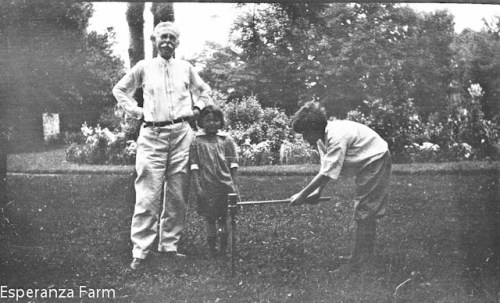
1905D001029

Circa 1915-1920.  Kennedy Creevey setting a croquet stake; Eileen Creevey and William Webster Ellsworth (Eileen’s grandfather) watching.  On the North Lawn, I think it is about where the ‘little’ Cucumber Magnolia now stands.  The flower garden in back is still, or again, a garden.  The gravel path, however, is long vanished.  Playing croquet on that lawn takes a bit of skill these days, tree roots and nearly a century have turned it into anything but a flat surface.

(I haven’t a clue as to what the white rectangle in the back left is)

Still not an off road vehicle Friday, Nov 16 2012 

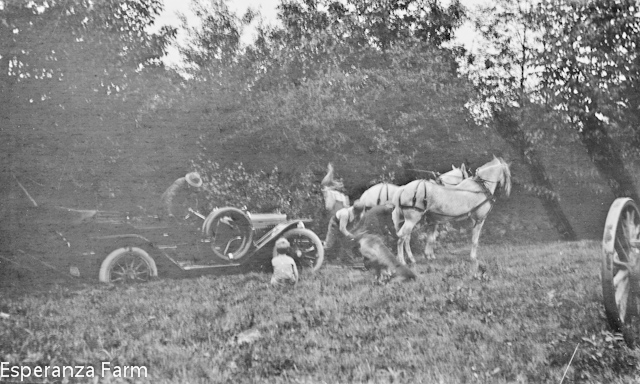
Another picture of the first car getting well and truly stuck, August 1911.  The young boy is Kennedy Creevey, the blur to the right is actually a dog (the Great Dane Nero).  Same team of horses, looking a bit put out this time around.  Of course, the car is looking a bit more stuck too…

Not an off road vehicle Monday, Nov 5 2012 

August, 1911. I can’t happily identify which field that is; however it is the Esperanza farm team to the rescue, so it must be nearby.  Possibly one of the fields below Eaglesnest.   Which is a Long way from the road!  In any case the car is definitely from Esperanza.*  I suspect the man with the pole is Mr. Rood, the farm’s manager.  George Creevey is probably the man in the suit coat.

*There are lots of pictures of it from that year,  several featuring it stuck in various spots…

Concerning daguerreotypes Thursday, Sep 13 2012 

In today’s digital world, photographs of people are as ephemeral as the time of their taking.  Images are so common that the majority have little intrinsic meaning or value.  For Julie and Morris, images of the people they loved had a very different value.  They were rare, and given as tokens of affection and remembrance.  Ownership of the image was shared, the person might take it back if the relationship soured.  Because of the physical distance between Julie and Morris, images play an important role right from the beginning. 

In the course of their letters, they discuss miniatures painted on ivory and the daguerreotype, which had entered the stage in 1839.  It was still a very uncertain process, however, and rare.

In 1848, Morris writes: “Speaking of pictures puts me in mind of my daguerreotype. I have had four taken in my life time besides the two you have, and of those four, not one remains perfect. By some chance they have all come back to me and every one has been spoiled and discoloured by the air. I hope that those you have have not suffered a like fate. Yours is as when first taken. I wish that some more experienced artist would visit Rochester and make it his abode, that we might procure more perfect ones.”

I have not examined our collection of daguerreotype, but it is possible that those early ones still exist.  If ever there were miniatures on ivory, they have vanished, however.  I do find the Rochester reference an amusing foreshadowing.

1911 Dump cart Wednesday, Sep 5 2012 

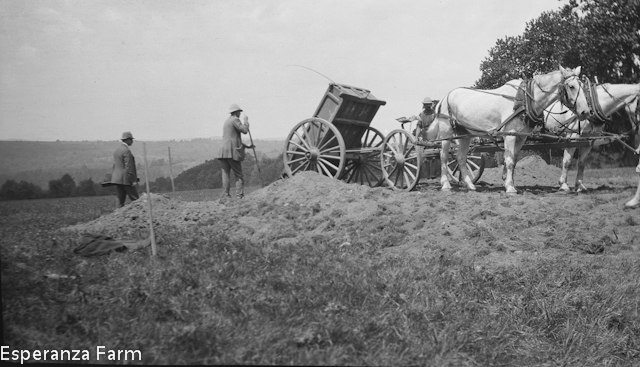
Building the tennis courts (now a nice pine grove, if entirely too well draining soil).  The team is the farm’s work team, probably Percherons or primarily of Percheron stock.  The cart appears to have a rather ingenious design: the actual dump-cart is balanced on the back wheels, which is actually a trailer.  It must have been very maneuverable, if tricky to load.  The wheels are wood, with iron frames and hubs.

Note the rather nice view over Beeney and West hills, the trees in the west hedgerow now obscure almost all of this view.  Note also that the men are wearing coats and hats, despite doing hard work in the full sun, in late August!

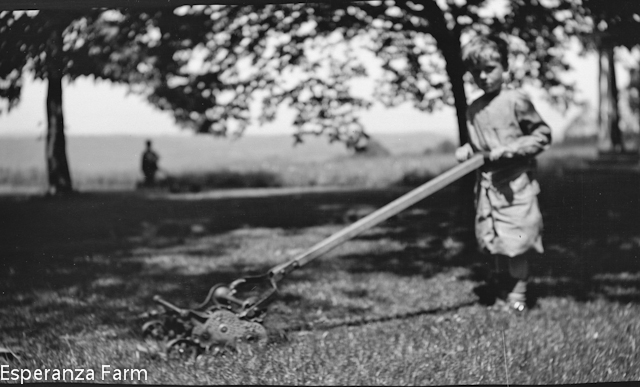
Mowing the Lawn, 1911 Thursday, Aug 23 2012 

Sadly slightly out of focus; but probably Kennedy Creevey mowing the north lawn or at least trying to. While we still have another reel mower of the same vintage, the one in the photograph is no longer around….looking at it, I can’t say I mind…

« Previous PageNext Page »