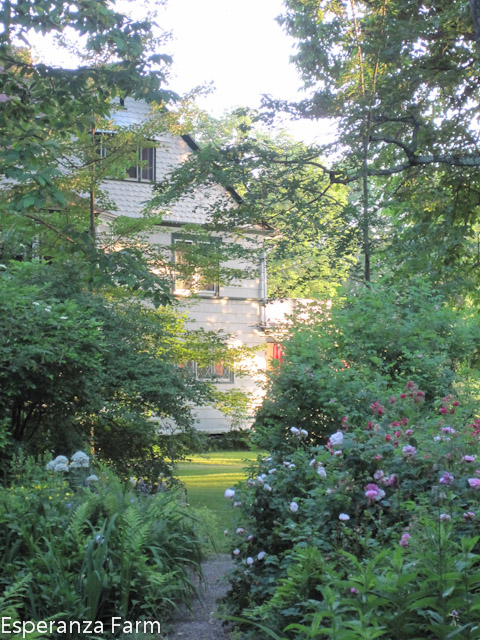
(or, down A garden path…multiply by ten around here…) The white/pink flowers that are visible are all old centifolia roses, no younger than 75 years of age. Scale is difficult in this photo, but the house peak is about forty feet, if that helps.
gardening and Modern Photos gardening, photography 20:45
(or, down A garden path…multiply by ten around here…) The white/pink flowers that are visible are all old centifolia roses, no younger than 75 years of age. Scale is difficult in this photo, but the house peak is about forty feet, if that helps.
In lieu of content.
Thanks to the weird spring we had, the flowers are all blooming fast. The ‘Fourth of July’ rose, a bright red floribunda rambler of unknown parentage, is nearly finished and will be done before the Fourth of July. The Goatsbeard, a July staple here, is nearly done. The Shastas and Snakeroots, which should be July-August will be starting soon.
So:
Straight orange daylilies (the ditch lily), cultivars and doubles will be starting in a few days.
June lilies are finishing
All of the roses: rugosas are almost done, the centifolias have peaked, the David Austin varieties are starting
Astilbes are going
Lady’s Mantle
Campanulas, all types
Ozark/Evening primrose
Nepeta Nepeta Mint
Delphinium
Ox-Eye daisy
Pinks
Blue-eyed grass
Milkweed
Cranesbill Geranium
Brown-eyed Susans
Blue Flax
Salvia
Scabiosa
Foxglove
Morning Glories
Nasturiums
Bread-seed poppies
Bachelor’s Buttons
Red Hawkweed
Yarrow
Adenophora
Clematis
Elderberries
Hydrangeas
Numerous others I have forgotten…
Comments Off on What is blooming?
gardening and Modern Photos gardening, photography 20:40
Comments Off on Centifolia Rose
gardening and Landscapes gardening 17:34
Fireflies are a particularly cherished part of summer, possibly more so on the eastern coast of North America, possibly because of some unformed, vague memory of a novel I once read. Nonetheless, the June nights when the moon is sailing high and the field grass whispers silver and green; in that rich darkness, fireflies float, pinpricks of light. The light is nothing like that which we use, it is the white-green phosphorescence of fox-fire, lightening, and fireflies, the light of the unknown world, of magic and of wonder.
Fireflies are actually not all that good looking in the light of day, but at night… They are also increasingly rare. Fireflies need tall grass, goldenrod, and that host of meadow plants. Leave a section of lawn unmowed, and the chances are very good that in New England, at least, you will have fireflies. We are experimenting with leaving sections of lawn as meadow, as a form of visual structure, that the fireflies benefit is a pleasant benefit.*
*and the bats, the butterflies, the moths, the birds…but you know my opinion on Chem-lawn…
Comments Off on On Fireflies
I have been staring at a particular view of the garden recently trying to figure out what the colours brought to mind, I knew it was something but couldn’t place it. A trip to the grocery store finally resolved the question: orange sherbet and black raspberry ice-cream. Say what? Well, there is a nice backdrop of doublefile viburnums, a good pure white now fading towards ivory; two Exbury type azaleas in front, one yellow/white and one the exact shade of orange ; and in front of that a border of Dame’s Rocket, the shade of raspberry ice-cream. a pity the scheme won’t last more than a day or so more; it isn’t patriotic, but it sort of fits Memorial Day and the promise of summer.
Comments Off on Sherbet!
Well, yes and no. It does as far as the human mind is concerned. On days like this, when the wind carries the scent of honeysuckle, viburnum, lily of the valley, and a thousand thousand growing things; when the sun is warm but not yet hot; when the birds are singing hard; when the light has a vibrancy that makes every flower, every blade of grass, every leaf glow….then the camera lies. For days of glory, there is no record but the soul.
Comments Off on The camera doesn’t lie
Lawns, and the mowing thereof, are a cherished American tradition.* Esperanza has Lawn. Lots of it. It had more, but I am determinedly shrinking it. However, Esperanza’s lawns would be a nightmare for any lawn care company or a dream come true for any chemical lawn care company. Why?
Two reasons: first, at no point does the lawn conform to a nice steady mowing pattern. It is composed of low-hanging trees, rising foundation walls and roots that can only be driven over in one direction, wildflowers to cut around, sections that are mowed on a different schedule, steep banks…
Second: only about 60% of the lawn is lawn. The rest is: speedwells, creeping jennys, moss (oh the horror!), gill-over-the-ground, bluets, violets (at least five types), Indian paintbrush, daisies (English and Ox-eye), pussy-toes, native sedges, buttercups, dandelions, wild strawberry, cinquefoil, barren strawberry, plantains, sorrel, thyme, and those are just what I can identify (and remember). Never mind the sections that have reverted to woods and are now dominated by wood asters, ferns, phlox, forget-me-not, etc.
Two large sections are only cut in late summer. Right now they are a blaze of red/purple grass with touches of dusky lavender (early English daisies), white bluets, pussy-toes, and a floating crown of pure gold from the buttercups.
What is interesting is that having these uncut sections actually makes the genuine lawn far more beautiful. The pure green ‘pops’, to use designerese, far better when set against such a background. Besides, we will have lightening bugs, phoebes, bluebirds, robins, swallows, bats…the list goes on.
*That lawns actually represent one of the biggest ecological disasters of our time is conveniently ignored. A monoculture of an invasive species forming a close to impervious surface carefully tended by tons upon tons of insecticides, herbicides, and petroleum.
Comments Off on On the mowing of lawns
gardening and Modern Photos gardening 20:15
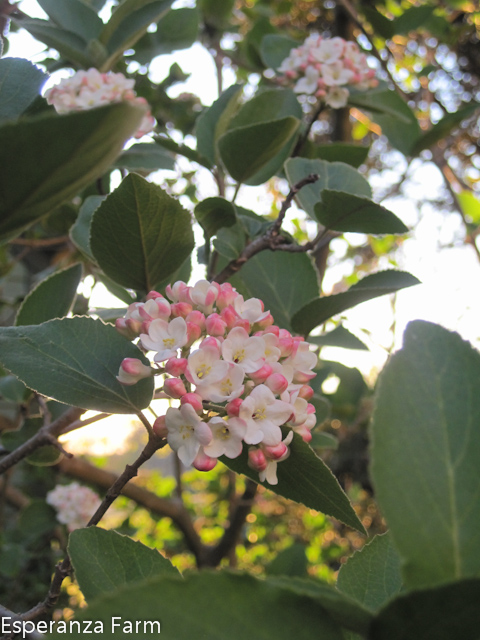
Carlesii viburnum in bloom. The shrub is full sized, at about fifteen feet in height; it is currently an arc of white blossoms against the moss-green of the cottage, Minnietrost, and in the evening (as in this photo) it is backlit by the sun slicing between the building and the big yew to the north. But such lighting only occurs in May and again in late September, both are times when the viburnum is at its peak, either in flower or foliage. A happy accident.
Comments Off on Carlesii viburnum flower
gardening and Modern Photos and Trees 14:55
For decades the north path wove its way past the garden shed, beneath the great locusts and hemlocks, and crossed into the garden between the great square boundary pillar and the twenty foot tall remains of the big cottonwood. The tree had been nearly three feet in diameter, after it fell about twenty years ago years the remant snag was left. Totally hollow, it fit the image of the slightly spooky, slighty romantic ruined tree trunk; the imagination could run rampant, maybe a parliament of owls, maybe a racoon family, maybe bats, weasels, snakes, maybe a person could hide in it? It was an elegant ruin, visible from several places in the garden, adding a sense of age, memento mori. In later years it was crowned by woodvine, crimson in the fall. And it was the woodvine, which held it together, that in the end probably pulled it over.
I went out the other day to find that it had toppled, quietly, without fanfare, falling towards the heaviest weight of the woodbine, away from the path. The shell had mostly crumbled, though it fell on soft ground. The largest piece, about a third of the trunk, had fallen on a young conifer; but it was so light and thin that I could roll it off the little tree, which had only been bent.
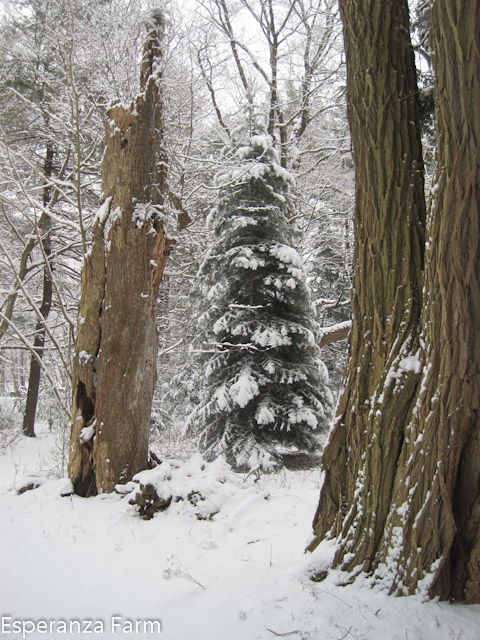
From the path, it fell to the right, the young conifer is behind the locust’s trunk in the photo.

You can just see the trunk, directly above the middle of the viburnum (white shrub!) in this picture.
Comments Off on All things end
gardening 15:32
Finally! A good soaking rain and the land has lost that sense of despair, of wrongness. Still short on water, but at least the soil is no longer dust.
I always find it frustrating, we don’t get many visitors, family or friends, and when they do come; they almost always come in either July or January. Entirely understandable given their schedules, but those are perhaps the worst months to visit. Either drab grey and cold or flat green and humid…..
But April and May….The daffodils are still going, mostly the late white ones now, the fragrant Peasant’s Eyes, Mount Hood, Sinopel, Princess Zaide; gleaming white with a touch of green. The clove currants, suddenly fragrant after the rain, are arching gold sprays. The apples are clouds of white blushed with pink; while on the other side of the house, in the woods, the redbuds and azaleas are almost too much pink, only the dark conifers balance them. Beneath them, the sparkling white trilliums, bleeding hearts, forget-me-nots, violets, and a thousand ferns unfurl.
 Acair Fearann