Diffuse light Wednesday, Sep 12 2012 

As part of the project which has me working on a rug, Jamie has been beautifully redoing the dining room floor (note: do you realize we didn’t take a ‘before’ picture yet again?).  This is a both trickier and less work than one might suppose.  It is less work than a modern floor for several reasons.  The first is that the boards, long, narrow tongue-and-groove; are rock hard and absolutely not in need of any sanding.*  Secondly, they are shellac floors.  This means that striping them is neither needed nor desired.  Clean them, rub them down with alcohol once or twice, and then a new coat can be put on.  It is tricky, however, because a shellac floor is very hard to get evenly reflective.  In an area such as the dining room, where low angle sunlight is common, and where the eye has a large expanse of floor to look across, any mistake or miss is easily seen.

However, the end result is a floor the colour of dark amber, not a solid colour but a shifting array of hues with a mirror shine.  This of course brings one to the diffuse light thing.  Mirrors are a well-known method of bringing more light into a room.**  I have observed with other rooms that once the floors are redone, the light level goes up: the floor bounces a warm light back up.  It will be very interesting to see what the effect is in the dining room.  It should be even greater than other rooms, because the ceiling is a smooth white plaster, unlike the other rooms which are painted or coloured rough plaster.

*He who sands old floors (beyond more than a light hand sanding to remove) ought to be summarily disposed of. 

**This can be taken to far: there was a memorable entirely mirrored, entirely round bathroom in Graz, Austria that I encountered.  It would have been too much at any time of day…never mind on a night out.
On rugs Monday, Sep 10 2012 

We have a peculiar assortment of rugs here.  The majority are lumped into the ‘oriental’ group with a scattering of others.   Originally, there were fewer.  As always, each generation perpetrated rugs, moved rugs in from other houses, and so forth.  The Keeping room floor was first covered only with a thin, green jute rug.  This was easily rolled up and out of the way to accommodate dancing.  At some point around 1920, the massive (14′ x21′) wool rug came, which is rather difficult to roll up, but then dancing doesn’t exactly happen much these days.  The Dining room has a large, elderly oriental but I strongly suspect (given the wear patterns on the wood underneath) that this room also didn’t have a rug originally.  In fact, I wouldn’t be surprised to find that rugs were generally only in upstairs rooms.*  As a summer house, with many guests wandering in and out at will, rugs in the big rooms downstairs would have been surplus and a pain. Without a vacuum cleaner, regularly cleaning (or even seasonally cleaning) any rug over 3’x5′ becomes increasingly hard; and over 5’x8′ you really need multiple hefty people, especially with the heavy but floppy hand-woven types.  Unlike modern, industrial rugs, hand-woven rugs generally have no stiff backing: roll them up and flip them over your shoulder and they happily droop…if long enough (or you’re short enough) they hit the ground.  This gets worse with age and wear.  I am working on an elderly oriental rug at the moment that I think I could tie in a knot if it was a bit longer.

*Of course, you end up needing a lot of little rugs…  Or, as is evident in two rooms upstairs you can opt for the early style of wall to wall carpet: long strips tacked or whip-sown together.  Or, everybody wears bed-slippers.

End of an era Friday, Aug 31 2012 

For their entire 110 years, the north basement stairs have stored the kerosene lamps.  Through the 1920’s, WWE would get up in the morning, collect the lamps, and then clean and refill them on the stairs.  The shelves and the stairs are covered in tin sheeting to avoid spills from soaking into the wood; originally the double-hung window was operable and would have provided ample ventilation and light.  It was a convenient, but discreet, location for a necessary task.  Since the house was electrified, the area has gradually acquired an odd array of spare fire-place tools, lampshades, vases, and mysterious glass containers of liquid.  Actually, three of those containers made of very pretty blue glass with cork stoppers and No markings are carbon-tet fire extinguishers.*  The fourth, a massive gallon jug claimed to be bleach, we decided that bleach had no right to be a nice dark brown.

However, we have plants, lots of plants, and no particular need for kerosene lamps.  Some of those plants need a good, cool place to overwinter: scented geraniums, fuschias, begonias, passion flowers…  And, frankly, we were all tired of navigating the stairs, highly breakable vases, and oddments with loads of firewood. 

And so, the kerosene lamps, their accoutrements, the fire extinguishers, and the purported jar of bleach** migrated to the cabinet that is built into/next to the little parlor’s chimney base.  This dry, dark, out-of-the-way location seemed to be a reasonable location for storing such things.  The odd bits of electrical fixtures got put with the other odd electrical bits.  The vases got rearranged on some safer shelves on the stairs, another shelf got built, and the whole thing got vaccuumed.  The hanging array of fire-place tools and oddments remains, as does the ridiculously sharp fire-axe.  I daresay I will fill the space with plants in no time flat…

*worthy of a post on their own, liquid carbon-tet is very effective at putting out fires…that it (if the fire is hot enough) can also create phosgene gas while doing so is a less desirable quality.

**what else can one do with it?  I am not dumping such things in a public watershed, even on dark and stormy nights.

Discoveries Tuesday, Aug 14 2012 

I think it is a good thing….I have discovered a box of letters.  (I know, not exactly a new item in this house)  If the inventory list that Eileen created for it is correct, and I have zero reason to doubt it, it adds a nice little bit.  They appear to be letters between Oliver Ellsworth and Caroline Smith primarily (so early 1800’s), with a number of others.   Also another box of letters by William Webster Ellsworth and Helen to various friends.  The Oliver Ellsworth ones are all in a painfully ornate copperplate style, on tiny sheets, and slightly moused.  Naturally.

and someone said once that most of the family letters no longer existed..

Sound travels Sunday, Aug 12 2012 

While this house is rather large and rather spread out, it is also remarkably easy to hear things in it… from certain places.  Upstairs, sound does not travel in between the north end and the center (never mind the south end) despite the short distance: this makes sense given the bent hallways and multiple walls.  It makes even more sense when one remembers that one of the walls in question was formerly an exterior wall containing a staircase.  On the other hand, in my room at the extreme north end on the second floor, I can hear the fire alarm above the washing machine located in the extreme south end in the basement.  Which doesn’t make sense right? 

Well, except that the basement going north is basically a long narrow box made of stone.  When it hits the north end it jogs around the old foundation wall (the same wall which is a former exterior wall on the second story), which would stop the sound, except…  The old hot air ducts for the forced air coal furnace are still in  place, but open at the bottom.  The sound is neatly funnelled into those and bounces on up to the second story quite neatly.

Now I suppose, that same alarm might not be audible in the center and south sections, despite being closer, since the hot air ducts are not in those areas.  I ought to experiment.

Useful to know the fire alarm will wake one up though.  Granted it took awhile since it was just a flat battery and not the full-on shriek.

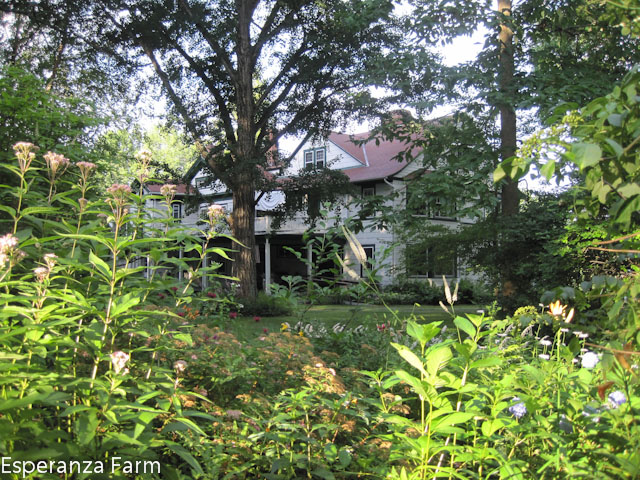
The house, hiding Thursday, Aug 2 2012 

For the gardeners, left to right: Joe-Pye Weed, Spirea, Monarda, Goose-neck, Cimicifuga racemosa, Shasta Daisies, Hydrangeas, (also Daylilies, Black-eyed susans, and Turks-cap lilies) are all visible.  The tree is a Gingko, about 110 years old, the closer trunk is a young (fifty years old) Cucumber Magnolia.

Perceptions of space Saturday, Jul 21 2012 

Esperanza is a large house.  However, it is also an old house and the size is sometimes deceptive.  There are a lot of windows, doors, interior trim, and immovable mirrors*, bookcases, or pieces of furniture.  The end result is surprisingly limited wall space.  This was brought home the other day following a visit to an artist in a very modern studio: cathedral ceiling and no interior trim.  In her space large paintings (3 feet by 2 or bigger) looked reasonable in size.  The same painting would be impossibly large in this house.  There isn’t the wall space or the ceiling height.  Yet, you don’t realize that most of the pieces of art are fairly small in Esperanza because they are in proportion to the house.  It is an interesting aspect to the problem of figuring out why something looks correct in one space and not another.  And why double-checking is always a good idea…

*There are six mirrors that are full height or more.  There are at least three other mirrors that are both large and critical for boosting light levels in rooms, plus various dresser mirrors…

Architectural definitions Friday, Jul 20 2012 

Sometime back I gave a rapid introduction to the house’s architecture: https://acairfearann.wordpress.com/2012/05/24/concerning-architectural-styles/

I am most amused, the tax assessor has given up on classification.  Queen Anne wasn’t correct, nor Shingle Style, nor Greek Revival….so…. ‘Antique’ it is!  I can’t recall encountering that as a building description before.  Furniture, yes, buildings, no.

On Roofs Wednesday, Jul 11 2012 

One of Esperanza’s signature features is the use of red roof shingles, everything except one side of the barn’s roof (corrugated metal) and the flat porch roofs (rubber) is done in red, asphalt shingles.  Matching the red is a bit of a job, we never do things the easy way.  But it is much more elegant and interesting than acres (not literally, it just feels that way) of black.

However, earlier roofs varied.  Wood shingles, ideally of cedar but not necessarily, were in use well into the twentieth century.  The 1929 inventory of all the buildings records another, somewhat surprising, interlude.  Most of the barns/outbuildings listed have wood shingles.  A few sections of flat roof were made of tin.  But Esperanza, Minnietrost (one of the small cottages), the farmhouse, the help’s cottage, and Appleby all had paper roofs.*  In the photographs it is apparent that this gave the buildings’ profiles a distinctly raw, unfinished look.  Perhaps more our modern sensibilities, since tar paper was a common roofing material at the time.  Unfortunately, I can’t determine either the color or if it was actually paper or felt that was being used.  I do wonder how long they lasted.  It can’t have been long, since I don’t have, I believe, any other photos that show that…but then I haven’t really looked.

*The farmhouse had been Satis Bene, by the time of the inventory it was no longer given a name, though the other named buildings were.  That half of the property, which included the massive dairy barn, several other barns, a creamery, and the help’s cottage was sold in the 1960’s.  It is now a winery.  Appleby was sold by World War II, it is now in disrepair, but is an elegant c.1800 farmhouse.  At the time it had an apple orchard, hence the name.

Brief Meditations on a Barn Tuesday, Jul 3 2012 

Esperanza’s barn, the barn that is still part of the property that is, is actually two structures: a purpose built horse barn and a standard, English style, barn now used as a garage.  The two are attached to each other, the dates are entirely uncertain.  The carriage/garage section could be anywhere from 1800-1875, without careful examination I wouldn’t care to guess; the horse barn (despite family lore) is almost certainly 1873.  Dating barns is hard, recycled timbers were the order of the day and styles for general purpose barns changed only slightly.

In any event,  having reason to wander in the horse barn, I amused myself by examining the actual structure.  It is a post and beam build, and a big one.  Three east-west beams carry the hayloft: at 48 feet long, and 8inches by 8inches.  The barn floor is carried by another three beams of the same length, but closing in on 12 inchx12inch dimensions.  There are a another set of north-south sills, close to thirty-five feet in length, plus two floors of joists: 38 to a floor, thirty-five feet long, three inches by ten…plus corner/side posts….and the sheathing, and the flooring…in no case can you drive a heavy and very sharp knife in more than two or three millimeters, even with one’s full body weight behind it.

You can’t build them like that today…

« Previous PageNext Page »