Some chronology Monday, Dec 3 2012 

Always useful…early chronology of Esperanza, before it was Esperanza.

c.1795-1800: the first property deed to mention a house on the site of Esperanza.  The first deed is 1800, but the interior evidence in the house suggests it was built in preceding decade….or the lumber was cut then….

1802-1832: the house (then just the center section built in a typical New England vernacular style) is owned by the Reverend Amasa Jerome, pastor of the Town Hill Church.

1832-1849: owned by Rev. Jerome’s widow, it may have been rented out as a farm during this time.

1849-1859: owned by Rufus Rood, during this time there is mention of a fire causing severe damage and then immediate rebuilding.  It was probably at this time that the core of the southern extension was added.  Remains in use as a farm.

1859-1872: owned by Frederick Lyman.  Continues to be used as a farm.  However, farming in New Hartford (at least on the hills) had collapsed completely by this time: the Town Hill Church and over a dozen houses on the hill were vacant or abandoned by 1870.

1872: bought by Julie Palmer Smith, who had purchased the adjacent property the year before.  The other property had, in her opinion, a better house…but it burnt to the ground in late 1871.  It was cheaper and easier to buy the Lyman property as it meant that they could, as planned, spend the summer of 1872 in New Hartford.

‘Make your house as fair as you are able’ Friday, Nov 30 2012 
Something of an earworm that tune, due no doubt to having been practicing it.*

Still guests or no guests, it is sort of inevitable that this is the time of year when I really clean things.  Partially, it is because we do ‘trim the hearth’, partially because most outdoor things are fairly wound up.*

I actually enjoy certain types of cleaning, especially of furniture.  I find that it gives me a chance to think about other things, such as writing, or simply to have a chance to closely examine how the piece is made.  It can also be a form of meditation, if one is in the right mood.  Cleaning, as the tune suggests on one level of interpretation, is a chance to prepare so that guests, whoever they may be, are welcome.  Yet not just the guests, it also is a welcome to those who live there.  It is a chance to reflect on what one has and to at least try and give thanks for having it.  Though I confess, such saintly thoughts are not always foremost in my mind…especially when vacuuming.  Putting up seasonal decorations also demands reorganization; this allows one to clear away the extraneous, so that what is important has pride of place.  Over time, a mantle or a shelf fills with things that we simply don’t have a chance to put away.  Clearing it off for the seasonal decorations gives one a chance to evaluate what is on it, what needs to be on it, why things are on it, and should they change.  At any rate, before I wander too far into half-baked metaphors…

  Oddly, some of the pieces I most enjoy (assuming the right frame of mind here) are the pieces that most people find to be excessive. The house has a number of pieces of moderate but emphatically Victorian furniture.  It may be a Shingle/Queen Anne style house; but the furniture came from Hartford and the earlier Victorian era.  Modern it is not.  Most people can’t stand it.*   The pieces are large but not designed for large people, they never have squishy seats, and all those intricately carved roses, flowers, curlicues…well they Do catch dust.  And are utterly pointless in regards to function.  Personally, I can’t stand squishy sofas that make me feel trapped.  Hard, narrow horsehair seats and an upright back is just fine for me.  As for the dust.  Well, once you get it really clean and well waxed…which does take near on a day for one sofa, keeping it dust free simply requires the careful application of the vacuum followed by a soft cloth.  Yes the curlicues are pointless, but why not create simply to create?  They still look good, 150 years on, not bad craftsmanship there.

*It is the advent hymn: ‘People look East’, an almost annoyingly catchy tune set with almost annoyingly well rhymed words that I haven’t been able to get out of my head since choir on Tuesday.

*Not this year, I still have some exceedingly large chunks of tree out there.

*From what I understand, antique dealers won’t touch the stuff because no one will buy it.

Cottage gardens Tuesday, Nov 27 2012 

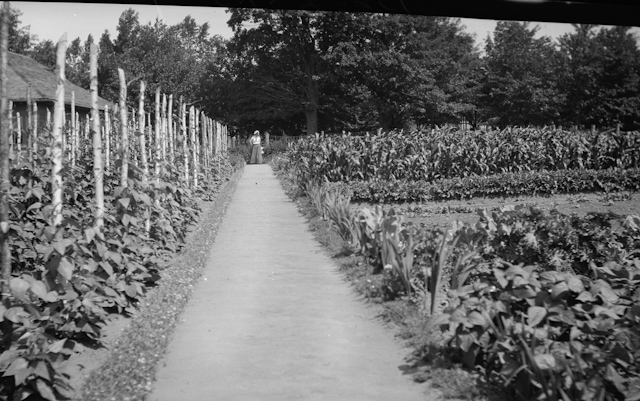
Esperanza is still sometimes for some purposes called Esperanza Farm.  The relationship between the house and the farm is a complicated one, leading deep into women’s history, the rise of scientific agriculture, and economics.  I won’t get into it here.  Suffice it that the cottage, long sold and now a winery, produced sufficient vegetables, dairy products, meat, and cut flowers to support Esperanza, its dependencies, and sometimes enough to sell.  Obviously, it did not have to support the family through the winter; although it did add to households of the various caretakers, we know late season vegetables were part of the wages so to speak.  The dairy products were sold during the winter.

Here is a picture of the edge of the cottage garden taken in 1909: corn, pole/bush beans, lettuce, and gladioli are all visible.

Spaces Saturday, Nov 24 2012 

Esperanza is big, absolutely no question.  Though no bigger in footprint than some of the new houses in town, the existence of four floors and a veritable maze of small rooms makes it seem even larger.*

I don’t believe it is haunted, a question people always ask; but it does have a weight to it.  And part of that weight is created by the physical space.  No matter what you do, how many lights you turn on, you can’t see around all the corners.*  Always, there is a great bulk above, below, behind.  I think that this freaks out a lot of people.  It is certainly easy to let the imagination run, wondering just what that noise was that echoed down the steam pipes or through the old ducts.  And what was that reflection which flickered across the window-pane?  Easier still on a dark and windy night.  You go up one stairs, but It might have gone down another….

I like the house on those nights, the house is its own and I am within. 

*Actually, the layout is very straightforward and I can navigate it in the pitch black, but first time visitors have a hard time with finding the stair-case they went up, because it isn’t the expected layout.   They certainly never know where all the doors lead.

*Leaving aside that some sections have essentially non-existent lighting, or lighting that can only be turned on having crossed the dark room and not from the door.

Photo of the Day Thursday, Oct 11 2012 

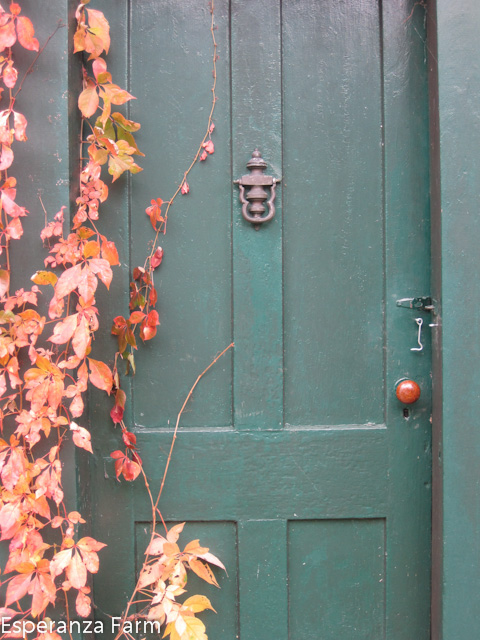
Old Door Thursday, Sep 27 2012 

Chaotic natures Wednesday, Sep 26 2012 

One of the distinguishing characteristics of the house is its chaotic nature.  Unlike a museum, there is no attempt to have things of one type all grouped together.  I should say, unlike a modern museum, for if one is familiar with the glorious whirl of the old British Victorian/Edwardian collections, then one has a sense for the interior of this house.  That Cuban sea shells ought to be next to rocks from Ontario, against Chinese pottery, against Victorian romantic art, against….well why not?  Children’s books shelved next to philosophy next to noir novels?  It tends to offend the modern desire for externally constructed and imposed order, full of divisions, walls, and credentials.  The British collections of a century ago reflected a polymath approach to the world.  Natural science and culture were not antagonists but part of a whole.

I got to thinking of this while dusting a room in which this approach is especially apparent: a carefully labelled (in Latin) shell collection interspersed with a range of decorative arts.  Science and art together, why not?

Of weddings Sunday, Sep 23 2012 

Esperanza has seen several family weddings, though none in living generations.  It has also seen its share of funerals.  Equal measure.

From September 1906, a newspaper clipping describing the wedding of Lucy Morris Ellsworth and George Mason Creevey:

“One of the most elaborate out-of-door weddings to take place in this State that has taken place for some time…Lucy Morris Ellsworth, daughter of William Webster Ellsworth of the Century Company of New York, was married to Dr. George Mason Creevey of New York. The wedding took place under the trees fronting the house on Esperanza Farm, Mr. Ellsworth’s summer home….. (genealogy)…(guest list)…the wedding was perfect in every detail. The house was draped with greens, with here and there decorations of goldenrod.  The trees were hung with gaily coloured ribbons of many different hues. An orchestra occupied a retired spot on a side veranda and furnished the music. The ceremony took place in a small wooded bower, twenty bridesmaids lining the pathway from the house….

so forth through a description of the dress, list of bridesmaids, gifts etc.

The bower is still there in part.  Of the two massive Norway spruces that made the front frame, only the south one survives at 109 feet in height.  Beyond though is a veritable cathedral grouping of several more Norway spruces and pines, all at well over 80 feet in height.  Now if only I could get rid of the road…


The refinishing of floors Thursday, Sep 20 2012 

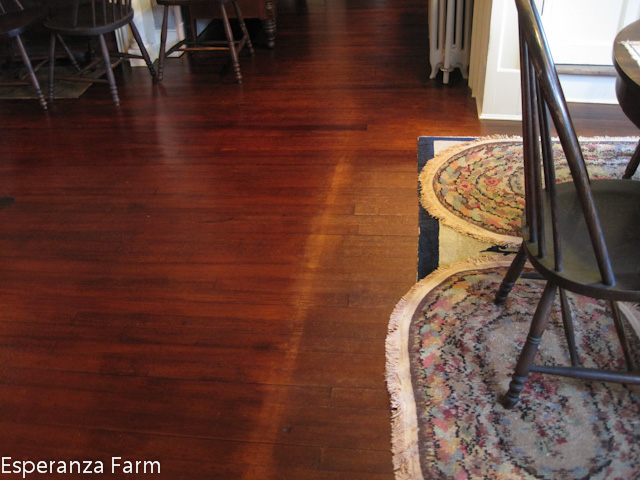
I am actually not the person that did the work, Jamie did it and well; I just ran off with the rug that was in desperate need of repair…thereby exposing a section of the floor.

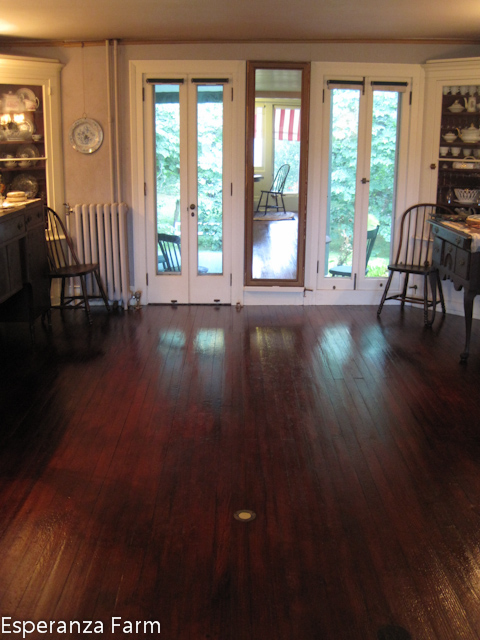
Hard to say what the wood is, it may be hard pine.  Originally coated with shellac, making restoration fairly straight-forward.  Shellac is suspended in alcohol (you can actually get shellac in flake form).  Clean it, then rub it down with denatured alcohol which re-amalgamates whatever shellac was left, then two coats of shellac with some areas needing three (heavy traffic, sun, water, or tape from a taped down rug).  No sanding required.

This photo is about as close as we come to a ‘before’ image: the floor on the right is not yet done, the light mark is a where a rug was taped down.  You can see the difference in the quality of the color/light.

The floor refinished.  The circle in the center is a floor outlet.  This picture is also a nice illustration of the standard tendency for old houses to be built less than straight: look at the wall, the plaster is not cracked, the ceiling height really is that different!

Year of the spider Tuesday, Sep 18 2012 

Old houses tend to develop their own little ecosystems.  Esperanza has bats in the roof, salamanders in the basement, red squirrels and chipmunks in the walls, and so forth.  This freaks out most people.  Perhaps the largest, visible population is the spider one.  For the most part, I have a love/hate relationship with them.  On the ‘hate’ side, I really would prefer to stay far away from them, especially the occasional massive wood spider.  Spider droppings do not come off of things, unless you use sand-paper.  Spider webs tend to illustrate, graphically, my cleaning skills.*  On the other hand…well, they are predators.  Presumably a healthy spider population helps to control the other insects.  Of course, a healthy predator population means a healthy prey population…. 

I practice survival of the fittest with the spiders.  If they can outrun the vacuum cleaner, they live.  Unless they are in a truly wrong spot (bathrooms, kitchen, beds/chairs) or they are setting up long-term living/breeding quarters, in which case I chase them down with said vacuum.  I prefer the minute green/gold spiders that don’t make real webs over the wood spiders though. 

This year though, the spiders really have been out of control.  Currently all spiders are being sucked up by the vacuum.  Interestingly, other people have commented on having way too many spiders as well.  Possibly last year’s very mild winter?  The hot, dry weather? Hard to say.

*This is actually not all bad, it serves as motivation.

« Previous PageNext Page »