Camouflage Tuesday, Mar 6 2012 

One of the largest landscaping headaches at Esperanza is the presence of a state highway running across the front of the lot.  Although this road was moved about fifty feet away from the house in the 1930’s, the massive increase in traffic makes it a constant presence in the landscape.  One of the goals, therefore, in the landscaping is to build a barrier between the house and the road.  Now, you might ask: why not build a fence?  Two reasons: number one, a truly effective sound/light barrier is costly.  Number two is that a fence which can’t be seen through is an attractive nuisance.  People decide that there must be something interesting behind it, something that makes trespassing inviting.

So trees it is.  Besides I prefer trees.  It is a Slow process, but if you drive past at 60 and are not actively looking, you probably won’t see the house.  We still hear and see the traffic, but there is an illusion of distance.  I count as a success the bicyclists, who I recognized as having gone past all summer, suddenly yelling “there is a house back there’ one day in the fall.  I also count as a success the state highway truck that refused to believe the drive was a drive.  I say nothing about the individuals’ situational awareness.  In general, one can safely assume that people don’t see things.  But there is a trick to this, the trees can’t look ‘planted’; they have to read as a forest, which means it has to be a forest.  In this case, it appears to be a mature mixed hardwood forest with a strong evergreen component.  Furthermore, because we want to keep the concept of distance, the dense planting must be close to the road, with a mixture of trees, understory, and strategic but visually pleasing clusters closer to the house.* 

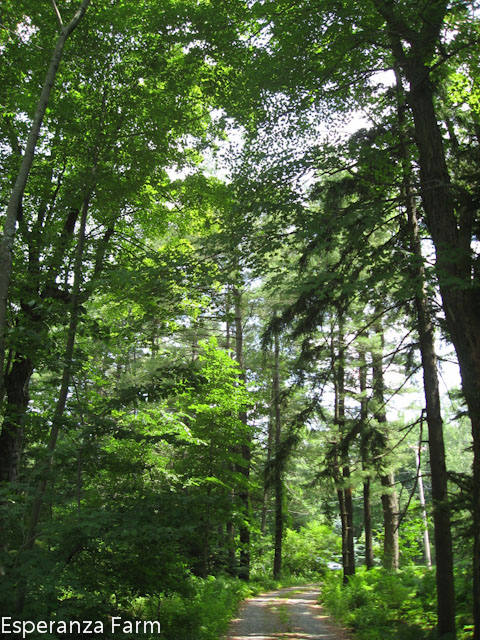
It is very complex section of the property, the description of which I won’t bore you with, but an idea is given by these photos which were all taken on the drive.  We obviously have the advantage of a century here for the large trees, but the strategic understory is a creation of the last decade. 

In the summer, the view from the drive entrance:
In the winter, looking out the drive from the pillars, at just about the farthest point of the drive in the summer picture. Here you can see how the barrier is still quite thin, the loss of one hemlock created that hole just to the right of the plow truck, the trees you see beyond are actually on the other side of the road:

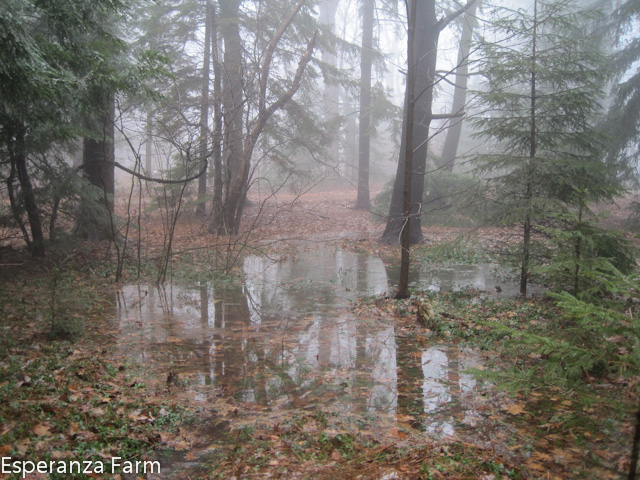
And a view from in the woods, looking at the road but in fog, showing rather well the varied ages and spacing, much of which comes from nature being allowed to run its course:
 

*Mercifully, trees want to do this, forest edges form dense thickets, while areas under closed forest canopies tend to be open.  Transitioning the edge from ineffective, ugly and invasive Norway saplings to native, or non-invasive species, is a bit harder though.

Squirrels, phone lines and nonsense Monday, Mar 5 2012 

Like all old New England houses, the center of the house is a post and beam construction on a dry/minimal mortar field-stone foundation.  The southern section is even less airtight, as it rests on stone piers and has no foundation.  It also isn’t actually connected in any structural way to the rest of the house.  Consequently, Esperanza houses quite a few more inhabitants than the homo sapiens and felix domesticus.  All of the small furry kind.  The walls can be quite noisy at night.  However, the cats catch those that get above the basement, the electrics are all metal sheathed, and they don’t chew through plaster, so it falls under the incurable, endurable category.   Though the red squirrels have gotten to be a bit much, seeing as two of them were arguing with such vigour over the seed packets (that had been left vulnerable for about an hour) in the basement that they didn’t pay attention to the appearance of a person.  They also fight, roll acorns around in the ceiling, and are generally loud. They may, like the over-population of chipmunks last year, be reduced in number.

All of which is why, when the phones went out a few days ago we naturally assumed that it was probably a problem in the house, and probably a problem caused by a rodent.  The electrical lines may be sheathed in metal, the phone and cable lines are not.  It was rather nice to discover that while the problem was caused by a rodent…it wasn’t one of ours.  Rather, it was a nest in the switch box, several miles away, and one of the lines that was actually chewed through was ours.  Fun and games.

A view from a window Sunday, Mar 4 2012 

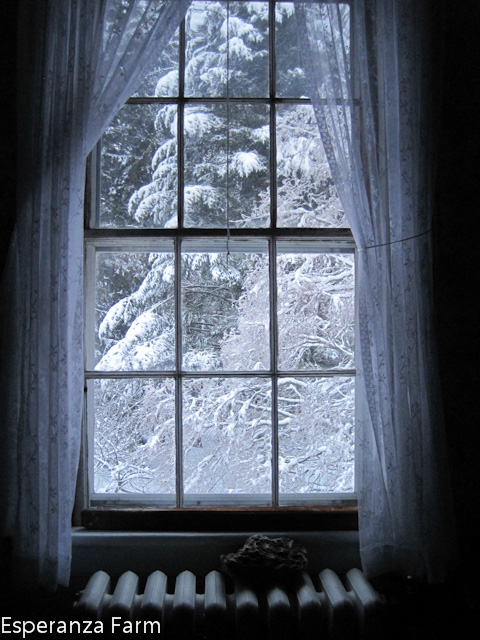
There is a strong tendency to look west out of the house, looking across the hayfield the view opens out towards the low hills that begin the Berkshires.  The view to the east is quite different… Here is a second story view during a recent snowstorm.*   If, of course, this was a hundred and fifty years ago, this would also be a spectacular view, but trees grow.  Personally, I rather like it, the trees have a great deal of character and the sense of enclosure helps to balance the western space.  Early morning light filtered through trees has a gentler, more subtle, feel to it, as well; partially, I imagine because we tend to sit and watch sunsets as opposed to sunrises.

*Please excuse the problems with horizonitis…in addition to my usually skewed view, I was dodging a very perturbed cat who thought I ought to be paying attention to him.

March 3, 1873 The Grand Tour, planning thereof. Saturday, Mar 3 2012 

From Julie in Hartford to Morris in New Orleans:

“I went to New Britain Monday. Mr. Kilbourn has got a list of sailing steamers. The Oceanic, which is a favorite of his, will sail on the 10th of May, and he intends to take passage in her for the girls. It is as yet uncertain whether he goes. If not, he will put them under the care of a friend and telegraph to Lizzie to meet them in Liverpool.

Mr. Kilbourn bought exchange on London, Julius Morgan, but he says he thinks it is cheaper to buy thalers, and Lizzie is banking now with Thode in Dresden. I don’t know if I have used the right words, ‘exchange, &c’ but if you will write to Mr. Joseph Kilbourn, New Britain, he will tell you all he knows. I told him to get the passage money from C.B. Smith and Co., New York, which I hope is right.  Nelly’s outfit I can furnish out of my own money, which makes me very happy. It will not cost you anything. Now I am sure you cannot say my books are no good anymore….

……Don’t borrow any trouble Darling about the European trip. I feel fully capable of everything and shall enjoy the details. Who would have thought that one of Julie Palmer’s children would go abroad. All that, and this, and everything, I owe to my Boy, with all love, and honour, and obedience…..

….Lunch is ready. Good bye sweet. Love me not as I deserve, but out of your plenteous goodness.  Your Julie.”

These excerpts from a longer letter are part of the planning for Helen’s trip to Europe, 1873-75.  Helen went with Mattie Kilbourn, a close friend.  European trips, the Grand Tour, were considered to be the ultimate ‘finishing school’.  But they were neither cheap nor easy to plan.  The slow nature of financial transactions is immediately obvious.  The Julius Morgan, referenced, may actually by Junius Morgan, father of the J.P. Morgan and the founder of the banking house, which would become JP Morgan.  The ship referenced, the Oceanic, was the first of the White Star Line’s ships built by Harland and Wolff and was, at the time, the pride of the fleet, being a major step forward towards the luxury liners.  http://www.titanic-titanic.com/oceanic.shtml

  I think one of the overlooked aspect of the Grand Tour was that of social networking.  For young women, in addition to a list of people to call on, there was the added complication of appropriate travelling companions, chaperones, and often teachers.   The introductory letter, now a completely extinct beast, was a critical part of any Grand Tour.  Tourism, as we understand it, was only in its infancy.  Instead of a network of anonymous businesses catering to the tourist trade, there was a network of expatriates, government, and business officials who would smooth the way for the tourist, if the tourist knew them, even in a distant fashion.  However, without access to that network, it would have been quite difficult.  In Helen’s case, the Kilbourns had familial connections in Europe, making Mattie Kilbourn an ideal companion for Helen.

Happy 140th Birthday! Thursday, Mar 1 2012 

“hundreds of nights on the white road have I passed it by, in my lonely walk, and stopped and listened to it, standing there in its lights, like a kind of low singing in the trees; and when I have come home later, on the white road, and the lights were all put out, I still feel it speaking there, faint against heaven, with all its sleep, its young and old sleep, its memories and hopes of birth and death, lifting itself in the night, a prayer of generations.”

Gerald Stanley Lee, writing of Esperanza in his book ‘The Lost Art of Reading’ published 1902.

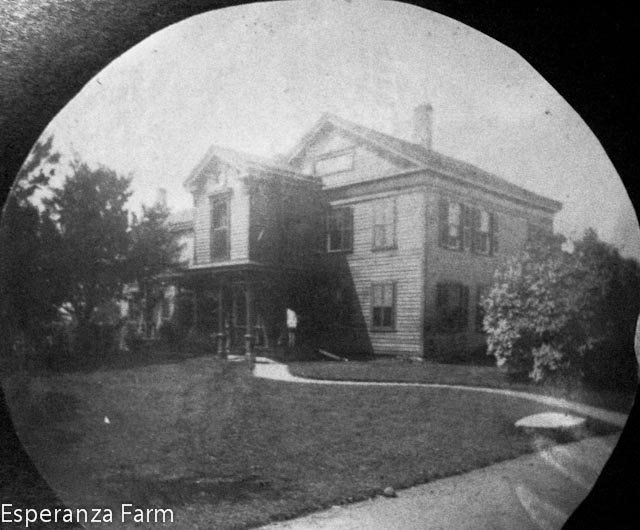
On March 1st, 1872, Julie took possession of the old Lyman house.  Morris had bought it over Christmas, 1871, as a replacement for the neighboring house, bought in 1871, which had burnt down in late November.   The Lyman house was not available until March, 1872 because it was being rented.

In January, 1872, Julie wrote to a friend, “Satis Bene lies in ruins, but I have become the happy possessor of the Lyman place, to which Morris and I have given the name, Esperanza-Anchor of Hope.”  Thus started the story.

Esperanza, circa 1875-1880, mid-summer.

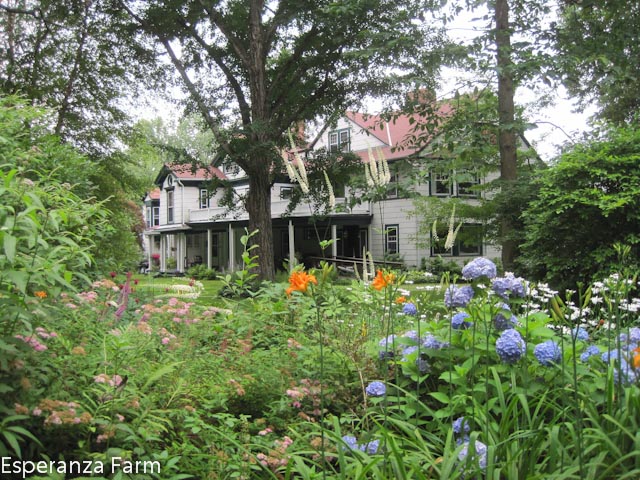
Esperanza, July 2011

May it continue!

« Previous Page